Choosing the right SSD enclosure can help a small business expand storage, improve file transfers, and reuse existing drives without investing in a full server or workstation upgrade.
This roundup covers portable M.2 and SATA adapters, high-speed Thunderbolt solutions, enterprise-style drive racks, and hybrid enclosures for growing storage needs. The best option depends on your drive type, connection standard, capacity goals, and how many users or devices need access.
Best 10 SSD Enclosures for Small Businesses Picks for 2026
Best Flexible M.2 Pick
Tool-Free NVMe & SATA Enclosure
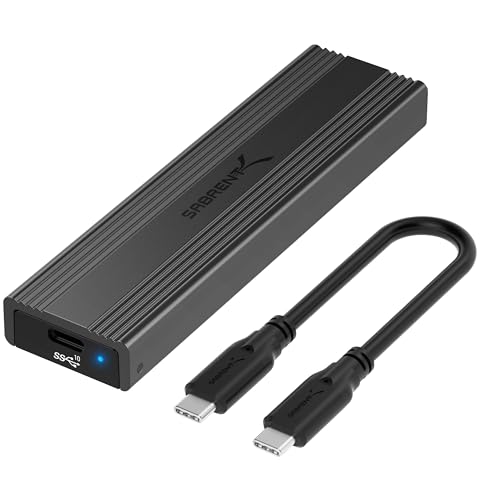
- Supports M.2 NVMe and SATA drives
- Tool-free drive installation
- USB 3.2 Type-C up to 10Gbps
Best For: Portable M.2 drive swaps and transfers
Best High-Density Rack Option
6-Bay U.2/U.3 NVMe Mobile Rack

- Holds up to six U.2/U.3 SSDs
- Fits a standard 5.25-inch bay
- PCIe 4.0 support up to 64Gbps per bay
Best For: Servers and workstations needing dense NVMe storage
Best Budget 2.5-Inch Choice
Tool-Free SATA SSD/HDD Enclosure
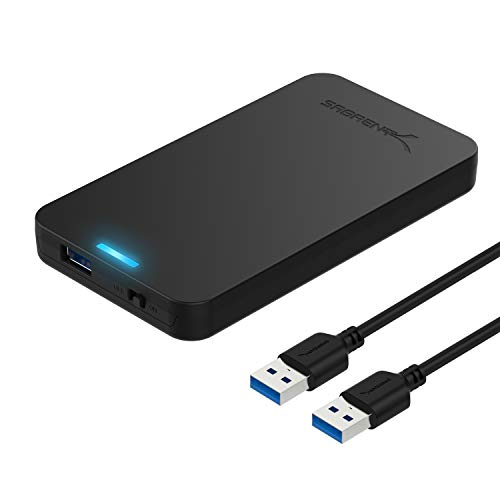
- Fits 2.5-inch SATA drives
- Tool-free, plug-and-play design
- USB 3.0 up to 5Gbps
Best For: Repurposing spare notebook SATA drives
Best Four-Drive Performance Setup
Thunderbolt 3 M.2 NVMe Enclosure

- Holds up to four PCIe NVMe SSDs
- Thunderbolt 3 up to 40Gbps
- Supports software RAID and DisplayPort
Best For: High-throughput multi-drive workstations
Compact NVMe Pick
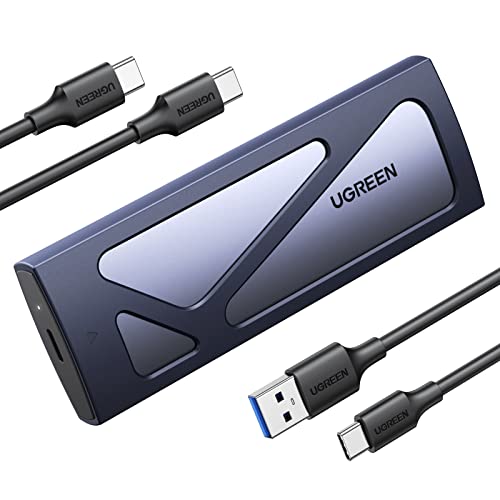
- 10Gbps USB 3.2 Gen 2 transfer support
- Tool-free design with multiple cables included
- Fits several NVMe M.2 sizes up to 8TB
Best For: Portable access to one compatible NVMe SSD
High-Capacity Expansion

- Supports four SATA and four NVMe drives
- Up to 152TB stated capacity support
- Eight independent disks with 10Gbps USB-C
Best For: Desktop storage expansion for growing teams
Flexible Dual-Protocol Choice

- Supports compatible NVMe and SATA M.2 drives
- Includes USB-C and USB-A connection cables
- Portable aluminum, bus-powered design
Best For: Mixed M.2 drive access across office devices
Enterprise M.2 Rack

- Holds four M.2 NVMe SSDs
- Supports 2230–22110 drive lengths
- Lockable design with passive cooling
Best For: Internal multi-drive NVMe deployments
IT Service Desk Pick

- Reads NVMe, SATA, and IDE drives
- Supports USB-C and USB-A
- Includes power adapter for larger drives
Best For: Drive migration, imaging, and recovery tasks
Hybrid Business Storage

- Combines four SATA and four NVMe bays
- Up to 152TB with supported drives
- Tool-free trays and active cooling
Best For: Mixed hot-data and archive storage
Best Flexible M.2 Pick – Tool-Free NVMe & SATA Enclosure
For small businesses comparing SSD enclosures for small businesses, the SABRENT EC-SNVE is a flexible choice when teams need to reuse either an M.2 NVMe or M.2 SATA drive. Its tool-free design and USB 3.2 Type-C connection make drive swaps and portable transfers straightforward.
Best For: Businesses that need a compact enclosure for bare M.2 NVMe or SATA SSDs in 2242, 2260, or 2280 sizes.
Pros:
- Supports both M.2 NVMe and M.2 SATA SSDs.
- Tool-free installation makes drive changes quick.
- USB 3.2 Type-C supports up to 10Gbps, with a slim aluminum build and thermal pad.
Cons:
- SSD is not included.
- Does not fit 2.5-inch SATA, mSATA, or drives with pre-installed heatsinks.
This is a practical all-purpose option for staff who rotate compatible M.2 drives between systems. Confirm the SSD type, length, and heatsink clearance before ordering.
Best High-Density Rack Option – 6-Bay U.2/U.3 NVMe Mobile Rack
For businesses building or upgrading a workstation or server, the ICY DOCK ToughArmor MB118VP-B provides a high-density way to mount six U.2 or U.3 PCIe NVMe SSDs in a standard 5.25-inch bay. It is aimed at infrastructure setups rather than casual portable storage.
Best For: Small-business servers and workstations that need six front-accessible U.2/U.3 NVMe drive bays.
Pros:
- Supports up to six U.2/U.3 PCIe NVMe SSDs.
- Fits a standard 5.25-inch optical drive bay.
- Supports PCIe 4.0 and transfer rates up to 64Gbps per drive bay.
Cons:
- Requires three SlimSAS SFF-8654 8i connections and compatible system hardware.
- Designed for 7mm drives, with a maximum drive height of 9.5mm.
- Not a simple USB portable enclosure.
The MB118VP-B makes sense when capacity, drive count, and internal deployment matter more than plug-and-play portability. Verify motherboard, controller, bay, and SlimSAS compatibility first.
Best Budget 2.5-Inch Choice – Tool-Free SATA SSD/HDD Enclosure
The SABRENT EC-UASP is a straightforward option for teams reusing 2.5-inch SATA SSDs or notebook hard drives. Among SSD enclosures for small businesses, it favors broad legacy compatibility and simple USB 3.0 connectivity over newer interface speeds.
Best For: Businesses converting spare 2.5-inch SATA drives into external storage or backup devices.
Pros:
- Tool-free installation for 2.5-inch SATA drives.
- USB 3.0 supports up to 5Gbps and is backward compatible with USB 2.0 and 1.1.
- Supports UASP SATA III, hot swapping, and plug-and-play use without drivers.
Cons:
- Limited to 2.5-inch SATA and SATA II drives.
- Uses USB 3.0 rather than USB-C or a 10Gbps interface.
- Plastic enclosure construction is less substantial than metal alternatives.
This enclosure is a sensible low-complexity choice for repurposing older drives across Windows and Mac systems. It is not suitable for M.2 SSDs or higher-speed NVMe workflows.
Best Four-Drive Performance Setup – Thunderbolt 3 M.2 NVMe Enclosure
For demanding creative, engineering, or data-heavy workflows, the StarTech M2E4BTB3 combines four M-Key PCIe NVMe bays with Thunderbolt 3 connectivity. It offers a faster, more expandable approach to SSD enclosures for small businesses, provided the host computers support Thunderbolt.
Best For: Teams that need up to four external NVMe drives, software RAID options, and high-speed Thunderbolt connectivity.
Pros:
- Supports up to four PCIe NVMe or AHCI M.2 80mm SSDs.
- Thunderbolt 3 provides data transfer rates up to 40Gbps.
- Includes software RAID support, DisplayPort output, downstream Thunderbolt 3, power supply, and cable.
Cons:
- Requires a compatible Thunderbolt 3 or Thunderbolt 4 host.
- Does not support SATA SSDs.
- Connected devices share bandwidth, including the downstream port and SSDs.
This is a strong fit for specialized workstations that can take advantage of multiple NVMe drives and software RAID. Its external power supply and active cooling also make it better suited to a permanent desk setup than travel.
Compact NVMe Pick – UGREEN USB-C M.2 Enclosure
For small businesses choosing SSD enclosures for small businesses, the UGREEN USB-C M.2 NVMe enclosure is a compact option for turning a compatible M.2 drive into portable external storage. It supports USB 3.2 Gen 2 speeds up to 10Gbps, provided you use a compatible USB-C Gen 2 cable.
Best For: Businesses needing a portable, tool-free enclosure for a single NVMe SSD, laptop upgrades, backups, or mobile file transfers.
Pros:
- Supports M.2 NVMe drives in 2230, 2242, 2260, and 2280 sizes, including M and B&M keys.
- Tool-free installation, plug-and-play operation, and included USB-C-to-C and USB-C-to-A cables.
- Aluminum housing, silicone case, thermal pad, UASP/TRIM support, and RTL9210 protection features.
Cons:
- Does not support SATA NGFF or mSATA SSDs.
- Achieving 10Gbps requires a USB-C 3.2 Gen 2 data cable and compatible host hardware.
- Supports one SSD at a time.
Its small footprint and simple installation make it practical for teams that need fast, individual-drive access rather than a multi-drive storage system. Verify that your existing SSD uses the NVMe protocol before purchasing.
High-Capacity Expansion – TERRAMASTER D8 Hybrid 2
For small businesses that need more than a single portable drive, the TERRAMASTER D8 Hybrid 2 is a substantial diskless enclosure combining four SATA bays with four M.2 2280 NVMe slots. Its USB 3.2 Gen 2 connection provides up to 10Gbps, while independent drives allow flexible storage expansion.
Best For: Small offices, creative teams, and workgroups needing high-capacity HDD and NVMe storage in one desktop direct-attached enclosure.
Pros:
- Holds four SATA HDDs or SSDs and four M.2 2280 NVMe SSDs, with stated capacity support up to 152TB.
- Provides eight independent disks without built-in RAID, simplifying individual drive management.
- Includes power management modes, plug-and-play compatibility, and support for macOS, Windows, Linux, and NAS systems.
- Can reach up to 1020MB/s read speed with a single M.2 SSD, according to the supplied specifications.
Cons:
- Diskless design means HDDs and SSDs must be purchased separately.
- Its desktop size and 1.9kg weight make it less portable than a single-drive enclosure.
- No built-in RAID is included; third-party RAID software is needed if required.
This is better viewed as a centralized expansion platform than a simple SSD adapter. It suits businesses planning a mixed storage pool, but its larger footprint and separate-drive requirement call for more setup than a compact enclosure.
Flexible Dual-Protocol Choice – SSK M.2 SSD Enclosure
The SSK M.2 enclosure is a useful option for small businesses with a mixed collection of compatible NVMe and SATA M.2 drives. It connects over USB 3.2 Gen 2 at up to 10Gbps, includes both USB-C and USB-A cables, and runs without an external power supply.
Best For: Teams that need one portable enclosure for supported M.2 NVMe and SATA drives across Windows, macOS, Linux, Android, or iOS devices.
Pros:
- Supports compatible NVMe PCIe and SATA M-Key or B+M-key M.2 SSDs in 2242, 2260, and 2280 sizes.
- Includes USB-C and USB-A cables, two thermal pads, installation hardware, and a screwdriver.
- Aluminum alloy shell, RTL9210B controller, UASP/TRIM support, LED activity indicator, and bus-powered operation.
- Plug-and-play compatibility across multiple operating systems.
Cons:
- Does not support M.2 PCIe AHCI drives, mSATA drives, Wi-Fi or capture-card devices, or non-M.2 SSDs.
- Only one SSD can be installed at a time.
- Actual 10Gbps performance depends on a compatible host, cable, and drive.
Its dual-protocol support can reduce the need for separate adapters when a business maintains both SATA and NVMe M.2 inventory. Check the drive type carefully, since several similarly shaped M.2 devices are explicitly unsupported.
Enterprise M.2 Rack – Rugged 4-Drive NVMe Bay
For small businesses building a workstation or server with demanding internal storage needs, this ICY DOCK unit is a specialized choice among SSD enclosures for small businesses. It holds four M.2 NVMe SSDs in a 5.25-inch bay and connects through four Mini-SAS HD ports, so it requires a compatible NVMe host rather than a typical USB setup.
Best For: IT teams that need four internally mounted M.2 NVMe drives with physical security and passive cooling.
Pros:
- Supports M.2 drive lengths from 2230 through 22110.
- Provides up to 64 Gbps per channel under the full NVMe bandwidth specification.
- Includes a two-segment key lock for added physical security.
- Uses a large heat sink and ventilation for passive cooling.
Cons:
- Requires an NVMe-compatible host and four Mini-SAS HD connections.
- Designed for a 5.25-inch bay, so it is not a portable external enclosure.
- Its specialized installation may be more involved than a USB enclosure.
This is a purpose-built storage rack rather than a general-purpose reader. It makes the most sense when a business already has the required host hardware and wants dense, lockable NVMe storage inside a desktop or server chassis.
IT Service Desk Pick – 3-in-1 M.2 and Drive Reader
For small-business IT work involving upgrades, backups, or drive recovery, this versatile reader is one of the more flexible SSD enclosures for small businesses. It supports M.2 NVMe drives plus 2.5- and 3.5-inch SATA or IDE drives, with USB-C and USB-A connectivity for broad computer compatibility.
Best For: IT professionals who need one tool for accessing M.2 NVMe and legacy SATA or IDE drives.
Pros:
- Supports M.2 NVMe drives in 2230, 2242, 2260, 2280, and 22110 lengths.
- Works with 2.5- and 3.5-inch SATA and IDE drives.
- Offers USB-C and USB-A connectivity with plug-and-play support for Windows, macOS, and Linux.
- Includes a power adapter for 3.5-inch drives, two-drive use, or higher-power devices.
Cons:
- Does not support M.2 SATA drives.
- NVMe performance is listed at up to 700 MB/s write speed, below the drive interface’s maximum potential.
- The plastic, open-top design is more suited to desk-based service work than transport.
This is a practical maintenance accessory for a small IT department. Its broad drive support can reduce the need for separate adapters, but teams should confirm the drive type and power requirements before starting a job.
Hybrid Business Storage – D8 4+4 HDD and NVMe Enclosure
For businesses that need both high-capacity storage and faster working data, the TERRAMASTER D8 Hybrid is a substantial option among SSD enclosures for small businesses. Its diskless enclosure combines four SATA HDD or SSD bays with four M.2 2280 NVMe slots and connects over USB 3.2 Gen 2 at up to 10 Gbps.
Best For: Small offices managing large archives alongside faster NVMe storage for frequently accessed data.
Pros:
- Combines four SATA bays with four M.2 2280 NVMe slots.
- Supports up to 152TB total based on the listed drive capacities.
- Provides tool-free trays with an automatic push-lock design.
- Includes temperature-controlled, low-noise fan cooling and power-on recovery.
Cons:
- Drives are not included, so the initial storage cost can be significant.
- USB 3.2 Gen 2 limits the enclosure’s connection bandwidth to 10 Gbps.
- The 8.74-by-7.05-by-6.06-inch chassis is better suited to a permanent desk or server-room setup than travel.
The D8 Hybrid is designed around mixed workloads: keep frequently used data on NVMe and place larger, less frequently accessed files on HDDs. It is a strong capacity-focused choice for teams that value flexible storage placement and unattended recovery after abnormal power loss.
How We Picked These SSD Enclosures for Small Businesses
We selected products across the main use cases small businesses encounter: portable backups, workstation upgrades, drive recovery, shared storage, and high-capacity expansion. The lineup includes enclosures for M.2 NVMe and SATA SSDs, 2.5-inch SATA drives, U.2/U.3 media, and multi-drive systems.
We also considered interface speed, installation convenience, cooling, compatibility, expandability, and practical deployment requirements. A tool-free USB enclosure may be ideal for one employee, while a multi-bay PCIe or hybrid enclosure can better suit a video team, lab, or office with several storage workflows.
Quick Comparison
| Use Case | Best Enclosure Type | What to Prioritize |
|---|---|---|
| Portable file transfers | USB-C M.2 enclosure | NVMe support, durable build, bus power |
| Legacy 2.5-inch drives | SATA-to-USB enclosure | UASP, tool-free access, broad compatibility |
| High-speed workstation storage | Thunderbolt multi-bay enclosure | 40Gbps connectivity, cooling, RAID options |
| Internal drive deployment | 5.25-inch mobile rack | PCIe compatibility, drive security, airflow |
| Large mixed storage pools | Hybrid HDD/NVMe enclosure | Drive count, networking, management software |
Key Buying Factors for SSD Enclosures for Small Businesses
Drive and Interface Compatibility
Confirm whether your SSD is NVMe, SATA, U.2, or U.3 before buying. M.2 drives can use different keying and protocols, and an enclosure designed for NVMe will not necessarily support M.2 SATA drives. For internal racks, check the host system’s PCIe lanes, connector type, and available 5.25-inch bay.
Real-World Transfer Speed
USB 3.2 Gen 2 commonly supports up to 10Gbps, while Thunderbolt 3 can reach 40Gbps under suitable conditions. Actual performance depends on the SSD, computer port, cable, thermals, and file sizes. Avoid paying for a faster enclosure if the host device cannot support its interface.
Cooling and Sustained Workloads
Large file transfers, video editing, virtual machines, and frequent backups can generate sustained heat. Look for ventilation, heat sinks, thermal pads, or active cooling where appropriate. Thermal throttling can reduce the advantage of a high-end SSD.
Expansion and Reliability
Multi-drive systems should offer adequate airflow, dependable power, accessible drive bays, and a clear management method. For business-critical data, use tested backups rather than relying on an enclosure or RAID array as the only copy.
Who Should Buy Which SSD Enclosures for Small Businesses?
Choose a compact USB-C NVMe enclosure for individual employees, field work, quick backups, and drive reuse. A SATA-to-USB model is the practical choice for older 2.5-inch SSDs and hard drives. Select a Thunderbolt enclosure when creative applications or large datasets require higher throughput.
Businesses deploying drives inside workstations or servers should consider a rugged mobile rack, provided the system supports the required PCIe connections. For centralized expansion, a hybrid HDD/NVMe enclosure offers the most capacity and flexibility, but it also demands more space, power, cooling, and storage administration.