Accurate oxygen readings can help protect fish, diagnose pond problems, and manage aquaculture systems more confidently. The best dissolved oxygen meters for water balance measurement range, calibration features, portability, and price.
We’ve gathered 10 options ranging from simple test kits to portable digital meters with temperature compensation, data memory, and extended probes. Use the guide below to narrow your choices by application and testing routine.
Best 10 Dissolved Oxygen Meters for Water Picks for 2026
Best Budget Test Kit

- Runs up to 60 tests
- 0–15 ppm measuring range
- Works for aquariums, ponds, and aquaculture
Best For: Low-cost, occasional dissolved oxygen checks
Best Simple Digital Meter
Milwaukee MW600 Portable DO Meter

- 0.0–19.0 mg/L range
- 0.1 mg/L resolution
- Two-point calibration with ATC
Best For: Focused educational, aquaculture, and water-analysis testing
Best Data-Ready Meter
Multi-Parameter DO Tester with Long Cable
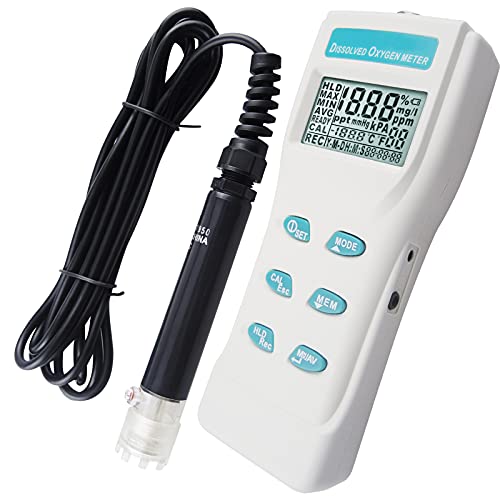
- 99-record memory and data hold
- Measures DO, temperature, salinity, and pressure
- Includes 11.48-foot cable and carrying case
Best For: Aquaculture and field users needing stored, multi-parameter readings
Best Multiparameter Kit

- Tests DO, pH, salt, EC, and temperature
- App supports calibration and data sharing
- Includes solutions, membranes, batteries, and case
Best For: Aquaculture and water-quality users needing a complete testing system
Reliable Field Testing

- Measures DO, saturation, and temperature
- ATC with altitude and salinity compensation
- Complete kit with spare membranes and case
Best For: Portable field water-quality monitoring
Professional Multi-Parameter Value

- 0.01 mg/L resolution across a 0–20 mg/L range
- Automatic temperature and manual pressure/salinity compensation
- IP65 housing with backlit display
Best For: Aquaculture and wastewater testing
Smart Pond and Aquarium Monitoring

- Measures up to 30 mg/L with mg/L and percentage modes
- Bluetooth app stores 1,000 readings
- Includes calibration supplies and portable case
Best For: Connected pond, aquarium, and aquaculture monitoring
Versatile DO Monitoring
Yewhick ATC Dissolved Oxygen Meter

- Reads 0–40 mg/L and 0–300% saturation
- ATC covers 0–50°C
- Includes membranes, electrolyte, calibration supplies, and batteries
Best For: Aquariums, ponds, aquaculture, brewing, and water treatment
Pond and Hydroponic Testing
EZTOCH Digital Dissolved Oxygen Meter

- Measures 0–40 mg/L and 0–300% saturation
- Includes calibration solution, electrolyte, and six membranes
- Backlit display with two-point calibration
Best For: Ponds, hydroponics, aquaculture, and environmental monitoring
Simple ATC Operation
Digital ATC DO Meter for Aquatic Systems

- Measures 0.0–40.00 mg/L
- ATC supports 0–50°C testing
- Backlit display, low-battery alert, and eight-minute auto-off
Best For: Aquariums, ponds, fish tanks, and general aquatic testing
Best Budget Test Kit – 60-Test Dissolved Oxygen Kit
Monitor DISSOLVED Oxygen Test KIT (60 Tests) - Monitor Aquarium and aquaculture Water Quality
Check Price On AmazonThis chemical test kit is a straightforward, economical alternative to electronic dissolved oxygen meters for water. It covers freshwater and marine aquariums, aquaculture systems, ponds, groundwater, and drinking water, with enough materials for 60 tests.
Best For: Aquarium keepers, pond owners, and aquaculture users who want an affordable way to check dissolved oxygen without carrying an electronic meter.
Pros:
- Provides up to 60 dissolved oxygen tests.
- Measures from 0 to 15 ppm with 0.5 ppm resolution.
- Suitable for freshwater, marine, pond, groundwater, and drinking water applications.
- Designed to be easy, fast, and economical to use.
Cons:
- Its 0.5 ppm resolution is less fine than that of the digital meters in this roundup.
- Testing is limited to the supplied 0–15 ppm range.
- As a test kit rather than a meter, it does not provide digital readings or stored data.
If you only need periodic checks and want to minimize upfront cost, this kit offers practical coverage. Choose a digital option instead if you need data memory, temperature compensation, or faster instrument-based readings.
Best Simple Digital Meter – Milwaukee MW600 Portable DO Meter
The Milwaukee MW600 is a portable digital choice among dissolved oxygen meters for water, offering readings from 0.0 to 19.0 mg/L. Its LCD, polarographic probe, manual two-point calibration, and automatic temperature compensation suit routine educational, aquaculture, environmental, and water-analysis work.
Best For: Users who want a focused handheld DO meter for field, classroom, aquaculture, or general water-analysis applications.
Pros:
- Measures 0.0–19.0 mg/L with 0.1 mg/L resolution.
- Offers two-point manual calibration.
- Includes automatic temperature compensation from 0 to 30°C.
- Comes with a polarographic probe and 3-meter cable.
Cons:
- Accuracy is specified at ±1.5%.
- The listed automatic temperature compensation range stops at 30°C.
- It does not list memory, salinity compensation, or barometric-pressure measurement.
This is a sensible dedicated meter when you prefer a recognizable digital workflow over chemical testing. Its feature set is more focused than the multiparameter models, so confirm that manual calibration and the stated temperature range match your routine.
Best Data-Ready Meter – Multi-Parameter DO Tester with Long Cable
This portable tester is a versatile option for dissolved oxygen meters for water, combining DO, temperature, salinity, and barometric-pressure readings. It adds automatic temperature compensation, manual salinity compensation, 99-record memory, and an 11.48-foot cable for reaching less accessible sampling points.
Best For: Aquaculture, aquarium, environmental, industrial, and educational users who need saved readings and several water-quality measurements in one handheld kit.
Pros:
- Measures DO from 0–19.99 ppm or mg/L and 0–199.9% saturation.
- Offers 0.01 ppm resolution.
- Includes temperature, salinity, and barometric-pressure measurement ranges.
- Provides 99-data memory, data hold, and automatic temperature compensation.
Cons:
- Manual salinity compensation requires user input.
- The Clark-type electrode requires maintenance, including membrane and electrolyte care.
- Its broader feature set may be more than needed for simple occasional DO checks.
For users who want more than a single DO value, this kit offers useful measurement breadth and recordkeeping in a portable package. The included membranes, electrolyte, batteries, and carrying case also make it a practical ready-to-use choice, provided you are comfortable maintaining the probe.
Best Multiparameter Kit – YINMIK Smart 6-in-1 DO Meter
The YINMIK YK-100 is a broad-featured smart option among dissolved oxygen meters for water. It measures dissolved oxygen alongside pH, salt, conductivity, and temperature, while its app supports calibration inputs, data storage, sharing, and printing for aquarium, aquaculture, farm, pool, laboratory, and environmental work.
Best For: Aquaculture operators and water-quality users who want one portable system for DO plus several related measurements and digital record management.
Pros:
- Measures DO from 0–200.0% or 0–20 mg/L.
- Combines DO, pH, salt, conductivity, and temperature testing.
- Supports 100% and 0-point calibration, automatic temperature compensation, and salinity and altitude inputs through the app.
- Includes calibration solutions, electrolyte, six replacement membranes, batteries, and a carrying case.
Cons:
- Its 4.22-pound listed weight is heavier than the other handheld options here.
- The extensive multiparameter feature set may be unnecessary for users checking DO alone.
- Accurate readings in different environments require appropriate salinity and altitude compensation inputs.
This is the most comprehensive choice in the group for users managing several water-quality variables. Its accessory package supports ongoing maintenance, while the smart data features help users organize and share measurements rather than relying only on a live screen reading.
Reliable Field Testing – Extech DO210
The Extech DO210 is a practical choice among dissolved oxygen meters for water when you need portable readings for dissolved oxygen, oxygen saturation, and temperature. Its automatic temperature compensation, plus adjustable altitude and salinity settings, helps support consistent measurements in changing field conditions.
Best For: Field water-quality checks, environmental monitoring, and users who want a complete portable kit.
Pros:
- Measures dissolved oxygen from 0–20.0 mg/L, oxygen saturation, and water temperature.
- Automatic temperature compensation is built into the oxygen probe.
- Adjustable altitude and salinity compensation support varied environments.
- Includes spare membranes, electrolyte, battery, cable, and carrying case.
Cons:
- Its 13-foot probe cable may be more than needed for compact aquarium testing.
- The meter uses a polarographic probe that requires membrane and electrolyte maintenance.
Choose the DO210 if dependable handheld operation and included field accessories matter more than advanced connectivity. Min/Max and Data Hold functions also make it easier to capture readings during inspections.
Professional Multi-Parameter Value – LOHAND LH-D701
The LOHAND LH-D701 combines detailed measurement capabilities with a rugged portable design, making it a strong option among dissolved oxygen meters for water. It measures dissolved oxygen, saturation, and temperature while offering automatic temperature compensation and manual atmospheric-pressure and salinity adjustments.
Best For: Aquaculture, sewage treatment, water-source monitoring, and users needing a broad compensation range.
Pros:
- Offers a 0.00–20.00 mg/L range, 0.01 mg/L resolution, and stated accuracy of ≤±0.3 mg/L.
- Measures dissolved oxygen, saturation up to 200%, and temperature.
- Includes automatic temperature plus manual pressure and salinity compensation.
- IP65 protection, backlit display, and one-click data switching support field use.
Cons:
- At 2.76 pounds, it is heavier than some compact handheld meters.
- Atmospheric pressure and salinity compensation require manual adjustment.
The LH-D701 is well suited to users who need a capable instrument for varied water environments. Its included long electrode cable, spare membrane components, and USB charging cable add practical value for repeated testing.
Smart Pond and Aquarium Monitoring – YINMIK YK-9100B
The YINMIK YK-9100B stands out among dissolved oxygen meters for water by pairing portable testing with Bluetooth app connectivity. It measures dissolved oxygen in mg/L or percentage mode, stores up to 1,000 readings, and lets users review changes through the YINMIK app.
Best For: Pond, aquarium, aquaculture, hydroponic, home-brewing, and outdoor monitoring applications.
Pros:
- Provides a 0–30 mg/L range with 0.01 mg/L resolution and a percentage mode up to 300%.
- Bluetooth app support stores up to 1,000 readings and displays changes via Excel.
- Includes automatic temperature compensation plus app-based salinity and altitude settings.
- Comes with zero-oxygen water, storage and testing caps, electrolyte, and a portable case.
Cons:
- App connectivity is needed for the salinity and altitude compensation settings.
- The listed kit uses a shorter 3.6-foot electrode cable than the Extech option.
The YINMIK is a particularly convenient choice for users who want to track readings over time rather than record them manually. Its expanded measurement range and included calibration supplies also support applications from aquariums to wastewater testing.
Versatile DO Monitoring – Yewhick ATC Dissolved Oxygen Meter
For shoppers comparing dissolved oxygen meters for water, this Yewhick model offers readings in both mg/L and saturation percentage. Its built-in temperature sensor, automatic temperature compensation, 0–40 mg/L range, and included calibration and maintenance supplies make it a practical choice for routine water testing.
Best For: Aquariums, fish tanks, koi ponds, aquaculture, brewing, wastewater testing, education, and general manufacturing applications.
Pros:
- Measures 0–40 mg/L or 0–300% dissolved oxygen.
- Built-in temperature sensor and automatic temperature compensation for 0–50°C.
- Includes electrolyte, calibration supplies, six spare membrane caps, and extra LR44 batteries.
- Offers two-point automatic calibration and a 1.1-meter probe cable.
Cons:
- Uses a polarographic probe that requires membrane and electrolyte maintenance.
- The display does not specify a backlight in the supplied details.
Choose this meter if you want broad application coverage and a well-stocked accessory package. Its long stated battery life and automatic shutoff also suit frequent routine checks.
Pond and Hydroponic Testing – EZTOCH Digital Dissolved Oxygen Meter
This EZTOCH model is one of the more application-focused dissolved oxygen meters for water, with a 0–40 mg/L range, percentage readings, and a 1.1-meter electrode cable. The included zero-oxygen solution, electrolyte, and membranes help you begin calibration and routine testing with fewer additional purchases.
Best For: Ponds, aquariums, hydroponic nutrient solutions, aquaculture, brewing, environmental monitoring, and water-quality checks.
Pros:
- Displays dissolved oxygen in mg/L and percentage saturation.
- Includes zero-oxygen calibration solution, two electrolyte bottles, and six membranes.
- Backlit display supports reading measurements in dim conditions.
- Provides two-point calibration and a five-minute automatic shutoff.
Cons:
- At 1.32 pounds, it is heavier than the other listed options.
- The supplied notes do not state an automatic temperature-compensation range.
This is a strong fit when pond or hydroponic monitoring is the priority. Its backlit screen and included consumables add convenience for regular testing in varied settings.
Simple ATC Operation – Digital ATC DO Meter for Aquatic Systems
For buyers seeking dissolved oxygen meters for water with straightforward operation, this compact tester combines a 0–40 mg/L range with automatic temperature compensation. The backlit LCD, low-battery indicator, and protective-cover-friendly electrode design make it convenient for repeated checks in aquatic environments.
Best For: Aquariums, fish tanks, ponds, aquaculture, swimming pools, research, and general water testing.
Pros:
- Measures dissolved oxygen from 0.0 to 40.00 mg/L.
- Automatic temperature compensation operates across 0–50°C.
- Backlit LCD and low-battery indicator improve day-to-day usability.
- Auto powers off after eight minutes of inactivity.
Cons:
- The supplied details do not list included calibration powder or spare membranes.
- Its stated auto-shutoff time is shorter than some meters, which may interrupt extended readings.
This model prioritizes easy handling over a large accessory bundle. It is a sensible option for users who want ATC, clear readings, and basic power-saving features for routine aquatic testing.
How We Picked the Best Dissolved Oxygen Meters for Water
We focused on the features that most affect real-world water testing: dissolved oxygen range, resolution, calibration controls, temperature and salinity compensation, probe design, cable length, portability, and ease of maintenance. We also considered whether each option suits aquariums, ponds, aquaculture tanks, field sampling, or general water-quality checks.
Digital meters generally offer faster, more repeatable readings than color-change kits, but they require proper calibration and electrode care. Test kits can still be useful when low cost, simplicity, and occasional testing matter more than numerical precision.
Quick Comparison
- Best for basic aquarium checks: A straightforward dissolved oxygen test kit or compact entry-level meter.
- Best for portable field work: A handheld meter with a durable probe, automatic temperature compensation, and a long cable.
- Best for ponds and aquaculture: A model with a broad 0–40 mg/L range, salinity adjustment, data hold, or memory.
- Best for frequent monitoring: A meter with reliable two-point calibration, replaceable consumables, and clear display controls.
Key Buying Factors for Dissolved Oxygen Meters for Water
Measurement Range and Resolution
Most aquarium and pond applications fall within a relatively modest oxygen range, while wastewater, specialized aquaculture, and unusual sampling conditions may benefit from a wider range. Resolution matters when tracking small changes, but a highly precise display cannot compensate for poor calibration or an aging probe.
Calibration and Compensation
Look for clear calibration instructions and, when needed, two-point calibration. Automatic temperature compensation helps account for changing water temperature. If you test saltwater or brackish water, choose a model that supports salinity correction rather than assuming freshwater conditions.
Probe, Cable, and Maintenance
A long cable is useful for tanks, ponds, and sampling points that are difficult to reach. Check whether the probe uses filling solution, membranes, or other replaceable parts, and confirm that accessories are available. Rinse the probe after use and store it according to the manufacturer’s instructions.
Data Features and Usability
Data hold, memory, automatic shutoff, a readable display, and a water-resistant case can make routine testing easier. For field work, prioritize portability and battery life; for scheduled monitoring, stored readings can simplify recordkeeping.
Who Should Buy Which Dissolved Oxygen Meters for Water?
Aquarium owners should choose a simple kit or compact meter that is easy to calibrate and provides enough accuracy for routine checks. Pond owners will usually benefit from automatic temperature compensation, a longer probe cable, and a broad measurement range. Aquaculture operators should prioritize repeatability, salinity adjustment, durable probes, and accessible replacement supplies. Water-quality professionals and frequent testers should consider a meter with two-point calibration, memory, data hold, and a robust field-ready design.
Before buying, confirm the stated range, included accessories, calibration method, and ongoing electrode costs. The best choice is not necessarily the most advanced meter—it is the one that matches your water type, testing frequency, and maintenance habits.