Choosing among light meters with data logging is easier when you match the instrument to your measurement range, logging workflow, and accuracy requirements. The right model can simplify inspections, lighting audits, plant-growth monitoring, and compliance records.
We selected 10 options spanning NIST-traceable instruments, Bluetooth-connected meters, general-purpose lux meters, and PAR/DLI tools for horticultural applications. Use the guide below to narrow the list by data handling, sensor design, and intended use.
Best 10 Light Meters with Data Logging Picks for 2026
Best for High-Capacity Records

- NIST traceable calibration
- Up to 87,000 PC-connected readings
- Up to 400,000 lux and 40,000 foot-candles
Best For: Detailed lighting surveys and quality-control records
Best for iPhone-Based Logging
Bluetooth Split-Sensor Lux Meter

- Split sensor for flexible positioning
- Logs up to 32,752 groups
- iPhone and PC app connectivity
Best For: Plant checks and mobile lighting measurements
Best for Calibrated Basic Logging
- NIST traceable calibration
- Stores up to 87,000 readings
- 0.01 foot-candle/lux resolution
Best For: Professional, high-volume light measurements
Best for Wireless Field Monitoring

- Wireless ExView app connectivity
- Live trends, graphs, and report exports
- Min, max, and average tracking
Best For: Field audits and app-based lighting reports
Best Budget PAR Logger
Quantum PAR Meter for Grow Lights

- Measures 400–700 nm PAR up to 4,000 µmol/m²/sec
- Stores up to 100 measurement groups
- Includes tripod mount and two cable lengths
Best For: Indoor growers and hydroponic setups using LED lights
Best Connected Illuminance Meter
UNI-T UT381A Digital Light Meter

- Measures illuminance from 0 to 400,000 lux
- Stores 99 records and supports Bluetooth app transfer
- Provides MAX, MIN, AVG, and real-time modes
Best For: General lux measurement with app-based data management
Best Long-Term Plant Logger

- Measures PPFD and DLI across 400–700 nm
- Records five years of DLI data with CSV export
- IP65 waterproof design with soil rod
Best For: Long-term indoor or outdoor plant-light tracking
Best Bluetooth Data Logger

- Bluetooth monitoring with up to 30 groups of cyclic data logging
- Measures up to 400,000 lux with lux/FC switching
- Real-time, maximum, and minimum modes
Best For: Remote monitoring and repeated indoor light checks
Best Windows-Connected Logger

- Data logging supports Windows 10 through XP
- 0–200,000 lux range with lux and foot-candle display
- Maximum, minimum, average, hold, and bar-graph readings
Best For: Windows-based lighting comparisons and facility checks
Best Simple High-Range Meter
Handheld 200,000-Lux Illuminance Meter
- Measures up to 200,000 lux plus ambient temperature
- Color LCD with hold and minimum/maximum readings
- Lightweight design with a two-year warranty
Best For: Portable spot checks in homes, offices, factories, and set design
Best for High-Capacity Records – Digi-Sense NIST Data Logger
For buyers comparing light meters with data logging, this Digi-Sense model stands out for its NIST traceable calibration and very large storage capacity. It measures up to 40,000 foot-candles or 400,000 lux and supports manual or automatic recording when connected to a PC.
Best For: Detailed lighting surveys, quality-control work, and users who need extensive PC-connected data records.
Pros:
- NIST traceable calibration
- Stores up to 87,000 manual or automatic readings with a PC
- Measures up to 40,000 foot-candles and 400,000 lux
- Offers 0.01 resolution
Cons:
- Data logging requires connection to a PC
- Its extensive capacity may be more than needed for simple spot checks
This is a strong choice when measurement capacity and calibration documentation matter more than a compact, app-first workflow.
Best for iPhone-Based Logging – Bluetooth Split-Sensor Lux Meter
This Bluetooth model is a practical option among light meters with data logging if you want to record measurements through an iPhone or PC. Its split sensor can be positioned in a bright beam while the display remains easier to photograph or view.
Best For: iPhone users measuring plants, bright areas, or changing lighting conditions where remote sensor placement is useful.
Pros:
- Split-type corded sensor supports flexible positioning
- Logs up to 32,752 groups and offers unlimited app-linked storage
- Four ranges cover up to 200,000 lux
- Includes lux, foot-candle, Celsius, and Fahrenheit units
Cons:
- App compatibility is limited to iPhone iOS, not Android
- Bluetooth and app features require a compatible device
Choose it for mobile logging and sensor-placement flexibility, but confirm iPhone compatibility before buying.
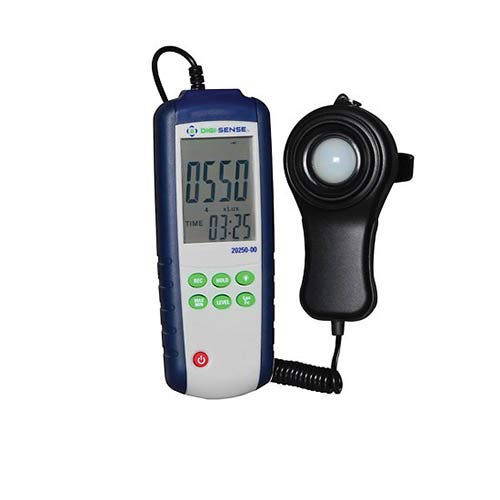
Best for Calibrated Basic Logging – Digi-Sense 20250-00
The Digi-Sense 20250-00 is a focused choice for shoppers seeking light meters with data logging and documented calibration. It covers broad light levels, stores up to 87,000 readings, and provides 0.01 foot-candle/lux resolution.
Best For: Professional measurement tasks that benefit from NIST traceable calibration and high-capacity recording.
Pros:
- NIST traceable calibration
- Stores up to 87,000 readings
- Measures from 0 to 40,000 foot-candles and 0 to 400,000 lux
- Provides 0.01 foot-candle/lux resolution
Cons:
- The supplied description does not specify wireless or smartphone connectivity
- Its broad measurement and storage capabilities may exceed casual needs
With its calibration documentation, range, and storage capacity, this model fits buyers prioritizing traceable, high-volume measurements.
Best for Wireless Field Monitoring – Extech LT250W
The Extech LT250W brings smartphone convenience to the category of light meters with data logging. It measures lux and foot-candles, wirelessly syncs with the ExView app, and supports live trends, graphs, report exports, and real-time recording.
Best For: Field audits, LED installation checks, workplace lighting reviews, and users who want app-based reporting.
Pros:
- Wireless connectivity with the ExView app
- Supports live trends, graphs, and report exports
- Records measurements in real time
- Tracks minimum, maximum, and average values
Cons:
- App-based features depend on a compatible smartphone or tablet
- The supplied notes do not specify a maximum storage capacity
This is a convenient, portable pick when wireless review and report creation are more important than a stated standalone memory capacity.
Best Budget PAR Logger – Quantum PAR Meter for Grow Lights
If you need light meters with data logging for indoor plants, this PAR meter focuses on the 400–700 nm range used for photosynthesis. It measures up to 4,000 µmol/m²/sec and stores up to 100 readings for quick review.
Best For: Indoor gardening, hydroponics, greenhouses, and aquarium setups using LED grow lights.
Pros:
- Measures PAR across the 400–700 nm photosynthetically active range.
- Stores up to 100 groups of measurements.
- Includes a 1/4-inch tripod mount and two cable lengths for flexible positioning.
- Compact handheld design with a one-year manufacturer warranty.
Cons:
- Requires two AAA batteries.
- Designed around PAR measurements rather than general illuminance in lux.
This is a practical choice when you want straightforward PPFD readings and modest onboard storage without needing long-term computer exports or app connectivity.
Best Connected Illuminance Meter – UNI-T UT381A Digital Light Meter
For buyers comparing light meters with data logging for broad illuminance work, the UNI-T UT381A covers 0 to 400,000 lux. It combines local storage for up to 99 records with Bluetooth transmission and app support for viewing and exporting measurements.
Best For: General illuminance measurements where Bluetooth access, remote viewing, and multiple measurement modes are useful.
Pros:
- Wide 0–400,000 lux measurement range.
- Stores up to 99 measurement records locally.
- Bluetooth and phone app support data viewing, exporting, and alarm limits.
- Offers MAX, MIN, AVG, and real-time display modes.
Cons:
- Its supplied specifications describe illuminance in lux rather than PAR or DLI.
- The notes do not specify the app’s supported operating systems.
Choose this model if your priority is high-range lux measurement with connected data handling. It is less tailored to plant-focused PPFD or DLI analysis than the PAR meters in this roundup.
Best Long-Term Plant Logger – 2-in-1 PAR and DLI Meter
Among light meters with data logging, this 2-in-1 model stands out for tracking both PPFD and daily light integral. It measures 400–700 nm light, records up to five years of DLI data, and can export records to a computer as CSV files.
Best For: Gardeners who want long-term plant-light tracking, DLI history, and outdoor use in gardens or on lawns.
Pros:
- Measures PPFD from 0 to 5,000 µmol/m²/sec and calculates DLI.
- Records up to five years of DLI data and supports CSV export.
- Displays 30 days of DLI data and photoperiod on the device.
- IP65 waterproof design with a 1/4-inch screw mount and included soil rod.
Cons:
- Computer export is required for CSV access.
- The screen turns off after three minutes without operation, although recording continues.
This is the strongest fit for plant-light analysis when historical DLI matters more than simple spot readings. Its waterproofing and soil rod also make it more adaptable to outdoor monitoring.
Best Bluetooth Data Logger – BTMETER BT-5000APP
For shoppers seeking light meters with data logging, the BTMETER BT-5000APP combines Bluetooth monitoring with up to 30 groups of cyclic light-data records. It measures up to 400,000 lux, supports lux and foot-candle readings, and offers real-time, maximum, and minimum modes.
Best For: Remote monitoring and repeated indoor light checks in offices, schools, galleries, museums, plant-growing setups, and aquariums.
Pros:
- Bluetooth app connectivity supports long-distance monitoring and 30 groups of cyclic data logging.
- Measures up to 400,000 lux with 0.1-lux/FC resolution.
- Includes maximum, minimum, and real-time measurement modes.
- Rotatable sensor, backlit display, temperature measurement, and protective cover improve usability.
Cons:
- Its stated accuracy varies across the measurement range, with wider tolerances at very high lux levels.
- The data logging capacity is limited to 30 groups of cyclic records.
The BTMETER is the strongest fit here when Bluetooth access and built-in logging matter as much as basic illuminance measurement. Its broad range also suits unusually bright environments, though buyers should review the stated accuracy by range.
Best Windows-Connected Logger – ennoLogic LUX29TK
The ennoLogic LUX29TK is a practical choice among light meters with data logging for comparing illumination in homes, offices, classrooms, laboratories, and warehouses. It covers 0 to 200,000 lux, displays lux and foot-candles, and adds Windows compatibility for its logging function.
Best For: Windows users who need broad-range illuminance checks, comparisons between lighting setups, and a more equipment-oriented meter.
Pros:
- Supports data logging with Windows 10, 8, 7, Vista, and XP compatibility.
- Measures 0 to 200,000 lux and displays both lux and foot-candle units.
- Provides maximum, minimum, average, hold, and analog bar-graph readings.
- Includes a tripod mount, analog outputs, external power option, carrying case, batteries, and interface cable.
Cons:
- The logging software is not compatible with Mac OS.
- The manufacturer states that it is not intended for determining photographic exposure.
- At 1 pound, it is heavier than the other listed handheld options.
This model stands out for users who want logging alongside analog outputs, tripod mounting, and multiple display statistics. Its Windows-only compatibility and explicit limitation for photography are important buying considerations.
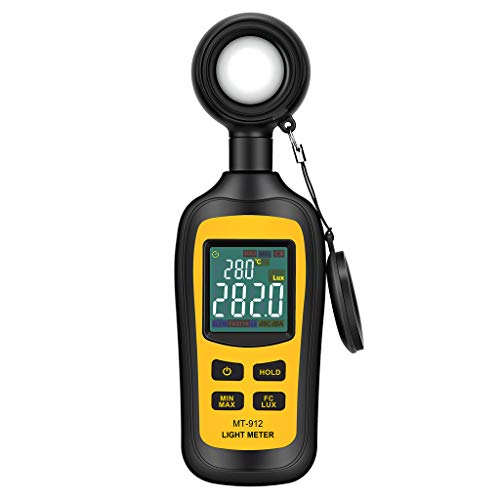
Best Simple High-Range Meter – Handheld 200,000-Lux Illuminance Meter
For buyers comparing light meters with data logging, this compact handheld meter focuses on straightforward illuminance measurement rather than app-based recording. It measures up to 200,000 lux, includes ambient-temperature measurement, and provides a color LCD with hold and minimum/maximum functions.
Best For: Home, office, factory, and set-design users who want a lightweight meter for spot checks and basic light-level comparisons.
Pros:
- Measures luminosity from 0 to 200,000 lux and also measures ambient temperature.
- Offers stated accuracy of ±3% rdg ±8 digits below 10,000 lux and ±4% rdg ±10 digits above 10,000 lux.
- Color LCD, data hold, minimum/maximum readings, auto power-off, and low-battery indication support routine use.
- Compact 6.7-ounce design and two-year warranty add portability and reassurance.
Cons:
- The supplied notes do not specify Bluetooth, computer connectivity, or dedicated historical data logging.
- It requires three AAA batteries.
This meter is best viewed as a compact, easy-to-use option for immediate readings and simple comparisons. If ongoing records or remote monitoring are essential, the other two products provide more clearly documented logging features.
How We Picked These Light Meters with Data Logging
We evaluated the selected meters by focusing on the features that matter most in real measurement work: logging capability, sensor range, connectivity, calibration support, display readability, portability, and application fit. Models with NIST-traceable calibration are particularly useful when readings need stronger documentation, while Bluetooth models can make remote collection and export more convenient.
We also separated conventional illuminance meters from PAR and DLI instruments. Lux and foot-candle meters are suited to workplace, facility, photography, and general lighting checks. PAR meters measure photosynthetically relevant light for plants, so they are a better match for grow rooms and greenhouse work.
Quick Comparison
- Best for documented professional measurements: Digi-Sense models with NIST-traceable calibration.
- Best for wireless workflows: Extech LT250W and Bluetooth-enabled BTMETER or split-sensor models.
- Best for LED grow lighting: PAR and PPFD meters covering the 400–700 nm range.
- Best for broad general-purpose readings: UNI-T UT381A and 200,000-lux handheld meters.
- Best for plant scheduling: A DLI meter that records and exports daily light integral data.
Key Buying Factors for Light Meters with Data Logging
Measurement Type and Range
Confirm whether you need lux, foot-candles, PAR, PPFD, or DLI. A high maximum lux range is useful for bright indoor and outdoor environments, but it does not replace a quantum sensor for plant-light measurements. Auto-ranging can speed up routine checks, while a detachable or split sensor helps reach awkward locations.
Logging, Export, and Connectivity
Check how readings are stored and retrieved. Internal memory may be adequate for periodic surveys; Bluetooth and app support are more convenient for live monitoring, remote placement, and exporting records to a phone or computer. Look for clear information about sampling intervals, file formats, memory capacity, and whether the app supports your device.
Accuracy and Calibration
For audits, facilities work, or regulated documentation, prioritize stated accuracy and traceable calibration. NIST-traceable certificates add confidence that the instrument was tested against recognized standards. For horticultural meters, also consider spectral response and whether the device is designed for modern LED fixtures.
Ease of Use
A readable display, stable sensor, simple controls, low-battery indicator, and protective case can matter as much as headline specifications. Temperature measurement, hold functions, zeroing, and a tripod or mounting option are useful extras depending on the workflow.
Who Should Buy Which Light Meters with Data Logging?
Choose a Digi-Sense model if calibration documentation and dependable records are priorities. Select the Extech or another Bluetooth meter if you want wireless monitoring and app-based reporting. Growers should choose a PAR or DLI instrument rather than relying on a standard lux meter. For occasional room, office, or facility checks, a general-purpose UNI-T, BTMETER, or broad-range handheld model may provide the best value. Before ordering, verify the current calibration status, included software or app compatibility, sensor range, and data-export method.