Reliable dissolved oxygen readings can make or break field studies involving streams, ponds, lakes, aquaculture systems, and wastewater. The right meter should match your sampling conditions, accuracy requirements, and tolerance for calibration and maintenance.
We selected 10 portable options ranging from established YSI instruments to budget-friendly meters with temperature compensation, extended cables, and broader measurement ranges. Use the guide below to narrow the list by field workflow and research priorities.
Best 10 Dissolved Oxygen Meters for Field Research Picks for 2026
Field-Tested Choice
YSI Pro20 DO/Temperature Meter

- Fast One Touch calibration
- IP67 impact-resistant housing
- Probe and cable options for lab or field use
Best For: Field teams needing a rugged, configurable meter
Optical Probe Pick
YSI EcoSense EcoODO Field Probe

- Optical dissolved oxygen connection
- Includes 1-meter cable
- Designed for indoor and outdoor use
Best For: Adding an optical DO probe to a compatible system
Complete Field Kit
Extech DO210 Portable DO Meter

- Includes probe and 13-foot cable
- Altitude, salinity, and temperature compensation
- Spare membranes, electrolyte, battery, and case included
Best For: Portable water-quality sampling with included accessories
High-Resolution Option
LOHAND LH-D701 Digital DO Meter

- 0.01 mg/L displayed resolution
- Manual pressure and salinity compensation
- Includes 9.84-foot probe cable and spare membrane
Best For: Users prioritizing resolution and compensation controls
Most Versatile Kit

- Measures DO, pH, salinity, conductivity, and temperature
- Supports calibration plus salinity and altitude compensation
- Includes field-ready accessories and data management
Best For: Multi-parameter field sampling and aquaculture monitoring
Best for Long-Reach Sampling

- Includes a 16.4-foot probe cable
- Uses a fluorescent DO sensor with automatic compensation
- Offers IP68 sensor protection and 50,000-record storage
Best For: Extended-reach outdoor and underwater sampling
Best Compact Value
Portable DO Tester with 11.48-Foot Cable
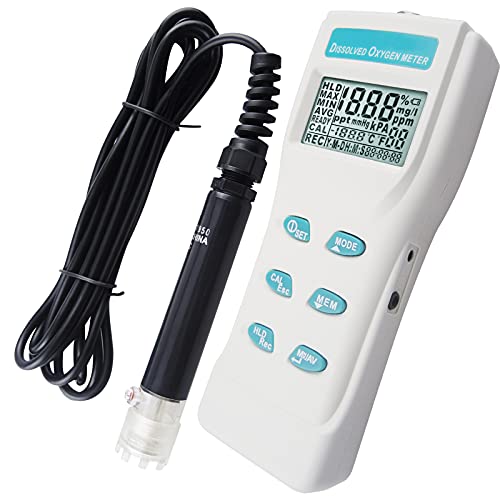
- Measures DO, temperature, salinity, and pressure
- Includes 99-record memory and automatic temperature compensation
- Ships with probe, maintenance supplies, batteries, and case
Best For: Routine field and educational water-quality testing
Field-Ready DO Kit

- 0–40 mg/L range with percentage readings
- ATC from 0–50°C and 1.1 m probe cable
- Includes calibration supplies, membranes, and batteries
Best For: Repeated field sampling with a need for included spares
Quick-Read Sampling Meter
ATC DO Meter with Backlit Display

- 0.0–40.00 mg/L measurement range
- Backlit LCD with low-battery indicator
- ATC and electrode use without removing the cover
Best For: Simple, readable measurements across varied water sites
Spare-Supplied DO Meter
ATC Meter with Calibration Powder

- 0.0–40.0 mg/L range with 0–50°C ATC
- Includes six protective covers and calibration powder
- No-backlight display with eight-minute auto-off
Best For: Users prioritizing replacement supplies and anaerobic calibration
Field-Tested Choice – YSI Pro20 DO/Temperature Meter
For researchers comparing dissolved oxygen meters for field research, the YSI Pro20 is a rugged handheld platform designed for both field and laboratory work. Its backlit graphical display, glow-in-the-dark keypad, and rapid One Touch calibration are useful when conditions and sampling locations vary.
Best For: Field teams that need a durable meter with flexible probe and cable options.
Pros:
- Measures dissolved oxygen and temperature.
- One Touch calibration completes in about three seconds.
- IP67-rated, impact-resistant, and waterproof housing.
- Supports field cables with polarographic or galvanic probes, or a lab cable-probe assembly.
Cons:
- Cables and probes are sold separately.
- Its compatibility options may require additional setup before field deployment.
The Pro20 stands out when durability and configuration flexibility matter more than an all-in-one package. Budget for the required cable and probe when comparing total cost.
Optical Probe Pick – YSI EcoSense EcoODO Field Probe
The YSI EcoSense EcoODO is a 1-meter optical dissolved oxygen and temperature field probe for researchers seeking a probe-focused option among dissolved oxygen meters for field research. Its optical connector and indoor/outdoor usage specification suit projects that already have compatible instrumentation.
Best For: Researchers replacing or adding an optical DO and temperature field probe.
Pros:
- Measures dissolved oxygen and temperature.
- Uses optical connectivity.
- Includes a 1-meter cable.
- Specified for indoor and outdoor use.
Cons:
- The supplied information identifies it as a probe rather than a complete meter kit.
- Compatibility with a host instrument should be confirmed before purchase.
This is best evaluated as an accessory for an existing compatible system, not as a standalone handheld meter. Confirm connector and instrument requirements before ordering.
Complete Field Kit – Extech DO210 Portable DO Meter
The Extech DO210 is a practical all-in-one option for dissolved oxygen meters for field research, combining DO, oxygen saturation, and temperature readings with automatic temperature compensation. Its included probe, 13-foot cable, membranes, electrolyte, battery, and carrying case reduce the need to assemble a field kit separately.
Best For: Mobile water-quality work requiring a ready-to-carry meter with long probe reach.
Pros:
- Measures 0–20.0 mg/L DO, 0–100% saturation, and water temperature.
- Provides automatic temperature, altitude, and salinity compensation.
- Includes a 13-foot cable, spare membranes, electrolyte, battery, and soft case.
- Offers Min/Max and Data Hold functions.
Cons:
- Uses a polarographic oxygen probe that requires membrane and electrolyte supplies.
- The carrying case is soft rather than a rigid protective case.
The DO210 is a strong convenience pick for teams that want the main accessories included. Its compensation controls also make it adaptable to varied water-testing conditions.
High-Resolution Option – LOHAND LH-D701 Digital DO Meter
The LOHAND LH-D701 combines a 0.00–20.00 mg/L measurement range with 0.01 mg/L resolution, making it a feature-rich choice among dissolved oxygen meters for field research. Manual atmospheric-pressure and salinity compensation, automatic temperature compensation, and a backlit LCD support work across changing water environments.
Best For: Field and lab users who want high displayed resolution and broad compensation controls.
Pros:
- Offers 0.01 mg/L resolution and stated accuracy of ±0.3 mg/L.
- Displays DO concentration, saturation, and temperature.
- Includes manual atmospheric-pressure and salinity compensation plus automatic temperature compensation.
- Includes a 9.84-foot probe cable, electrolyte, spare membrane head, USB charging cable, and manual.
Cons:
- Atmospheric pressure and salinity compensation are manual.
- Its IP65 rating is lower than the IP67 rating specified for the YSI Pro20.
The LH-D701 offers a generous feature set and useful included supplies for environmental, aquaculture, and wastewater applications. It is especially appealing when displayed resolution and compensation flexibility are priorities.
Most Versatile Kit – YINMIK Smart DO Meter
For researchers comparing dissolved oxygen meters for field research, the YINMIK YK-100 stands out as a broad water-quality testing kit. It measures dissolved oxygen in percent or mg/L and also covers pH, salinity, conductivity, and temperature, with calibration supplies and a protective case included.
Best For: Field teams and aquaculture users who need one portable instrument for dissolved oxygen plus several related water-quality measurements.
Pros:
- Measures DO from 0–200.0% or 0–20 mg/L, with 100% and 0-point calibration support.
- Provides automatic temperature compensation and allows manual salinity and altitude compensation through the app.
- Includes calibration solutions, electrolyte, six replacement membranes, batteries, and a carrying case.
- Stores, shares, and prints data for easier field-record management.
Cons:
- Its broad six-in-one feature set may be more than needed for projects focused only on DO.
- At 4.22 pounds, it is heavier than the more compact options in this group.
The YINMIK is a practical choice when field research involves multiple water parameters and regular calibration or maintenance. Its accessory bundle can reduce setup friction, while the app-based compensation features provide flexibility across different sampling environments.
Best for Long-Reach Sampling – LOHAND Fluorescent DO Meter
For dissolved oxygen meters for field research that need reach and weather resistance, the LOHAND portable meter uses a fluorescent dissolved oxygen electrode with a 16.4-foot probe cable. Its waterproof sensor, automatic compensation, and large display are well suited to sampling around ponds, treatment facilities, and other wet environments.
Best For: Researchers who need to take readings from a distance or perform extended outdoor and underwater sampling.
Pros:
- The 16.4-foot stainless-steel probe cable supports sampling in hard-to-reach locations.
- Fluorescence-quenching technology is designed for rapid, stable, and accurate DO detection.
- IP65 main-unit and IP68 sensor protection help handle splashes, immersion, and humid conditions.
- Stores up to 50,000 readings and includes a carrying case.
Cons:
- The supplied notes identify DO and temperature compensation but do not list additional parameters such as salinity or pH.
- The long cable may be less convenient for compact, close-range sampling setups.
The LOHAND is particularly compelling for fieldwork where probe reach, water exposure, and substantial data logging capacity matter more than multi-parameter testing. Its 3.3-inch display and portable case also support practical use away from the lab.
Best Compact Value – Portable DO Tester with 11.48-Foot Cable
Researchers seeking dissolved oxygen meters for field research with straightforward logging and compensation features may find this portable DO tester a practical fit. It measures dissolved oxygen, temperature, salinity, and barometric pressure, while the 11.48-foot cable provides useful reach for aquarium, aquaculture, environmental, and educational sampling.
Best For: Budget-conscious field users who want core DO measurements, manual salinity input, and simple onboard data storage.
Pros:
- Measures DO in percent or ppm/mg/L, with readings up to 0–19.99 mg/L and 0–199.9%.
- Includes automatic temperature compensation, manual salinity settings, and barometric-pressure readings.
- Offers 99-data memory, data hold, a stability indicator, and selectable auto power-off.
- Comes with a Clark-type electrode, replacement membranes and O-rings, electrolyte, batteries, and a carrying case.
Cons:
- Its 99-reading memory is much smaller than the LOHAND’s 50,000-entry capacity.
- The Clark-type electrode requires maintenance, including membrane and electrolyte care.
This tester is a sensible choice for routine sampling when a long probe cable and essential compensation functions are more important than very large data storage. The included maintenance supplies and carrying case make it usable immediately, while the stated operating range covers common water-testing conditions.
Field-Ready DO Kit – Yewhick DO9100S with ATC
For dissolved oxygen meters for field research, the Yewhick DO9100S offers a broad 0–40 mg/L range, automatic temperature compensation, and a 1.1 m probe cable. Its built-in temperature sensor and included calibration and replacement supplies make it practical for repeated water checks.
Best For: Field teams and educators measuring oxygen and temperature across aquariums, ponds, aquaculture sites, and wastewater settings.
Pros:
- Measures dissolved oxygen in mg/L or percentage saturation, with a 0–40 mg/L range.
- ATC covers 0–50°C and the probe includes a built-in temperature sensor.
- Includes electrolyte, calibration materials, six spare membrane caps, and extra batteries.
- Supports two-point automatic calibration and up to 2,000 hours of continuous use.
Cons:
- Uses small LR44 batteries rather than a rechargeable battery system.
- Requires membrane and electrolyte maintenance over time.
This is a well-equipped option when field research calls for extended operating time and replacement supplies in the kit. Its cable length and wide measurement range are useful for routine sampling, while the polarographic probe adds ongoing maintenance to the workflow.
Quick-Read Sampling Meter – ATC DO Meter with Backlit Display
Among dissolved oxygen meters for field research, this model emphasizes straightforward operation: immerse the electrode, read the LCD, and use ATC across 0–50°C. Its backlit display, low-battery indicator, and automatic shutoff support routine checks in varied water environments.
Best For: Researchers and technicians who prioritize simple operation and readable measurements for ponds, aquaculture, aquariums, pools, and related sites.
Pros:
- Measures dissolved oxygen from 0.0–40.00 mg/L.
- Automatic temperature compensation adapts across a 0–50°C range.
- Backlit LCD, low-battery indication, and eight-minute auto power-off improve usability.
- The electrode can be used and calibrated without removing its protective cover.
Cons:
- Only three LR44 batteries are included, so spares may be needed for extended fieldwork.
- The supplied notes do not specify a probe cable length or spare membrane quantity.
This meter is a sensible choice for teams seeking a compact, uncomplicated instrument for regular water checks. The illuminated display and simple electrode handling are particularly useful when sampling conditions make setup and readout the main priorities.
Spare-Supplied DO Meter – ATC Meter with Calibration Powder
For dissolved oxygen meters for field research, this no-backlight model combines a 0–40.0 mg/L range with automatic temperature compensation and a calibration setup designed for anaerobic water. It is suited to researchers who value included probe covers and calibration materials over illuminated operation.
Best For: Field and laboratory users needing a wide-range DO meter with replacement covers and anaerobic-water calibration supplies.
Pros:
- Expanded 0.0–40.0 mg/L range supports aquatic and industrial applications.
- ATC operates across 0–50°C for changing water temperatures.
- Includes six probe protective covers and anaerobic water calibration powder.
- Auto power-off after eight minutes and low-battery indication help conserve power.
Cons:
- The display has no backlight, which may be less convenient in dim conditions.
- Calibration requires preparing anaerobic water in the supplied transparent bottle.
- Membrane sleeves may need replacement if readings or calibration become inaccurate.
This option stands out for its maintenance-oriented package and anaerobic calibration provisions. It fits controlled sampling workflows well, but users working in low light may prefer a model with a backlit display.
How We Picked the Best Dissolved Oxygen Meters for Field Research
We compared these meters by measurement range, temperature-compensation features, probe and cable design, calibration requirements, portability, display and memory functions, and suitability for repeated outdoor sampling. Established laboratory and field instruments received consideration for their purpose-built designs, while lower-cost models were assessed for useful features such as automatic temperature compensation, manual salinity adjustment, data hold, and included calibration accessories.
Because field research conditions vary widely, no single meter is best for every project. A short integrated probe may suit surface-water checks, while a long cable can help sample tanks, wells, or difficult-to-reach locations. Confirm the specifications and included accessories before purchase, particularly when replacement membranes, filling solution, or a separate probe are required.
Quick Comparison
| Priority | Look for | Best fit in this roundup |
|---|---|---|
| Professional field and lab use | Purpose-built construction, dependable calibration, and broad operating specifications | YSI Pro20 |
| Optical measurement | Optical DO probe and reduced membrane-maintenance concerns | YSI EcoSense Optical DO |
| Portable water-quality testing | Compact housing, temperature measurement, and straightforward controls | Extech DO210 |
| Long-reach sampling | Extended probe cable and a readable handheld display | LOHAND 16.4-foot model or the 11.48-foot cable model |
| Budget flexibility | ATC, calibration supplies, and a 0–40 mg/L range where needed | YINMIK and the 0–40 mg/L meters |
Key Buying Factors for Dissolved Oxygen Meters for Field Research
Measurement Range and Resolution
Many freshwater applications fall within a 0–20 mg/L range, but a wider 0–40 mg/L range can provide additional headroom for specialized work or unusual samples. Resolution matters when tracking small changes, although displayed precision should not be confused with overall accuracy.
Probe Technology and Maintenance
Electrochemical probes commonly require membrane inspection, electrolyte replacement, and regular calibration. Optical probes can reduce some routine maintenance and may be attractive for frequent sampling, but verify response time, replacement costs, and the manufacturer’s operating guidance.
Temperature, Salinity, and Calibration
Temperature compensation is important because oxygen solubility changes with temperature. If you work in brackish or marine water, prioritize salinity adjustment or compensation. Check whether the meter supports air-saturation calibration, zero-oxygen calibration, or anaerobic-water calibration, and confirm that filling fluid and other supplies are included.
Field Ergonomics and Data Handling
Consider cable length, probe durability, display readability, battery access, water resistance, and whether the meter stores readings. Memory and data-hold functions are useful when recording results manually, while larger studies may require a model with a clear export workflow or a separate logging system.
Who Should Buy Which Dissolved Oxygen Meters for Field Research?
Choose the YSI Pro20 when dependable, purpose-built field and laboratory operation is more important than the lowest price. Choose the YSI EcoSense Optical DO if optical sensing and a streamlined probe setup fit your sampling routine.
Choose the Extech DO210 for general portable water-quality checks from a recognizable test-equipment brand. Choose a long-cable LOHAND or similar model when sampling depth, tanks, banks, or hard-to-reach containers is the main challenge.
Choose a YINMIK or one of the 0–40 mg/L ATC meters when you want broader range and included calibration supplies at a lower entry price. Before ordering, make sure the selected model’s accuracy, replacement parts, cable length, and environmental rating meet your research protocol.