The best light meters for photographers make exposure decisions faster and more consistent, especially when your camera’s built-in meter struggles with contrast, backlighting, or off-camera flash.
We’ve compared compact digital models, classic analog meters, cine-focused tools, and affordable lux meters to help you choose the right balance of accuracy, controls, portability, and price.
Best 10 Light Meters for Photographers Picks for 2026
Best Compact Hybrid Meter

- Ambient and flash readings to one-tenth stop
- Photo, Cine, and HD Cine modes
- Pocket-sized design with wide exposure range
Best For: Still photographers and DSLR or mirrorless videographers
Best Advanced Flash Meter
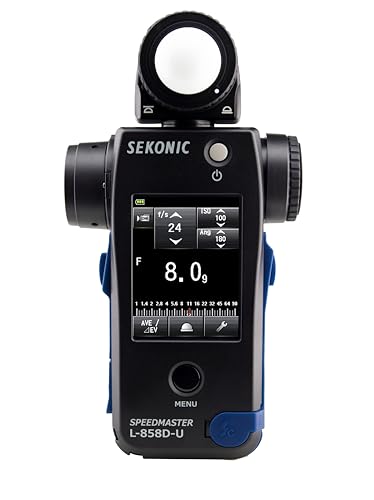
- Incident ambient and flash metering
- 1-degree spot metering with viewfinder
- Radio-trigger options and flash-duration measurement
Best For: Flash photographers needing advanced measurement control
Best Pocket Film-and-Video Meter

- Ambient, flash, and reflected-light measurement
- Dedicated Cine and HD Cine modes
- Lux and foot-candle readouts
Best For: Location photographers and filmmakers needing a lightweight meter
Best Illuminance Meter

- 0–200,000 lux measurement range
- Lux and foot-candle conversion
- Peak recording for brief high-intensity sources
Best For: General light-intensity checks, plants, workspaces, and outdoor areas
Battery-Free Classic
Sekonic L-398A Studio Deluxe III

- Battery-free analog ambient metering
- Incident and reflected measurement
- Full aperture/shutter dial readout
Best For: Photographers wanting a durable, screen-free meter
Compact Lux Reader
UNI-T UT383 Digital Light Meter

- Measures lux and foot-candles
- Backlit four-digit LCD
- Max/min, hold, and 0.5-second sampling
Best For: Portable illuminance checks and studio lighting measurements
Advanced Touchscreen Meter
Sekonic LiteMaster Pro L-478D-U
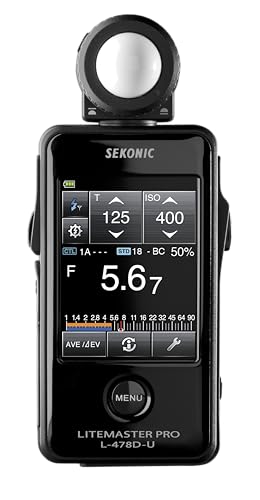
- Incident, reflected, and flash metering
- Cine frame-rate and shutter-angle controls
- Touchscreen with illuminance/luminance modes
Best For: Professional stills, flash, and motion-production workflows
Best Retro-Style Pick

- 35° reflective metering with ±0.1EV accuracy
- Manual, aperture-auto, shutter-auto, and EV modes
- Metal body with USB-C rechargeable battery
Best For: Film photographers who prefer tactile controls
Best General-Purpose Lux Meter
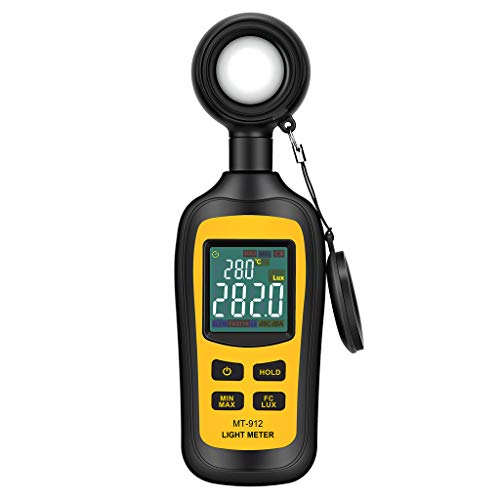
- Measures 0–200,000 lux
- Reads ambient temperature
- Includes min/max, hold, and auto power-off
Best For: General lighting and set measurements
Best Simple High-Range Option

- Measures up to 200,000 lux and 18,500 FC
- Automatically switches measurement ranges
- Adds lux/FC selection, hold, backlight, and min/max
Best For: Brightness checks across studio and outdoor settings
Best Compact Hybrid Meter – Sekonic L-308X-U Flashmate
The Sekonic L-308X-U is a practical choice among light meters for photographers who need one compact meter for still photography, flash, and video. It provides ambient and electronic-flash readings to one-tenth-stop accuracy, with dedicated Photo, Cine, and HD Cine modes.
Best For: Photographers and DSLR or mirrorless videographers who want a pocket-sized meter with broad exposure controls.
Pros:
- Measures ambient and electronic flash exposure accurately to one-tenth stop in full-stop mode.
- Supports corded and cordless flash measurement.
- Includes Photo, Cine, and HD Cine modes for stills and video workflows.
- Offers a wide ambient range and shutter speeds from 60 seconds to 1/8000 second.
Cons:
- Requires two AAA batteries.
- Its compact control set may be less suitable for users seeking advanced spot-metering features.
Choose this model when portability and versatility matter more than specialized high-end features. Its flash support and video modes make it a flexible everyday meter.
Best Advanced Flash Meter – Sekonic L-858D-U Speedmaster
The Sekonic L-858D-U Speedmaster is aimed at photographers who need more advanced light-metering capability. It combines incident ambient and flash metering with 1-degree spot metering, a broad measurement range, radio-trigger compatibility, and flash-duration measurement.
Best For: Studio and location photographers working with flash who need spot metering and compatible radio-trigger options.
Pros:
- Provides incident metering for ambient and flash light.
- Includes precise 1-degree spot metering with a viewfinder.
- Measures from -5 to 22.9 EV at ISO 100.
- Offers radio-trigger options for Phottix, Elinchrom, and PocketWizard systems.
Cons:
- Heavier and larger than the compact models in this roundup.
- Its advanced feature set may be more than casual photographers need.
This is the stronger fit for photographers who regularly control flash setups or need narrow-angle spot readings. Consider it when measurement flexibility is more important than minimal size.
Best Pocket Film-and-Video Meter – Sekonic L-308X Flashmate
Sekonic FLASHMATE L-308X Photographers and Film Makers Exposure Meter - Black/Blue
Check Price On AmazonThe Sekonic L-308X is a compact exposure meter for photographers and filmmakers who want ambient, flash, and video support in one simple tool. Its sliding lumisphere supports ambient readings, while a 40-degree lens provides reflected-light measurement.
Best For: Photographers, filmmakers, and cinematographers who need a lightweight meter for location scouting or quick on-set checks.
Pros:
- Measures ambient and flash lighting in a pocket-sized body.
- Supports reflected-light readings through a 40-degree reception angle.
- Includes dedicated Cine and HD Cine modes.
- Displays measurements in lux or foot-candles.
Cons:
- Requires AA batteries.
- Does not list the advanced 1-degree spot metering of the L-858D-U.
The L-308X is a sensible everyday option when you value low weight and broad usefulness. It is particularly convenient for scouting, quick checks, and mixed photo-video work.
Best Illuminance Meter – Dr.meter Digital Lux Meter
The Dr.meter Digital Illuminance Light Meter is a straightforward choice for measuring light intensity rather than camera exposure. Its 0–200,000 lux range, fast readings, and selectable lux or foot-candle display make it useful for evaluating sunlight, workspaces, and growing environments.
Best For: Users who need general-purpose illuminance measurements for homes, offices, factories, outdoor areas, or plants.
Pros:
- Measures illuminance across a 0–200,000 lux range.
- Provides readings twice per second for fast response.
- Switches between lux and foot-candle units.
- Peak recording can capture brief high-intensity pulses.
Cons:
- It is an illuminance meter, not a dedicated photographic exposure meter for aperture and shutter settings.
- Uses a 9V battery.
This meter is best treated as a general light-intensity tool rather than a traditional camera meter. Choose it when lux or foot-candle data is the priority, especially for environmental or plant-light measurements.
Battery-Free Classic – Sekonic L-398A Studio Deluxe III
The Sekonic L-398A Studio Deluxe III is a distinctive choice among light meters for photographers who prefer an analog workflow and dependable battery-free operation. Its incident and reflected metering, swivel head, and full dial readout make it practical for studio work and location photography.
Best For: Photographers and cinematographers who want a durable analog meter without relying on batteries.
Pros:
- Battery-free amorphous photocell supports convenient use in studio or on location.
- Measures both incident and reflected ambient light with interchangeable accessories.
- Full dial readout shows aperture and shutter speed combinations at a glance.
- Includes a lumisphere, lumidisc, lumigrid, high slide, strap, soft case, and manual.
Cons:
- Analog operation may feel less immediate to photographers accustomed to digital displays.
- Its ambient-light focus does not provide the flash-analysis functions found on advanced digital meters.
The L-398A stands out for its simple, screen-free design and broad accessory package. Choose it if tactile controls and battery-free metering matter more to you than touchscreen features or electronic automation.
Compact Lux Reader – UNI-T UT383 Digital Light Meter
The UNI-T UT383 is a compact digital option for photographers who need straightforward illuminance readings. As one of the more accessible light meters for photographers, it measures light in lux or foot-candles, displays results on a backlit LCD, and includes useful hold and maximum/minimum functions.
Best For: Photographers, studios, and general lighting checks where lux or foot-candle measurements are sufficient.
Pros:
- Measures from 0 to 199,900 lux or 0 to 18,500 foot-candles.
- Large four-digit LCD includes backlighting for easier viewing.
- Offers 0.5-second sampling, data hold, maximum/minimum readings, and overload indication.
- Compact five-ounce design is easy to carry between locations.
Cons:
- It is an illuminance meter rather than a dedicated incident/reflective photographic exposure meter.
- The supplied notes do not list aperture, shutter-speed, or flash-exposure readouts.
The UT383 is best treated as a practical light-intensity measuring tool rather than a full exposure calculator. It makes sense for users who value portability and numerical lux/FC readings for photography, studios, or general lighting tasks.
Advanced Touchscreen Meter – Sekonic LiteMaster Pro L-478D-U
The Sekonic LiteMaster Pro L-478D-U is a feature-rich choice among light meters for photographers working with ambient light, flash, and motion production. Its color touchscreen combines incident and reflected metering with flash analysis, cine controls, and illuminance and luminance measurement modes.
Best For: Professional photographers, filmmakers, and hybrid creators managing flash, ambient, and cine exposures.
Pros:
- Touchscreen interface provides clear navigation and exposure data visibility.
- Measures incident ambient and flash light, including flash-to-ambient analysis.
- Cine mode supports frame-rate and shutter-angle control for motion work.
- Illuminance and luminance modes expand its usefulness for technical lighting evaluation.
Cons:
- Requires two AAA batteries, unlike the battery-free L-398A.
- The reflected spot function requires an optional 5° attachment.
- Its advanced feature set may be more than needed for basic ambient exposure readings.
The L-478D-U is the strongest fit for users who need one meter across still photography and motion production. Its touchscreen and flash-analysis tools add flexibility, while the optional spot attachment allows more selective reflected-light measurement.
Best Retro-Style Pick – LightMate AirPro
For photographers comparing light meters for photographers, the LightMate AirPro is a compact reflective meter designed for film-camera use. Its 35-degree metering angle, multiple exposure modes, tactile dials, and rechargeable battery make it a practical choice for photographers who want hands-on control.
Best For: Film photographers who prefer physical controls, customizable indicators, and a compact metal meter.
Pros:
- 35-degree wide-angle metering with stated ±0.1EV accuracy
- Supports aperture-priority, shutter-priority, manual, and EV modes
- Independent ISO, aperture, and shutter-speed dials with half-stop adjustment
- Rechargeable USB-C battery with more than 20 hours of battery life
Cons:
- Its reflective metering design may be less suitable when you specifically need incident metering
- More specialized for photography than general-purpose illuminance measurement
The AirPro stands out for its tactile retro controls and flexible exposure workflow. It is a strong fit for photographers who want a dedicated camera meter rather than a general lux-reading tool.
Best General-Purpose Lux Meter – Digital Illuminance Meter
Among light meters for photographers, this handheld digital illuminance meter is a straightforward option for measuring visible light in studios, sets, offices, homes, and other spaces. It measures up to 200,000 lux and adds ambient-temperature readings for broader environmental checks.
Best For: Photographers, set designers, and home or workplace users who need a simple high-range lux meter.
Pros:
- Measures illumination from 0 to 200,000 lux
- Displays ambient temperature alongside light readings
- Includes minimum/maximum readings, data hold, auto power-off, and low-battery indication
- Compact 6.7-ounce design with a stated two-year warranty
Cons:
- Uses three AAA batteries rather than a rechargeable battery
- Reports lux rather than camera-specific exposure settings
This meter is best viewed as a versatile illuminance instrument rather than a dedicated exposure meter. Its broad range and memory functions make it useful for checking lighting conditions across practical shooting and setup environments.
Best Simple High-Range Option – S8608 Digital Lux Meter
The S8608 is a practical choice for photographers seeking light meters for photographers that focus on brightness measurement rather than camera exposure calculations. Its automatic range selection, large display, and support for both lux and foot-candles make it useful indoors, outdoors, and around grow-light or studio setups.
Best For: Users who want a lightweight, high-range brightness meter with multiple illuminance units.
Pros:
- Measures brightness up to 200,000 lux, or 18,500 foot-candles
- Automatically converts across measurement ranges
- Supports lux and foot-candle units
- Provides maximum/minimum readings, data hold, backlight, and auto power-off
Cons:
- Does not list camera-specific aperture, shutter, or ISO exposure modes
- Requires three AAA batteries
With its broad measurement range and readable display features, the S8608 is a useful brightness-checking tool for photography spaces and other applications. Choose it when illuminance data matters more than direct exposure guidance.
How We Picked the Best Light Meters for Photographers
We evaluated these meters by looking at the type of measurement they provide, supported exposure modes, usability in real shooting conditions, portability, power requirements, and likely buyer. Dedicated photographic meters that measure incident and reflected light generally offer more useful exposure control than general-purpose illuminance meters, while lux meters can be practical for checking ambient brightness on a budget.
We also considered features such as flash measurement, cine frame rates, shutter-angle support, touchscreen controls, analog operation, display readability, battery life, and measurement range. Because photographers work in different ways, the best choice depends on whether you shoot stills, film, studio portraits, video, or simply need a basic brightness tester.
Quick Comparison
| Best For | Recommended Type | Features to Prioritize |
|---|---|---|
| Everyday still photography | Compact photographic meter | Incident and reflected readings, simple exposure controls |
| Studio and flash work | Advanced flash meter | Flash analysis, wireless compatibility, broad exposure range |
| Film and cine production | Cine-capable meter | Frame rate, shutter angle, HD cine modes |
| Travel and handheld use | Small digital or analog meter | Low weight, clear display, dependable battery or battery-free operation |
| General brightness checks | Digital lux meter | Wide lux range, hold function, readable LCD, low cost |
Key Buying Factors for Light Meters for Photographers
Incident Vs. Reflected Metering
Incident metering measures light falling on the subject and can produce consistent results across different colors and tones. Reflected metering measures light bouncing from the subject and is useful when you cannot stand near the scene. Models offering both are the most flexible.
Flash and Cine Features
If you use studio strobes or speedlights, choose a meter with flash measurement and controls suited to your lighting system. Video and film shooters should look for frame-rate, shutter-angle, and cine exposure modes rather than relying on a basic lux reading.
Range, Accuracy, and Display
A broad measurement range helps in bright sunlight and dim interiors, but the controls should remain easy to read and operate. Backlighting, a clear LCD, memory or hold functions, and a responsive interface are useful when working quickly.
Power and Portability
Compact battery-powered meters are convenient for location work, while the Sekonic L-398A’s battery-free design appeals to photographers who prefer an analog tool with minimal maintenance. Check the meter’s size, battery type, and expected runtime before buying.
Who Should Buy Which Light Meters for Photographers?
Choose a compact photographic meter such as the Sekonic L-308X-U if you want a straightforward tool for stills, film, or occasional flash work. The Sekonic L-478D-U or L-858D-U is better for professionals who need advanced flash analysis, broader control, or more demanding studio and location workflows.
The Sekonic L-398A suits photographers who value a classic, battery-free analog experience. Cine shooters should focus on models with dedicated cine modes, frame-rate controls, and shutter-angle support. The LightMate AirPro can appeal to users who want a retro-style digital meter with rechargeable operation.
Finally, Dr.meter, UNI-T, and similar 200,000-lux handheld meters are best for general illuminance checks, classroom or workplace measurements, and budget experimentation. They may be useful for understanding ambient brightness, but they are not a substitute for a dedicated photographic exposure meter when incident, reflected, or flash readings are required.