Finding the right signal generator under $500 depends less on maximum frequency alone and more on the signals, controls, and measurement tasks you handle most often.
This roundup compares 10 affordable options, including DDS function generators, audio-focused units, arbitrary-waveform models, and 4–20 mA or 0–10 V process simulators.
Best 10 Signal Generators Under 500 Picks for 2026
Versatile DDS Workhorse
Koolertron 15MHz Dual-Channel Signal Generator

- Independent dual-channel DDS and TTL output
- Multiple waveforms, sweeps, and user storage
- Measures frequency, period, pulse width, and counts
Best For: Labs, teaching, and flexible electronics testing
PLC Testing Specialist
Riiai SG003A 4-20mA and Voltage Generator

- Generates current, voltage, pulse, passive-current, and PWM signals
- Precise 0.01mA and 0.01V adjustment
- Rechargeable battery with up to 26 hours of operation
Best For: PLC testing and industrial automation troubleshooting
30MHz Dual-Channel Performer
SEESII DDS Arbitrary Waveform Generator

- Independent dual channels with adjustable phase difference
- 0.01µHz–30MHz range and 266MSa/s sampling
- Seven integrated test and generation functions
Best For: Circuit debugging, R&D, and university laboratory work
Simple Audio Bench Oscillator
ECUTEE TAG-101 Low-Frequency Generator

- 10Hz–1MHz range across five frequency ranges
- Sine and square outputs with adjustable level
- Six-step 10dB attenuator for controlled output
Best For: Audio testing and amplifier gain measurements
Best Portable Process Signal Tool
Riiai 0-10V/0-22mA Signal Generator
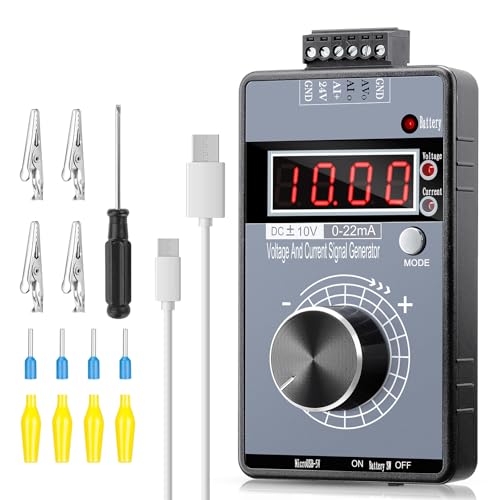
- Adjustable -10V to +10V and 0-22mA output
- Rechargeable battery with multiple power options
- Four-digit display and programmable quick-output points
Best For: Portable PLC and industrial-control debugging
Best Compact Waveform Generator
FG-200 DDS Function Signal Generator

- Sine output from 0.01Hz to 500kHz
- Sine, square, and sawtooth waveform modes
- Adjustable amplitude, DC bias, and filtering
Best For: Circuit testing and oscilloscope-based measurements
Best Simple 4-20mA Simulator
DROK Adjustable 0-10V/4-20mA Generator

- Generates 0/4-20mA and 0-10V signals
- One module handles current and voltage output
- Multi-cycle precision potentiometer for adjustment
Best For: Basic PLC, panel, and analog-input testing
Best Compact DDS Pick
Mini DDS Function Signal Generator

- 1Hz–500kHz frequency range
- Multiple waveform and modulation options
- Portable design with stable output
Best For: Portable electronics testing and waveform experimentation
Best Industrial Control Pick
Adjustable 4-20mA Signal Generator

- 0-24mA and ±12V adjustable outputs
- 1-150kHz PWM with adjustable duty cycle
- Built-in rechargeable battery and protections
Best For: 4-20mA loop and control-signal testing
Best Classroom and Audio Pick

- 1Hz–500kHz DDS output
- Four waveforms with switchable filtering
- AC/DC or external battery-pack operation
Best For: Classroom, audio, and portable electronics testing
Versatile DDS Workhorse – Koolertron 15MHz Dual-Channel Signal Generator
For shoppers comparing signal generators under 500, the Koolertron 15MHz DDS Signal Generator stands out as a versatile bench instrument with two independently configurable channels. It supports multiple standard and user-defined waveforms, frequency and pulse measurements, sweeps, and waveform storage for repeatable testing.
Best For: Electronics labs, teaching, production-line testing, and users who need dual-channel waveform generation with measurement functions.
Pros:
- Dual-channel DDS output with independently adjustable parameters and TTL output.
- Supports sine, square, triangle, sawtooth, pulse, white noise, and user-defined waveforms.
- Includes sweep, frequency, period, pulse-width, counting, and storage functions.
- Offers up to 15MHz sine-wave output, 200MSa/s sampling, and 14-bit waveform resolution.
Cons:
- The supplied notes do not specify an included accessory package.
- Its broad feature set may be more than needed for simple single-waveform tasks.
With extensive waveform and measurement capabilities, this is a strong option when flexibility and repeatable bench testing matter more than minimal controls.
PLC Testing Specialist – Riiai SG003A 4-20mA and Voltage Generator
Among signal generators under 500, the Riiai SG003A is tailored to industrial signal simulation rather than general bench waveform work. It can generate adjustable current, voltage, passive-current, pulse, and PWM signals, making it useful for checking PLC inputs, converters, and control-system responses.
Best For: PLC testing, industrial automation troubleshooting, analog signal simulation, and portable field work.
Pros:
- Supports 0–24mA current, 0–24V voltage, passive current, and 0–9999Hz pulse output.
- Provides 0.01mA and 0.01V adjustment precision for current and voltage modes.
- Includes VCA conversion, PWM output, automatic rise/fall/cycle modes, and real-time graph interfaces.
- Rechargeable 3000mAh battery provides up to 26 hours of working time according to the supplied notes.
Cons:
- It is designed for industrial signal simulation, not broad arbitrary-waveform generation.
- Charging through the micro 5V USB port may require planning around field use.
The SG003A is a focused, portable choice for technicians who need practical 4-20mA, voltage, pulse, and PWM simulation in one handheld unit.
30MHz Dual-Channel Performer – SEESII DDS Arbitrary Waveform Generator
For buyers seeking signal generators under 500 with higher-frequency coverage, the SEESII Dual Channel 30MHz DDS Signal Generator combines two equal-performance channels with arbitrary-waveform, pulse, noise, frequency-meter, counter, and sweep functions. Its independent controls and adjustable phase are useful for synchronized and differential circuit testing.
Best For: R&D work, university labs, electronic inspection, circuit debugging, and users needing dual-channel operation up to 30MHz.
Pros:
- Two independently adjustable channels with continuously adjustable phase difference from 0° to 359.9°.
- Covers 0.01µHz to 30MHz with 266MSa/s sampling, 14-bit resolution, and ±20ppm frequency accuracy.
- Includes 60 built-in arbitrary waveforms plus standard sine, square, triangle, and pulse outputs.
- Combines seven functions, including generator, arbitrary waveform generator, pulse generator, noise generator, meter, counter, and sweeper.
Cons:
- The supplied notes do not provide an output-load specification.
- The larger feature set may require more setup time than a basic generator.
With 30MHz coverage, dual independent channels, and a complete accessory set, the SEESII is well suited to users who want one instrument for varied circuit-testing tasks.
Simple Audio Bench Oscillator – ECUTEE TAG-101 Low-Frequency Generator
For straightforward audio and amplifier work, the ECUTEE TAG-101 offers a focused alternative among signal generators under 500. Its 10Hz–1MHz range, sine and square outputs, adjustable level control, and six-step attenuation are suited to basic signal injection and gain measurements.
Best For: Audio testing, amplifier gain measurements, sine-wave generation, and users who prefer simple front-panel operation.
Pros:
- Provides a 10Hz–1MHz frequency range across five selectable ranges.
- Outputs sine and square waveforms for basic testing and signal injection.
- Offers six 10dB attenuation steps plus a level regulator for output adjustment.
- Delivers greater than 5Vrms sine output at no load and greater than 2.8Vrms at 600Ω load.
Cons:
- It does not offer the dual-channel, arbitrary-waveform, or digital storage features listed for other models.
- The supplied notes identify a 110V version, so power compatibility should be checked.
- At 4.85 pounds, it is less portable than compact handheld options.
The TAG-101 makes sense when dependable, manually adjustable sine and square signals are enough for audio servicing or amplifier evaluation.
Best Portable Process Signal Tool – Riiai 0-10V/0-22mA Signal Generator
For shoppers comparing signal generators under 500, the Riiai is a practical choice for testing and debugging industrial control equipment. It combines adjustable voltage and current output with a rechargeable battery, four display modes, and programmable quick-output points.
Best For: PLC, panel, valve, servo, and frequency-converter debugging where portable 0-10V or 0/4-20mA output is useful.
Pros:
- Generates -10V to +10V and 0-22mA signals with 0.01-unit precision.
- Offers four display modes and a four-digit readout.
- Includes a 1,000mAh rechargeable battery plus micro-USB and 15-30V DC power options.
- Provides short-circuit and reverse-connection protection.
Cons:
- Its feature set is focused on process voltage and current signals rather than general-purpose waveform generation.
- The battery is charged through micro USB rather than a more modern USB-C port.
The Riiai stands out when portability and flexible analog-output testing matter most. Its programmable output points and adjustable active or passive current modes add convenience for field troubleshooting.
Best Compact Waveform Generator – FG-200 DDS Function Signal Generator
Among signal generators under 500, the FG-200 is aimed at electronics work that requires waveform output rather than process-current simulation. Its DDS design supports sine, square, and sawtooth signals, with frequency adjustment extending to 500 kHz for sine waves.
Best For: Bench testing, oscilloscope calibration, audio-amplifier measurements, and basic circuit debugging.
Pros:
- Generates sine waves from 0.01Hz to 500.00kHz.
- Supports sine, square, and sawtooth waveforms.
- Includes adjustable amplitude, DC bias up to ±10V, filtering, and a frequency-counter function.
- Can save settings and run from a 4-9V supply or 3.7V lithium battery.
Cons:
- Other waveform modes are specified at 0.01Hz-100.00kHz.
- Sine-wave output amplitude decreases as frequency rises.
- The module requires an external power source or battery.
The FG-200 is a versatile compact signal source for electronics benches. Its filter, bias, amplitude, and run/stop controls make it useful for practical measurements, though it is less suited to industrial 4-20mA or 0-10V process simulation.
Best Simple 4-20mA Simulator – DROK Adjustable 0-10V/4-20mA Generator
For buyers searching signal generators under 500 for straightforward industrial testing, the DROK provides adjustable current and voltage from one compact module. A multi-cycle precision potentiometer lets you set 0/4-20mA current or 0-10V voltage without switching between separate tools.
Best For: PLC and panel checks, valve-related testing, and LED or control-input verification requiring analog current or voltage signals.
Pros:
- Combines current and voltage signal generation in one module.
- Supports 0/4-20mA current and 0-10V voltage output.
- Uses a multi-cycle precision potentiometer for manual adjustment.
- Compact and lightweight at approximately 4.6 ounces.
Cons:
- The supplied notes do not specify a built-in battery or alternate power options.
- No display, protection features, or output precision rating are provided in the supplied details.
The DROK is a focused option for users who need the two most common analog-control signals in a simple package. It is best chosen for basic signal adjustment rather than waveform-generation tasks or applications requiring detailed onboard readouts.
Best Compact DDS Pick – Mini DDS Function Signal Generator
For shoppers comparing signal generators under 500, this compact DDS function generator offers a broad waveform selection and adjustable frequency range from 1Hz to 500kHz. Its portable design and intuitive controls make it practical for electronics testing, development, and repeatable measurements.
Best For: Portable bench work, waveform experimentation, and general electronic-system testing.
Pros:
- Generates sine, square, triangle, pulse, and arbitrary waveforms.
- Supports advanced modulation options for communication-system testing.
- Offers precise frequency control with stable, low-distortion output.
- Compact, lightweight design with AC/DC or battery operation.
Cons:
- Its frequency range tops out at 500kHz.
- The supplied notes do not specify included accessories or battery details.
This is a versatile choice when portability and waveform variety matter more than a larger laboratory instrument. It suits users who want a straightforward DDS generator for testing and development.
Best Industrial Control Pick – Adjustable 4-20mA Signal Generator
Among signal generators under 500, this battery-powered unit stands out for process-control signals rather than general waveform work. It provides adjustable voltage, current, and PWM outputs, making it useful for calibrating and checking compatible industrial electronics.
Best For: Testing 4-20mA loops, voltage inputs, and low-current PWM-controlled equipment.
Pros:
- Adjustable 0-24mA current output with a factory default of 4-20mA.
- Provides selectable voltage output up to ±12V.
- PWM frequency is adjustable from 1-150kHz with 0-100% duty cycle.
- Includes short-circuit, reverse-connection, and charging protection.
Cons:
- PWM output is fixed at a 5V high level and is not suitable for 12V or 24V systems.
- Battery runtime varies with load and is listed at approximately 1-5 hours.
- Charging generally takes more than six hours.
This is the more specialized option in the group, focused on current-loop and control-signal servicing. Confirm the 5V PWM level and your equipment’s input requirements before choosing it.
Best Classroom and Audio Pick – SEESII 500kHz DDS Generator
This SEESII model is a distinctive option among signal generators under 500, combining a 1Hz-500kHz DDS generator with a 7.83Hz Schumann resonator. It supplies common test waveforms and a switchable filter for tasks such as oscilloscope calibration and audio amplifier testing.
Best For: Classroom instruction, field testing, oscilloscope calibration, and audio-focused electronics work.
Pros:
- Produces sine, square, triangle, and sawtooth waveforms.
- Switchable filter helps optimize sine and pulse outputs.
- Compact design supports AC/DC adapter or external battery-pack operation.
- Uses precision components for stable, accurate frequency output.
Cons:
- External battery pack is not included.
- The integrated Schumann resonator may be unnecessary for users seeking only conventional test signals.
- Its maximum frequency is 500kHz.
The SEESII is a flexible, portable generator for basic lab and audio tasks, with extra resonator functionality that sets it apart. It is especially appealing when teaching or field portability is part of the use case.
How We Picked the Best Signal Generators Under 500
We organized these Signal Generators Under 500 around practical bench use rather than headline specifications alone. The selection covers frequency generation, waveform variety, output channels, display and control layout, signal stability, and application fit. We also included dedicated current and voltage simulators because industrial control testing often requires 4–20 mA or 0–10 V output instead of conventional laboratory waveforms.
Product descriptions and stated capabilities were compared for frequency range, supported waveforms, channel count, adjustment resolution, portability, and intended use. Before purchasing, verify the latest specifications, included accessories, connector type, output limits, and electrical safety information.
Quick Comparison
| Best For | Look For | Typical Choice From This Roundup |
|---|---|---|
| General electronics testing | DDS generation, multiple waveforms, frequency counter | 15–30 MHz dual-channel models |
| Audio troubleshooting | Low-frequency coverage, simple amplitude and frequency adjustment | 10 Hz–1 MHz audio generator |
| PLC and process simulation | 4–20 mA, 0–10 V, clear display, adjustable output | Current/voltage analog simulators |
| Portable or embedded projects | Compact size, low power needs, straightforward controls | Mini DDS modules and kits |
| Waveform experimentation | Arbitrary-waveform output and dual channels | 30 MHz arbitrary-waveform generator |
Key Buying Factors for Signal Generators Under 500
Frequency Range and Resolution
Choose a range that comfortably exceeds your normal test frequency. Lower-frequency audio and control applications may benefit more from fine adjustment and stable output than from a very high top frequency. Check whether the advertised range applies to every waveform and whether frequency accuracy changes near the upper limit.
Waveforms and Output Channels
Sine, square, and sawtooth outputs cover many basic tests. Arbitrary-waveform capability is more useful when you need custom patterns, while dual channels help with synchronized signals, phase comparisons, or two-input circuit testing. A single-channel generator can be the better value for simple repairs and educational work.
Voltage, Current, and Load Compatibility
Traditional function generators and process simulators serve different purposes. For PLC panels, transmitters, indicators, and control loops, confirm the required 4–20 mA or 0–10 V range, output mode, polarity, and load capability. Do not assume a frequency generator can directly replace a calibrated process simulator.
Controls, Display, and Portability
A readable display and dedicated adjustment controls make repeated tests faster. Compact modules are convenient for embedded projects but may require an external enclosure, power supply, or test leads. Bench instruments are usually easier to operate, while handheld or kit-style products save space.
Safety and Measurement Practice
Check maximum output, grounding arrangement, isolation, connector style, and power requirements before connecting a generator to a live circuit. Use appropriate attenuation, current limiting, and an oscilloscope or multimeter to verify the signal at the load.
Who Should Buy Which Signal Generators Under 500?
Choose a dual-channel DDS model if you regularly test audio, analog, or digital circuits and need synchronized outputs. Choose an arbitrary-waveform generator for development work involving custom pulse patterns or nonstandard signals. Choose an audio-focused generator for speaker, amplifier, filter, and low-frequency troubleshooting where simple operation matters most.
Choose a 4–20 mA or 0–10 V simulator for PLC commissioning, sensor-loop testing, panel checks, and industrial instrumentation. Choose a compact DDS kit or mini generator when portability, low cost, or integration into a project matters more than advanced bench controls. For broad general-purpose use, prioritize waveform coverage, stable adjustment, readable controls, and compatibility with your existing test equipment.