The right logic analyzer can turn confusing digital-signal behavior into clear, time-stamped data. Whether you are troubleshooting UART, I²C, SPI, CAN, or GPIO signals, the best tool depends on channel count, sampling speed, software support, and your project’s voltage levels.
Our roundup covers affordable USB analyzers for beginners, portable Saleae options, open-hardware development tools, and high-speed DSLogic models for more demanding debugging.
Best 10 Logic Analyzers for Hobbyists Picks for 2026
Flexible 16-Channel Pick

- 16 channels for simultaneous digital capture
- 100MHz sampling per channel
- 30+ protocol decoders and cross-platform support
Best For: Embedded debugging and multi-signal testing
Budget Starter Tool
HiLetgo 8-Channel USB Analyzer

- Eight channels for basic digital capture
- Sampling rates up to 24MHz
- Compact USB design for UART, IIC, and SPI debugging
Best For: Beginners and low-speed embedded projects
High-Speed Capture Choice
DSLogic Plus 400MHz Logic Analyzer

- 16 channels with dual capture modes
- Up to 400MHz buffer-mode sampling
- 256Mbits onboard memory and deep stream capture
Best For: Fast buses and timing-sensitive debugging
Easy Multisignal Pick

- Eight digital/analog multi-use inputs
- 100MS/s digital and 10MS/s analog sampling
- Logic 2 supports 23+ protocol decoders
Best For: Accessible mixed-signal hobby projects
Best Expandable Development Platform

- Combines logic analysis, debugging, and USB development
- Expandable through add-on “neighbor” boards
- Includes Wiggler, cable, and 120 prototyping wires
Best For: Programmable USB projects and expandable electronics development
Best All-Around Professional-Style Pick

- 16 multi-use digital/analog inputs
- Decodes SPI, I2C, and 23+ other protocols
- Supports Windows, Mac, and Linux
Best For: Flexible digital and analog troubleshooting
Best for Comfort

- Up to 1 GHz sampling with 2 Gbits onboard memory
- 16 channels with dual stream and buffer modes
- Open-source DSView supports nearly 100 decoders
Best For: High-speed buses and long-duration captures
Versatile Protocol Debugger
LA2016 16-Channel Logic Analyzer

- 16 channels with 200 MHz sampling and 1Gbit memory
- Decodes more than 20 common protocols
- Portable, USB-powered, and cross-platform
Best For: General embedded debugging and multi-protocol projects
High-Speed Powerhouse
DSLogic U3Pro32 32-Channel Analyzer

- 32 channels with sampling rates up to 1 GHz
- Dual stream and buffer capture modes
- USB 3.0 and open-source DSView software
Best For: Fast, wide-bus analysis and advanced hobby projects
Balanced High-Depth Pick
DSLogic Plus 16-Channel Analyzer
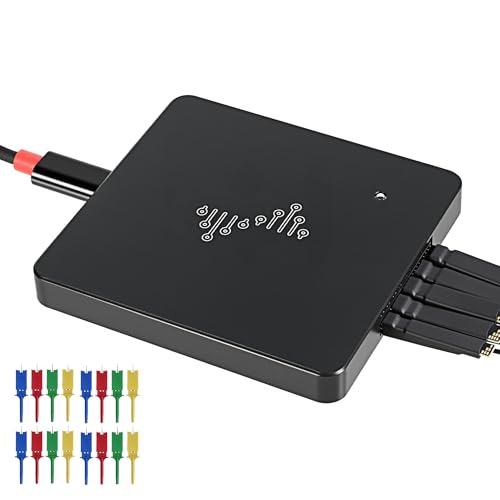
- 16 channels with 400 MHz sampling
- Up to 16G samples in stream mode
- Dual capture modes with adjustable threshold
Best For: Long embedded-system captures and flexible protocol debugging
Flexible 16-Channel Pick – LA1010 100MHz Logic Analyzer
For hobbyists comparing logic analyzers for hobbyists projects, the LA1010 offers 16 input channels, up to 100MHz sampling per channel, and broad computer compatibility. Its KingstVIS software supports real-time waveform viewing and decoding for more than 30 protocols, including UART, I2C, SPI, and CAN.
Best For: Embedded-system debugging, multi-signal digital testing, and protocol analysis across Windows, macOS, or Linux.
Pros:
- Captures up to 16 digital signals at once.
- Supports more than 30 protocol decoders.
- Works with Windows, macOS, and Linux, with low 0.5-watt power consumption.
Cons:
- Requires a computer and USB connection for operation.
- The supplied specifications focus on digital analysis rather than analog measurement.
The LA1010 is a strong all-purpose option when channel count and protocol coverage matter more than standalone operation. Its portable design makes it practical for bench work and signal monitoring.
Budget Starter Tool – HiLetgo 8-Channel USB Analyzer
The HiLetgo is a compact, low-cost choice for hobbyists exploring logic analyzers for hobbyists projects. It provides eight channels with selectable sampling rates up to 24MHz, making it suitable for common digital debugging tasks and basic UART, IIC, and SPI work.
Best For: Beginners, Arduino-style projects, and straightforward embedded-systems signal checks.
Pros:
- Eight channels support multiple digital lines.
- Sampling rates can be selected from 25kHz to 24MHz.
- Input range and impedance are specified for basic circuit compatibility.
Cons:
- Lower maximum sampling rate than the other analyzers in this roundup.
- Its eight-channel capacity may limit larger projects.
- The supplied notes do not specify included protocol-decoding software.
This analyzer keeps the setup simple and affordable for low-speed digital signals. Choose it when you need basic channel monitoring without the higher performance or capacity of more advanced models.
High-Speed Capture Choice – DSLogic Plus 400MHz Logic Analyzer
For hobbyists who need deeper captures, the DSLogic Plus combines 16 channels, a 400MHz maximum buffer-mode sampling rate, and 256Mbits of onboard memory. Its dual-mode design balances high-speed snapshots with long stream-mode recordings, while DSView supports Windows, macOS, and Linux.
Best For: Fast digital buses, timing-sensitive debugging, and projects requiring either deep recordings or high sample rates.
Pros:
- Reaches 400MHz in buffer mode with four channels.
- Offers 256Mbits of onboard SDRAM and up to 16G sample depth in stream mode.
- Supports adjustable thresholds and nearly 100 protocol decoders through DSView.
Cons:
- Maximum sampling rate varies with the number of active channels.
- Its advanced modes may be more than beginners need.
- Requires a computer and USB 2.0 Type-C connection.
The DSLogic Plus is the performance-oriented pick in this group. Its channel-dependent sampling modes give experienced hobbyists flexibility when troubleshooting fast or lengthy digital transactions.
Easy Multisignal Pick – Saleae Logic 8 Analyzer
The Saleae Logic 8 is a user-friendly option for hobbyists evaluating logic analyzers for hobbyists work. Its eight inputs can serve as digital or analog channels, with digital sampling up to 100MS/s, analog sampling up to 10MS/s, and Logic 2 software for Windows, Mac, and Linux.
Best For: Hobbyists who want a portable analyzer with both digital protocol decoding and basic analog waveform measurement.
Pros:
- Eight multi-use digital/analog inputs add measurement flexibility.
- Decodes SPI, I2C, and more than 23 other protocols.
- Supports long captures using PC memory and works across major desktop platforms.
Cons:
- Has fewer channels than the 16-channel models listed here.
- Analog sampling is limited to 10MS/s.
- Operation depends on a connected PC and USB 2.0.
Logic 8 stands out when ease of use and mixed digital/analog work are priorities. It is a practical choice for learning, troubleshooting sensors, and decoding common embedded communications.
Best Expandable Development Platform – GreatFET One Bundle
For hobbyists who want more than a dedicated probe, the GreatFET One Bundle combines logic-analyzer capabilities with USB development, debugging, and hardware expansion. Its Python support also makes it approachable for experimenting with custom tools and workflows.
Best For: Hobbyists interested in programmable USB projects, debugging, and expandable electronics development.
Pros:
- Supports logic analyzing, debugging, and electronic development.
- Can be expanded with add-on “neighbor” boards.
- Python libraries support both high-level and low-level programming.
- Bundle includes the GreatFET One, Wiggler, USB cable, and 120 prototyping wires.
Cons:
- Its broader development-board focus may be more than users need for basic signal capture.
- Getting the most from it may require programming and hardware experimentation.
The GreatFET One is a flexible choice among logic analyzers for hobbyists, particularly when USB work and expandability matter as much as protocol troubleshooting.
Best All-Around Professional-Style Pick – Saleae Logic Pro 16
The Saleae Logic Pro 16 is a versatile option for hobbyists who want both digital and analog measurement in one compact, USB-powered analyzer. With 16 multi-use inputs and broad protocol-decoding support, it suits a wide range of electronics troubleshooting tasks.
Best For: Hobbyists who need flexible digital and analog capture across Windows, Mac, or Linux.
Pros:
- Provides 16 digital/analog inputs for flexible measurement.
- Decodes SPI, I2C, and more than 23 additional protocols.
- Offers digital sampling up to 500 MS/s and analog sampling up to 50 MS/s.
- Works across Windows, Mac, and Linux.
Cons:
- Its USB 3.0 operation and large capture capacity rely on the connected computer.
- It may be more capability than needed for simple, occasional digital checks.
For buyers comparing logic analyzers for hobbyists, the Logic Pro 16 stands out as a balanced solution when multi-platform software, protocol decoding, and analog visibility are priorities.
Best for Comfort – DSLogic U3Pro16
The DSLogic U3Pro16 targets hobbyists working with fast signals or needing long captures. Its 16 channels, dual capture modes, high sampling rates, onboard memory, and open-source DSView software make it a strong fit for demanding analysis projects.
Best For: Hobbyists analyzing high-speed buses, long-duration captures, and complex protocols.
Pros:
- Offers up to 1 GHz sampling and 2 Gbits of onboard DDR3 memory.
- Supports 16 channels, with channel-dependent sampling rates.
- Stream mode supports up to 16G samples and real-time transfer to PC memory.
- DSView works with Windows, macOS, and Linux and includes nearly 100 protocol decoders.
Cons:
- The highest sampling rates are available only on fewer channels.
- Its advanced modes and settings may take more time to learn.
- The analyzer is heavier than the other compact details suggest, at 1 pound.
The DSLogic U3Pro16 is one of the more capable logic analyzers for hobbyists who need speed and depth, especially when adjustable thresholds, shielded wires, and extensive decoder support are useful.
Versatile Protocol Debugger – LA2016 16-Channel Logic Analyzer
For hobbyists who need broad protocol coverage without giving up portability, this 16-channel analyzer offers 200 MHz sampling, 1Gbit memory, and English PC software for Windows, macOS, and Linux. It is a practical all-around choice among logic analyzers for hobbyists working with digital buses and embedded projects.
Best For: Hobbyists debugging I2C, SPI, UART, CAN, and other digital protocols across multiple operating systems.
Pros:
- Captures 16 digital signals at up to 200 MHz with deep 1Gbit memory.
- Decodes more than 20 protocols, including I2C, SPI, UART, CAN, I2S, USB 1.1, JTAG, and Modbus.
- Includes waveform compression, data export, saving tools, and a built-in PWM generator.
- Portable, USB-powered, and supplied with probes, hook clips, and a USB cable.
Cons:
- Its 200 MHz sampling rate is lower than the faster analyzers in this roundup.
- The listed Windows support officially extends through Windows 10.
The LA2016 is a well-equipped general-purpose option when protocol decoding and cross-platform convenience matter more than maximum sampling speed. Its included accessories also make it easy to start testing immediately.
High-Speed Powerhouse – DSLogic U3Pro32 32-Channel Analyzer
The DSLogic U3Pro32 is aimed at hobbyists who need many channels and very high-speed capture. With 32 channels, a 1 GHz maximum sampling rate, USB 3.0, and dual stream/buffer modes, it provides substantial flexibility for demanding digital troubleshooting.
Best For: Advanced hobbyists analyzing wide buses, fast signals, or long captures with a modern computer setup.
Pros:
- Offers 32 digital channels and up to 1 GHz sampling in supported modes.
- Dual-mode operation balances long real-time captures with high-speed buffered acquisition.
- Stream mode supports up to 16G samples, while onboard memory provides 2Gbits for buffer mode.
- DSView works with Windows, macOS, and Linux and includes nearly 100 protocol decoders.
Cons:
- The highest sampling rates are limited to fewer active channels.
- Its advanced capabilities may be more than beginners need for simple projects.
- USB 3.0 and the supplied Type-C interface may require a compatible computer and cable setup.
This is the strongest choice here for channel count and capture flexibility. The combination of dual modes, open-source DSView software, and extensive protocol decoding gives experienced hobbyists room to grow.
Balanced High-Depth Pick – DSLogic Plus 16-Channel Analyzer
The DSLogic Plus offers a useful middle ground for logic analyzers for hobbyists: 16 channels, a 400 MHz sampling rate, and up to 16G samples in stream mode. Its dual-mode design and broad operating-system support make it suitable for both extended captures and faster buffered tests.
Best For: Hobbyists who want high sample depth, adjustable thresholds, and flexible capture modes without moving to a 32-channel unit.
Pros:
- Captures 16 channels at up to 400 MHz sampling rate.
- Stream mode supports up to 16G samples for long-duration captures.
- Buffer mode, 256Mbits of onboard SDRAM, and adjustable thresholds support cleaner, targeted testing.
- Works with Windows XP–10, macOS, and Linux and supports nearly 100 protocol decoders through DSView.
Cons:
- It has fewer channels and lower maximum sampling speed than the DSLogic U3Pro32.
- The USB 2.0 interface is less current than a USB 3.0 connection.
- The supplied operating-system range is listed through Windows 10.
The DSLogic Plus is a sensible balance for embedded work that benefits from long captures but does not require 32 inputs. Its open-source software, adjustable threshold, and shielded wiring add useful flexibility for hobby benches.
How We Picked These Logic Analyzers for Hobbyists
We selected these models by comparing the specifications that matter most during real-world electronics debugging: channel count, maximum sampling rate, memory depth, connection type, protocol support, software compatibility, portability, and overall versatility. The list includes both budget-friendly analyzers and advanced instruments, so hobbyists can choose based on project complexity rather than paying for features they will not use.
We also considered whether each device is suited to common maker workflows, including microcontroller development, Raspberry Pi projects, Arduino debugging, FPGA experimentation, and serial-bus troubleshooting. Listed specifications can vary by operating mode, software, and connected signal conditions, so verify the manufacturer’s current documentation before purchase.
Quick Comparison
- Best for ease of use: Saleae Logic 8 offers a polished interface and broad Windows, Mac, and Linux compatibility.
- Best for more channels: Saleae Logic Pro 16 and the 16-channel DSLogic models provide additional visibility for larger systems.
- Best budget starting point: An 8-channel USB analyzer is often enough for basic UART, I²C, and SPI work.
- Best for high-speed capture: The DSLogic U3Pro16 and U3Pro32 offer 1GHz sampling and deep memory for demanding signals.
- Best open-hardware option: The GreatFET One combines logic-analysis features with experimentation and development capabilities.
Key Buying Factors for Logic Analyzers for Hobbyists
Channel Count
Choose enough channels to monitor every relevant signal at once. Four to eight channels can cover many small microcontroller projects, while 16 or 32 channels are better for parallel buses, multiple peripherals, or complex board bring-up.
Sampling Rate and Memory
A higher sampling rate captures faster transitions more accurately, but it also consumes memory faster. For ordinary low-speed serial protocols, 24MHz to 100MHz may be adequate. Faster clocks, precise timing analysis, and long captures benefit from 200MHz, 400MHz, or 1GHz hardware and deeper memory.
Protocol Decoding and Software
Check that the software supports the protocols you use, such as UART, I²C, SPI, CAN, and 1-Wire. A polished application can save substantial setup time, while open-source or third-party software may provide flexibility but require more configuration.
Voltage Compatibility and Accessories
Confirm the analyzer’s input-voltage range and whether it supports the logic levels used by your board. Also check for suitable probes, ground leads, clips, and a reliable USB connection. Never connect signals beyond the device’s rated limits.
Who Should Buy Which Logic Analyzers for Hobbyists?
Beginners and occasional troubleshooters should start with an affordable 8-channel USB model if they mainly inspect simple UART, I²C, or SPI traffic. Regular makers and embedded developers will benefit from 16 channels, better software, and at least moderate sampling speed for simultaneous signal monitoring.
Advanced hobbyists working with fast buses, FPGAs, or long capture sessions should prioritize deep memory, high sampling rates, and USB 3.0 performance. A 32-channel model is worthwhile when many signals must be observed together. Finally, experimenters who value hardware flexibility may prefer an open-hardware development board such as GreatFET, while users who want the smoothest workflow should favor a well-supported Saleae device.