The right light meter can turn guesswork into useful data when you are checking room brightness, positioning plants, evaluating work areas, or setting up photography at home. These handheld models measure illuminance in lux, with several also supporting foot-candle readings.
We selected 10 accessible options with broad measurement ranges, readable displays, practical sensors, and features that make repeated household checks easier.
Best 10 Light Meters for Home Use Picks for 2026
Best Overall Value
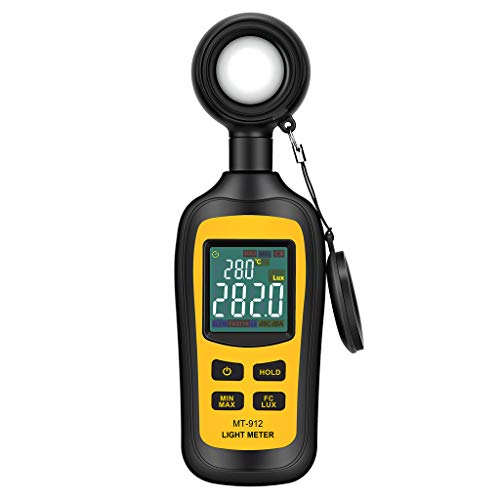
- 0–200,000 lux measurement range
- Temperature measurement and MIN/MAX readings
- Compact body with 2-year warranty
Best For: Home users wanting broad range and practical controls
Best Compact Option

- Measures in lux or foot-candles
- 0.5-second sampling time
- 5-ounce portable design with backlit LCD
Best For: Portable household, office, and studio measurements
Best for Plants
TopTes TS-710 Rotating-Sensor Meter

- 180-degree rotating probe
- Lux and foot-candle measurement to broad ranges
- Also measures temperature and humidity
Best For: Plants, LEDs, and measurements from awkward angles
Best Simple Controls

- Measures up to 200,000 lux
- Lux and foot-candle modes
- Auto/manual range selection and hold function
Best For: Basic home lighting checks with manual control
Flexible Precision Pick
MT-92H Split-Sensor Light Meter
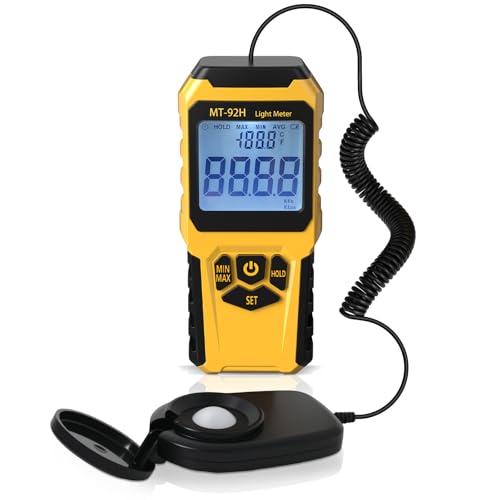
- 0–200,000 lux range with ±3% stated accuracy
- Separate probe with 0.5-second refresh rate
- Backlit display with lux/FC and °C/°F switching
Best For: Flexible home measurements and plant-light checks
Everyday Versatility Pick
S8608 Digital Illuminance Meter

- Measures brightness up to 200,000 lux
- Automatic range conversion and lux/FC switching
- Backlight, data hold, min/max, and auto power-off
Best For: Routine indoor, plant, and occasional outdoor checks
Peak-Reading Pick

- 0–200,000 lux measurement range
- Two readings per second for quick checks
- PEAK recording plus FC/lux conversion
Best For: Plant care and brief high-intensity light measurements
Best Overall Range
POROMETISTO 200,000-Lux Light Meter

- Measures 0–200,000 lux and 0–20,000 FC
- Backlit display with digital and analog readings
- Includes batteries and a two-year warranty
Best For: Home growers, photography setups, and broad indoor-to-outdoor light checks
Best Simple LCD Pick
Mcbazel 200,000-Lux Photometer

- Measures brightness up to 200,000 lux
- Switches between lux and foot-candle units
- Includes hold, MAX/MIN, backlight, and auto shutoff
Best For: Everyday home, garden, plant, and office brightness checks
Best Adjustable Sensor
DANOPLUS Rotating-Sensor Light Meter

- 360-degree rotating, separated light sensor
- Measures 0–200,000 lux with auto-ranging
- Includes MIN/MAX, hold, and two AAA batteries
Best For: Home and office measurements where sensor positioning is important
Best Overall Value – High-Range Digital Lux Meter
For shoppers comparing light meters for home use, this handheld model offers a broad 0–200,000 lux range, a compact design, and useful tracking features. It also measures ambient temperature, making it practical for checking rooms, work areas, and lighting setups.
Best For: Home users who want broad measurement range and straightforward readings.
Pros:
- Measures light from 0 to 200,000 lux
- Includes MIN/MAX, data hold, auto shutoff, and low-battery indication
- Compact 6.7-ounce design with a 2-year warranty
Cons:
- Uses three AAA batteries
- Accuracy varies by measurement range
This is a well-rounded choice for routine household measurements, especially if you want temperature readings and a generous lux range without a bulky instrument.
Best Compact Option – UNI-T UT383 Lux Meter
The UNI-T UT383 is a compact option for light meters for home use, with readings available in lux or foot-candles. Its fast 0.5-second sampling, backlit display, and simple hold and MAX/MIN functions suit quick checks around a home, office, studio, or workshop.
Best For: Users who prefer a small, easy-to-carry meter with lux and foot-candle modes.
Pros:
- Measures up to 199,900 lux or 18,500 foot-candles
- Provides lux and FC readings with 0.5-second sampling
- Lightweight 5-ounce design with backlit LCD
Cons:
- Supplied notes do not list included batteries
- Accuracy is specified as ±(4%+8)
Choose the UT383 when portability and dual-unit measurement matter most. It keeps the controls focused while still offering useful data-hold and peak-reading functions.
Best for Plants – TopTes TS-710 Rotating-Sensor Meter
For light meters for home use that need to handle plants and awkward angles, the TopTes TS-710 combines a 180-degree rotating probe with a large backlit display. It measures lux and foot-candles while also recording temperature and humidity.
Best For: Plant owners and homeowners checking LEDs, lamps, and lighting from different positions.
Pros:
- Measures 0.1–200,000 lux and 0.1–20,000 foot-candles
- Rotating sensor and 2.25-inch backlit LCD improve positioning and readability
- Includes temperature, humidity, MAX/MIN, and data-hold functions
Cons:
- Requires three AAA batteries, even though they are included
- Temperature sensing adapts over time to a new environment
The rotating probe is the standout feature here, making this a convenient choice when measuring plants, ceiling fixtures, or other sources that are difficult to approach straight on.
Best Simple Controls – Leaton Digital Lux Meter
The Leaton digital lux meter is a straightforward choice among light meters for home use, offering automatic or manual range selection and readings in lux or foot-candles. Its 200,000-lux maximum and hold function make it suitable for checking lighting levels in different areas.
Best For: Buyers seeking a basic meter with manual range control and dual measurement units.
Pros:
- Measures up to 200,000 lux with 0.1-lux resolution
- Supports lux and foot-candle readings
- Offers hold, auto/manual range, and low-battery detection
Cons:
- 9V battery is not included
- Specified accuracy is ±4%
- Auto power-off occurs after approximately 15 minutes
This model fits users who want essential light readings without extra environmental sensors. Manual range selection is particularly useful when you want more control over the measurement process.
Flexible Precision Pick – MT-92H Split-Sensor Light Meter
For shoppers comparing light meters for home use, the MT-92H combines a broad 0–200,000 lux range with a separate probe that can be positioned where needed. Its fast refresh rate, switchable units, and backlit display make it practical for checking rooms, workspaces, and plant-lighting conditions.
Best For: Home users who want flexible probe placement, fast readings, and both lux and foot-candle measurements.
Pros:
- Measures from 0–200,000 lux with stated ±3% accuracy and 0.1-lux resolution.
- Split-sensor design supports flexible positioning while keeping the meter separate from the measurement point.
- Switches between lux/foot-candles and Celsius/Fahrenheit.
- Backlit, glare-resistant display and compact 188-gram design.
Cons:
- Requires three AAA batteries.
- Its temperature-measurement feature may be unnecessary for users seeking only light readings.
The MT-92H is a strong all-around choice when convenient sensor placement and easy readability matter. Its wide range also leaves room for varied indoor and outdoor applications.
Everyday Versatility Pick – S8608 Digital Illuminance Meter
The S8608 is a straightforward option for people comparing light meters for home use. It covers up to 200,000 lux, automatically changes range, and includes practical functions such as data hold, minimum/maximum readings, backlighting, and automatic shutoff.
Best For: Homeowners who want a simple meter for indoor brightness checks, plant areas, or occasional outdoor measurements.
Pros:
- Wide measurement range up to 200,000 lux.
- Automatic range conversion simplifies operation.
- Switches between lux and foot-candles.
- Large display with backlight, data hold, and low-battery indicator.
Cons:
- The supplied notes do not specify accuracy or resolution.
- Requires three AAA batteries.
With its broad range and useful hold and min/max functions, the S8608 is well suited to routine brightness comparisons around the home. It is especially appealing if you prefer uncomplicated controls over specialized features.
Peak-Reading Pick – Dr.meter 0–200,000 Lux Meter
For light meters for home use that prioritize quick readings and peak capture, this Dr.meter model offers a 0–200,000 lux range and refreshes twice per second. Its dedicated PEAK function can retain the highest brief light pulse, while FC/lux conversion supports different measurement preferences.
Best For: Plant growers and home users who need fast readings or want to capture short-lived high-intensity light levels.
Pros:
- Measures from 0–200,000 lux with readings refreshed twice per second.
- Switches between foot-candles and lux.
- PEAK button records the highest brief light pulse.
- Includes a low-battery alert and works indoors or outdoors.
Cons:
- Uses a 9V battery rather than AAA batteries.
- The supplied notes do not specify accuracy or display backlighting.
The PEAK function gives this meter a useful edge for changing or momentary light sources, while the broad range fits everyday plant and home checks. Choose it if fast response and peak recording are more important than a split probe.
Best Overall Range – POROMETISTO 200,000-Lux Light Meter
For shoppers comparing light meters for home use, the POROMETISTO stands out with a broad 0–200,000 lux range, quick readings, and practical controls for checking rooms, plants, and brighter outdoor areas.
Best For: Home growers, lighting checks, photography setups, and users who want a ready-to-use meter with a wide measurement range.
Pros:
- Measures up to 200,000 lux and 20,000 foot-candles.
- Offers digital and analog bar-graph readings at up to two samples per second.
- Includes data hold, MAX/MIN recording, backlight, low-battery indicator, and auto shutoff.
- Comes with batteries, a sensor cap, lanyard, and a two-year warranty.
Cons:
- Its stated ±(3% + 5 lux) accuracy is specified under standard incandescent lamps.
- The product details contain inconsistent battery information, listing both AAA batteries in the package notes and AA batteries in the specifications.
With its compact design and unusually broad range, the POROMETISTO is a flexible pick for household light checks. Its hold and MAX/MIN modes are especially useful when measuring in awkward or changing conditions.
Best Simple LCD Pick – Mcbazel 200,000-Lux Photometer
The Mcbazel is a straightforward option for light meters for home use, combining a 200,000-lux maximum, switchable lux and foot-candle units, and an LCD with backlight for everyday brightness checks.
Best For: Home users, plant hobbyists, photographers, and anyone who wants basic current, minimum, and maximum readings.
Pros:
- Provides a measurement range up to 200,000 lux with readings twice per second.
- Switches between lux and foot-candle units.
- Offers data hold, MAX/MIN readings, backlight, auto shutoff, and low-battery indication.
- Compact and suitable for homes, gardens, schools, hospitals, and workplaces.
Cons:
- Requires three AAA batteries, which are not included.
- Below approximately 2 lux, the meter displays 0 even when dim light may still be visible to the eye.
- Accuracy is listed as ±3% + 10 digits below 10,000 lux and ±4% + 10 digits above 10,000 lux.
The Mcbazel keeps the feature set practical without adding unnecessary complexity. Its low-light threshold is worth noting, but for ordinary room, plant, and office measurements it offers useful range and readable controls.
Best Adjustable Sensor – DANOPLUS Rotating-Sensor Light Meter
Among light meters for home use, the DANOPLUS offers a useful physical adjustment: its sensor rotates 360 degrees and separates from the meter, helping you position it toward the light source in rooms, offices, or plant areas.
Best For: Users who need flexible sensor positioning for home, office, plant, headlight, or general visible-light measurements.
Pros:
- Uses a 360-degree rotating sensor that separates from the main meter.
- Measures from 0 to 200,000 lux across four ranges and supports up to 20,000 foot-candles.
- Includes MIN/MAX, data hold, auto-ranging, low-battery indication, and selectable auto power-off.
- Comes with two AAA batteries.
Cons:
- Its stated accuracy is ±4% + 10 digits, less precise on paper than some competing models here.
- It measures visible light in the stated 400–700 nm spectral range, rather than describing a broader light spectrum.
The rotating, separated sensor is the main reason to choose this model. It can make alignment easier when the meter body cannot be placed directly in the desired position, while the automatic range and hold functions simplify routine measurements.
How We Picked the Best Light Meters for Home Use
We focused on handheld digital meters suited to ordinary indoor tasks rather than specialized laboratory instruments. Our comparison emphasizes measurement range, display readability, sensor positioning, refresh speed, unit selection, portability, and straightforward controls. Models offering features such as rotating or split sensors, backlighting, temperature readings, and both lux and foot-candle modes received extra consideration when those features could improve practical use.
Because listings and included accessories can vary, confirm the current specifications, battery requirements, and calibration information before ordering. A home light meter is most useful when its readings are repeatable, its sensor can be positioned accurately, and its display is easy to read in the environment being tested.
Quick Comparison
| What to compare | Why it matters |
|---|---|
| Maximum range | Higher ranges help measure bright windows, lamps, and strong work lighting without exceeding the meter’s limit. |
| Units | Lux is common for general home checks; foot-candles may be useful for photography, studio, or trade references. |
| Sensor design | Rotating or remote sensors make it easier to measure at awkward angles or keep the display visible. |
| Display and refresh rate | A backlit, large, fast-updating display improves readability while moving between locations. |
| Extra measurements | Temperature readings or data-hold functions can be convenient, but they should not replace accurate illuminance measurement. |
Key Buying Factors for Light Meters for Home Use
Choose the Right Range
Most household buyers will benefit from a meter capable of covering dim rooms through bright artificial or natural light. A range up to 200,000 lux provides considerable headroom, although maximum range alone does not guarantee precision at low light levels. Check whether the meter specifies resolution or accuracy across its measurement ranges.
Prioritize Positioning and Readability
The sensor should face the light source or measurement plane consistently. A rotating head or split sensor can be more useful than a slightly larger range if you regularly test shelves, desks, ceilings, or hard-to-reach fixtures. Large LCD characters and a backlight are especially helpful in dark rooms.
Consider Your Measurement Units
Lux works well for general indoor brightness checks and many plant-lighting references. Foot-candle support is helpful if your photography workflow, equipment documentation, or local guidance uses that unit. A unit switch is a worthwhile convenience for mixed projects.
Look for Practical Operation
Auto-ranging, data hold, quick refresh, automatic shutoff, and a protective case can make a basic meter easier to use repeatedly. For occasional checks, simple controls and a clear display may matter more than advanced functions.
Who Should Buy Which Light Meters for Home Use?
For general room checks: Choose a straightforward digital lux meter with a wide range, clear LCD, and data-hold function.
For houseplants: Select a model with dependable low-light readability and easy sensor positioning so you can compare shelves, windows, and grow-light locations.
For photography or video: Favor a fast-refreshing meter that supports both lux and foot-candle readings, with a sensor that can be aimed accurately.
For workshops and home offices: A backlit display, broad range, and quick operation are more valuable than rarely used extras.
For occasional users: Pick the simplest well-reviewed option that covers your expected brightness levels and uses readily available batteries. No matter which model you choose, take several readings from the same position and angle before making lighting changes.