Video editors need fast, dependable access to source footage, project files, proxies, and backups. The right docking station can simplify drive swapping while adding the connectivity and capacity a busy workflow demands.
We selected 10 options ranging from compact USB-C NVMe docks to multi-bay enclosures built for large SATA storage arrays, so you can match the hardware to your editing setup and budget.
Best 10 Hard Drive Docking Stations for Video Editing Picks for 2026
Best All-in-One Cloning Dock

- Supports M.2 and 2.5/3.5-inch SATA drives
- 10 Gbps USB 3.2 Gen 2 interface
- One-touch offline cloning
Best For: Mixed-format editing and backup workflows
Best High-Capacity RAID Enclosure
ORICO 5-Bay RAID Storage Station

- Five bays and up to 110TB capacity
- Supports multiple hardware RAID modes
- 150W supply and active cooling
Best For: Large media libraries and multi-drive workstations
Best Lay-Flat Hybrid Dock
SABRENT NVMe & SATA USB-C Dock

- Supports NVMe and 2.5/3.5-inch SATA drives
- 10 Gbps USB-C with both cable types included
- Tool-free offline cloning
Best For: Frequent drive swaps across mixed formats
Best Budget 5-Bay Storage Dock
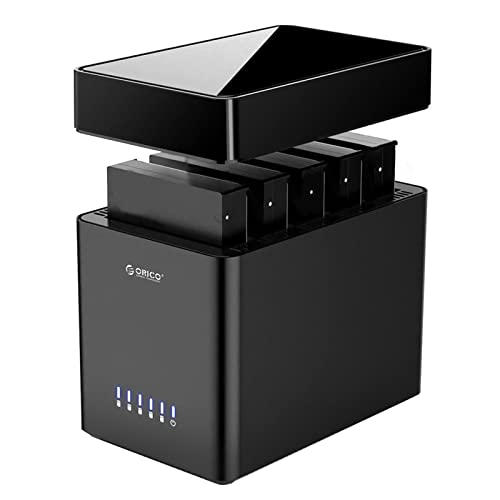
- Five SATA bays with up to 110TB capacity
- Tool-free magnetic cover
- Fan cooling and multiple protections
Best For: Large SATA archives and video backups
Best Dual-Bay USB-C Cloner

- Dual-bay SATA access over USB-C
- Offline cloning without a computer
- Supports 2.5-inch and 3.5-inch drives
Best For: Editors transferring or duplicating bare SATA drives
Best Four-Bay 10Gbps Enclosure

- Four SATA bays for large project libraries
- USB-C 3.2 speeds up to 10Gbps
- Built-in fans and optional 4K HDMI
Best For: Editors managing several drives and high-volume media files
Best Value Dual-Bay Dock

- Dual-bay SATA HDD and SSD support
- Offline cloning up to 60Mbps
- Plug-and-play USB 3.0 operation
Best For: Editors seeking a simple, affordable two-drive dock
Best Multi-Drive Enclosure

- Four bays for 2.5-inch and 3.5-inch SATA drives
- Tool-free installation with hot swapping
- USB-A/C 3.0 connectivity up to 5Gbps
Best For: Editors managing several removable SATA drives
Best for Cloning and Connectivity

- Offline cloning without a computer
- Two-bay SATA HDD/SSD support
- Three USB 3.0 hub ports
Best For: Editors needing backups, cloning, and extra USB-A connectivity
Best UASP Dual-Bay Dock

- Dual-bay access for simultaneous drive work
- Offline cloning with one-button operation
- USB-C, UASP, and up to 5Gbps transfers
Best For: Editors migrating or backing up two SATA drives
Best All-in-One Cloning Dock – ICY BOX M.2 NVMe & SATA Dock
For shoppers comparing hard drive docking stations for video editing, the ICY BOX combines M.2 NVMe, M.2 SATA, and 2.5/3.5-inch SATA drive support in one compact, tool-free unit. Its USB 3.2 Gen 2 connection supports transfers up to 10 Gbps, while the open-frame design helps dissipate heat during demanding file transfers.
Best For: Editors who need one dock for mixed drive formats, fast media transfers, and offline cloning.
Pros:
- Supports M.2 NVMe, M.2 SATA, and 2.5/3.5-inch SATA HDDs and SSDs.
- USB 3.2 Gen 2 provides up to 10 Gbps transfer speeds.
- One-touch offline cloning works without a computer.
- Tool-free bays and included USB-C/USB-A cable support easy setup.
Cons:
- Offline cloning requires the target drive to be larger than the source.
- Drive capacity and real-world speed depend on the installed media.
This is a versatile choice for video workflows that involve swapping between NVMe scratch drives and SATA archive disks. The combination of broad compatibility, cloning, and active airflow makes it especially useful for a small editing desk or backup station.
Best High-Capacity RAID Enclosure – ORICO 5-Bay RAID Storage Station
The ORICO 5-bay enclosure is built for editors who need a large desktop storage pool rather than a quick single-drive reader. It accepts 2.5- and 3.5-inch SATA drives, supports up to 110TB based on five 22TB drives, and offers hardware RAID modes for speed, redundancy, or independent disk operation.
Best For: Video editors managing large media libraries, backups, and multi-drive workstation storage.
Pros:
- Five bays support 2.5- and 3.5-inch SATA HDDs and SSDs.
- Hardware RAID supports RAID 0, 1, 3, 5, 10, JBOD, Clone, and Clear modes.
- Built-in 150W power supply supports multiple high-consumption drives.
- Aluminum housing, an 80mm fan, and vented airflow support extended operation.
Cons:
- USB 3.0 is rated up to 230MB/s, below the 10 Gbps interface of newer docks.
- Drives are not included, so reaching the stated capacity requires five compatible disks.
For a dedicated editing workstation, this enclosure provides the capacity and RAID flexibility needed for project storage and backups. Its USB 3.0 connection is practical for bulk access, though editors prioritizing the newest interface speeds may prefer a USB-C 10 Gbps model.
Best Lay-Flat Hybrid Dock – SABRENT NVMe & SATA USB-C Dock
The SABRENT lay-flat dock is a flexible option among hard drive docking stations for video editing, supporting M.2 PCIe NVMe drives alongside 2.5- and 3.5-inch SATA storage. Its USB 3.2 Gen 2 interface reaches up to 10 Gbps, and both USB-C and USB-A cables are included for connecting to newer or older computers.
Best For: Editors who frequently swap NVMe and SATA drives and want a compact, tool-free desktop dock.
Pros:
- Reads M.2 2242, 2260, and 2280 NVMe drives plus 2.5/3.5-inch SATA drives.
- USB 3.2 Gen 2 supports up to 10 Gbps transfers.
- Offline cloning uses a direction switch, clone button, and progress LEDs.
- Includes USB-C-to-USB-C and USB-A-to-USB-C cables plus a 12V adapter.
Cons:
- Real-world speeds depend on the installed drive; mechanical HDDs remain limited by their own performance.
- The target drive must be equal to or larger than the source for cloning.
Its hinged lid and lay-flat format make drive changes convenient during active projects. With broad format support and two connection cable options, it is a strong fit for editors moving footage between portable NVMe media and larger SATA disks.
Best Budget 5-Bay Storage Dock – ORICO 5-Bay USB 3.0 Enclosure
For editors who need substantial SATA storage at a straightforward price, this ORICO 5-bay enclosure holds five 2.5- or 3.5-inch drives and supports up to 110TB with compatible disks. Its USB 3.0 interface provides up to 5 Gbps, while the tool-free magnetic cover makes drive installation quick.
Best For: Video editors building a large SATA-based archive for footage, photos, and backups.
Pros:
- Five bays support 2.5- and 3.5-inch SATA HDDs and SSDs.
- Supports up to 110TB total capacity, with up to 22TB per drive.
- Tool-free magnetic cover enables quick drive installation.
- 60mm fan, honeycomb vents, and multiple protection features support long-term use.
Cons:
- USB 3.0 tops out at 5 Gbps, slower than USB 3.2 Gen 2 docks.
- The supplied notes state that Linux systems can read only one drive at a time in multi-drive enclosures.
- Plastic construction is less substantial than an aluminum enclosure.
This model makes sense when capacity and multiple SATA bays matter more than cutting-edge interface speed. It can serve as a practical footage archive or backup enclosure, especially for Windows and Mac users working with several large drives.
Best Dual-Bay USB-C Cloner – Sabrent EC-CH2B
For video editors who need a straightforward way to access or duplicate SATA drives, the SABRENT EC-CH2B is a practical pick among hard drive docking stations for video editing. Its two bays let you read and write two drives at once over USB-C, while the offline cloner can copy one SATA drive to another without a computer.
Best For: Editors managing two bare 2.5-inch or 3.5-inch SATA HDDs or SSDs who also want offline drive cloning.
Pros:
- Reads and writes two SATA drives simultaneously when connected to a computer.
- Offline 1-to-1 cloning requires no computer and reaches up to 60MBps.
- Tool-free, hot-swappable bays support both 2.5-inch and 3.5-inch SATA drives.
- USB 3.0 transfer rates up to 5Gbps and plug-and-play Windows and Mac operation.
Cons:
- Supports SATA drives only; it does not support IDE/PATA, M.2, or NVMe drives.
- The included cable is USB-C on the dock end, so a USB-C computer port or separate cable may be needed.
- Cloning requires the target drive to be the same size as or larger than the source.
The EC-CH2B is a focused dual-drive dock rather than a general-purpose storage hub. It makes the most sense for video workflows built around bare SATA drives, especially when quick drive transfers and offline backups are priorities.
Best Four-Bay 10Gbps Enclosure – WAVLINK RapidFire H4
The WAVLINK RapidFire H4 is built for large video libraries and multi-drive editing setups. With four SATA bays, USB-C 3.2 connectivity up to 10Gbps, active cooling, and optional 4K HDMI output, it offers more capacity and workspace connectivity than a basic dual-bay dock.
Best For: Video editors who need a four-drive SATA enclosure for high-volume storage, transfers, and a connected display setup.
Pros:
- Four bays support 3.5-inch and 2.5-inch SATA HDDs and SSDs, with capacity up to four 32TB drives.
- USB 3.2 Type-C supports transfer rates up to 10Gbps.
- Temperature-controlled fans activate at 48°C to help cool drives during intensive work.
- Includes HDMI output up to 4K at 60Hz when the host USB-C port supports video output.
Cons:
- 2.5-inch drives require separate 2.5-to-3.5-inch mounting brackets, which are not included.
- HDMI video requires a compatible host USB-C port and a USB-C-to-C connection.
- Its four-bay aluminum enclosure is larger and heavier than a simple two-drive dock.
For editors working with multiple project drives, the RapidFire H4 provides useful capacity and cooling in one enclosure. Its display feature is a bonus, but buyers should verify host video support and account for the mounting-bracket requirement for 2.5-inch drives.
Best Value Dual-Bay Dock – Sabrent EC-HD2B
The SABRENT EC-HD2B is a simple dual-bay option for editors who need convenient access to bare SATA drives without installing them in an enclosure. It supports standard 2.5-inch and 3.5-inch SATA HDDs and SSDs, with USB 3.0 transfers up to 5Gbps and offline cloning up to 60Mbps.
Best For: Budget-conscious video editors who need a basic two-drive reader and occasional offline duplicator.
Pros:
- Accepts standard 2.5-inch and 3.5-inch SATA hard drives and SSDs.
- Supports two-drive access and offline cloning without requiring a computer.
- Plug-and-play operation requires no drivers.
- Supports drives up to 10TB and USB 3.0 transfer rates up to 5Gbps.
Cons:
- Uses USB 3.0 rather than the faster USB-C 3.2 connection found on newer docks.
- Supports SATA drives only, not other storage formats.
- Offline cloning runs at up to 60Mbps, so large drive copies may take time.
The EC-HD2B keeps the feature set focused and useful: connect two SATA drives, move files, or clone a drive offline. It is a sensible fit for straightforward editing-storage tasks when advanced connectivity and four-drive capacity are unnecessary.
Best Multi-Drive Enclosure – CENMATE 4-Bay SATA Enclosure
For editors who need several project drives connected at once, the CENMATE is a practical option among hard drive docking stations for video editing. Its four bays accept 2.5-inch or 3.5-inch SATA HDDs and SSDs, while USB 3.0 provides up to 5Gbps connectivity over USB-A or USB-C.
Best For: Video editors managing multiple removable SATA drives and expanding desktop storage.
Pros:
- Four bays support 2.5-inch and 3.5-inch SATA HDDs or SSDs.
- Tool-free installation and hot swapping simplify drive changes.
- USB-A/C 3.0 connectivity and support for Windows, Mac, and Linux.
- Supports up to 20TB per drive, according to the supplied specifications.
Cons:
- Uses USB 3.0 with a stated maximum transfer rate of 5Gbps rather than a faster interface.
- The supplied details do not mention offline cloning.
- Hot swapping should be used with appropriate drive and operating-system safeguards.
The four-bay layout makes this enclosure well suited to editors who regularly rotate or organize several SATA volumes. It is a storage-access solution rather than a dedicated cloning dock, so choose it when bay count and flexible drive access matter most.
Best for Cloning and Connectivity – MAIWO Dual-Bay HDD Cloner
The MAIWO combines a dual-bay drive dock with offline cloning and three USB 3.0 hub ports. For video editors comparing hard drive docking stations for video editing, it offers a convenient way to access 2.5-inch or 3.5-inch SATA drives, copy a source disk without a computer, and connect compatible USB accessories.
Best For: Editors who need occasional drive duplication, backup, and extra USB-A ports.
Pros:
- Supports 2.5-inch and 3.5-inch SATA HDDs and SSDs in two bays.
- Offline cloning works without connecting to a computer.
- USB 3.0 offers up to 5Gbps bandwidth and includes three Type-A hub ports.
- Independent 12V/3A power supply supports the dock’s operation.
Cons:
- The supplied details specify USB 3.0 rather than a higher-speed interface.
- Offline cloning is designed for drive duplication, not selective project-file copying.
- The enclosure is ABS plastic rather than aluminum.
This dock is a versatile choice for editors who want both drive access and a simple cloning workflow. Its dual-bay design is less suited to maintaining four active volumes, but the offline copier and integrated USB hub add useful flexibility for backup and workstation setups.
Best UASP Dual-Bay Dock – BENFEI USB-C HDD Dock
BENFEI’s dual-bay dock is designed for simultaneous access to two 2.5-inch or 3.5-inch drives. It is a strong contender among hard drive docking stations for video editing when quick drive-to-drive management matters, with USB-C connectivity, UASP support, and a one-button offline clone function.
Best For: Editors migrating, backing up, or comparing two SATA HDDs or SSDs at a time.
Pros:
- Two bays allow simultaneous reading, writing, and transfers between drives.
- Offline cloning works without a PC when the target drive is equal to or larger than the source.
- USB 3.1 Gen 1 and UASP support provide transfer speeds up to 5Gbps.
- Dedicated 12V/2.5A power and an 18-month warranty support dependable use.
Cons:
- It has two bays, so it offers less drive capacity at once than a four-bay enclosure.
- The target drive must be equal to or larger than the source for cloning.
- The supplied instructions advise switching off power before connecting or disconnecting drives.
BENFEI is a focused choice for two-drive workflows such as project migration and backup. UASP and USB-C add useful modern connectivity, while the cloning button simplifies duplication, although users needing several active drives may prefer a larger enclosure.
How We Picked the Best Hard Drive Docking Stations for Video Editing
We focused on the features that matter most in real editing workflows: drive compatibility, connection speed, bay count, sustained storage access, cloning support, cooling, and ease of use. The selection includes docks for bare 2.5-inch and 3.5-inch SATA drives, M.2 NVMe SSDs, and multi-drive enclosures for larger libraries.
Because video work often involves moving large files, we also considered USB-C and USB 3.x performance, UASP support where specified, tool-free installation, hot-swapping, and practical capacity limits. A fast interface cannot make a slow hard disk perform like an SSD, but it can reduce connection bottlenecks and make drive management more convenient.
Quick Comparison
- Best for M.2 flexibility: ICY BOX and SABRENT Lay Flat docks support combinations of NVMe and SATA media.
- Best for large libraries: ORICO five-bay and WAVLINK four-bay enclosures provide room for multiple 3.5-inch drives.
- Best for simple cloning: SABRENT, MAIWO, and BENFEI dual-bay models offer standalone or computer-assisted copying features.
- Best for budget SATA access: USB 3.0 dual-bay docks are practical for occasional drive transfers and backups.
Key Buying Factors for Hard Drive Docking Stations for Video Editing
Interface and Real-World Speed
Look for USB-C 10Gbps when transferring large footage libraries or working from an external SSD. USB 5Gbps and USB 3.0 models remain suitable for backups and hard disks, whose mechanical limits may be below the interface rating. Check your computer’s ports and cables before assuming you will receive the advertised speed.
Drive Compatibility and Capacity
Confirm whether the dock accepts 2.5-inch SATA, 3.5-inch SATA, M.2 NVMe, or multiple formats. Multi-bay units are better for expanding media storage, while dual-bay docks are easier to move between workstations. Stated maximum capacities may depend on drive size, firmware, and the host operating system.
Cooling, Noise, and Power
Several drives operating together generate heat, especially during long renders or transfers. A ventilated enclosure or temperature-controlled fan is preferable for sustained use. Multi-bay models also need a reliable external power supply; they are less portable than bus-powered single-drive docks.
Cloning and Workflow Features
Offline cloning can copy one SATA drive to another without a computer, but the destination normally needs to be equal to or larger than the source. For editing, cloning is useful for migrations and backups, while a true backup strategy should also include separate storage and versioned copies.
Who Should Buy Which Hard Drive Docking Stations for Video Editing?
Choose a compact NVMe/SATA dock if you edit from removable SSDs, test bare drives, or need a portable ingest station. Choose a dual-bay cloner for straightforward drive duplication, recovery tasks, and occasional transfers. Choose a four- or five-bay enclosure if your workflow depends on a large collection of 3.5-inch media drives and you want fewer cables on the desk.
For the best overall match, prioritize the drives you already own, then select the fastest compatible interface your computer supports. Editors working with active 4K or 8K projects should favor SSD-based storage and 10Gbps connectivity, while slower USB models can remain useful for archival hard disks and routine backups.