The best physics experiment sets turn abstract lessons into hands-on discoveries. This roundup compares 10 options covering circuits, magnetism, mechanics, optics, motion, and engineering for different ages and learning goals.
Whether you are shopping for a classroom, homeschool workspace, or curious student, use the guide below to match the kit’s experiments, included components, and difficulty level to the learner.
Best 10 Physics Experiment Sets Picks for 2026
Best All-in-One Kit
EUDAX Electricity & Magnetism Lab
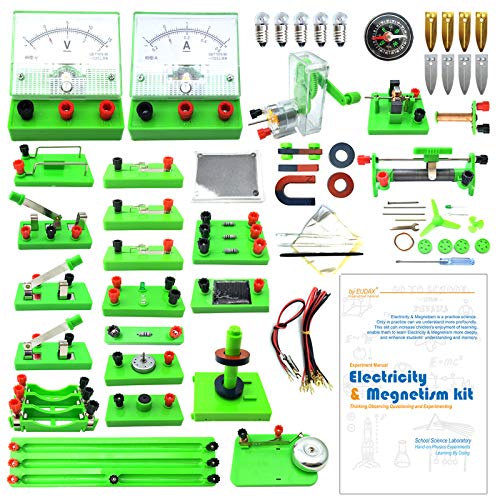
- 79-piece set covers electricity and magnetism
- Includes color manual, tools, and storage bag
- Supports circuits, electromagnets, and generators
Best For: Broad introductory electromagnetism projects
Best for Simple Machines

- Offers 26 model-building exercises
- Covers all six classic simple machines
- Includes a force-measuring spring scale
Best For: Hands-on lessons about force and mechanical advantage
Best Magnetism Starter

- Includes 14 magnets and experiment accessories
- Features a compass, magnetic cars, and iron filings box
- Uses common household items for extra activities
Best For: Beginner magnetism exploration at home or school
Best for Motion Laws

- Builds six working motion-related models
- Covers inertia, friction, and circular motion
- Includes theory, experiments, quizzes, and a 3D app
Best For: Young builders studying motion through projects
Optics Explorer

- Includes lenses, mirrors, prism, and acrylic tile
- Demonstrates refraction and multiple types of reflection
- Battery-powered light source and English manual
Best For: Introductory physical optics demonstrations
Motion Lab

- Two carts for hands-on motion experiments
- Explores velocity, acceleration, friction, and momentum
- Includes steel and rubber bumpers
Best For: Newton's laws and collision lessons
Circuit Builder
Basic Electricity Learning Kit

- Builds introductory series and parallel circuits
- Includes English assembly instructions
- Stores accessories in a plastic box
Best For: Beginning electricity and STEM projects
Top Mechanics Pick

- Covers 26 hands-on mechanics experiments
- Includes pulleys, balance, force gauge, trolley, and ramp
- Manual and storage box support organized learning
Best For: Middle and high school mechanics study
Best Electricity Starter
Electricity and Magnetism STEM Kit

- Includes more than 50 DIY experiments
- Covers circuits, electromagnets, switches, and LEDs
- 55 items come in an organized storage case
Best For: Teen students learning electricity and magnetism
Best Expanded Mechanics Set

- Supports more than 30 mechanics experiments
- Covers friction, pressure, buoyancy, pulleys, and energy
- Includes a detailed manual and organized storage
Best For: Junior school labs and teacher demonstrations
Best All-in-One Kit – EUDAX Electricity & Magnetism Lab
If you want physics experiment sets that cover both electricity and magnetism, the EUDAX kit offers a broad starting point for students in grades 9–11. Its 79 pieces, color manual, and storage bag support projects ranging from series and parallel circuits to electromagnets and a hand-crank generator.
Best For: Students ages 8–18 exploring electricity, magnetism, and introductory electronics through guided hands-on projects.
Pros:
- Covers both electricity and magnetism in one set.
- Includes 79 items, repair tools, a color manual, and storage bag.
- Supports projects such as fruit batteries, Ohm’s law, electric bells, and electromagnets.
Cons:
- Requires three AA batteries, which are not included.
- The wide range of components may require adult or instructor guidance for younger users.
Choose this set when variety matters most and you want one kit for several introductory electromagnetism lessons. It is especially useful for structured classroom or home STEM exploration.
Best for Simple Machines – T&K Physics & Engineering Set
For physics experiment sets focused on mechanical advantage, the T&K Simple Machines set combines model building with force measurement. Students can complete 26 exercises involving all six classic simple machines while using the included spring scale to explore force direction and magnitude.
Best For: Children ages 8 and up learning how levers, pulleys, gears, wheels, inclined planes, screws, and wedges work.
Pros:
- Includes 26 model-building exercises.
- Covers all six classic simple machines.
- Spring scale adds hands-on force measurement.
- Full-color, 32-page manual provides step-by-step guidance and science explanations.
Cons:
- Focuses primarily on simple machines rather than electricity or magnetism.
- Plastic construction may be less suitable for rough handling.
This is a focused choice for introducing force and mechanical advantage through familiar examples such as seesaws, wheelbarrows, and flagpoles. It requires no batteries and can also complement compatible Thames & Kosmos building pieces.
Best Magnetism Starter – Sntieecr Junior Magnetism Set
If you need compact physics experiment sets for an introduction to magnetism, this Sntieecr kit provides a straightforward collection of magnets and accessories. It includes 14 pieces, experiment ideas, and components such as a compass, magnetic cars, and an iron filings box for observing magnetic effects.
Best For: Learners ages 8 and up conducting beginner magnetism activities at home or in the classroom.
Pros:
- Includes bar, U-shaped, and ring ceramic magnets.
- Iron filings box and compass support visible magnetic-field and direction activities.
- Magnetic cars provide an engaging way to explore magnetic forces.
- Additional experiments can use common items such as paper, rulers, and pens.
Cons:
- Primarily covers magnetism rather than a broad range of physics topics.
- Some activities require household tools or materials not included.
This small set is a practical pick when storage space and simplicity matter. It works well for observation-based activities and open-ended questions about magnets, forces, and the Earth.
Best for Motion Laws – Engino Physics Laws STEM Kit
Among physics experiment sets centered on motion, the Engino Physics Laws kit combines construction projects with explanations of inertia, friction, and circular motion. Children ages 9 and up can build six working models, follow theory and experiment instructions, and review their learning with a quiz section.
Best For: Young builders who learn best by constructing working models and testing motion-related concepts.
Pros:
- Builds six working models, including a rocket launcher, crash test rig, and sharpening wheel.
- Includes theory, experiments, amazing facts, and a four-page quiz section.
- Interactive 3D app supports virtual building alongside the physical kit.
- Develops construction, creative, critical-thinking, and logical-thinking skills.
Cons:
- Focuses on inertia, friction, and circular motion rather than broad physics coverage.
- Plastic components and app-based features may not suit children seeking purely traditional experiments.
This kit is a strong fit for learners who enjoy building and testing rather than only reading instructions. Its models, theory material, and quiz create a more structured path from construction to understanding motion laws.
Optics Explorer – Hands-On Light and Lens Kit
For shoppers comparing physics experiment sets focused on optics, this kit combines lenses, mirrors, a prism, and an adjustable three-way light source. It supports demonstrations of refraction, reflection, and related light behavior in a compact, manual-operated package.
Best For: Students and teachers exploring introductory physical optics through hands-on demonstrations.
Pros:
- Includes multiple convex and concave lenses, a triangular prism, acrylic tile, and multifunction reflector.
- Supports experiments involving refraction, plane and diffuse reflection, and curved-mirror reflection.
- Includes an English color-page manual and a storage color box.
- The light source direction can be adjusted with a screwdriver.
Cons:
- Requires two AAA batteries, which are not included.
- Recommended for ages 14 and up, so it may not suit younger children.
- The components are relatively small, with the set measuring 9.45 by 5.51 by 0.98 inches.
This is a focused choice for optics lessons rather than a broad physics laboratory. Its variety of acrylic optical components makes it useful for structured classroom demonstrations or guided student work.
Motion Lab – Newton's Law Dynamics Carts
Among physics experiment sets for motion studies, this two-cart kit provides a straightforward way to investigate velocity, acceleration, friction, collisions, and conservation of momentum. Its interchangeable bumpers allow students to compare different collision setups.
Best For: Classroom or home-lab lessons on Newton’s laws and one-dimensional motion.
Pros:
- Teaches several core dynamics concepts, including acceleration, friction, and momentum.
- Includes two 6-inch carts with low-friction snap-in wheels and deep weight wells.
- Spring steel and rubber bumpers support varied collision experiments.
- Experiment suggestions are included for classroom or independent study.
Cons:
- The set is centered on motion dynamics and does not include equipment for other physics topics.
- Additional lesson materials or measuring tools may be needed for more advanced investigations.
This is a practical, focused kit for demonstrating motion rather than a full multi-topic science set. The two-cart format and bumper options make it especially convenient for repeatable collision activities.
Circuit Builder – Basic Electricity Learning Kit
This electricity-focused option among physics experiment sets helps students build basic series and parallel circuits while reinforcing current and introductory electrical rules. The included English instructions and storage box make it suitable for organized school, homeschool, or club activities.
Best For: Junior and senior high school introductory electricity projects, science fairs, and STEM activities.
Pros:
- Supports construction of basic series and parallel circuits.
- Includes English instructions to guide assembly and experimentation.
- Designed to build hands-on, thinking, and creativity skills through simple circuit projects.
- Accessories are packed in a plastic storage box for convenient organization.
Cons:
- Two AA batteries are not included.
- The basic kit is aimed at introductory circuits rather than advanced electrical experiments.
- Students may need supervision and additional project planning for science-fair activities.
Choose this kit when the learning goal is foundational electricity rather than mechanics or optics. Its circuit-building emphasis and compact storage make it a useful starting point for guided STEM instruction.
Top Mechanics Pick – 26-Experiment Physics Kit
This comprehensive physics experiment set is designed for students aged 14 and up who are studying classical mechanics. With 26 experiments and tools for investigating force, motion, pressure, buoyancy, pulleys, and levers, it offers a practical way to connect physics lessons with hands-on results.
Best For: Middle and high school students, classroom instruction, independent study, and family STEM exploration.
Pros:
- Includes a broad selection of mechanics equipment, including pulleys, a balance, force gauge, trolley, and ramp.
- Supports experiments involving Newton’s laws, kinematics, gravity, friction, pressure, and buoyancy.
- Comes with a professional manual covering operating steps and physics principles.
- Portable storage box helps organize the metal and plastic components.
Cons:
- Its focus is classical mechanics rather than electricity, magnetism, or other physics topics.
- The recommended age of 14 and up may make it less suitable for younger children.
Choose this set if you want a structured mechanics-focused kit with enough equipment for demonstrations and repeated student practice. Its combination of experiment coverage, manual guidance, and organized storage makes it a strong option for foundational physics work.
Best Electricity Starter – Electricity and Magnetism STEM Kit
This physics experiment set focuses on electricity and magnetism, making it a useful starter for students who want to explore circuits, electromagnets, switches, and related STEM concepts. It includes more than 50 guided projects, 55 items, and an illustrated manual for learning by doing.
Best For: Students ages 13–18 who are beginning electricity and magnetism studies or reinforcing classroom lessons.
Pros:
- Offers more than 50 DIY experiments covering circuits, electromagnets, magnetic switches, and light-control LEDs.
- Includes 55 items and a clearly illustrated manual explaining both procedures and underlying ideas.
- Encourages students to design additional experiments beyond the projects in the manual.
- Solid storage case keeps components organized and supports portable use.
Cons:
- Its subject coverage centers on electricity and magnetism rather than broad mechanics.
- The many small components may require careful sorting and supervision during use.
This is a practical choice for learners who are most interested in basic circuits and electromagnetism. The high project count and explanatory manual provide room to progress from following instructions to creating original experiments.
Best Expanded Mechanics Set – 30+ Experiment Lab Kit
This physics experiment set is built for systematic mechanics instruction, with equipment for more than 30 classic experiments. It covers measurement, density, friction, pressure, buoyancy, levers, pulleys, mechanical efficiency, energy conversion, and gravity-car activities, making it suitable for school labs and demonstrations.
Best For: Junior school physics classes, laboratory practice, teacher demonstrations, and structured after-school STEM learning.
Pros:
- Includes a wide range of tools such as a tray balance, weights, pulleys, lever ruler, pressure gauge, spring scale, cylinder, trolley, and ramp.
- Supports more than 30 experiments across measurement, motion, pressure, buoyancy, simple machines, and energy.
- Detailed manual explains experiment steps and the related physics principles.
- Durable metal and plastic construction, with compact storage for repeated classroom use.
Cons:
- The extensive component list may take time to inventory and organize.
- It is primarily a mechanics kit, so it does not provide the electricity and magnetism focus of a circuit-based set.
Consider this kit when experiment breadth is a priority. Its larger mechanics scope and classroom-oriented design can support a complete unit of practical physics, from basic measurement through simple machines and buoyancy.
How We Picked These Physics Experiment Sets
We selected kits that support practical learning rather than relying on demonstration alone. The lineup includes focused sets for electricity, magnetism, optics, Newtonian mechanics, simple machines, and motion, along with broader STEM kits that combine several concepts.
We also considered age suitability, the variety of experiments, the usefulness of included hardware, and how easily each set can fit into a classroom, homeschool, or independent study routine. Product descriptions and component lists should still be checked before purchase, since contents and instructions can vary by version.
Quick Comparison
| Best For | Look For | Featured Kit Types |
|---|---|---|
| Electricity and circuits | Wires, holders, switches, bulbs, motors, and circuit diagrams | Basic circuit and electricity kits |
| Magnetism | Magnets, compasses, magnetic materials, and guided activities | Junior magnetism and electromagnetism sets |
| Mechanics | Pulleys, balances, force gauges, carts, and weights | Mechanics and dynamics kits |
| Optics | Prisms, lenses, mirrors, light sources, and measuring tools | Refraction and reflection experiment sets |
| Engineering and motion | Buildable parts and activities involving friction, inertia, or circular motion | Simple-machine and STEM construction kits |
Key Buying Factors for Physics Experiment Sets
Choose the Right Physics Topics
Start with the concepts the learner needs to practice. A circuit kit is a better choice for current, voltage, and series-or-parallel lessons, while a mechanics set is more useful for force, work, pulleys, balance, and Newton’s laws. Optics kits are specialized and usually include lenses, mirrors, prisms, or a controlled light source.
Check Age, Supervision, and Difficulty
Beginner kits should have clear instructions, larger components, and straightforward activities. More advanced students may benefit from measurement-focused experiments and equipment such as force gauges, dynamics carts, or adjustable light sources. Young learners should use small parts and electrical components with adult supervision.
Review What Is Actually Included
Compare the parts list, not just the product title. Check whether batteries, power supplies, measuring tools, replacement parts, storage, and printed or digital instructions are included. A low-cost kit may require additional supplies before the first experiment.
Prioritize Repeatable Learning
The strongest Physics Experiment Sets support multiple trials and encourage students to record observations, change one variable, and explain the result. Durable components and organized storage also matter when a kit will be used repeatedly in a classroom or shared by siblings.
Who Should Buy Which Physics Experiment Sets?
Choose an electricity or electromagnetism kit for students learning basic circuits, switches, conductivity, and magnetic effects of current. Pick a junior magnetism set for younger learners who need a simpler introduction to attraction, repulsion, and magnetic fields.
Mechanics kits with pulleys, balances, force gauges, or carts suit students studying force, motion, energy, and Newton’s laws. Simple-machine and engineering sets are a good fit for hands-on builders who learn best by assembling and testing mechanisms.
For lessons about reflection, refraction, and light paths, select the dedicated optics set with lenses, mirrors, prisms, and a light source. If you want broader STEM coverage, choose a multi-topic construction kit—but verify that its activities match the physics concepts you intend to teach.