Choosing the right hot air rework station can make SMD repair, desoldering, and component replacement faster and more controlled. The best models combine stable temperature regulation, adjustable airflow, practical nozzles, and an iron or power-supply function when needed.
This roundup compares 10 hot air rework stations for circuit boards across different budgets and workloads, so you can match the station’s capabilities to your projects instead of paying for features you may not use.
Best 10 Hot Air Rework Stations for Circuit Boards Picks for 2026
Best All-in-One Pick

- Combines hot air and soldering functions
- PID control with dual displays
- Includes tips, nozzles, and repair tools
Best For: Versatile electronics repair and DIY work
Best Simple Hot Air Option

- 700W rapid-heating system
- Adjustable temperature and airflow
- Brushless fan for quieter operation
Best For: Dedicated PCB and SMD hot air repair
Best Value 2-in-1 Kit
- Combines soldering and hot air tools
- PID stabilization with independent displays
- Includes tips, nozzles, tweezers, and pump
Best For: Ready-to-use DIY electronics repair
Best for Preset Workflows

- Stores three temperature presets
- Reaches 932°F with 120L airflow
- Includes ESD tweezers and heat-resistant mat
Best For: Repeated repairs with changing settings
Compact Dual-Tool Pick
WEP 882D 2-in-1 Rework Station

- Combines soldering and hot air tools
- Adjustable temperatures and airflow
- Includes tips, nozzles, solder, and tools
Best For: Compact electronics repair setups
All-in-One Bench Station
YIHUA 853D 3-in-1 Rework Station

- Combines hot air, soldering, and power supply
- Supports simultaneous station operation
- Includes 10 tips and four nozzles
Best For: Full electronics repair benches
Portable Hot-Air Specialist
LRT 8858 Digital Rework Station

- Temperature range reaches 932°F
- F1–F10 adjustable airflow
- Compact 0.7 kg design with six nozzles
Best For: Mobile SMD hot air rework
Best All-in-One Value
YIHUA 862BD+ 2-in-1 Rework Station
- 2-in-1 hot-air and soldering station
- PID control with three digital displays
- Includes nozzles, tips, and repair tools
Best For: Complete electronics workstations and hobby repairs
Best Heavy-Duty Pick
WEP 2009D-II Hot Air Rework Station

- Four programmable preset channels
- 212–896°F temperature range
- Auto-standby and cool-air functions
Best For: Repeatable PCB repair workflows
Best Temperature Range
8586D 2-in-1 Soldering Station

- Hot-air and soldering controls work independently
- Temperatures reach up to 932°F
- Automatic sleep with included tips and nozzles
Best For: Wide-range electronics repair and rework
Best All-in-One Pick – YIHUA 8786D I 2-in-1 Station
For shoppers comparing hot air rework stations for circuit boards, the YIHUA 8786D I combines hot air work and conventional soldering in one compact unit. Its PID temperature control, dual displays, ESD-safe design, and included accessories make it a practical choice for varied electronics repairs.
Best For: Electronics users who want a versatile 2-in-1 station with a broad accessory bundle.
Pros:
- Combines a soldering station and hot air rework station.
- PID control provides fast temperature monitoring and compensation.
- Includes 10 soldering tips, four hot air nozzles, an extractor, pump, and lead-free solder.
- Fail-safe protection can cut heater power if airflow stops unusually.
Cons:
- Designed for 110–127V operation with a U.S.-standard plug.
- Its combined design may be more equipment than users who only need hot air.
The 740W YIHUA 8786D I is a well-rounded starter and repair station, especially when you need both soldering and hot air capabilities without purchasing separate tools.
Best Simple Hot Air Option – LRT 858D 700W Rework Station
The LRT 858D is a focused option among hot air rework stations for circuit boards, offering 700W heating power with adjustable temperature and airflow. Its brushless fan and ergonomic handle support repeated PCB, SMD, and component-repair tasks.
Best For: Users who need a dedicated hot air station for PCB, SMD, phone, laptop, or USB-C repairs.
Pros:
- 700W heating system supports rapid heat-up and temperature recovery.
- Digital LED display shows temperature settings clearly.
- Brushless fan is designed for stable, quieter, longer-lasting operation.
- Suitable for continuous lead-free operation and varied electronics repairs.
Cons:
- Does not include a separate soldering iron station.
- The supplied package is limited to the fan and handle.
- Temperature stability is not described with a conventional accuracy specification in the supplied details.
This LRT model keeps the setup straightforward: it is a dedicated 700W hot air tool for buyers who already have soldering equipment or want to focus on SMD and rework applications.
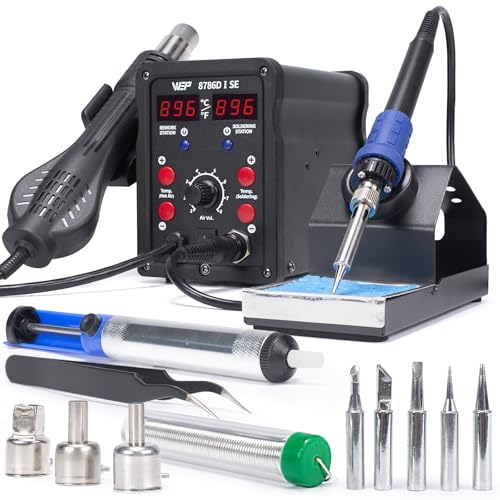
Best Value 2-in-1 Kit – WEP 8786D-I SE Station
The WEP 8786D-I SE gives shoppers considering hot air rework stations for circuit boards both a hot air tool and soldering iron in one station. Independent controls, PID stabilization, sleep mode, and hot air standby make it suited to hands-on repair work.
Best For: DIY repairers who want a ready-to-use 2-in-1 kit with useful accessories and power-saving features.
Pros:
- Provides separate soldering and hot air functions with individual digital readouts.
- Includes five soldering tips, three nozzles, tweezers, a desoldering pump, and solder wire.
- Both tools use adjustable temperature controls with PID stabilization.
- Sleep and hot air standby modes can reduce wear during idle periods.
Cons:
- Rated for 110–127V U.S. specifications and should not be connected to 220V.
- Includes fewer soldering tips than some competing bundled stations.
With its useful starter accessories and separate standby functions, the WEP 8786D-I SE is a practical middle-ground choice for users building a compact electronics repair bench.
Best for Preset Workflows – YIHUA 959D Hot Air Station
The YIHUA 959D stands out among hot air rework stations for circuit boards with three programmable memory channels and a maximum stabilized temperature of 932°F. Its 120L airflow output, standby cooling function, and included ESD-safe tweezers suit repeated component rework.
Best For: Repairers who regularly switch between different temperature and airflow settings.
Pros:
- Three preset channels provide quick access to commonly used settings.
- Reaches up to 932°F with up to 120L of hot air output.
- In-holder standby function helps cool the gun when it is not in use.
- Includes a heat-resistant mat, ESD-safe tweezers, and three nozzles.
Cons:
- It is a dedicated hot air station rather than a 2-in-1 soldering station.
- Designed for 110–127V operation with a U.S.-standard plug.
- Its larger listed dimensions may require more bench space.
The 959D is a strong fit for repetitive repair workflows where saved settings matter. Its high temperature range and preset channels make it easier to move between different board and component tasks.
Compact Dual-Tool Pick – WEP 882D 2-in-1 Rework Station
For shoppers comparing hot air rework stations for circuit boards, the WEP 882D is a practical space-saving option that combines a soldering station and hot air tool. Independent LED displays and controls provide separate temperature and airflow adjustments, while the included accessories help you begin electronics repair immediately.
Best For: Hobbyists and repair benches needing soldering and hot air functionality in one compact unit.
Pros:
- Combines a soldering station and hot air rework station in one body.
- Offers adjustable soldering temperatures from 392°F to 896°F and hot air temperatures from 212°F to 896°F.
- Includes two solder spools, five soldering tips, three hot air nozzles, tweezers, a brass wool cleaner, and a desoldering pump.
- Provides sleep, standby, automatic shutdown, calibration, and °C/°F conversion functions.
Cons:
- It is designed for 110–127V US power and should not be connected to a 220V outlet.
- The included soldering and hot air functions share a compact, single-channel-style unit rather than separate full-size stations.
The WEP 882D stands out when convenience and included accessories matter more than adding a separate power supply or maximizing bench space. Its broad temperature ranges and maintenance features make it a versatile entry point for circuit-board rework.
All-in-One Bench Station – YIHUA 853D 3-in-1 Rework Station
Among hot air rework stations for circuit boards, the YIHUA 853D is built for users who also need a bench power supply and testing capability. Its soldering station, hot air rework station, and 0–15V, 0–3A power supply can operate simultaneously, helping reduce tool swapping during repair work.
Best For: Electronics workbenches that need integrated soldering, hot air rework, and low-voltage power testing.
Pros:
- Integrates three functions: soldering, hot air rework, and a power supply/testing station.
- Supports simultaneous use of all three stations.
- Provides 0–15V and 0–3A power-supply output and testing modes.
- Includes 10 iron tips, four hot air nozzles, tweezers, an IC extractor, and a desoldering pump.
Cons:
- At 4.82 kg, it is substantially heavier than the compact single-purpose options here.
- It is designed for 110–127V US power and uses a US-standard plug.
- The supplied details do not specify a hot-air temperature range.
The 853D is the most feature-rich choice in this group for a dedicated electronics bench. Choose it if the integrated power supply and simultaneous operation justify its larger, heavier design; otherwise, a simpler station may be easier to place and use.
Portable Hot-Air Specialist – LRT 8858 Digital Rework Station
If you need hot air rework stations for circuit boards without a built-in soldering iron, the LRT 8858 focuses on digital heat-gun control and adjustable airflow. Its compact controller, automatic cooling behavior, and six included nozzles suit SMD repair, chip removal, heat-shrink work, and preheating.
Best For: Mobile technicians and small repair benches focused specifically on hot air SMD rework.
Pros:
- Offers microprocessor-controlled temperature adjustment from 212°F to 932°F.
- Provides F1–F10 airflow adjustment for different rework tasks.
- Automatically enters cooling mode when the handle is placed in its holder.
- Includes six nozzles, anti-static tweezers, an IC extractor, a stand, and a power cable.
Cons:
- It is a hot air-only station and does not include a soldering iron station or bench power supply.
- Its 100–500°C range may be more capability than needed for simple heat-shrink or occasional repairs.
The LRT 8858 is a focused choice for users who already own a soldering iron or want a dedicated hot air tool. Its airflow range and nozzle selection provide flexibility while the compact 0.7 kg design is convenient for crowded benches or mobile work.
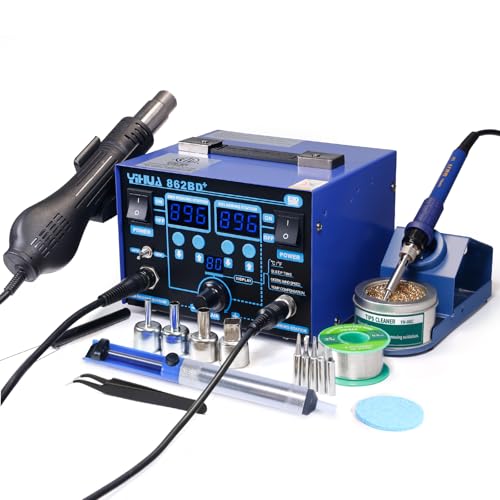
Best All-in-One Value – YIHUA 862BD+ 2-in-1 Rework Station
For shoppers comparing hot air rework stations for circuit boards, the YIHUA 862BD+ combines hot-air rework and soldering in one ESD-safe setup. Its PID temperature control, dual-core stabilization, three displays, and broad accessory kit make it a practical choice for general electronics work.
Best For: Hobbyists and repair users who want a complete 2-in-1 station with included tools and adjustable soldering sleep mode.
Pros:
- Combines a 75W soldering station with a hot-air rework station.
- Includes five soldering tips, four hot-air nozzles, tweezers, a desoldering pump, solder, and an IC extractor.
- PID temperature control and three digital displays provide monitoring of key settings.
- Detachable hot-air gun and soldering iron can be replaced separately.
Cons:
- Designed for 110–127V US-standard power only.
- The supplied station has a relatively broad footprint compared with compact single-function tools.
Choose this model when accessory value and an integrated soldering setup matter as much as hot-air capability. Its 12-month US manufacturer technical coverage and 24/7 assistance add useful support for new users.
Best Heavy-Duty Pick – WEP 2009D-II Hot Air Rework Station
The WEP 2009D-II is a focused option among hot air rework stations for circuit boards, with adjustable temperature and air volume plus four preset channels. Its detachable heat gun, cool-air mode, and automatic standby function support repeatable bench work.
Best For: Repair benches that frequently switch between stored temperature and airflow settings.
Pros:
- Offers a 212–896°F temperature range and air-volume adjustment from 1 to 10.
- Four preset channels reduce repeated manual adjustments.
- Automatically cools to 212°F when the hot-air gun is placed in its holder.
- Includes cool-air mode, digital calibration, three nozzles, tweezers, and an IC extractor.
Cons:
- Rated for 110–127V US power and should not be connected to a 220V outlet.
- Its included accessory set does not list soldering iron tips or solder.
This is a sensible pick when quick access to repeatable settings is more important than a larger accessory bundle. The one-year US technical support and 24-hour assistance are additional advantages for ongoing use.
Best Temperature Range – 8586D 2-in-1 Soldering Station
For buyers seeking hot air rework stations for circuit boards with a wide adjustment range, the 8586D pairs an independently controlled soldering iron and hot-air gun. Dual LED displays, automatic sleep, and included tips and nozzles make it a versatile kit for electronics work.
Best For: Users who want independent soldering and hot-air controls with temperatures reaching up to 932°F.
Pros:
- Supports soldering temperatures from 356–932°F and hot-air temperatures from 212–932°F.
- Independent displays, adjustment buttons, and switches allow separate or combined operation.
- Automatic hot-air sleep mode helps reduce high-heat exposure while the handle is idle.
- Includes five soldering tips, three air nozzles, solder, a desoldering pump, tweezers, and a sponge pad.
Cons:
- The supplied details do not specify a voltage range beyond the 120V rating.
- The kit’s model information is less specific than the named branded alternatives.
The 8586D stands out for its high maximum temperature and broad control range. It is worth considering when you need a flexible 2-in-1 station and appreciate automatic sleep functionality for the hot-air handle.
How We Picked the Best Hot Air Rework Stations for Circuit Boards
We focused on the features that matter during real PCB repair: temperature range and control, airflow adjustment, heating response, display readability, nozzle and tip selection, ESD-safety features, and overall versatility. We also considered whether a station includes a soldering iron, preset memories, a detachable gun, or an integrated bench power supply.
Because the 10 selected models target different users, the list includes both straightforward hot-air units and multifunction stations. A larger accessory bundle can be useful for beginners, while experienced technicians may value precise controls, repeatable settings, and easier maintenance more than the number of included tips.
Quick Comparison
- 2-in-1 stations: Combine hot air with a soldering iron for general electronics repair.
- Hot-air-only models: Suit users who already own an iron and primarily need SMD rework capability.
- Multifunction stations: Add features such as a DC power supply, useful for diagnostics and prototyping.
- Preset-capable models: Help repeat common temperature and airflow settings more consistently.
- Accessory-rich kits: Offer multiple nozzles, tips, solder, or brass wool for getting started quickly.
Key Buying Factors
Temperature Control and Airflow
Look for an adjustable temperature range broad enough for leaded and lead-free solder, along with fine control over airflow. Stable regulation is more important than a high maximum temperature alone. Excessive heat or airflow can displace small components, damage pads, or overheat nearby parts.
Nozzles, Tips, and Compatibility
Different nozzle sizes help concentrate heat on individual components or distribute it across larger packages. Check whether replacement nozzles and soldering tips are easy to find. A broad accessory set is convenient, but standard dimensions and readily available spares are more valuable over time.
Power, Ergonomics, and Safety
Higher wattage can improve recovery when working on boards with substantial thermal mass, but it does not automatically guarantee better results. Consider the handpiece weight, hose flexibility, stand quality, automatic cooling, ESD protection, and whether the unit returns to a safe standby temperature.
Controls and Repeatability
Digital displays, memory channels, and separate temperature and airflow controls make repeat work easier. For occasional repairs, simple analog controls may be sufficient; for production or frequent servicing, repeatable presets can save time.
Who Should Buy Which Hot Air Rework Stations for Circuit Boards?
Choose a 2-in-1 station if you want one compact setup for both hot-air rework and conventional soldering. These are the most practical all-purpose options for hobbyists, repair benches, and students.
Choose a hot-air-only station if SMD rework is your main task and you already have a dependable soldering iron. This can reduce clutter and keep the purchase focused.
Choose a multifunction model if you troubleshoot boards, prototype circuits, or need an adjustable DC output alongside rework tools. The added flexibility can justify the larger footprint.
Choose a higher-control digital model for frequent repairs or repeated jobs. Preset channels, accurate displays, and stable airflow are especially helpful when working with sensitive ICs and densely populated boards.