Whether you need to protect a freezer, monitor a greenhouse, check a server room, or document storage conditions, the right WiFi temperature data logger can provide useful readings without constant on-site checks.
We selected 10 options spanning simple app-connected sensors, multi-device systems, USB recorders, and cellular-enabled monitors, so you can match features, connectivity, and operating range to your needs.
Best 10 Wifi Temperature Data Loggers Picks for 2026
Best Overall

- No subscription with unlimited text alerts
- Stores data while offline and uploads after reconnecting
- One- to two-year battery life
Best For: Remote monitoring of homes, RVs, refrigerators, and freezers
Best App Value
Govee WiFi Thermometer Hygrometer

- Two-second refresh rate with app alerts
- Exports up to two years of historical data
- WiFi and Bluetooth connectivity
Best For: Indoor rooms needing affordable app-based monitoring
Best Offline Logger

- Stores 32,000 temperature readings
- Built-in USB creates PDF reports
- Measures from -22°F to 158°F
Best For: Storage and transport records without remote WiFi monitoring
Best Multi-Room System
GoveeLife 2.0 WiFi Sensor 3-Pack

- Three sensors plus a WiFi gateway included
- Gateway supports up to 10 sensors
- Two-year sensor battery life and data export
Best For: Multi-location monitoring in cellars, greenhouses, farms, and homes
Best Connected Cold-Chain Logger
Cellular + Wi-Fi Remote Monitor

- Global LTE 4G and Wi-Fi connectivity
- 100,000-point offline storage
- Two-year subscription included
Best For: Pharmacies, cold-chain operations, and shared remote monitoring
Best No-Subscription Pick
WiFi Temperature & Humidity Sensor

- No monthly fee or subscription
- Battery lasts up to four months per charge
- Exports CSV, Excel, and PDF reports
Best For: Homes, greenhouses, RVs, and remote storage areas
Best Dual-Probe Monitor
RCW-800W-TDE Temperature Logger
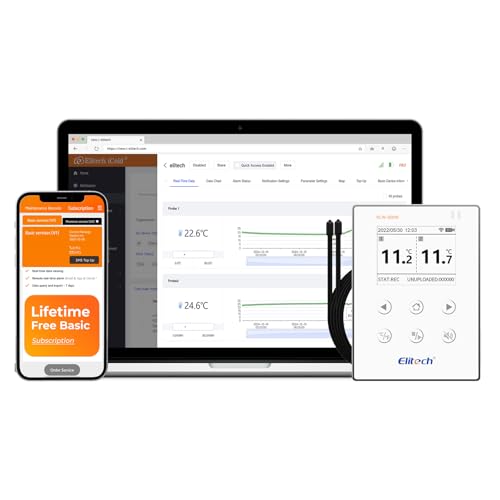
- -40°F to 176°F measurement range
- Dual external temperature probes included
- At least seven days of power-failure upload runtime
Best For: Refrigerators, cold storage, and temperature-critical monitoring
Best Connected Indoor-Outdoor Monitor
GS1-A Smart WiFi Thermometer Hygrometer

- Tracks temperature and humidity remotely
- IP65 enclosure for demanding environments
- Alerts, reports, exports, and device sharing
Best For: Continuous monitoring in storage, lab, server, greenhouse, and industrial settings
Best Cellular Backup Option
Elitech RCW-360Pro-WG-THE 4G/WiFi Logger

- Combines global LTE 4G with WiFi
- Includes 16.4-foot calibrated external probe
- Supports broad alarm and offline-storage features
Best For: Warehouses and pharmacies needing resilient remote monitoring
Best Dual-Band WiFi Logger

- Supports 2.4GHz and 5GHz WiFi
- Includes a 16.4-foot calibrated probe
- Provides dual-channel monitoring and cloud alerts
Best For: WiFi-equipped warehouses and pharmacies needing detailed records
Best Overall – Temp Stick Remote WiFi Sensor
For dependable wifi temperature data loggers with remote alerts, the Temp Stick combines temperature and humidity monitoring with app, email, and text notifications. It works on 2.4GHz WiFi, records data while temporarily offline, and can upload up to a month of stored readings after reconnecting.
Best For: Homes, RVs, refrigerators, freezers, and other locations needing long-term remote monitoring without a subscription.
Pros:
- No subscription for monitoring or alerts
- Unlimited text alerts and multiple alert thresholds
- One- to two-year battery life with two AA batteries
- Automated daily, weekly, and monthly email reports
Cons:
- Supports 2.4GHz WiFi only
- Designed for indoor and sheltered monitoring rather than general outdoor use
The Temp Stick is a strong all-around choice when remote notifications and low maintenance matter most. Its offline data retention and scheduled reports make it especially useful for unattended spaces.
Best App Value – Govee WiFi Thermometer Hygrometer
The Govee H5179 is a practical entry point for wifi temperature data loggers, pairing WiFi and Bluetooth connectivity with the Govee Home app. It refreshes readings every two seconds, supports app alerts, and provides historical charts with data export.
Best For: Indoor spaces such as basements, baby rooms, and bedrooms where app-based temperature and humidity alerts are useful.
Pros:
- Temperature accuracy of ±0.54°F/±0.3°C and humidity accuracy of ±3% RH
- Two-second refresh rate
- Stores 20 days of online history and allows export of up to two years of data
- Includes three AA batteries
Cons:
- Supports 2.4GHz WiFi only
- Battery life is listed at about six months
- Intended for indoor use
This model offers useful app connectivity and historical reporting in a compact indoor monitor. Choose it when easy setup and trend tracking are more important than extended battery life.
Best Offline Logger – Elitech RC-5 USB Data Logger
The Elitech RC-5 is a USB temperature recorder rather than a remote WiFi monitor, but it belongs in a comparison of wifi temperature data loggers for buyers who need detailed local records. It stores up to 32,000 readings, displays status on an LCD, and connects directly to a computer without a separate cable or reader.
Best For: Temperature recording during storage and transport, including vaccine storage, dry ice applications, and other situations where direct USB reporting is sufficient.
Pros:
- Stores up to 32,000 recording points
- Measures from -22°F to 158°F
- Built-in USB connector can generate PDF reports
- IP65 protection and temperature alarms
Cons:
- Does not provide WiFi or remote app alerts
- Battery life is listed at up to six months in the features, despite a separate 365-day detail
- Requires software for Fahrenheit/Celsius switching
The RC-5 is a sensible alternative when you need a rugged, high-capacity logger and downloadable reports instead of live WiFi access. Its broad measuring range makes it suitable for demanding storage and transport tasks.
Best Multi-Room System – GoveeLife 2.0 WiFi Sensor 3-Pack
For monitoring several locations, the GoveeLife 2.0 is a flexible wifi temperature data logger system with three mini sensors and a dedicated gateway. The gateway supports up to 10 sensors, while the app provides remote readings, alerts, trend charts, and data export.
Best For: Wine cellars, greenhouses, farms, bedrooms, drawers, and other setups requiring temperature and humidity monitoring in multiple locations.
Pros:
- Includes three sensors and one WiFi gateway
- Gateway can pair with up to 10 sensors
- Two-year battery life for the sensors
- App and email notifications with up to two years of exportable data
Cons:
- Requires the included gateway for WiFi monitoring
- Supports 2.4GHz WiFi only
- Compatible only with gateway models H5151/H5042
This is the most convenient option here for expanding coverage across multiple rooms or storage areas. The included gateway and three sensors provide broader coverage than a single-device monitor while retaining app-based history and alerts.
Best Connected Cold-Chain Logger – Cellular + Wi-Fi Remote Monitor
For demanding wifi temperature data loggers applications, the Elitech RCW-360Pro combines Wi-Fi and global LTE 4G connectivity with cloud-based monitoring. It records up to 100,000 points, supports real-time access, and can send app, email, and SMS alerts when conditions change.
Best For: Pharmacies, cold-chain operations, refrigerators, greenhouses, and shared monitoring responsibilities.
Pros:
- Cellular and Wi-Fi connectivity supports remote access through the app and web dashboard.
- Stores up to 100,000 points offline and uploads them when the network returns.
- Offers cloud, SMS, email, app, sound, and light alarms.
- Includes a two-year subscription and supports multiple users.
Cons:
- Interchangeable probes are sold separately.
- The device itself does not include a calibration certificate; probes do.
- May offer more connectivity and monitoring features than basic home users need.
Choose this model when network resilience and broad remote access matter more than a simple local reading. Its large display, flexible probe compatibility, and extensive offline storage make it a strong fit for professional monitoring.
Best No-Subscription Pick – WiFi Temperature & Humidity Sensor
This WiFi temperature & humidity sensor is a practical choice among wifi temperature data loggers for homes, greenhouses, RVs, and storage areas. It works on 2.4GHz Wi-Fi without a monthly subscription and provides app-connected alerts, offline recording, and downloadable reports.
Best For: Users who want long battery life, shared access, and cloud history without recurring subscription fees.
Pros:
- No monthly subscription is required.
- Provides text, email, buzzer, and flashing LED alerts for several conditions.
- A seven-hour charge can last up to four months.
- Supports multi-user access and CSV, Excel, or PDF exports.
Cons:
- It is compatible only with 2.4GHz Wi-Fi networks.
- Cloud history lasts up to one year depending on the update frequency.
- External probe sensors are sold separately.
This is a sensible value-focused option when subscription-free operation is a priority. Its long battery life and collaborative alerts are especially useful for locations that are not checked every day.
Best Dual-Probe Monitor – RCW-800W-TDE Temperature Logger
The Elitech RCW-800W-TDE is a focused option for wifi temperature data loggers users who need a wide temperature range and a dual external probe setup. It uploads readings to the cloud in real time and can issue SMS, email, app, web, audible, and visual alarms.
Best For: Refrigerators, cold storage, and other locations requiring external temperature probes and long power-failure operation.
Pros:
- Measures from -40°F to 176°F with stated accuracy of 0.5°C.
- Includes dual external temperature probes and a calibration certificate.
- Rechargeable battery can provide at least seven days of upload operation after power failure under the listed conditions.
- Magnetic mounting simplifies refrigerator installation.
Cons:
- It monitors temperature rather than humidity or other environmental metrics.
- Its surface-mount design may be less suitable where magnetic mounting is unavailable.
- More specialized than a basic single-sensor household logger.
Consider this model when temperature range, external sensing, and backup runtime are more important than compact simplicity. The dual-probe configuration and broad operating range suit temperature-critical storage applications.
Best Connected Indoor-Outdoor Monitor – GS1-A Smart WiFi Thermometer Hygrometer
The UbiBot GS1-A is a practical choice for buyers comparing wifi temperature data loggers for general environmental monitoring. It tracks temperature and humidity through the UbiBot app or web console, stores data locally during temporary network interruptions, and supports historical reports and exports.
Best For: Cold storage, laboratories, server rooms, greenhouses, factories, and agricultural areas that need continuous temperature and humidity visibility.
Pros:
- Measures -4°F to 140°F temperature and 0% to 100% RH humidity, with stated accuracy of ±0.2°C and ±2% RH.
- IP65 enclosure helps protect against dust and low-pressure water jets.
- Supports app, email, HTTP, API, Alexa, and IFTTT notifications, plus PDF/CSV exports and device sharing.
- Offers free 200MB cloud storage and optional private on-premises deployment.
Cons:
- Uses 2.4GHz WiFi rather than dual-band WiFi.
- The GS1-A does not support external sensor expansion.
- The listed operating voltage is 12 volts, which may require planning for installation.
The GS1-A stands out when flexible alerts, reporting, sharing, and environmental protection matter more than an external probe. Confirm that its built-in sensing arrangement fits your installation before buying.
Best Cellular Backup Option – Elitech RCW-360Pro-WG-THE 4G/WiFi Logger
For buyers who need wifi temperature data loggers with connectivity beyond a local network, the Elitech RCW-360Pro-WG-THE combines WiFi with built-in global LTE 4G. Its external probe, cloud dashboard, and multiple alarm channels make it suited to facilities where remote access and prompt notifications are important.
Best For: Warehouses, pharmacies, and other sites needing flexible probe placement, cellular connectivity, and audit-oriented records.
Pros:
- Includes a 16.4-foot external temperature and humidity probe with an individual calibration certificate.
- Measures -40°F to 176°F and 0% to 100% RH.
- Provides cloud, SMS, email, app, web, sound, and light alarms.
- Stores up to 100,000 offline data sets and offers more than 10 days of battery monitoring at five-minute intervals.
Cons:
- The supplied details do not specify whether ongoing cellular service involves additional fees.
- Its 4G/WiFi connectivity and compliance features may be more than basic household monitoring requires.
- The external probe requires placement and cable-management planning.
This model is the stronger fit when WiFi alone may not provide sufficient coverage. Its long probe, LTE connection, calibration certificate, and FDA CFR 21 Part 11 compliance make it particularly relevant for controlled storage workflows.
Best Dual-Band WiFi Logger – Elitech RCW-360Pro-W-THE
The Elitech RCW-360Pro-W-THE is a strong option among wifi temperature data loggers for users who want 2.4GHz/5GHz WiFi support without the cellular version. It pairs a long external probe with cloud monitoring, dual-channel coverage, automated alerts, and substantial offline storage.
Best For: Warehouses, pharmacies, and facilities with dependable dual-band WiFi that need remote temperature and humidity records.
Pros:
- Supports both 2.4GHz and 5GHz WiFi for flexible network connectivity.
- Includes a 16.4-foot external temperature and humidity probe with an individual calibration certificate.
- Covers -40°F to 176°F and 0% to 100% RH, with dual-channel monitoring.
- Offers SMS, email, app, and web alerts, plus storage for up to 100,000 offline data sets.
Cons:
- Unlike the related 4G/WiFi model, the supplied notes specify WiFi connectivity rather than cellular backup.
- The external probe and 16.4-foot cable may be unnecessary for simple nearby measurements.
- Its specialized monitoring and compliance features may be excessive for casual use.
Choose this version when dual-band WiFi is a priority and your site has reliable network coverage. The calibrated probe, dual-channel capability, cloud access, and long offline history support more demanding monitoring programs.
How We Picked These Wifi Temperature Data Loggers
We focused on the features that matter in real monitoring situations: connection type, temperature and humidity coverage, alert delivery, data storage, sensor placement, power options, and ease of reviewing historical records. The selection includes WiFi-only models, systems with gateways, cellular backup, external probes, and a non-WiFi USB logger for locations where wireless access is unavailable.
Product descriptions and listed capabilities were compared for practical use cases such as homes, offices, food storage, pharmacies, greenhouses, laboratories, and equipment rooms. Because specifications can vary by configuration, verify the exact model, probe arrangement, subscription terms, and app requirements before ordering.
Quick Comparison
- Best for simple remote monitoring: Choose a dedicated WiFi sensor with app, email, or text alerts and no recurring subscription.
- Best for multiple rooms: A gateway-based kit with several sensors can simplify monitoring across a home, office, or storage area.
- Best for documented records: Look for cloud history, downloadable reports, scheduled reporting, and clear alarm logs.
- Best for unreliable internet: Cellular-and-WiFi models can provide an additional connection path and power-failure notifications.
- Best for offline recording: A USB data logger stores readings locally and is useful where WiFi is unavailable or restricted.
Key Buying Factors for Wifi Temperature Data Loggers
Connectivity and Reliability
Confirm whether the device supports 2.4GHz WiFi, 5GHz networks, or both. WiFi-only units need dependable internet at the installation site. Cellular models may be better for remote locations, but they can require a SIM, service plan, or subscription.
Temperature Range and Probe Design
Match the rated range to the environment rather than choosing by headline features alone. External probes are useful for refrigerators, freezers, cabinets, ducts, and other spaces where the main display should remain outside. Check cable length, probe placement, and whether the sensor is replaceable.
Alerts, Records, and Reporting
Useful alarms can include high and low temperature, humidity thresholds, loss of power, disconnected sensors, and connection failures. App notifications are convenient, while text and email alerts may be more practical for teams. If compliance or insurance documentation matters, prioritize exportable history and scheduled reports.
Power, Installation, and Operating Cost
Battery operation makes installation easier, but check expected battery life and whether alerts continue during an outage. Plug-in systems may be better for permanent installations. Also compare subscription requirements, cloud-storage limits, user-sharing controls, and gateway costs.
Who Should Buy Which Wifi Temperature Data Loggers?
Homeowners and vacation-property owners should favor simple, no-subscription sensors with dependable app and text alerts. Small businesses and facilities teams may benefit from shared access, multiple sensors, cloud history, and scheduled reports. Pharmacies, food operations, and laboratories should prioritize accurate readings, external probes, audit-friendly records, power-failure alerts, and cellular backup where an internet outage could be costly. Greenhouse and equipment-room users should look for broad temperature and humidity ranges, weather-resistant construction where needed, and probes suited to the installation. Finally, choose a USB logger when local recording is more important than live remote notifications.