Choosing the right vacuum gauge can make HVAC evacuations faster, more repeatable, and easier to verify. The best option depends on whether you need a dedicated micron gauge, wireless readings, a rugged analog dial, or a broader diagnostic kit.
We compared 10 vacuum gauges and testers across accuracy, display options, connectivity, durability, convenience, and use case to help you find the right fit for professional service work or occasional repairs.
Best 10 Vacuum Gauges Picks for 2026
Precision Pick

- NIST-calibrated digital readings
- Four selectable measurement units
- Includes T-fitting and padded case
Best For: Versatile HVAC evacuation measurements
Wireless Workhorse
Fieldpiece MG44 Wireless Vacuum Gauge

- 50–2,000 micron measurement range
- Works standalone or with Job Link
- Up to 1,000-foot line-of-sight range
Best For: Connected HVACR evacuation monitoring
Industrial Dial Option
Winters PFQ798 Pressure and Vacuum Gauge

- Liquid-filled 2.5-inch analog dial
- Dual vacuum and pressure scale
- IP65 stainless steel case
Best For: Fixed machinery and equipment monitoring
Smart HVAC Probe
testo 552i Wireless Vacuum Probe

- Deep-vacuum readings to single-digit resolution
- 45-degree service-port design
- Bluetooth app and manifold integration
Best For: Documented wireless HVAC evacuation work
Best All-Around Engine Diagnostics

- Tests fuel pressure and vacuum
- Large color-coded 4-inch dial
- Includes adapters and storage case
Best For: DIY engine troubleshooting and carburetor diagnostics
Best Digital HVAC Precision

- Smart evacuation and leak modes
- ±0.2% FS accuracy with four units
- 3-inch LCD with alarms and auto compensation
Best For: Detailed HVAC evacuation and sealed-system checks
Best Value Analog Kit
Hromee Fuel Pump and Vacuum Tester
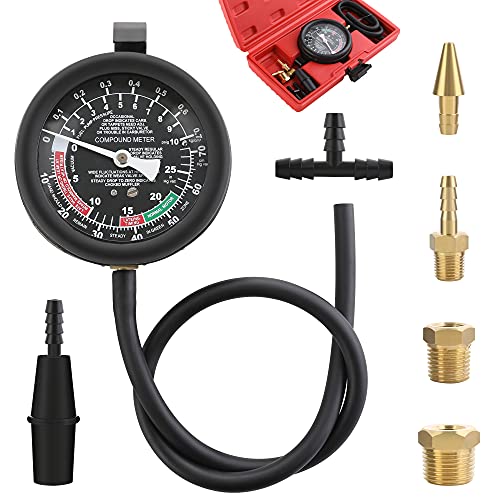
- Covers fuel and engine vacuum tests
- Large protected color-coded dial
- Includes adapters, hose, and case
Best For: Basic carburetor and mechanical fuel-pump diagnostics
Professional Precision Pick

- 0–75,000-micron measurement range
- Four selectable pressure units
- Includes SAE extension, T-connector, and case
Best For: HVAC professionals needing broad-range, alarm-enabled measurements
Field Monitoring Value

- Pirani sensor for micro-pressure detection
- Backlit display with four pressure units
- Includes batteries and portable tool bag
Best For: Field service users wanting simple alerts and portability
Connected Workflow Pick
Elitech VGW-Mini Wireless Gauge

- Wireless app monitoring and notifications
- Exports recorded data to Excel or PDF
- Compact 0–19,000-micron measurement range
Best For: Technicians needing connected records and portable monitoring
Precision Pick – CPS VG200 Digital Vacrometer
For technicians who want flexible readings from their vacuum gauges, the CPS VG200 combines NIST-calibrated accuracy with a clear five-digit LCD. It measures microns, millibar, torr, and inches of mercury, making it adaptable to different evacuation procedures.
Best For: HVAC professionals who want a versatile, easy-to-read digital gauge with a protective case and included fittings.
Pros:
- Calibrated to strict NIST standards for precise readings.
- Switches between four measurement units with two-button operation.
- Automatic temperature compensation helps maintain consistent readings.
- Includes a T-fitting, gauge hook, and padded vinyl case.
Cons:
- Uses a plastic construction rather than a metal housing.
- The included kit is designed around the listed fittings and accessories.
The VG200 is a practical choice when unit flexibility and straightforward operation matter. Its cleanable sensor and ability to withstand up to 400 PSI positive pressure add useful durability for service work.
Wireless Workhorse – Fieldpiece MG44 Wireless Vacuum Gauge
The Fieldpiece MG44 is one of the more connected vacuum gauges for HVACR work. It can operate independently, through the Job Link System App, or from an SMAN manifold screen, while its reversible angled coupler helps connect directly at the system port.
Best For: HVACR technicians who value wireless monitoring, long range, and multiple viewing options during evacuations.
Pros:
- Measures from 50 to 2,000 microns with backlit display options.
- Offers stand-alone, Job Link App, and SMAN manifold use.
- Provides up to 1,000 feet of line-of-sight wireless range.
- Typical alkaline battery life is rated at 40 hours.
Cons:
- Its wireless features are most useful within the Fieldpiece ecosystem.
- Requires batteries for operation.
With a long wireless range and readings shown as a rate, bar graph, or rate meter, the MG44 is built for efficient remote observation. The reversible 1/4-inch, 45-degree coupler is also helpful in tight service spaces.
Industrial Dial Option – Winters PFQ798 Pressure and Vacuum Gauge
The Winters PFQ798 takes a traditional approach to vacuum gauges with a liquid-filled analog dial and dual pressure/vacuum scale. Its stainless steel case, brass and bronze internals, and bottom-mounted 1/4-inch NPT connection suit fixed installations and machinery monitoring.
Best For: Pumps, compressors, hydraulic equipment, and other systems that need a durable, always-visible analog gauge.
Pros:
- Dual scale displays 30 inches Hg to 0–30 psi/kPa.
- Glycerin-filled dial helps support clear readings.
- 304 stainless steel case has IP65 protection against solids, dust, and liquids.
- Offers listed accuracy of plus or minus 1.5% of full-scale value.
Cons:
- Analog dial does not provide digital micron readings.
- The 1/4-inch NPT bottom mount may require compatible system fittings.
This gauge is best suited to permanent or semi-permanent equipment monitoring rather than portable HVAC evacuation diagnostics. Its 2.5-inch dial and liquid-filled construction prioritize visibility and rugged everyday service.
Smart HVAC Probe – testo 552i Wireless Vacuum Probe
The testo 552i is a compact wireless option among vacuum gauges, designed to connect through a single service port and send live data to compatible testo digital manifolds or the testo Smart App. Its integrated 45-degree design simplifies placement during HVAC evacuation work.
Best For: HVAC technicians who want app-based vacuum readings, wireless manifold integration, and digital service documentation.
Pros:
- Measures deep vacuum to single-digit resolution with listed accuracy of ±10 microns plus 10% of measured value.
- Integrated 45-degree angle supports quick service-port installation.
- Automatically connects to testo digital manifolds and works with the Smart App.
- App supports remote control, documentation, and report sharing.
Cons:
- Its wireless workflow depends on compatible testo manifolds or the Smart App.
- It does not list an integrated standalone display in the supplied specifications.
For technicians already using testo equipment, the 552i can reduce setup complexity and help avoid refrigerant loss by measuring from one service port. IP54 protection and the included case further support mobile service work.
Best All-Around Engine Diagnostics – Fuel Pump Tester Gauge Kit
If you need vacuum gauges for troubleshooting both fuel delivery and engine performance, this NYXOVA kit offers a practical combination of pressure and vacuum testing. Its large, color-coded dial covers common carburetor and mechanical fuel-pump diagnostics, while the included adapters help accommodate different connections.
Best For: DIY mechanics and technicians diagnosing carburetor engines, fuel-pump pressure, vacuum readings, and common engine faults.
Pros:
- Supports fuel-pump pressure, fuel-pump vacuum, intake-manifold, and general vacuum tests.
- Large 4-inch gauge with color-coded scales for easier reading.
- Includes hose, multiple adapters, instructions, and a carrying case.
- Measures vacuum from 0–28 inHg and pressure from 0–10 PSI.
Cons:
- Pressure range is intended for systems operating at or below 10 PSI.
- The analog gauge may be less convenient than a digital display for fine readings.
This is a flexible choice when one gauge needs to cover several basic engine tests. The organized case and broad adapter selection make it especially useful for mobile troubleshooting and routine garage work.
Best Digital HVAC Precision – Digital Vacuum Gauge Pro
For HVAC work requiring detailed readings, this digital vacuum gauge adds smart evacuation monitoring and pressure leak detection to standard vacuum measurement. It offers selectable units, fine resolution, temperature compensation, and a large LCD for monitoring evacuation and sealed-system tests.
Best For: HVAC users who want digital vacuum readings, evacuation data, and pressure-based leak testing in one instrument.
Pros:
- Provides evacuation and pressure leak detection modes.
- Offers ±0.2% full-scale vacuum accuracy with selectable Torr, mbar, hPa, and inHg units.
- Displays measurement time, temperature-related values, pressure differential, and starting pressure.
- Includes a 3-inch LCD, alarm threshold, auto temperature compensation, and altitude calibration.
Cons:
- Its advanced features may be more than needed for simple vacuum checks.
- The listed vacuum range is relative to 0–50 mbar, so users should confirm it suits their application.
This is the most feature-focused option in the group. The diagnostic modes and alerts can make evacuation and static leak checks easier to document, while the included 1/4-inch SAE hose and tee joint support immediate setup.
Best Value Analog Kit – Hromee Fuel Pump and Vacuum Tester
Hromee Fuel Pump and Vacuum Tester Gauge, Carburetor Pressure Diagnostics Leakage Tool Kit
Check Price On AmazonThis Hromee kit is a straightforward option for shoppers comparing vacuum gauges for carburetor and engine troubleshooting. The large analog dial covers vacuum and low-pressure fuel-pump readings, and the included hose, fittings, and case provide a complete setup for common diagnostic jobs.
Best For: Vehicle owners and mechanics testing mechanical fuel pumps, carburetors, vacuum lines, brake-assist systems, and intake leaks.
Pros:
- Handles fuel-pump pressure, engine vacuum, carburetor, and intake-manifold checks.
- Large 4-inch color-coded gauge with protective rubber surround and top hook.
- Includes several adapters and a 2-foot hose rated for a maximum working pressure of 40 PSI.
- Heavy-duty blow-molded case supports storage and transport.
Cons:
- Designed for carburetor engines with mechanical fuel-pump pressures below 10 PSI.
- Analog display lacks the digital features and selectable units of a smart gauge.
With its broad vehicle-focused testing range and organized case, this kit is a sensible choice for basic automotive diagnostics. It is best suited to low-pressure fuel systems and traditional vacuum troubleshooting rather than advanced HVAC measurement.
Professional Precision Pick – PYY Digital Micron Gauge
For HVAC technicians comparing vacuum gauges, the PYY Digital Micron Gauge offers a broad 0–75,000-micron measurement range, switchable pressure units, and connection accessories for AC, refrigeration, and heat pump service.
Best For: Professionals who want adjustable alarms, broad measurement coverage, and flexible 1/4-inch SAE connections.
Pros:
- Measures from 0 to 75,000 microns with claimed accuracy of ±5% of reading under specified conditions.
- Switches among microns, Pa, mbar, and mmHg.
- Includes a 1/4-inch SAE extension, T-connector, carrying case, and one-year warranty.
Cons:
- The 10-minute auto shut-off may interrupt longer monitoring sessions.
- Its 1.4-pound weight is higher than the compact wireless option in this roundup.
This is a practical choice when connection flexibility and a wide vacuum range matter more than app-based logging. The adjustable alarm and clear LCD add useful convenience during evacuation work.
Field Monitoring Value – Digital Vacuum Gauge Tester
This digital vacuum gauge is designed for real-time HVAC and heat pump monitoring, pairing a Pirani sensor with a backlit display, target-vacuum alerts, and a portable tool bag.
Best For: Field technicians who want a straightforward gauge with responsive sensing, audible prompts, and included batteries.
Pros:
- Uses a high-precision Pirani sensor with a stated 0.1–1,000 Pa accuracy range of ±5%.
- Supports microns, Pa, mBar, and mmHg with a large backlit LCD.
- Includes three AA batteries, extension connector, tee connector, tool bag, and user manual.
Cons:
- The monitoring alert stops automatically after 35 seconds unless manually stopped.
- It does not list app connectivity or data export features.
With its non-slip rubber housing and portable accessories, this model emphasizes practical field use. Choose it if audible target alerts and a ready-to-use kit are more important than wireless reporting.
Connected Workflow Pick – Elitech VGW-Mini Wireless Gauge
Among vacuum gauges, the Elitech VGW-Mini stands out for wireless app connectivity, offline recording, and exportable readings. It measures from 0 to 19,000 microns for HVAC and refrigeration evacuation work.
Best For: Technicians who want app-based monitoring, recorded evacuation data, and a compact rechargeable gauge.
Pros:
- Records and exports data in Excel and PDF formats through the Elitech Tools app.
- Supports target settings, notifications, temperature compensation, and automatic H2O-status judgment.
- Compact 7.36-ounce design with a large LCD and included adaptor.
Cons:
- Its 0–19,000-micron range is narrower than the two 0–75,000-micron gauges.
- The supplied notice says an oil-proof film can delay readings when connected directly to a vacuum pump.
- Accuracy is listed as ±10% or ±10 microns, depending on the reading.
This is the strongest fit for technicians who value documentation and remote oversight. Its smaller range and app-dependent workflow may be less suitable for users seeking a basic standalone gauge.
How We Picked the Best Vacuum Gauges
We focused on the features that matter during real evacuation and diagnostic work: readable micron measurements, useful unit options, measurement range, accuracy claims, connection style, battery or rechargeable power, alarm functions, and resistance to job-site wear. Wireless models were also assessed for app compatibility and remote monitoring, while analog and fuel-system testers were judged by clarity, simplicity, and versatility.
Because these products serve different purposes, this list includes dedicated HVAC micron gauges, wireless probes, analog compound-style gauges, and fuel-pump or carburetor testing kits. A gauge designed for evacuation is not automatically the best choice for engine diagnostics.
Quick Comparison of These Vacuum Gauges
| Type | Best For | Notable Features |
|---|---|---|
| Digital micron gauge | HVAC evacuation verification | Precise readings, multiple units, alarms |
| Wireless gauge or probe | Remote monitoring and service speed | App connectivity, fewer hoses near the system |
| Analog vacuum gauge | Simple visual checks | No batteries, rugged dial-style operation |
| Fuel and vacuum tester | Automotive diagnostics | Pressure, vacuum, and leakage testing |
Key Buying Factors for Vacuum Gauges
Accuracy and Measurement Range
For HVAC work, micron resolution is usually more useful than a basic inches-of-mercury reading. Look for a range suitable for deep evacuation and an accuracy specification you can trust. Multiple units such as microns, Torr, mbar, hPa, and inHg are helpful when working with different manuals or service procedures.
Connection and Placement
Consider where the gauge connects. A 1/4-inch SAE fitting is common for HVAC service, while a 45-degree probe or compact wireless adapter may be easier to position at a service port. Keeping the sensor away from the vacuum pump can produce a more useful reading of system conditions.
Wireless Features and Alerts
Wireless models can improve visibility during long evacuations, especially when paired with a mobile app or larger digital manifold. Audible or visual alarms are valuable when a target vacuum is reached or readings rise unexpectedly, but confirm range and app requirements before buying.
Durability and Power
HVAC tools face oil, moisture, drops, and temperature changes. Look for sealed construction, protective cases, automatic shutoff, and a battery system that suits your work frequency. Rechargeable gauges reduce disposable-battery costs, while replaceable batteries may be more convenient in the field.
Who Should Buy Which Vacuum Gauges?
Choose a dedicated digital micron gauge if you regularly evacuate refrigeration or air-conditioning systems and need repeatable readings. Models with multiple units and adjustable alarms are especially useful for professional service calls.
Choose a wireless gauge or probe if you want to monitor evacuation from a distance, reduce clutter around the service port, or integrate readings with a compatible HVAC app. Verify smartphone and platform compatibility first.
Choose an analog gauge for straightforward visual checks, backup use, or environments where battery-free operation matters more than fine micron resolution.
Choose a fuel-pump and vacuum tester kit for automotive troubleshooting involving carburetors, fuel pumps, vacuum lines, and leakage checks. These kits are practical diagnostic tools but are not substitutes for a precision HVAC micron gauge.
Before purchasing, match the gauge to the system you service most often, then confirm fitting size, reading range, accuracy, power source, and environmental protection. Those details matter more than adding features you will rarely use.