The best weather stations with data logging do more than display temperature and rainfall. They collect trends over time, send readings to your phone, and help you understand conditions around your home, garden, or property.
This roundup compares 10 standout models from Sainlogic and Ambient Weather, with attention to connectivity, sensor coverage, display quality, power options, and practical data access.
Best 10 Weather Stations with Data Logging Picks for 2026
Best Overall Data Logger
Sainlogic 14-in-1 WiFi Weather Station

- Stores up to 2 years of readings with Excel export
- Tracks wind, rain, UV, sunlight, pressure, and more
- Large 8.5-inch display with app alerts
Best For: Detailed historical records for gardens, farms, and homes
Best Smart-Home Pick
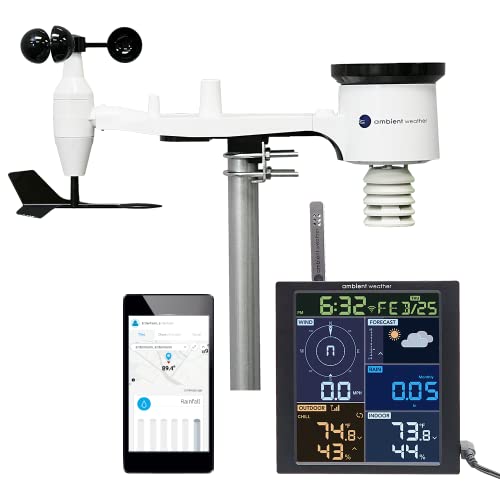
- Updates console readings every 16 seconds
- Supports Alexa, Google Home, and IFTTT
- Connects to Ambient Weather Network remotely
Best For: Connected homes needing remote monitoring and automation
Best Feature-Packed Option
Sainlogic 14-in-1 Weather Station

- Stores 2 years of history with downloadable Excel data
- Adds AI forecasts and customizable alerts
- Covers rain, wind, UV, sunlight, and pressure
Best For: Detailed monitoring and trend analysis across many weather metrics
Best Low-Maintenance Design

- Ultrasonic wind and haptic rain gauges have no moving parts
- Solar-powered outdoor array
- Remote monitoring through Ambient Weather Network
Best For: Low-maintenance garden and property monitoring
Best Smart Data Logger
Sainlogic 5G/2.4G WiFi Weather Station

- Two years of local storage with Excel export
- Dual-band Wi-Fi and Bluetooth fast pairing
- 443-foot range with rainfall history logging
Best For: Downloadable records for gardens, greenhouses, and home monitoring
Best Connected Weather Station
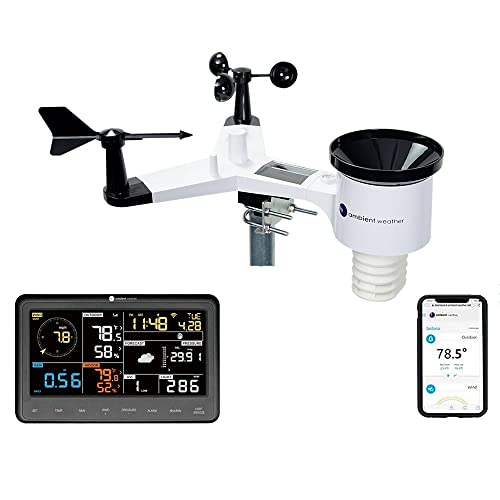
- Wi-Fi remote monitoring and customizable alerts
- Tracks wind, rain, UV, and solar radiation
- Works with Alexa, Google Home, and IFTTT
Best For: Smart-home users wanting remote hyperlocal weather access
Best Touchscreen Logger
Sainlogic SA68 Plus Wi-Fi Weather Station
- 6.5-inch touchscreen weather dashboard
- Two years of logs with spreadsheet export
- Dual-band Wi-Fi and 443-foot wireless range
Best For: Enthusiasts wanting a large display and downloadable history
Smart Backyard Monitoring
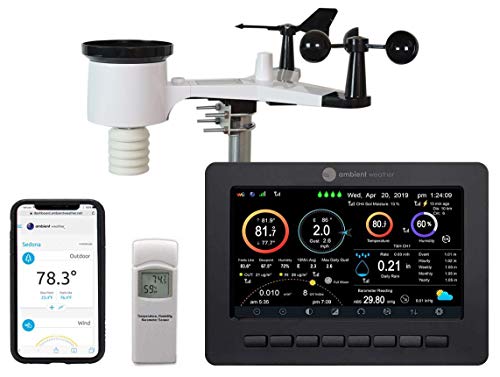
- Tracks wind, temperature, humidity, rain, UV, and solar radiation
- TFT color console with imperial/metric units and calibration
- Optional Wi-Fi transmission for remote monitoring
Best For: Home weather monitoring and gardening
Long-Term Data Export
Sainlogic Smart WiFi Weather Station

- Archives up to 24 months and exports selected data to Excel
- App logs rainfall across hourly, daily, weekly, monthly, and yearly views
- High-contrast display plus phone alerts for weather changes
Best For: Growers, farm managers, and data-focused weather users
Ultrasonic Smart Sensing
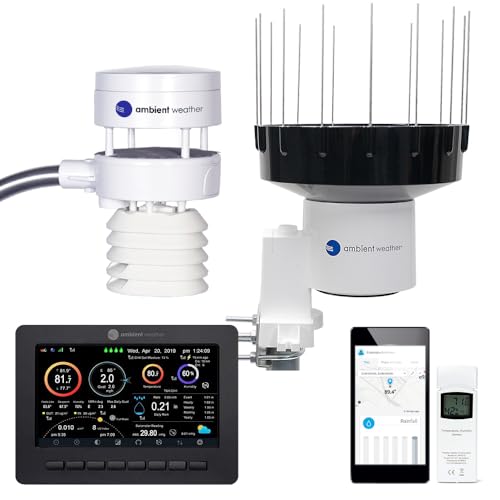
- Moving-parts-free ultrasonic array updates every five seconds
- Includes one year of AWN+ graphing and SMS-alert features
- Supports remote monitoring and major smart-home platforms
Best For: Connected homes and advanced weather tracking
Best Overall Data Logger – Sainlogic 14-in-1 WiFi Weather Station
For shoppers comparing weather stations with data logging, this Sainlogic model stands out with two years of historical storage and Excel export through the Weatherseed app. It also combines broad outdoor measurements, AI forecasts, alerts, and a large display in one system. Note that Wi-Fi connectivity is limited to 2.4 GHz.
Best For: Garden, farm, or home users who want detailed historical weather records and app-based monitoring.
Pros:
- Stores up to two years of data and supports Excel exports in the app.
- Tracks temperature, humidity, rainfall, wind, UV, sunlight, and pressure.
- Large 8.5-inch display with customizable app or email alerts.
- Wireless outdoor sensor uses solar power with battery backup.
Cons:
- Wi-Fi supports only 2.4 GHz networks.
- Three AAA batteries are required and are not included.
This is a strong choice when data logging and export matter as much as live readings. Its broad sensor coverage and large console make it practical for ongoing garden or property monitoring.
Best Smart-Home Pick – Ambient Weather WS-1965
The Ambient Weather WS-1965 is a practical option among weather stations with data logging for buyers who prioritize remote access and smart-home integration. Its all-in-one sensor measures core conditions, while Wi-Fi connects the station to the Ambient Weather Network and supported automation platforms.
Best For: Smart-home users who want remote monitoring, alerts, and weather-based automation.
Pros:
- Measures temperature, humidity, pressure, wind speed, wind direction, and rainfall.
- Provides real-time console updates every 16 seconds.
- Works with IFTTT, Google Home, Alexa, and Ambient Weather Network.
- Includes a color LCD display and all-in-one sensor array.
Cons:
- The supplied notes do not specify a storage duration or export format.
- Its listed temperature accuracy is ±1.11°C.
Choose this model if connected monitoring and smart-home control are more important than a stated long-term export workflow. The rapid console updates and network access make it well suited to live weather awareness.
Best Feature-Packed Option – Sainlogic 14-in-1 Weather Station
This Sainlogic model is designed for buyers seeking weather stations with data logging plus extensive environmental coverage. It records readings every five minutes, stores up to two years of history, and allows Excel export through the Weatherseed app. The system uses 2.4 GHz Wi-Fi only.
Best For: Users who want a feature-rich station with historical charts, downloadable data, and detailed outdoor readings.
Pros:
- Offers two-year data storage and app-based Excel export.
- Includes AI-driven 24-hour and seven-day forecasts.
- Monitors temperature, humidity, rain, wind, UV, sunlight, and pressure.
- Includes customizable alerts and an 8.5-inch display.
Cons:
- Only compatible with 2.4 GHz Wi-Fi.
- AAA battery backup batteries are not included.
Its combination of logging, export, forecasting, and sensor breadth makes this a versatile choice for users who want more than basic temperature readings. It is especially useful when reviewing trends and sharing data matters.
Best Low-Maintenance Design – Ambient Weather WS-4000
The Ambient Weather WS-4000 is a compelling alternative among weather stations with data logging for shoppers who value durable, low-maintenance hardware. Its ultrasonic wind and haptic rain gauges have no moving parts, while Wi-Fi and the Ambient Weather Network support remote monitoring, data analysis, and alerts.
Best For: Garden and property owners who want solar operation and fewer mechanical components to maintain.
Pros:
- Uses ultrasonic wind and haptic rain gauges without moving parts.
- Solar-powered outdoor array reduces dependence on conventional power.
- Connects to the Ambient Weather Network for monitoring and analysis.
- Includes a color display and an indoor temperature, humidity, and pressure sensor.
Cons:
- The supplied notes do not state a specific storage duration or export format.
- Listed temperature accuracy is 1°C.
This station is best suited to buyers who prefer a streamlined installation and low-maintenance sensor design. Its network integration adds useful remote access, though shoppers seeking a clearly specified export period should verify the logging details.
Best Smart Data Logger – Sainlogic 5G/2.4G WiFi Weather Station
If you want weather stations with data logging for both everyday monitoring and longer-term review, this Sainlogic model combines dual-band Wi-Fi, app access, and two years of local storage. Its sensor array tracks temperature, humidity, rainfall, wind, pressure, and related readings, while Excel export supports trend analysis.
Best For: Gardeners, greenhouse owners, wine-cellar users, and households that want downloadable historical weather records.
Pros:
- Stores up to two years of data and exports records to Excel.
- Supports both 5GHz and 2.4GHz Wi-Fi, with Bluetooth fast pairing.
- Offers up to 443 feet of wireless range and rainfall logging from hourly through yearly totals.
- Uses a Swiss SHT40 sensor chip with stated temperature accuracy of ±0.2°C.
Cons:
- Each Excel export covers up to 30 days, so longer histories require multiple exports.
- The outdoor sensor requires careful leveling for the stated rainfall accuracy.
This is a strong choice when data logging and export matter as much as live readings. The dual-band connection and extended wireless range also make it practical for larger properties.
Best Connected Weather Station – Ambient Weather WS-2902 Wi-Fi
The Ambient Weather WS-2902 is a connected option for shoppers comparing weather stations with data logging and remote access. Its Osprey sensor array measures wind, temperature, humidity, rainfall, UV intensity, and solar radiation, while Wi-Fi enables remote monitoring, alerts, and optional network sharing.
Best For: Home users who prioritize Wi-Fi access, smart-home compatibility, and hyperlocal outdoor readings.
Pros:
- Measures wind speed and direction, temperature, humidity, rainfall, UV intensity, and solar radiation.
- Supports remote access and alerts through Wi-Fi.
- Works with IFTTT, Google Home, Alexa, and other smart-home setups.
- Can transmit data to the Ambient Weather Network and the larger personal weather station network.
Cons:
- Its stated temperature accuracy is ±1°C, less precise than some alternatives.
- Wi-Fi connectivity is listed at 2.4GHz rather than dual-band operation.
- The product carries a one-year warranty.
Choose this model if connected features are central to your setup. It offers broad sensor coverage and smart-home integrations, though buyers seeking the most detailed local export specifications may want to verify their preferred logging workflow.
Best Touchscreen Logger – Sainlogic SA68 Plus Wi-Fi Weather Station
For buyers who want weather stations with data logging and a more interactive console, the Sainlogic SA68 Plus pairs a 6.5-inch touchscreen with dual-band Wi-Fi and two years of historical storage. It records temperature, humidity, wind, rain, and barometric pressure, with spreadsheet downloads for further analysis.
Best For: Weather enthusiasts who want a large dashboard, remote app monitoring, and long-term records for gardens, homes, or RVs.
Pros:
- Provides a 6.5-inch HD touchscreen with adjustable three-level backlighting.
- Logs up to two years of data and supports spreadsheet export.
- Uses 5GHz and 2.4GHz Wi-Fi for remote monitoring and alerts.
- Offers up to 443 feet of wireless range and rainfall totals from hourly through yearly periods.
Cons:
- The listed temperature reading accuracy is ±1°C.
- Its stated battery life is 24 hours, so power planning may matter for battery operation.
- Wind and rain accuracy can depend on correct outdoor sensor placement.
The SA68 Plus stands out for its large touchscreen and accessible dashboard. It is a practical fit for users who want both at-a-glance readings and downloadable history without giving up app-based access.
Smart Backyard Monitoring – Ambient Weather WS-2000
The Ambient Weather WS-2000 is a practical choice among weather stations with data logging for homeowners who want local readings plus optional Wi-Fi connectivity. Its integrated outdoor array tracks wind, temperature, humidity, rainfall, UV, and solar radiation, while the TFT color display keeps current conditions easy to view.
Best For: Home weather monitoring, gardening, and users who want Wi-Fi-based remote access to station data.
Pros:
- Measures wind, temperature, humidity, rainfall, UV, and solar radiation.
- Supports imperial and metric units with calibration options.
- Wi-Fi connectivity can transmit data to the personal weather station network.
- Includes a high-definition TFT color display.
Cons:
- The outdoor sensor array requires three AAA batteries, which are not included.
- The console uses a 5V DC adapter rather than battery power.
- Remote monitoring depends on the Wi-Fi connection.
Choose the WS-2000 if you want broad backyard-weather coverage and a dedicated color console, with Wi-Fi access available when you want to review data remotely.
Long-Term Data Export – Sainlogic Smart WiFi Weather Station
For shoppers prioritizing weather stations with data logging, the Sainlogic Smart WiFi Weather Station stands out with up to 24 months of records and Excel export. Its Weatherseed app logs rainfall and other conditions over time, while phone alerts and a high-contrast display make everyday monitoring straightforward.
Best For: Growers, farm managers, weather enthusiasts, and users who want long-term records they can export for analysis.
Pros:
- Stores up to 24 months of weather records and supports Excel export.
- Logs rainfall hourly, daily, weekly, monthly, and yearly.
- Provides app alerts for changes in temperature, humidity, and barometric pressure.
- Large, high-contrast digits are designed for easy at-a-glance reading.
Cons:
- Wi-Fi connectivity is limited to 2.4GHz networks.
- Each export download can cover a selected 30-day window.
- The outdoor sensor must be installed carefully to avoid inaccurate wind-direction and temperature readings.
This is the strongest fit here for structured historical analysis, particularly if exporting weather records and reviewing seasonal trends matters more than simply checking current conditions.
Ultrasonic Smart Sensing – Ambient Weather WS-5000
The Ambient Weather WS-5000 is a feature-rich option among weather stations with data logging, combining an ultrasonic sensor array with remote access and smart-home compatibility. Its moving-parts-free design updates conditions every five seconds, and the included one-year AWN+ subscription adds advanced graphing, SMS alerts, and other premium features.
Best For: Users who want fast updates, remote monitoring, smart-home integrations, and enhanced graphing tools.
Pros:
- Ultrasonic all-in-one array has no moving parts and updates every five seconds.
- Complete setup includes the sensor array, rain cup, thermo-hygrometer-barometer, and color display.
- Works with IFTTT, Google Home, Alexa, and remote alerts.
- Includes one year of AWN+ features such as advanced graphing and SMS alerts.
Cons:
- The advanced AWN+ subscription is included for one year; ongoing access may require renewal.
- The listed temperature accuracy is 1°C.
- The sensor system uses batteries as its power source.
The WS-5000 is a compelling upgrade for connected households that value rapid readings and automation, especially when its included AWN+ tools align with your data-review needs.
How We Picked the Best Weather Stations with Data Logging
We focused on models that combine dependable outdoor sensors with useful recording and connected features. Each station was evaluated for the range of measurements it provides, Wi-Fi or app support, display readability, installation practicality, power design, and the usefulness of its weather-history tools.
Because specifications and software support can vary by configuration, check the current product listing for included sensors, network requirements, subscription terms, and compatibility before buying. A station that records data locally may suit a different buyer than one designed primarily for cloud dashboards and phone alerts.
Quick Comparison
- Best for broad measurement coverage: Choose a 14-in-1 Sainlogic model if you want temperature, humidity, wind, rain, UV, light, and related readings in one system.
- Best for established connected ecosystems: Ambient Weather models are worth considering when cloud access, app monitoring, and network integration are priorities.
- Best for low-maintenance outdoor operation: The Ambient Weather WS-4000 uses solar power and ultrasonic wind sensing to reduce moving parts and routine battery dependence.
- Best for a larger at-a-glance display: Sainlogic stations with 8.5-inch screens make indoor monitoring easier from across a room.
- Best for advanced sensor performance: The Ambient Weather WS-5000 is a strong candidate for buyers who want an ultrasonic sensor platform and expanded monitoring capabilities.
Key Buying Factors for Weather Stations with Data Logging
Measurements and Sensor Layout
Decide which readings you genuinely need. Temperature and humidity are standard, while rainfall, wind speed, wind direction, barometric pressure, UV, and solar radiation add value for gardening, home projects, weather observation, and property management. Also check whether the outdoor unit combines sensors in one assembly or requires separate mounting locations.
Data Storage and Access
Look for clear information about historical graphs, export options, update intervals, and whether records are stored on the console, in an app, or in the cloud. Cloud logging is convenient for remote access, but it may depend on an account, internet connection, or changing service policies. If long-term records matter, prioritize a system with dependable history views and a practical way to retrieve your data.
Wi-Fi and App Reliability
Confirm whether the station supports your home network, including 2.4GHz or dual-band requirements. App alerts are useful for frost, heat, heavy rain, or high winds, but only if the connection remains stable. Read setup details carefully, especially if your router uses separate network names or advanced security settings.
Power, Placement, and Maintenance
Solar assistance can reduce battery changes, but it does not eliminate the need to consider winter light, battery backup, and sensor accessibility. Install the outdoor array away from obstructions, heat sources, and sprinkler spray. Wind and rain accuracy depend heavily on correct height, leveling, and exposure.
Who Should Buy Which Weather Stations with Data Logging?
Choose a Sainlogic 14-in-1 station if broad sensor coverage and an oversized indoor display are your main priorities. A dual-band Sainlogic model is a practical choice for households that want flexible Wi-Fi connectivity and app-based alerts.
Choose an Ambient Weather station if you prefer a mature connected monitoring ecosystem and detailed remote access. The WS-4000 suits buyers seeking solar-assisted operation and ultrasonic wind measurement, while the WS-5000 is better suited to enthusiasts who want a more advanced sensor platform. For straightforward home monitoring, the WS-1965, WS-2902, or WS-2000 can provide a balanced combination of indoor display access, outdoor readings, and logged weather history.