Choosing the right vibration meter can make machinery inspection faster, more accurate, and easier to document. The best models help you spot imbalance, misalignment, looseness, and bearing wear before they turn into costly downtime.
Below, we’ve narrowed the field to 10 strong options for maintenance teams, technicians, and plant operators who need dependable vibration readings on the shop floor.
Best 10 Vibration Meters for Machinery Inspection Picks for 2026
Fluke Field-Ready Vibration Check

- Angle-resistant sensor design
- Four-level severity scale
- Consistent low/high frequency data
Best For: Routine machine health screening and bearing condition checks
Sper Portable Tester
Handheld Vibration Meter 840063

- Measures velocity and acceleration
- Includes magnetic probe and case
- RMS, peak, min/max, hold functions
Best For: Portable maintenance inspections on pumps, motors, and similar equipment
SWANSOFT Multi-Check Analyzer

- 5-in-1 readings including temperature
- Large storage with CSV/BMP export
- Remote magnetic sensor for access
Best For: Predictive maintenance and inspection work that needs logging and quick diagnostics
PM63A Precision Field Meter

- High-sensitivity shear-type accelerometer
- Measures acceleration, velocity, displacement
- Includes calibration report and probes
Best For: Predictive maintenance teams needing lightweight field diagnostics
Portable Shop-Use Pick

- Measures acceleration, velocity, and displacement
- Includes long and short probe heads
- Portable body with LCD backlight and low-power alert
Best For: Routine on-site machinery checks
Predictive Maintenance Pick

- Shows acceleration, velocity, and displacement at once
- Includes bearing condition monitoring
- Built for rotating machinery inspection and predictive maintenance
Best For: Rotating machinery checks and bearing monitoring
Field-Friendly LCD Pick
AS63B Portable Vibration Tester

- Large backlit LCD for easier reading
- Shows acceleration, speed, and distance
- Compact and portable for industrial use
Best For: General inspection across multiple industrial environments
Industrial Vibration Analysis
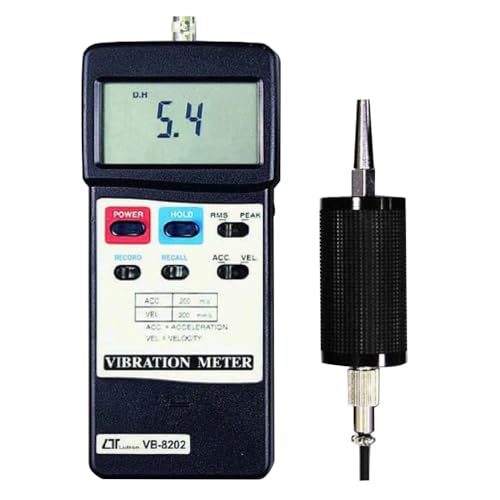
- Measures acceleration and velocity for machine checks
- Adds RMS, peak, max/min recording, and memory recall
- Includes probe, magnetic base, case, and RS-232 cable
Best For: technicians needing a practical field vibration analyzer
Portable Multi-Mode Inspection
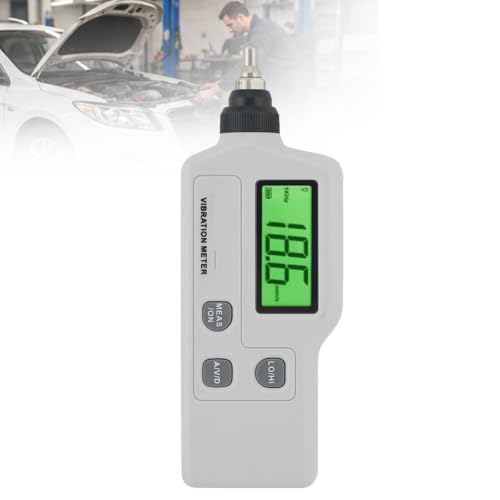
- Measures acceleration, velocity, and displacement
- Backlit LCD with HI/LO frequency selection
- USB rechargeable compact handheld design
Best For: routine machinery checks and fault screening
Smart Data Logging Inspection

- Measures five values including temperature and frequency
- Stores about 397,000 data points with USB export
- TFT screen shows trend graphs and summary values
Best For: condition monitoring and logged vibration analysis
Fluke Field-Ready Vibration Check – Fluke-805 FC
If you want vibration meters for machinery inspection that feel built for routine field checks, the Fluke-805 FC is aimed at fast, repeatable screening. Its sensor design is meant to reduce variation from device angle or contact pressure, while the four-level severity scale helps you judge overall vibration and bearing condition at a glance.
Best For: Maintenance teams that want a straightforward vibration meter for quick machine health checks and urgency screening.
Pros:
- Sensor design helps minimize reading variation from angle or contact pressure
- Consistent data quality across low and high frequency ranges
- Four-level severity scale supports quick assessment of vibration and bearing condition
- Portable, battery-powered design with included AA batteries
Cons:
- Not positioned as a multi-channel or full-spectrum diagnostic tool
- Limited details provided on advanced data storage or transfer features
For practical machinery inspection, the Fluke-805 FC focuses on dependable screening rather than complex analysis. That makes it a solid fit when the main goal is quick condition checks and a clear severity readout.
Sper Portable Tester – Handheld Vibration Meter 840063
This portable option fits well in vibration meters for machinery inspection when you need a compact handheld tester for pumps, motors, and other equipment. It measures vibration velocity and acceleration, and its display adds RMS, peak, min/max, hold, low-battery, and auto power-off functions for field use.
Best For: Technicians who want a compact vibration tester with a magnetic probe and simple readout functions for maintenance inspections.
Pros:
- Measures vibration velocity and acceleration for machinery diagnostics
- Includes a detachable magnetic probe for steadier measurements
- Displays RMS, peak, min/max, hold, and low-battery status
- Comes with a hard-shell carrying case, 9V battery, and instructions
Cons:
- Product notes do not list long-term logging or PC transfer features
- The field-focused design emphasizes quick testing over advanced analysis
As a straightforward maintenance tool, this Sper Scientific meter covers the essentials without adding much setup complexity. It looks best suited to inspectors who want portability, a magnetic probe, and basic measurement modes in one kit.
SWANSOFT Multi-Check Analyzer – 5-in-1 Vibration Meter
Among vibration meters for machinery inspection, this SWANSOFT unit stands out for combining multiple measurements in one handheld analyzer. It covers acceleration, velocity, displacement, frequency, and temperature, and it adds a remote magnetic sensor plus storage and PC file transfer for trend work.
Best For: Users who want a feature-rich handheld analyzer for predictive maintenance, record keeping, and quick preliminary machine checks.
Pros:
- 5-in-1 measurement set includes acceleration, velocity, displacement, frequency, and temperature
- Supports automatic/manual recording with large storage capacity
- Can transfer CSV and BMP files through PC software on Windows
- Remote magnetic sensor helps with hard-to-reach measurement points
Cons:
- Explicitly not a permanent online monitoring system
- Not intended as a full-spectrum FFT vibration analysis tool
This model is a strong fit if your inspection workflow benefits from both quick field readings and archived records. The combination of a backlit display, removable sensor, and data export features makes it more versatile than a basic vibration checker.
PM63A Precision Field Meter – Handheld Vibration Tester
If your shortlist for vibration meters for machinery inspection leans toward precision, the PM63A is designed around a high-sensitivity piezoelectric accelerometer and real-time field diagnostics. It measures acceleration, velocity, and displacement, and it is aimed at spotting looseness, resonance, and bearing wear before failures become expensive.
Best For: Maintenance professionals who want a lightweight, high-precision handheld tester for predictive maintenance and motor analysis.
Pros:
- High-sensitivity shear-type accelerometer for real-time measurements
- Measures acceleration, velocity, and displacement with stated ±5% accuracy
- Designed to identify looseness, resonance, and bearing wear
- Includes long and short probes, battery, calibration report, case, and manual
Cons:
- Does not list storage, transfer, or display-enhancement features
- More focused on core measurement than multi-function data handling
The PM63A is a compact, inspection-first meter with a clear emphasis on measurement precision and early fault detection. For users who mainly need reliable handheld readings and a calibration report, it offers a practical, no-frills approach.
Portable Shop-Use Pick – Compact 3-Function Vibrometer
If you need vibration meters for machinery inspection that are easy to carry and straightforward to read, this portable vibrometer covers the basics well. It measures acceleration, velocity, and displacement, and includes long and short probe heads so you can adapt to different inspection setups.
Best For: Technicians who want a compact, portable meter for routine machinery checks and simple field measurements.
Pros:
- Measures acceleration, velocity, and displacement in one unit
- Includes both long and short probe heads for different situations
- LCD backlight and low-power indication help with field use
- AC signal output interface adds flexibility for setup
Cons:
- Velocity and displacement ranges are limited by the acceleration range
- Accuracy is listed at ±10% + 2 digits, so it is best for general inspection rather than precision lab work
- Display updates every second, which is not ideal for very fast changing readings
This is a practical pick when portability and multi-parameter checking matter more than advanced analysis features. For everyday machinery inspection, it offers a simple way to assess vibration levels on site.
Predictive Maintenance Pick – VM-6370 3-Parameter Analyzer
For vibration meters for machinery inspection where you want broader measurement coverage, the VM-6370 is built around simultaneous display of acceleration, velocity, and displacement. It also adds a bearing condition monitoring function, making it a strong fit for checking rotating equipment during inspection and maintenance work.
Best For: Maintenance teams and inspectors who need a more feature-rich meter for rotating machinery and bearing checks.
Pros:
- Displays acceleration, velocity, and displacement simultaneously
- Wide measurement ranges support a broad set of machinery checks
- Bearing condition monitoring adds useful inspection capability
- Designed for rotating machinery inspection and predictive maintenance
Cons:
- No backlight or portability features are highlighted in the supplied notes
- More capability may be more than needed for simple spot checks
- Frequency coverage differs by mode, so setup still matters
This model stands out for condition-monitoring tasks where you want more than a basic vibration readout. If your workflow includes commissioning, quality control, or ongoing fault detection, it is the most inspection-focused option here.
Field-Friendly LCD Pick – AS63B Portable Vibration Tester
If you want vibration meters for machinery inspection with a clear display and simple operation, the AS63B is a practical portable tester. It uses a piezoelectric acceleration transducer and shows acceleration, speed, and distance readings for general vibration evaluation across industrial settings.
Best For: Users who need a portable, easy-to-read vibration meter for power, petrochemical, machinery, metallurgy, or vehicle inspection work.
Pros:
- Large LCD with backlight improves readability in low-light areas
- Displays acceleration, speed, and distance
- Compact and portable for field use
- Listed as suitable for power, petrochemical, machinery, metallurgy, and vehicles
Cons:
- No detailed measurement ranges are provided in the supplied notes
- Plastic construction may not feel as robust as metal-bodied tools
- Supplied information does not mention advanced analysis or bearing-specific functions
The AS63B is a straightforward inspection tool when readability and portability are top priorities. It is best suited to general vibration checking rather than specialized diagnostic work.
Industrial Vibration Analysis – VB-8202 Digital Meter
If you need vibration meters for machinery inspection that cover both quick checks and deeper diagnostics, the VB-8202 is built around the core measurements maintenance teams use most. It monitors acceleration and velocity, adds RMS, peak, max/min recording, and includes a separate probe plus magnetic base for field use.
Best For: Technicians who want a practical vibration analysis meter for general machine health checks, troubleshooting, and trend tracking.
Pros:
- Measures acceleration up to 200 m/s² and velocity up to 200 mm/s.
- Includes RMS, peak, max/min recording, data hold, and memory recall.
- Large LCD with 0.6-inch digits is easy to read in different lighting.
- Supplied with probe, magnetic base, carrying case, and RS-232 cable.
Cons:
- Does not list displacement measurement.
- Wired probe setup may be less convenient than fully integrated designs.
- RS-232 output is useful, but not as simple as newer USB-based workflows.
The VB-8202 focuses on the essentials of vibration inspection with a strong set of diagnostic functions. For users who want a straightforward industrial meter with recording tools and field-ready accessories, it is a solid fit.
Portable Multi-Mode Inspection – Handheld Vibration Meter
For vibration meters for machinery inspection that balance portability and broader measurement coverage, this handheld unit is designed to simplify routine maintenance checks. It measures acceleration, velocity, and displacement, while the backlit LCD and simple mode controls make it easier to use in everyday plant and field work.
Best For: Maintenance staff and technicians who need a compact handheld meter for routine machinery inspection and fault screening.
Pros:
- Measures acceleration, velocity, and displacement in one meter.
- Supports HI/LO frequency selection for different inspection needs.
- Backlit LCD and straightforward button layout help with quick operation.
- USB rechargeable and compact for convenient field use.
Cons:
- Fewer advanced recording features are listed than on some analysis-focused models.
- No storage/export tools are mentioned in the supplied notes.
- Portable housing is compact, but not described with rugged certification details.
This model makes sense if you want a simple, versatile inspection tool rather than a data-heavy analyzer. Its three measurement modes and easy handheld operation are well suited to daily checks on common rotating equipment.
Smart Data Logging Inspection – TFT Vibration Meter
If your vibration meters for machinery inspection need to do more than show a live reading, this model adds logging, trend views, and export tools. It measures acceleration, velocity, distance, frequency, and temperature, and the TFT display helps present max/min/average values and live trend graphs for more detailed analysis.
Best For: Users who want a feature-rich vibration meter with logging and data export for condition monitoring.
Pros:
- Five measurement functions: acceleration, velocity, distance, frequency, and temperature.
- Stores about 397,000 data points with automatic or manual recording.
- Exports CSV and BMP files via USB for easier reporting and sharing.
- TFT screen shows live trend graphs, max/min, and average values.
Cons:
- More settings may add complexity for basic spot checks.
- Bilingual interface may be unnecessary for users who only need simple readings.
- The broad feature set may be more than needed for very casual use.
This is the most data-oriented option in the group, especially if you care about recording and transferring inspection results. It is a strong match for teams that want a handheld meter with more analysis and reporting capability built in.
How We Picked These Vibration Meters for Machinery Inspection
We focused on Vibration Meters for Machinery Inspection that offer practical measurement ranges, clear display/readout options, and features useful in real maintenance workflows. Priority went to models that support velocity and acceleration readings, include useful probe or sensor options, and appear suited for recurring checks on motors, pumps, bearings, and rotating equipment.
We also considered portability, runtime, data storage, and whether a meter looks appropriate for both quick spot checks and more structured preventive maintenance routines.
Quick Comparison
For fast decision-making, think in terms of use case: some meters are better for basic handheld inspections, while others are built for broader vibration analysis, remote sensing, or longer-term data capture. If you need simple field checks, a compact LCD model may be enough. If you want deeper diagnostics or more repeatable workflows, look for multi-function units with separate probes, higher storage capacity, and stable sensor handling.
Key Buying Factors for Vibration Meters for Machinery Inspection
Measurement Types
Most buyers should confirm whether the meter measures acceleration, velocity, and displacement. Velocity is especially common for machinery condition checks, while acceleration can be useful for higher-frequency issues and bearing-related problems.
Sensor Design and Probes
Probe style matters. A separate probe, magnetic base, or remote sensor can improve contact and consistency on different machine surfaces. That helps reduce operator error and makes readings easier to repeat across inspections.
Accuracy, Range, and Readability
Look for a range that matches the assets you inspect. Good readability also matters in the field, so backlit LCDs or TFT screens can save time in dim mechanical rooms or noisy production areas.
Data Handling and Runtime
If you document trends, choose a meter with memory, data logging, or export-friendly features. Longer battery life is also valuable for route-based maintenance, especially when inspecting multiple machines in one shift.
Who Should Buy Which Vibration Meters for Machinery Inspection?
Choose a simpler handheld meter if you need quick checks on a limited set of machines and want easy operation. Pick a more advanced analyzer if you manage a larger maintenance program, need repeatable trend monitoring, or inspect a mix of motors, gearboxes, and rotating assets.
For teams standardizing on Vibration Meters for Machinery Inspection, the best option is usually the one that balances measurement capability, durability, and ease of use for your daily workflow.