USB switch boxes make it easier to share a keyboard, mouse, printer, scanner, webcam, or storage device between a Mac and another computer. Instead of unplugging cables, you can switch connected peripherals between systems with a button, remote, or desktop controller.
This roundup compares 10 options across USB-A and USB-C connectivity, port capacity, switching layouts, transfer speeds, and multi-computer support. Use the guide below to narrow your choice based on your Mac setup and the devices you need to share.
Best 10 USB Switch Boxes for Mac Picks for 2026
Best Value

- Shares four USB devices between two computers
- Up to 5Gbps data transfer with macOS support
- Physical button and optional USB-C power input
Best For: Straightforward two-computer Mac peripheral sharing
Best USB-C Choice
Cable Matters USB-C 4-Port Switch

- Combines two USB-A and two USB-C ports
- 10Gbps data transfer for high-bandwidth peripherals
- Includes button and RF remote switching
Best For: Mixed USB-C and USB-A Mac workstations
Best Remote Control

- Three USB 3.0 ports plus one USB-C port
- 5Gbps transfer speeds with macOS compatibility
- Switches by device button or included remote
Best For: Remote-controlled peripheral sharing on Mac setups
Best High-Capacity Option
UGREEN 7-Port 10Gbps USB Switch
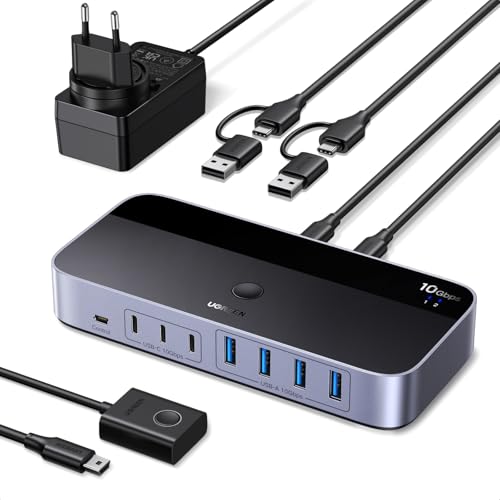
- Shares seven USB-A and USB-C devices
- 10Gbps USB 3.2 Gen 2 transfer speeds
- Includes power adapter and USB-C-to-A cable
Best For: Large Mac workstations with many shared peripherals
Four-Computer Hub

- Shares four USB 2.0 devices across four computers
- Includes panel and wired-controller switching
- Mac-compatible and driver-free
Best For: Multi-computer offices sharing several peripherals
Simple Sharing Pick

- Shares four USB 2.0 peripherals between two computers
- Uses one-button switching with LED status lights
- Supports Mac OS X without driver installation
Best For: Two-computer setups with everyday USB peripherals
Speed-Focused Choice

- Supports USB 3.0 speeds up to 5Gbps
- Works as 2-in-1-out or 1-in-2-out
- Aluminum build with macOS compatibility
Best For: Fast peripheral switching and higher-speed file transfers
Best Overall

- Shares four USB devices between two computers
- Combines one USB-C and three USB-A ports
- Supports 5Gbps data and optional power
Best For: Two-computer desks with multiple USB peripherals
Best for Four Computers
10Gbps USB 3.2 Switch Selector

- Shares USB peripherals among four computers
- Provides three USB-A and one USB-C ports
- Supports up to 10Gbps transfer speeds
Best For: Multi-computer workstations needing fast USB sharing
Best Compact Option

- Shares two USB devices between two computers
- Delivers up to 5Gbps data transfer
- Uses one-button switching with LED status
Best For: Simple two-computer setups with two shared peripherals
Best Value – BENFEI 4-Port USB 3.0 Switch
If you need usb switch boxes for mac setups, the BENFEI USB 3.0 Switch offers a straightforward way to share four USB peripherals between two computers. It supports up to 5Gbps data transfer, works with macOS, and switches devices with a physical button and status indicator.
Best For: Mac users sharing keyboards, mice, storage, printers, or scanners between a work computer and a personal computer.
Pros:
- Shares four USB devices between two computers.
- Supports USB 3.0 speeds up to 5Gbps and USB 2.0 backward compatibility.
- Driver-free compatibility with macOS, Windows, Linux, and Chrome OS.
- Includes an optional USB-C power input for higher-power peripherals.
Cons:
- Requires BENFEI USB-A-to-USB-A cables for the computer connections.
- Power adapter is not included.
- Switching is controlled by the unit’s button rather than a remote.
This is a practical, uncomplicated choice for a two-computer Mac workstation. Add external power when using demanding devices such as hard drives, cameras, or headphones.
Best USB-C Choice – Cable Matters USB-C 4-Port Switch
Among usb switch boxes for mac, the Cable Matters USB-C Switch stands out for mixed USB-C and USB-A workspaces. It lets two computers share two USB-A and two USB-C peripherals, with 10Gbps transfer speeds and switching through either the front button or included RF remote.
Best For: MacBook, Mac mini, or desktop users who need both USB-C and USB-A peripheral connections in one switch.
Pros:
- Provides two USB-A and two USB-C peripheral ports.
- Supports data rates up to 10Gbps.
- Includes an RF remote for switching from a convenient location.
- Compatible with macOS, Windows, ChromeOS, Linux, and iPadOS devices.
Cons:
- Data-only design does not support video output or host-device charging.
- Not intended for USB-C monitors, video adapters, or docking stations.
- Optional power adapter is not included.
This model is a strong fit when your Mac setup includes newer USB-C accessories alongside legacy USB-A gear. Keep its data-only limitation in mind before using it as a display or docking solution.
Best Remote Control – BENFEI USB 3.0/USB-C Switch
For usb switch boxes for mac that can be controlled from a distance, this BENFEI model combines three USB 3.0 ports with one USB-C port. Two computers can share the connected peripherals, and you can switch sources using either the device button or the included remote.
Best For: Mac users who want flexible USB-A and USB-C peripheral sharing without reaching behind or under the desk.
Pros:
- Offers three USB 3.0 ports plus one USB-C port.
- Supports transfer speeds up to 5Gbps.
- Provides both physical-button and remote-control switching.
- Uses USB-C for optional power input and supports major desktop operating systems.
Cons:
- Requires BENFEI USB-A-to-USB-A cables for operation.
- Power adapter is not included.
- It has fewer USB-A ports than a four-port USB-A-only switch.
The remote makes this a convenient choice for a compact two-computer setup, especially where the switch is placed out of easy reach. Use supplemental power for demanding peripherals to help maintain stable operation.
Best High-Capacity Option – UGREEN 7-Port 10Gbps USB Switch
If your Mac workspace needs more connections than typical usb switch boxes for mac provide, the UGREEN 2-in-7-out switch supports up to seven shared peripherals. It combines four USB-A and three USB-C ports, reaches up to 10Gbps, and includes a power adapter for more dependable use with higher-power devices.
Best For: Mac users managing a large collection of USB-A and USB-C peripherals across two computers.
Pros:
- Shares up to seven devices through four USB-A and three USB-C ports.
- Supports USB 3.2 Gen 2 transfer speeds up to 10Gbps.
- Includes a USB-C-to-USB-A cable for mixed computer connections.
- Includes a power adapter and controller for a tidier, more stable setup.
Cons:
- Does not provide video output and is not a KVM switch.
- Audio device connections are not recommended.
- Its larger port count may be unnecessary for simpler setups.
This is the most capable option here for a busy Mac workstation with many shared peripherals. Its included power supply is particularly useful for setups involving external drives and printers, but it should not replace a display-capable dock.
Four-Computer Hub – 4-in-4-out USB Switch
For buyers comparing USB switch boxes for Mac, this 4-in-4-out model is built to share four USB 2.0 peripherals among four computers. It supports Mac OS along with Windows, Linux, and Chrome OS, and includes both front-panel and wired desktop-controller switching.
Best For: Offices or home workspaces that need to share several USB peripherals across four computers.
Pros:
- Shares four USB devices among four computers.
- Includes a wired desktop controller as well as panel buttons.
- Driver-free compatibility with Mac OS and other major operating systems.
- Includes four USB cables and supports transfer rates up to 480Mbps.
Cons:
- Uses USB 2.0 rather than USB 3.0 speeds.
- An external 5V/1A power adapter may be needed for high-power devices such as hard drives, and the adapter is not included.
This is a practical choice when the main requirement is broad device sharing across four computers. Its generous port count and remote switching are useful, but users moving large files may prefer a USB 3.0 alternative.
Simple Sharing Pick – UGREEN 2-in-4-out USB Switch
This UGREEN model is a straightforward option among USB switch boxes for Mac, letting two computers share up to four USB 2.0 peripherals. A single button swaps control, while LED indicators show the active computer.
Best For: Mac and PC users who want one-button sharing for keyboards, mice, printers, scanners, or storage devices.
Pros:
- Shares four USB peripherals between two computers.
- One-button switching and LED status indication keep operation simple.
- Driver-free support for Mac OS X, Windows, Linux, and Chrome OS.
- Includes two USB A-to-A cables and a 24-month UGREEN warranty service.
Cons:
- It is not a KVM switch and does not support monitors or video transmission.
- Optional power is recommended when using multiple devices simultaneously; the charging cable and charger are not included.
- USB-C-only computers require a USB-C-to-A adapter.
Choose this switch for uncomplicated peripheral sharing between two computers. Its USB 2.0 interface is adequate for common input devices and printers, but it is less suitable when high-speed transfers are the priority.
Speed-Focused Choice – Bi-Directional USB 3.0 Switch
For Mac users seeking faster connectivity, this aluminum USB 3.0 switch supports up to 5Gbps and offers two operating modes: two computers can share one USB device, or one computer can switch between two USB devices. It is compatible with macOS, Windows, Linux, and Chrome OS.
Best For: Users who want faster USB transfers and flexible A/B switching for printers, storage, keyboards, mice, or scanners.
Pros:
- USB 3.0 connectivity supports transfer speeds up to 5Gbps.
- Bi-directional design supports both 2-in-1-out and 1-in-2-out use.
- Aluminum housing is described as scratch-resistant and designed to aid heat dissipation.
- Includes two USB 3.0 A-to-A cables and blue LED activity indicators.
Cons:
- It does not support HDMI or video output.
- Switching is independent A/B selection, not simultaneous output.
- The supplied details list a 12-month warranty rather than a longer coverage period.
This is the strongest fit of the three for speed-conscious buyers and flexible device routing. Its bidirectional design adds versatility, while the lack of video support means it should be viewed strictly as a USB peripheral switch.
Best Overall – UGREEN 4-Port USB 3.0 Switch
For shoppers comparing usb switch boxes for mac, the UGREEN CM662 is a flexible two-computer switcher with both USB-C and USB-A connectivity. It lets two computers share up to four USB peripherals, with button or remote-style controller switching. It is for data peripherals only, not displays.
Best For: Mac users sharing several keyboards, mice, printers, scanners, cameras, or other USB devices between two computers.
Pros:
- Supports two computers sharing four USB devices.
- Includes one USB-C and three USB-A USB 3.0 ports.
- Offers data speeds up to 5Gbps and plug-and-play macOS compatibility.
- Optional USB-C power input can improve stability with higher-power devices.
Cons:
- It is not a KVM and cannot transmit video or connect a monitor.
- USB-C input devices may require a USB-C-to-USB adapter.
- Separate power may be needed when using multiple devices.
Choose this model when you need four shared peripherals and appreciate both USB-C connectivity and a remote switching option. It is less suitable for a monitor-sharing setup or device charging.
Best for Four Computers – 10Gbps USB 3.2 Switch Selector
Among usb switch boxes for mac, this USB 3.2 selector stands out for supporting four computers and high-speed peripheral sharing. It provides three USB-A ports and one USB-C port, with front-button or remote control switching. Like the other options here, it handles USB data rather than monitor signals.
Best For: Users who need to share keyboards, mice, storage devices, printers, scanners, webcams, or gamepads among four computers.
Pros:
- Supports switching shared USB peripherals among four computers.
- Offers three USB-A 3.2 ports and one USB-C 3.2 port.
- Advertises data transfer speeds up to 10Gbps.
- Includes button and remote control switching plus a USB-C-to-USB-A adapter.
Cons:
- It is not a KVM switch and does not support monitors.
- The remote control batteries are not included.
- High-power devices require independent power for reliable operation.
This is the strongest fit when four computers and faster USB 3.2 transfers matter. Its broader switching capacity comes with the need to plan for external power with demanding peripherals.
Best Compact Option – UGREEN 2-Port USB 3.0 Switch
If you only need to alternate a couple of peripherals, this compact UGREEN switch keeps usb switch boxes for mac simple. It connects two computers to two shared USB devices, switches with one button, and uses LED status indicators to show the active connection.
Best For: Mac users sharing a keyboard, mouse, printer, webcam, or similar USB devices between two computers.
Pros:
- Shares two USB devices between two computers.
- Provides up to 5Gbps USB 3.0 data transfer and USB 2.0 backward compatibility.
- Plug-and-play support includes macOS, Windows, Chrome OS, and Linux.
- One-button switching and LED indicators make operation straightforward.
Cons:
- Only two USB output ports are available.
- It does not support monitor or video transmission.
- The USB output ports are intended for data, not video.
This model is a practical choice for a streamlined two-computer desk where two shared USB devices are enough. Consider a larger switch if you need USB-C peripheral ports, more outputs, or four-computer support.
How We Picked the Best USB Switch Boxes for Mac
We evaluated these USB Switch Boxes for Mac by comparing the number and type of upstream computer connections, available peripheral ports, USB generation, switching method, and stated compatibility. Models supporting USB-C can be especially convenient for newer MacBook models, while USB-A versions may be a better fit for older Macs, desktops, printers, and standard accessories.
We also considered practical layouts, including two-computer switches, four-computer models, bidirectional designs, and units that combine USB-A and USB-C ports. A good switch should make everyday peripheral sharing simple without requiring repeated cable changes.
Quick Comparison
| Best For | Look For |
|---|---|
| Basic keyboard and mouse sharing | Two computer inputs and four peripheral ports |
| Newer MacBook setups | USB-C compatibility or USB-C peripheral ports |
| Fast storage and data devices | USB 3.0 or USB 3.2, preferably 10 Gbps |
| Several computers | Four-input switching |
| Easy desk control | Remote, wired controller, or accessible front button |
| Older printers and scanners | USB-A ports and broad peripheral compatibility |
Key Buying Factors for USB Switch Boxes for Mac
Mac and Port Compatibility
Check how the switch connects to your Mac before buying. A Mac with USB-C or Thunderbolt ports may need a USB-C cable or a reliable adapter when using a USB-A switch. Confirm that the product includes the required upstream cables; many switches require separate cables for each computer.
Port Type and Capacity
Count the devices you plan to share, then leave at least one spare port if possible. USB-A remains common for keyboards, mice, printers, and scanners, while USB-C ports are useful for newer accessories and laptops. A mixed-port design offers more flexibility, but verify whether all ports operate at the advertised speed.
Speed and Device Type
USB 2.0 is generally sufficient for keyboards, mice, printers, and scanners. Choose USB 3.0 or USB 3.2 for flash drives, external SSDs, webcams, and other higher-bandwidth devices. A switch may pass data but not provide enough power for every bus-powered accessory, so powered hubs can help with demanding setups.
Switching Method and Placement
A physical button is dependable, while a wired desktop controller or remote lets you switch without reaching behind your computer. Consider cable length and where the control sits on your desk. Also check whether the switch changes one shared peripheral group at a time rather than routing individual devices separately.
Who Should Buy Which USB Switch Boxes for Mac?
Choose a compact two-computer USB 3.0 model if you mainly share a keyboard, mouse, printer, or scanner between a Mac and one other computer. Pick a USB-C model if your MacBook setup relies on USB-C connections and you want fewer adapters. For external drives or other fast devices, prioritize a USB 3.2 model rated for 10 Gbps, while remembering that actual performance also depends on the cables and connected hardware.
Users with four computers should choose a four-input switch rather than daisy-chaining smaller units. A bidirectional switch is useful when you need flexible one-in/two-out or two-in/one-out routing, but it may be less suitable for a full multi-device workstation. Finally, choose a USB 2.0 switch when affordability and basic peripherals matter more than transfer speed.