Schools often need to prepare identical USB drives for software installers, digital coursework, recovery tools, testing environments, and event materials. The right duplicator can reduce repetitive setup work while helping staff avoid inconsistent copies.
This roundup compares 10 USB duplicators for schools, from compact one-to-two-port units to higher-capacity systems designed for labs, districts, and IT departments. Consider target count, transfer speed, drive compatibility, verification, and secure erasure before buying.
Best 10 USB Duplicators for Schools Picks for 2026
Compact IT Copy Station

- Standalone duplication for two USB drives
- Copy, compare, erase, and error-scan functions
- Asynchronous mode for small source files
Best For: Small school IT batches and technician workstations
High-Volume PC Station
Nexcopy 16-Target USB 3.0 Duplicator

- Copies to 16 target drives
- PC-based with Drive Manager software
- USB 3.0 performance for large batches
Best For: School IT departments with recurring high-volume duplication
Large-Batch Standalone Workhorse

- Duplicates up to 15 drives simultaneously
- No computer or software required
- Supports bit-by-bit and asynchronous copying
Best For: Recurring school-wide or multi-class drive preparation
Touchscreen Media Manager
- Duplicates up to 10 USB drives
- Touchscreen copy, compare, format, and erase controls
- Supports USB 2.0, 3.0, and 3.1 media
Best For: Staff-friendly daily USB management
High-Speed 7-Target Pick
USBShark Standalone USB Duplicator
- Copies to 7 USB targets
- No PC required
- Supports USB 3.0, 2.0, and 1.0
Best For: Schools distributing files to small batches of USB drives
Touchscreen SOHO Choice
Acumen Disc EZ Dupe 1-to-10 USB Duplicator

- Copies to up to 10 drives
- Touchscreen operation
- Includes compare, erase, and format tools
Best For: Schools wanting simple controls for routine USB distribution
Large-Batch Standalone Pick
Vinpower USBDBL 15-Target Duplicator

- Copies to 15 USB targets
- Asynchronous duplication
- Supports secure erase and optional media adapters
Best For: Schools preparing large batches of USB and flash media
Best High-Capacity Pick
EZ Dupe Mini USB Plus MK III 1-to-7 Duplicator

- Copies up to seven USB drives simultaneously
- Standalone operation needs no computer
- Supports USB 1.0, 2.0, and 3.0 media
Best For: Schools preparing larger batches of USB drives
Best Budget Batch Option
BestDuplicator UB300 1-to-2 USB Duplicator

- Copies one USB drive to two targets
- Supports quick and bit-for-bit copying
- Includes LCD monitoring and media tests
Best For: Small school IT batches and routine duplication
Best Drive-Sanitizing Pick
StarTech.com 1-to-1 USB and SATA Duplicator

- Duplicates USB and SATA HDDs or SSDs
- Includes five drive-erasure modes
- Copy-and-Compare verifies cloned drives
Best For: School IT teams managing duplication and drive retirement
Compact IT Copy Station – StarTech 1:2 USB Duplicator
For schools seeking USB duplicators for schools, the StarTech USBDUP12 is a compact standalone option for creating up to two copies at a time. It supports common USB 3.0 and 2.0 flash media, requires no computer, and includes copying, comparison, and erasing functions for routine IT tasks.
Best For: School technicians managing small batches of boot drives, shared files, or sanitized USB media.
Pros:
- Duplicates to two USB drives without a computer.
- Offers system/file copy, sector-by-sector copying, and multiple erase modes.
- LCD controls, error scanning, and Copy & Compare help monitor results.
- Asynchronous mode can keep copying while finished drives are replaced when source content is under 64 MB.
Cons:
- Only two target ports are available per batch.
- Asynchronous copying is limited to source content under 64 MB.
- External USB devices may require their own power source.
The StarTech is a practical choice when a school values standalone operation and verification features more than high-volume output. Its two-target capacity suits smaller labs and technician workstations.
High-Volume PC Station – Nexcopy 16-Target USB 3.0 Duplicator
The Nexcopy SSUSB160PC is designed for schools that need USB duplicators for schools with a larger copying workload. This PC-based USB 3.0 system provides 16 target connections and includes Nexcopy Drive Manager software for managing duplication tasks from a computer.
Best For: School IT departments preparing many USB drives at once from a PC-based workstation.
Pros:
- Provides 16 target USB connections for larger batches.
- Uses USB 3.0 technology and can copy at a flash drive’s maximum transfer speed.
- Includes Nexcopy Drive Manager software.
- Designed to make copying as straightforward as using a photocopier.
Cons:
- Requires a computer because it is PC based.
- Its 12-pound weight makes it less portable than compact duplicators.
- The supplied notes do not specify standalone erase or verification functions.
For a school preparing classroom media or deployment drives in sizable batches, the 16-target layout can reduce repeated loading. It is best suited to a permanent PC-connected IT setup rather than occasional portable use.
Large-Batch Standalone Workhorse – Systor 1:15 USB Duplicator
The Systor SYS-USBD-15 gives schools a standalone way to create up to 15 USB copies per batch. For USB duplicators for schools, its consistent 2GB-per-minute transfer rate, bit-by-bit copying, and support for synchronous and asynchronous modes make it suited to repeatable media preparation.
Best For: School technology teams duplicating many USB flash drives without relying on a computer or software.
Pros:
- Copies to 15 target drives at once.
- Operates without a computer or software.
- Supports bit-by-bit duplication plus synchronous and asynchronous modes.
- Rated for copying at speeds up to 2GB per minute, with speed remaining the same as the load count increases.
Cons:
- Uses a USB 2.0 interface.
- Its large target capacity may be more than small schools need for occasional jobs.
- The supplied notes do not list display, comparison, or dedicated erase features.
The Systor is a strong fit when batch size and standalone operation are the main priorities. Its 15-target design can streamline recurring school-wide or multi-class drive preparation.
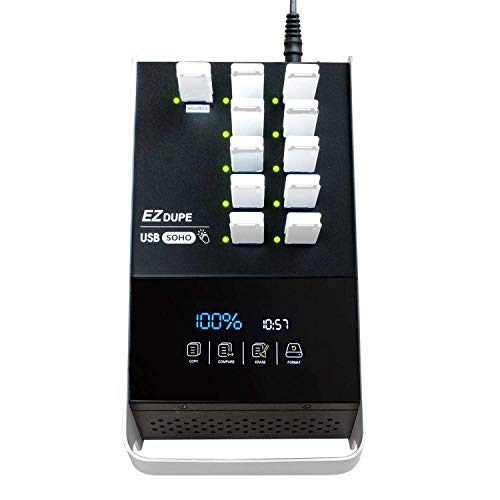
Touchscreen Media Manager – EZ Dupe SOHO Touch 1:10
The EZ Dupe SOHO Touch offers a user-friendly approach to USB duplicators for schools, with a touchscreen menu for copying, comparing, formatting, and erasing. It handles USB 2.0, 3.0, and 3.1 thumb drives and supports all file formats, file sizes, and drive capacities on USB flash media.
Best For: School staff who want straightforward touchscreen control for regular USB copying and media management.
Pros:
- Copies to up to 10 USB drives at a stated 35MB per second.
- Touchscreen interface simplifies copy, compare, format, and erase operations.
- Supports USB 2.0, 3.0, and 3.1 flash drives and all file formats, sizes, and capacities.
- Designed for daily operation with a lightweight, ergonomic construction.
Cons:
- The supplied notes do not specify a standalone copy speed comparison across different drive types.
- It has fewer target ports than 15- or 16-target alternatives.
- The warranty is listed as one year.
The SOHO Touch stands out for accessible controls and built-in media-management functions. It is a sensible middle ground for schools that need more than a small two-drive duplicator but do not require the largest batch capacity.
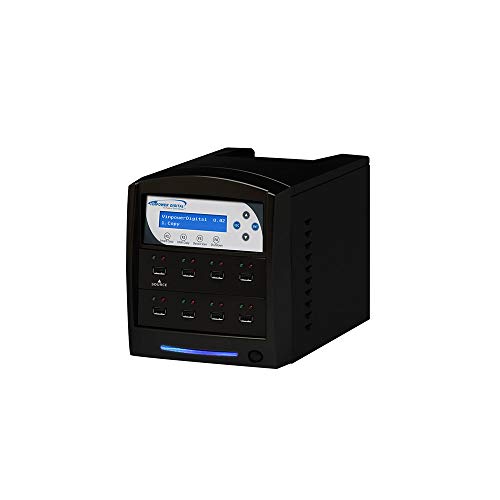
High-Speed 7-Target Pick – USBShark Standalone USB Duplicator
Vinpower Digital USBShark Standalone USB Flash Drive Duplicator - 7 Targets (High Speed)
Check Price On AmazonFor schools needing practical usb duplicators for schools, the Vinpower Digital USBShark provides standalone copying to seven target USB drives. Its Smart Copy, Raw Mode-style bit-by-bit duplication, and USB prescan features support routine media distribution and checking without a computer.
Best For: Schools copying accessible files or complete USB contents to up to seven drives at a time.
Pros:
- Copies to seven USB targets.
- Standalone operation requires no PC.
- Supports USB 3.0, 2.0, and 1.0 devices.
- Includes secure erase and source-device error prescan features.
Cons:
- At 10 pounds, it is less convenient to move between rooms.
- The supplied notes do not specify a warranty.
This is a strong fit when staff want a dedicated, high-capacity duplicator with broad USB compatibility and error-checking features. Verify that seven target ports meet your distribution volume before choosing a larger model.
Touchscreen SOHO Choice – Acumen Disc EZ Dupe 1-to-10 USB Duplicator
The Acumen Disc EZ Dupe is a user-friendly option for schools comparing usb duplicators for schools. Its touchscreen interface supports copying, comparing, erasing, and formatting, while the standalone design avoids the need for a connected computer.
Best For: Staff who value simple touchscreen control and distribution to up to 10 flash drives.
Pros:
- Copies to up to 10 USB targets.
- Easy-to-read touchscreen interface.
- Standalone operation requires no computer.
- Supports copy, compare, erase, and format functions.
Cons:
- The listed transfer speed is up to 35 MB/s, which may be slower than higher-speed alternatives.
- The listed USB interface is USB 1.1 with USB 2.0 Type-A connectivity.
Choose this model when ease of use and a clear touchscreen matter more than maximum throughput. Its 1-to-10 capacity can suit classroom or department-level batches without adding a computer to the workflow.
Large-Batch Standalone Pick – Vinpower USBDBL 15-Target Duplicator
For larger school deployments, the Vinpower USBDBL is a high-capacity choice among usb duplicators for schools. It works without a PC and uses patented asynchronous duplication, allowing multiple target drives to be copied independently.
Best For: Schools and districts preparing large batches of USB drives with independent asynchronous copying.
Pros:
- Provides 15 target slots for larger batches.
- Standalone operation requires no PC.
- Offers Smart Copy and Raw Mode for accessible or bit-by-bit duplication.
- Supports secure erase and optional adapters for SD, microSD, and CompactFlash media.
Cons:
- At 11 pounds, it is not especially portable.
- Additional flash-media formats require corresponding interface adapter modules.
This model is the most suitable of the three for high-volume preparation, especially when asynchronous copying can streamline multiple jobs. Its 15-target capacity and one-year warranty add practical value for institutional use.
Best High-Capacity Pick – EZ Dupe Mini USB Plus MK III 1-to-7 Duplicator
For schools that need to prepare several USB drives at once, the EZ Dupe Mini USB Plus MK III is a practical choice among USB duplicators for schools. Its standalone design requires no computer, while asynchronous copying lets you start new drives without waiting for an entire batch to finish.
Best For: Schools distributing software, course materials, or bootable media across up to seven USB drives simultaneously.
Pros:
- Copies to up to seven USB drives at the same time.
- Standalone plug-and-use operation requires no computer.
- Supports USB 1.0, 2.0, and 3.0 media, plus external USB storage with its own power source.
- Updated model offers a claimed copy speed of up to 2.5GB per minute.
Cons:
- External USB hard drives must have their own power source.
- Actual speed depends on the read/write performance of the connected drives.
Its seven-port capacity makes this the strongest option here for larger school rollouts. It is best suited to repeatable bulk duplication rather than occasional one-off copying.
Best Budget Batch Option – BestDuplicator UB300 1-to-2 USB Duplicator
The BestDuplicator UB300 offers straightforward two-drive duplication for schools that need a compact, independent tool. As one of the simpler USB duplicators for schools, it supports both quick data copying and whole-media, bit-for-bit cloning without Windows or Mac software.
Best For: School IT staff and technicians who usually need to create two matching USB drives at a time.
Pros:
- Duplicates one source drive to two target drives simultaneously.
- Offers Quick Copy and Whole Media Copy modes.
- Includes erase, capacity-check, device-information, and speed-test functions.
- Compact standalone design includes an LCD and status LEDs.
Cons:
- Supports USB 1.1 and USB 2.0 media rather than newer USB standards.
- Only handles two target USB drives per duplication cycle.
- Card duplication requires a compatible USB card reader sold separately.
This is a sensible fit for smaller deployments and routine technician work. Its verification and maintenance tools are useful when schools want to check media before distributing it.
Best Drive-Sanitizing Pick – StarTech.com 1-to-1 USB and SATA Duplicator
Schools handling retired storage or mixed drive formats may prefer the StarTech.com SU2DUPERA11. It combines USB duplication with SATA HDD/SSD cloning and multiple erase modes, making it a broader data-management tool than a USB-only copier.
Best For: School IT departments that need to duplicate USB media while also securely erasing SATA hard drives or SSDs.
Pros:
- Copies and erases both USB drives and 2.5- or 3.5-inch SATA drives.
- Provides four duplication modes, including sector-by-sector copying.
- Offers five erase modes, including secure, cryptographic, and three-pass overwrite options.
- Copy-and-Compare can verify a completed clone against the source.
Cons:
- Duplicates only one target drive at a time.
- Some additional interfaces, including IDE and M.2 SATA, require separately sold adapters.
- Its wider drive support may be more than needed for USB-only school deployments.
This model is the most versatile choice when duplication and storage sanitization belong in the same workflow. Choose it over a basic USB duplicator when drive retirement and cross-interface support are priorities.
How We Picked These USB Duplicators for Schools
We focused on duplicators that can copy USB flash drives without requiring a complicated workflow. The selection includes standalone models for quick, repeatable jobs and PC-based units for teams that need more centralized control. We also considered the number of target ports, advertised transfer rates, support for newer USB standards, touchscreen or LCD controls, and erasing or sanitizing functions.
Because school environments vary widely, the list covers compact 1:1 and 1:2 devices as well as systems capable of handling seven, 10, 15, or 16 target drives at once. Specifications can vary by source media, target drives, file sizes, and interface, so treat rated speeds as a comparison point rather than a guaranteed classroom result.
Quick Comparison
- Small offices and occasional use: A 1:1 or 1:2 standalone duplicator is usually easier to store and less expensive.
- Computer labs and recurring deployments: Seven- to 10-target models can prepare a classroom batch with fewer cycles.
- District IT and larger rollouts: Fifteen- and 16-target units are better suited to repeated, high-volume imaging.
- Mixed media workflows: Look for models that support multiple USB generations, flash media, or SATA drives when the school uses more than standard thumb drives.
- Data cleanup: Built-in erase or sanitization modes are useful when drives are reused, reassigned, or returned to inventory.
Key Buying Factors for USB Duplicators for Schools
Target Capacity and Workload
Count how many drives staff typically need per batch. A higher target count saves time on large deployments, but a smaller unit may be more practical for a library, media center, or individual teacher.
Speed and USB Compatibility
USB 3.x support can shorten transfer times when both the source and target drives support the standard. Older USB 2.0 drives may remain useful for basic files, but they can limit performance.
Ease of Operation
Standalone controls, clear status displays, and simple copy-and-verify steps reduce training requirements. Touchscreen menus may be especially convenient for IT staff who process different jobs throughout the day.
Verification, Erasure, and Security
Verification helps confirm that target drives match the source. Erase and sanitizer features can support responsible reuse, but schools should still follow their own data-retention, privacy, and asset-disposal policies.
Source and Target Drive Planning
Use reliable, equal-capacity target drives from a consistent batch when possible. Confirm whether the duplicator copies only usable data or performs a sector-by-sector clone, since this affects speed, capacity requirements, and compatibility.
Who Should Buy Which USB Duplicators for Schools?
Choose a compact 1:1 or 1:2 model if you handle occasional drive preparation, troubleshooting, or small classroom batches. Choose a seven- or 10-target unit for regular lab refreshes, standardized student materials, or recurring staff deployments. Choose a 15- or 16-target system when district IT teams need to prepare many identical drives with fewer operator cycles. If your workflow includes hard drives or broader media management, a hybrid duplicator may provide better long-term value than a USB-only device.