Choosing the right gauge can make steel plate inspections faster, more consistent, and far less guesswork-driven. The best models balance accuracy, measurement range, and ease of calibration.
Below, we break down top options for shop, field, and industrial use so you can match the tool to your materials, coating needs, and budget.
Best 10 Ultrasonic Thickness Gauges for Steel Plates Picks for 2026
Industrial Inspection Pick
Industrial-882 Handheld Thickness Tester

- 1-225 mm range for steel plates and pipes
- Adjustable sound velocity for multiple materials
- Color LCD plus data storage for inspections
Best For: Maintenance crews inspecting steel plates and industrial metal parts
Calibration Accessory Pick

- Four steel steps for calibration checks
- Built for thickness and linearity verification
- Compact accessory for ultrasonic gauges
Best For: Anyone calibrating ultrasonic gauges against known steel thicknesses
Feature-Rich Field Pick
GOYOJO UTG-2 Digital Thickness Gauge

- Steel range from 1.0 to 300 mm
- Through-coating mode and coupling prompt
- Stores up to 1500 measurement groups
Best For: Field inspectors needing storage and through-coating support
Long-Range Measuring Pick
Triplett UTG300 Ultrasonic Gauge

- 1-300 mm range for steel and other metals
- Single or continuous measurement modes
- High/low alarms plus 300 stored records
Best For: General-purpose thickness checks with alarm and record features
Industrial-882X Color LCD Gauge
Steel, Metals, Plastics & Glass

- 0.039 to 11.811 inch range for steel
- 0.001 inch resolution with velocity calibration
- Color LCD and handheld design
Best For: Portable inspection of steel plates and other homogeneous materials
High-Sensitivity Steel Plate Gauge

- Measures steel and plastic wall thickness
- Standard and micro-diameter probes included
- Backlit display with mm/inch readout
Best For: Routine steel plate checks with flexible probe selection
PM1301 Rechargeable Gauge
Steel Plates, Pipes and Corrosion Checks

- 0.5-second readings with up to 0.0003 inch resolution
- Rechargeable battery with up to 8 hours runtime
- Min/max/average modes plus alarms and data support
Best For: Feature-rich inspections of steel plates, pipes, and corrosion loss
Industrial 3-Mode NDT Gauge
Through-Coating Thickness Meter

- Measures through paint with Echo-Echo mode
- Also supports direct Pulse-Echo checks
- Built-in memory, no PC export
Best For: Coated steel plates and industrial inspection work
Color Screen Shop Gauge
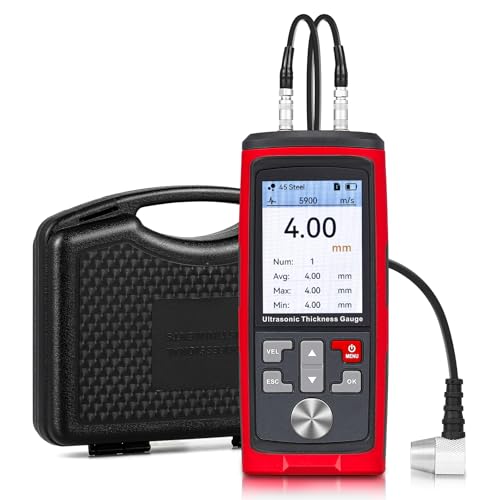
- 0.039 to 11.811 in measuring range
- Stores 1500 data points
- Color screen with adjustable backlight
Best For: Versatile shop use with data logging
Steel Plate Precision Gauge
- Measures steel and plastic wall thickness
- Probe choices for standard and curved parts
- Backlit display shows mm or inches
Best For: Simple, precise steel plate and mechanical part checks
Industrial Inspection Pick – Industrial-882 Handheld Thickness Tester
If you need ultrasonic thickness gauges for steel plates, the Industrial-882 is built for one-sided inspection on solid materials where cutting or drilling is not an option. It measures steel structures, pipes, tanks, and metal plates across a broad range, and the adjustable sound velocity helps match readings to different material types.
Best For: Maintenance teams and inspectors who need a portable gauge for steel plates, pipes, and routine industrial checks.
Pros:
- Measures solid materials from 1-225 mm, covering thin sheets and thicker steel plates
- Adjustable sound velocity supports steel, aluminum, copper, plastic, and glass
- Color LCD display makes readings easier to see in workshop or field settings
- Data storage helps track measurements during inspection routines
Cons:
- Not designed for paint or coating thickness
- Not suitable for cast iron
- Requires access from one side only, but only for solid-material thickness measurement
Overall, this is a practical handheld option for non-destructive steel plate inspection when you want a wide range, clear display, and basic data logging in a field-ready package.
Calibration Accessory Pick – 4-Step UT Block #1018
When comparing ultrasonic thickness gauges for steel plates, a calibration block helps verify that your readings are lining up correctly. This 4-step Step Wedge UT Block #1018 is made for thickness and linearity calibration on ultrasonic thickness gauges, with four steel steps for checking performance at known values.
Best For: Users who want a simple steel calibration standard for checking gauge accuracy and linearity.
Pros:
- Designed specifically for thickness and linearity calibration
- Four steel steps at 0.040, 0.060, 0.080, and 0.100 inches
- Compact and lightweight for bench or field calibration use
Cons:
- Not a measuring gauge itself
- Very narrow thickness range compared with full inspection tasks
This is a useful companion piece if your workflow depends on repeatable measurements and you want a straightforward way to confirm instrument response on steel targets.
Feature-Rich Field Pick – GOYOJO UTG-2 Digital Thickness Gauge
The GOYOJO UTG-2 is a strong choice if you want ultrasonic thickness gauges for steel plates with through-coating capability and built-in data handling. It measures steel, pipes, tanks, castings, and other metal parts from one side, and its 5MHz probe, sound velocity adjustment, and coupling prompt are aimed at improving consistency in real inspection work.
Best For: Inspectors who need a portable gauge with through-coating mode, storage, and longer battery life.
Pros:
- Measures steel from 1.0 to 300 mm with a 5MHz probe
- Through-coating mode can reduce surface prep when conditions are suitable
- Stores up to 1500 groups of results with statistics support
- Rechargeable design offers up to 15 hours of working time
Cons:
- Through-coating mode depends on suitable surface conditions
- Measures material thickness, not paint-layer thickness
- More feature-heavy than a basic spot-check gauge
For field inspections that involve steel plates and related metal structures, this model stands out for data storage, portable power, and extra measurement features that help reduce guesswork.
Long-Range Measuring Pick – Triplett UTG300 Ultrasonic Gauge
For ultrasonic thickness gauges for steel plates, the Triplett UTG300 offers a long measuring range and straightforward inspection features. It reads steel, stainless steel, brass, copper, iron, lead, glass, and more, and supports single or continuous measurement with real-time minimum, maximum, and average values.
Best For: Users who want a long-range handheld gauge with simple storage and alert functions.
Pros:
- Measures steel and other materials from 1 to 300 mm
- Single or continuous mode with real-time min/max/avg
- Stores 300 records with measured values and sound velocity
- High/low alarms can flag out-of-range readings
Cons:
- Monochrome dot matrix display is less modern than color screens
- Manual record storage may be slower for large inspection jobs
This is a practical choice when range, alarms, and basic data logging matter more than a high-end interface, especially for general steel plate and metal thickness checks.
Industrial-882X Color LCD Gauge – Steel, Metals, Plastics & Glass
If you need ultrasonic thickness gauges for steel plates that also cover a wide mix of non-porous materials, the Industrial-882X is built for broad industrial use. It measures steel, metals, plastics, ceramics, glass, PVC, and pipes, with a 0.039 to 11.811 inch range for 45# steel and a 0.001 inch resolution for fine readings.
Best For: Maintenance, inspection, and quality-control users who want a portable gauge for steel plates and other homogeneous materials.
Pros:
- Wide 0.039 to 11.811 inch measurement range for steel
- High-resolution readings with customizable sound velocity settings
- HD color LCD with adjustable backlight brightness
- Compact handheld design for portable industrial use
Cons:
- Not recommended for porous materials like cast iron or carbon fiber
- Calibration requires a reference block for best accuracy
Overall, this model is a strong fit if you want a versatile gauge that can move beyond steel plate work into general industrial inspection. Its display and calibration flexibility make it practical for field use, while the material limitations are worth noting before buying.
High-Sensitivity Steel Plate Gauge – Dual Units and Probe Options
For shoppers comparing ultrasonic thickness gauges for steel plates, this model focuses on straightforward metal and steel measurement with high sensitivity. It supports wall-thickness checks for steel and plastic, includes probe options for conventional workpieces and small curved materials, and shows results in both mm and inches.
Best For: Users who want a simple steel plate thickness meter with flexible probe choices.
Pros:
- Designed for precise thickness measurement on steel and plastic
- Includes standard and micro-diameter probe options
- Backlight helps reading in low-light conditions
- Displays measurements in mm and inches
Cons:
- Supplied notes do not list range or accuracy specs
- Fewer advanced features than some competing models
This gauge is a practical pick if you mainly need steel plate readings and value probe flexibility over extra software or data features. It keeps the feature set focused, which may suit users who want an uncomplicated tool for routine checks.
PM1301 Rechargeable Gauge – Steel Plates, Pipes and Corrosion Checks
If you want ultrasonic thickness gauges for steel plates with more measurement features, the PM1301 stands out for speed and usability. It measures steel from 0.039 to 11.811 inches in about 0.5 seconds, adds 12 material presets, and includes min/max/average modes, alarms, and data support for reporting.
Best For: Technicians and maintenance teams that need a feature-rich handheld gauge for steel plates, pipes, and corrosion loss checks.
Pros:
- Fast non-destructive measurement with up to 0.0003 inch resolution
- Rechargeable 1000mAh battery for up to 8 hours of use
- Color LCD backlight plus min/max/average and alarm functions
- Includes probe, gel, calibration block, case, and USB-C cable
Cons:
- More functions may be more than basic users need
- Heavier than the smallest handheld gauges at 5.57 oz
For steel plate work, this is the most feature-packed option in the group and a strong fit for inspection workflows that benefit from presets, logging, and quick readings. Its rechargeable design and accessory bundle add value for regular field use.
Industrial 3-Mode NDT Gauge – Through-Coating Thickness Meter
If you need ultrasonic thickness gauges for steel plates that can work on coated surfaces, this industrial model is built for more than basic direct contact testing. Its Echo-Echo mode measures base metal thickness without removing paint or protective layers, while Pulse-Echo handles uncoated materials and rough surfaces. It’s also geared for corrosion monitoring on pipes, vessels, structural steel, and large metal plates.
Best For: Inspectors who need through-coating measurement, standard direct thickness checks, and basic material verification in one handheld tool.
Pros:
- Echo-Echo mode measures through paint and protective layers without surface prep
- Pulse-Echo mode supports direct readings on uncoated steel and cast iron
- Custom sound velocity settings improve flexibility across multiple metals
- Scanning mode helps catch thinning areas on long pipelines and large plates
Cons:
- Does not support PC connectivity or software export
- VERI mode is specialized and may be unnecessary for routine steel plate checks
- Best suited to industrial inspection rather than simple hobby use
This is a strong fit when coated steel plates or other industrial surfaces make standard direct measurement inconvenient. The built-in memory and three-mode setup add practical value for field work, especially where you need thickness readings without stripping coatings first.
Color Screen Shop Gauge – Large-Range Ultrasonic Meter
For buyers comparing ultrasonic thickness gauges for steel plates, this Bonvoisin unit offers a broad measurement range and a clear color display for everyday shop and maintenance work. It measures metals such as steel, copper, and aluminum, and also supports plastics, glass, PVC, and ceramics when the material is suitable for ultrasonic testing. The adjustable sound speed and onboard calibration features help make setup more manageable.
Best For: Maintenance teams and shops that want a versatile thickness gauge with data storage and software-backed analysis.
Pros:
- Wide range from 0.039 to 11.811 inches covers many steel plate jobs
- Stores up to 1500 data points for later review
- High-definition color screen with adjustable backlight
- Includes calibration block, probe, coupling agent, and USB cable
Cons:
- Primarily a general-purpose gauge rather than a specialized through-coating model
- Data export depends on computer software
- Designed for good ultrasonic conductors, so material suitability still matters
Overall, this is a practical all-around meter if you want thickness readings plus onboard logging and analysis tools. It is especially appealing for users who expect to measure a mix of metals and other compatible materials, not just steel plates.
Steel Plate Precision Gauge – Probe Options Thickness Meter
This ultrasonic thickness gauge for steel plates is aimed at straightforward measurement work where precision and readability matter. It measures wall thickness for steel and plastic, shows results in mm or inches, and offers a backlight for easier viewing in dim areas. The adjustable sound velocity range also gives you room to dial in readings for different materials.
Best For: Users who want a simple, high-precision meter for steel plate and mechanical part measurements.
Pros:
- High-precision thickness measurement for steel and plastic
- Choice of probe types for standard workpieces or small curved materials
- Backlight improves readability in low-light conditions
- Displays measurements in both mm and inches
Cons:
- Fewer advanced features are listed than on more industrial models
- No data storage or PC software features are mentioned
- Best suited to direct measurement tasks rather than through-coating inspection
For simple steel plate checks, this model keeps the focus on accurate readings and easy operation. The probe options make it more adaptable than a basic fixed-probe gauge, especially when working with smaller or curved parts alongside flat plate work.
How We Picked the Best Ultrasonic Thickness Gauges for Steel Plates
We focused on measurement range, stated resolution, calibration support, coating-handling features, and overall suitability for steel plate work. For Ultrasonic Thickness Gauges for Steel Plates, practical usability matters as much as raw specs: a gauge should be easy to calibrate, stable on flat steel, and clear to read in real working conditions.
We also gave preference to models that cover common shop and field thicknesses, since steel plates can vary from thin sheet to heavy structural material.
Quick Comparison
When comparing the lineup, think in terms of use case: entry-level gauges are best for occasional checks, while higher-end industrial units are better if you need through-coating measurement, broader material compatibility, or more dependable repeat use. Calibration blocks are worth considering if you want to verify performance regularly or train new users.
Key Buying Factors for Ultrasonic Thickness Gauges for Steel Plates
Measurement Range and Resolution
Make sure the gauge covers the thickness of the steel plates you inspect most often. A finer resolution can help with quality control, but only if the tool is stable and repeatable in real use.
Calibration and Zeroing
Reliable calibration is essential. Look for clear calibration procedures and, if possible, a compatible step block or reference standard to confirm readings over time.
Through-Coating Capability
If your steel plates are painted, coated, or lightly oxidized, through-coating mode can save time by reducing prep work. For clean bare steel, a standard pulse-echo gauge may be enough.
Probe and Surface Contact
Steel plate readings improve when the probe couples well to the surface. Flat, smooth plates are easiest, but a more forgiving probe can help on slightly rough or industrial surfaces.
Material Versatility
Some gauges are optimized for steel, while others also handle metals, plastics, PVC, glass, or cast materials. Broader compatibility is useful if your inspections extend beyond plate stock.
Who Should Buy Which Ultrasonic Thickness Gauges for Steel Plates?
If you need a simple, affordable tool for occasional steel plate checks, choose a straightforward digital gauge with an easy interface. If you inspect coated or painted steel, prioritize a model with through-coating capability. For plant maintenance, fabrication, or NDT workflows, choose a more robust industrial gauge with stronger calibration support and a wider measurement range. And if you want to validate readings or support training, add a step wedge calibration block to your setup.