The right pH meter can make testing faster, more consistent, and easier to repeat than relying on color strips or guesswork. However, the best choice depends on whether you are checking hydroponic water, fermented food, aquarium conditions, or laboratory samples.
We compared 10 selected pH meters across accuracy, probe design, calibration, durability, temperature features, and overall usability to help you find a practical match for your testing routine.
Best 10 Ph Meters Picks for 2026
Best Value Waterproof Pick

- ±0.1 pH accuracy with automatic calibration
- Waterproof design with temperature compensation
- Case, buffers, and lanyard included
Best For: Routine indoor and outdoor water testing
Best Double-Junction Probe

- ±0.1 pH accuracy for varied water applications
- Double-junction probe helps minimize contamination
- Waterproof, floating design with calibration indicator
Best For: Hydroponics, aquariums, pools, and brewing
Best Maintenance Bundle

- Includes brush for probe cleaning
- CalBox organizes solutions and reduces buffer waste
- Automatic calibration and temperature compensation
Best For: Frequent testers focused on probe care
Best High-Accuracy Meter

- ±0.02 pH stated accuracy
- Wide -2.00 to 16.00 pH measurement range
- Separate temperature probe and lab-grade electrode
Best For: Users needing precise, broad-range measurements
Best Overall Pocket Tester
Apera PH60 Waterproof pH Pocket Tester

- 0.01 pH accuracy with a broad measurement range
- Automatic calibration and temperature compensation
- Complete portable kit with replaceable probe
Best For: Portable testing of pools, hydroponics, beverages, and other water solutions
Best for Food and Fermentation
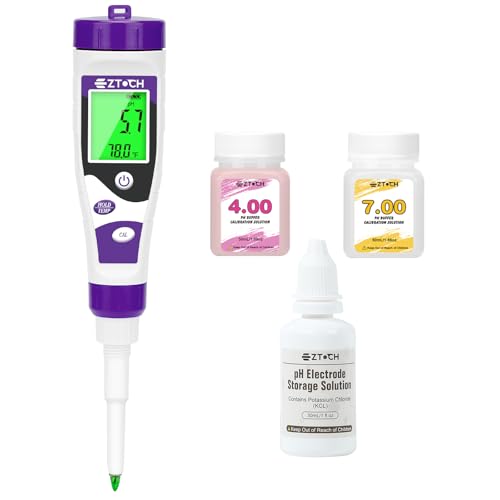
- Designed for canning, baking, brewing, and fermentation
- Stores readings through the YINMIK app
- Includes calibration and probe-protection solutions
Best For: Home food processing, sourdough, brewing, and fermentation tracking
Best Benchtop Option
Apera PH700 Benchtop Lab pH Meter
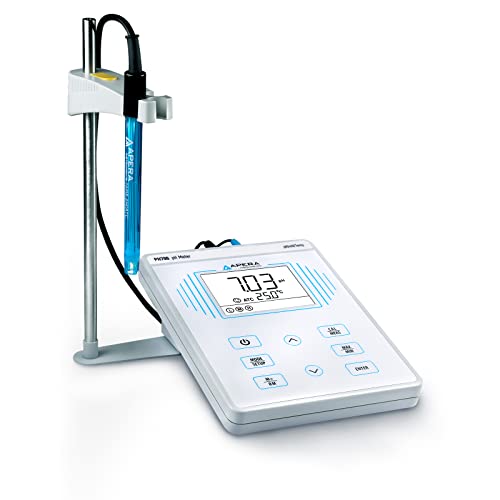
- 0.01 pH accuracy with automatic calibration
- Three-in-one pH/temperature electrode included
- Data storage and maximum/minimum reading modes
Best For: Organized benchtop testing of general water solutions
Best Food Fermentation Pick

- Direct-insertion spear probe for food and cosmetics
- 0.00–14.00 range with stated ±0.1 accuracy
- Three-point calibration and ATC
Best For: Sourdough, fermentation, canning, and thicker samples
Best Waterproof Flat-Electrode Option

- IP67 waterproof specification
- Flat-surface electrode design
- LCD temperature display and protective cap
Best For: Wet environments and flat-surface testing
Best Compact Water Testing Pick

- Stated ±0.01 pH accuracy with ATC
- Backlit LCD, memory, and compact design
- Includes batteries and three buffer powders
Best For: Hydroponics, aquariums, pools, and liquid testing
Best Value Waterproof Pick – Apera AI209 PH20
APERA INSTRUMENTS AI209 Value Series PH20 Waterproof pH Tester Kit, ±0.1 pH Accuracy
Check Price On AmazonThe Apera AI209 PH20 is a practical choice for shoppers comparing ph meters for routine water testing, gardening, and other indoor or outdoor tasks. It combines ±0.1 pH accuracy with automatic calibration, temperature compensation, and a waterproof design.
Best For: Buyers who want a straightforward, portable pH tester with useful accessories and long battery life.
Pros:
- Automatic calibration with buffer recognition simplifies setup.
- Automatic temperature compensation supports readings from 32 to 122°F.
- Includes a rugged case, pH 4 and pH 7 buffers, and a lanyard.
- Offers up to 2,000 hours of continuous operation on AAA batteries.
Cons:
- Its stated accuracy is ±0.1 pH rather than the tighter accuracy offered by some laboratory-style meters.
- The kit uses a plastic body and requires hand washing for care.
With stable-value recognition and a fast-response sensor, the PH20 is an appealing everyday option for users who prioritize convenience, portability, and low-maintenance operation.
Best Double-Junction Probe – Bluelab pH Pen
The Bluelab pH Pen is a versatile option among ph meters for hydroponics, aquariums, pools, brewing, and drinking water. Its double-junction probe is designed to reduce contamination, while the backlit display shows a 30-day calibration indicator.
Best For: Growers and water testers who want a floating, waterproof pen with a durable double-junction probe.
Pros:
- Provides ±0.1 pH readings in 0.1 pH increments.
- Uses a two-point calibration process with included pH 4, pH 7, and KCl sachets.
- Automatic temperature compensation helps account for temperature changes.
- Waterproof and floats, making it convenient for water-focused applications.
Cons:
- Readings in tap, reverse-osmosis, or distilled water may be slow or unstable because of low dissolved ions.
- The supplied calibration materials are sachets, so replacements will be needed after use.
The pH Pen stands out for broad application coverage and probe design. Its calibration reminder and included hydration solution are especially useful for users who want a repeatable maintenance routine.
Best Maintenance Bundle – Apera AI209-T PH20 Combo
The Apera AI209-T PH20 Combo Kit builds on a portable pH tester with a maintenance-focused accessory set. For shoppers comparing ph meters, it is a strong fit when probe care, organized calibration, and repeatable upkeep matter as much as basic measurement.
Best For: Users who want a pH tester bundled with cleaning and calibration-storage accessories.
Pros:
- Includes a probe cleaning brush to help remove contaminants.
- Comes with Apera’s CalBox for organizing solutions and reducing buffer waste.
- Offers automatic calibration with buffer recognition.
- Automatic temperature compensation supports testing from 32 to 122°F.
Cons:
- The added maintenance components may be unnecessary for buyers seeking only a basic tester.
- The supplied notes do not specify the kit’s accuracy rating or battery life.
This combo is most compelling for regular users who understand that probe cleaning and calibration storage affect long-term testing consistency. It packages those maintenance tools with the PH20 platform in a single purchase.
Best High-Accuracy Meter – Milwaukee MW102
The Milwaukee MW102 is a more measurement-focused choice among ph meters, pairing ±0.02 pH accuracy with a broad -2.00 to 16.00 pH range. Its separate temperature probe, large LCD, and included carrying case make it suited to users who want a portable meter with lab-style features.
Best For: Buyers who prioritize tighter stated accuracy and a wide measurement range over pen-style simplicity.
Pros:
- Provides high stated accuracy of ±0.02 pH.
- Measures across an extended -2.00 to 16.00 pH range.
- Includes automatic temperature compensation and a stainless temperature probe.
- Comes with a double-junction, gel-filled lab-grade pH electrode and carrying case.
Cons:
- Battery life is listed at 300 hours, considerably less than some long-runtime testers.
- It requires a 9V battery rather than AAA batteries.
- The separate temperature probe may add setup steps compared with all-in-one pens.
The MW102 is the strongest choice here for users who need tighter accuracy and an unusually broad pH range. Its component-style design favors performance and flexibility, though it may be less convenient for quick casual checks.
Best Overall Pocket Tester – Apera PH60 Waterproof pH Pocket Tester
If you want a versatile option among ph meters, the Apera AI311 combines 0.01 pH accuracy with automatic calibration, temperature compensation, and a replaceable probe. Its compact design and included case make it practical for routine testing in pools, hydroponics, beverages, and other water-based solutions.
Best For: Home users and professionals who need a portable, accurate pH tester for regular water-solution testing.
Pros:
- Offers 0.01 pH accuracy across a -2.00 to 16.00 pH range.
- Supports one- to three-point automatic calibration and recognizes five calibration solutions.
- Includes automatic temperature compensation, dual pH/temperature display, and stable-reading reminders.
- Complete kit includes calibration solutions, storage solution, batteries, lanyard, and a rugged case.
Cons:
- Automatic power-off occurs after eight minutes without operation.
- The replaceable glass probe still requires proper storage and maintenance.
The AI311 is a strong all-around choice when portability and dependable features matter. Its replaceable probe and included accessories add useful long-term practicality for frequent testing.
Best for Food and Fermentation – Bluetooth Food pH Meter
Among ph meters designed for kitchen use, this food pH meter stands out for its focus on canning, fermentation, baking, and brewing. Bluetooth connectivity lets you save readings in the YINMIK app, while the backlit display and included calibration supplies simplify routine measurements.
Best For: Home cooks, bakers, and fermentation hobbyists who want to measure and record pH readings for food projects.
Pros:
- Suitable for foods and processes including canning, sourdough, yogurt, beer, kombucha, wine, pickles, and sauces.
- Bluetooth app connectivity can store historical readings and automatically save up to 1,000 data points.
- Comes calibrated with pH 4.00 and 7.00 solutions, plus probe protective solution.
- Backlit display supports reading in dim conditions, and automatic shutdown helps conserve power.
Cons:
- Its food-focused design may be less suitable for users seeking a general-purpose laboratory meter.
- Using the Bluetooth data features requires the YINMIK app.
This is a practical choice for users who need more than a single pH reading. Its app-based recordkeeping is especially useful when tracking fermentation or documenting repeated canning measurements.
Best Benchtop Option – Apera PH700 Benchtop Lab pH Meter
For a more stationary setup, the Apera PH700 provides a benchtop format with 0.01 pH accuracy and a three-in-one pH/temperature electrode. This lab-style meter adds self-diagnosis, data storage, and maximum/minimum reading modes for users who want a more organized testing workstation.
Best For: Benchtop testing of general water solutions in home, workshop, or laboratory-style environments.
Pros:
- Provides 0.01 pH accuracy with one- to three-point automatic calibration.
- Includes a combined pH/temperature electrode with automatic temperature compensation.
- Maximum/minimum reading mode helps analyze measurements over a period of time.
- Offers 50 sets of data storage and includes calibration solutions and an electrode holder.
Cons:
- At three pounds, it is less portable than a pocket-style pH tester.
- The IP54 rating is described as spill-proof and dust-proof, not fully waterproof.
The PH700 makes sense when you prefer a stable benchtop workflow over handheld convenience. Its electrode holder, data storage, and reading-analysis modes provide useful structure for repeated measurements.
Best Food Fermentation Pick – YINMIK Spear-Probe pH Meter
Among ph meters, the YINMIK food pH tester stands out for applications where a spear probe can be inserted directly into a sample. Its 0.00–14.00 range, stated ±0.1 accuracy, automatic temperature compensation, and three-point calibration make it a practical option for fermentation and food preparation.
Best For: Sourdough, fermented foods, canning, sauces, and cosmetic or lotion testing.
Pros:
- Spear probe can test foods, cosmetics, and lotions without making a slurry.
- Automatic temperature compensation supports readings across changing temperatures.
- Includes three-point calibration and six buffer-solution powder packets.
- Protective cap includes a KCL-moistened sponge to help keep the probe moist.
Cons:
- Its stated ±0.1 accuracy may be less precise than some laboratory-oriented meters.
- The specialized spear design is more focused on food and semi-solid samples than general-purpose water testing.
If your main goal is checking pH in dough, fermented foods, or thicker products, the YINMIK’s direct-insertion spear probe is a useful advantage. It is less compelling if you only need a basic water tester.
Best Waterproof Flat-Electrode Option – Extech PH100 ExStik II
For shoppers comparing ph meters for demanding environments, the Extech PH100 offers a waterproof design with an IP67 specification and a flat-surface electrode. Its LCD temperature display and included protective sensor cap add practical features for routine measurements and cleanup.
Best For: Users who want a waterproof pH meter with a flat electrode for surface-oriented testing.
Pros:
- IP67 waterproof construction is suited to wet testing conditions.
- Flat-surface electrode design supports contact with flat samples or surfaces.
- LCD includes temperature display for added measurement context.
- Includes a protective sensor cap and has a one-year meter warranty.
Cons:
- The supplied notes do not specify the pH range or accuracy.
- The electrode should be rinsed with distilled water after use, adding a maintenance step.
- The listed battery requirement is four lithium-metal batteries.
The PH100 is a sensible choice when waterproofing and a flat electrode matter more than a compact pen-style design. Because the supplied specifications do not state accuracy or pH range, verify those details before buying for precision-critical work.
Best Compact Water Testing Pick – VIVOSUN Digital pH Meter
The VIVOSUN is one of the more versatile ph meters for everyday liquid testing. This compact pen-style tester provides stated ±0.01 pH accuracy, automatic temperature compensation, auto calibration, and a backlit LCD for reading water and other liquids.
Best For: Hydroponics, aquariums, pools, spas, drinking water, and general liquid testing.
Pros:
- Stated ±0.01 pH accuracy supports precise routine testing.
- Automatic temperature compensation adjusts readings to water temperature.
- Compact, lightweight design includes a backlit LCD and memory function.
- Includes batteries and three pH buffer powders for calibration.
Cons:
- The pen-style design is intended primarily for liquids rather than direct testing of solid or thick foods.
- Calibration supplies are limited to three included buffer powders.
- The supplied notes do not identify the exact IP or waterproof rating.
Choose the VIVOSUN if you need a portable meter for frequent liquid checks and value precise stated accuracy. Its broad application list makes it flexible, while the lack of a specified waterproof rating means users should follow care instructions carefully around water.
How We Picked the Best Ph Meters
We focused on the features that most affect real-world testing: stated accuracy, calibration options, probe construction, waterproofing, display readability, temperature measurement, and maintenance requirements. The lineup includes compact pocket testers, food-focused meters with spear probes, portable temperature-capable instruments, and a benchtop model for more controlled laboratory work.
We also considered the needs of beginners and frequent users. A meter with excellent specifications is not necessarily the best buy if calibration is difficult, the electrode is hard to maintain, or replacement parts are unavailable. Kits that include calibration or storage accessories may offer better value for routine testing.
Quick Comparison
| Type | Best suited to | Features to prioritize |
|---|---|---|
| Pocket tester | Water, hydroponics, aquariums | Water resistance, simple calibration, replaceable probe |
| Food pH meter | Fermentation and canning | Spear or flat electrode, food-safe handling, easy cleaning |
| Portable meter | Field and multipurpose testing | Temperature readout, durable probe, stable readings |
| Benchtop meter | Labs and repeatable measurements | Multi-point calibration, electrode compatibility, larger display |
Key Buying Factors for Ph Meters
Accuracy and Calibration
Match the meter’s accuracy to your application. Basic water monitoring may not require laboratory-level precision, while fermentation, research, and quality control can benefit from readings to 0.01 pH. Look for automatic or guided calibration and confirm which buffer solutions are required.
Probe Design and Replacement
The electrode is often the most important part of the instrument. A spear probe helps penetrate food samples, while a flat or general-purpose electrode may be more versatile for liquids and surfaces. Replaceable probes can extend the useful life of a meter and reduce long-term costs.
Durability and Temperature Compensation
Waterproof construction is useful for fieldwork and accidental splashes, but it does not eliminate the need for proper cleaning and storage. Automatic temperature compensation can improve consistency when sample temperatures vary, especially when testing water or food.
Maintenance and Storage
pH electrodes must stay hydrated and should not be stored dry unless the manufacturer specifically says otherwise. Check whether the package includes storage solution, calibration buffers, cleaning supplies, or a protective cap. These details can matter as much as the headline accuracy rating.
Who Should Buy Which Ph Meters?
Choose a compact pocket tester if you need quick checks for hydroponics, aquariums, pools, or general water quality. These models are convenient and easy to carry.
Choose a food-specific meter if you regularly test fermentation, sauces, preserves, or canning recipes. A suitable probe shape makes sampling safer and more consistent.
Choose a portable temperature-capable meter for varied field or production work where samples change temperature or require readings away from a bench.
Choose a benchtop model for frequent laboratory measurements, repeatable workflows, and applications where calibration control and electrode flexibility matter more than portability.