The right anemometer makes wind-speed and airflow measurements faster, clearer, and more repeatable. This roundup compares 10 practical options for HVAC work, outdoor recreation, weather monitoring, and everyday troubleshooting.
We focused on measurement capabilities, display design, portability, data features, and specialized tools such as vane probes, temperature readings, Bluetooth connectivity, and telescoping shafts.
Best 10 Anemometers Picks for 2026
Best All-Around Anemometer
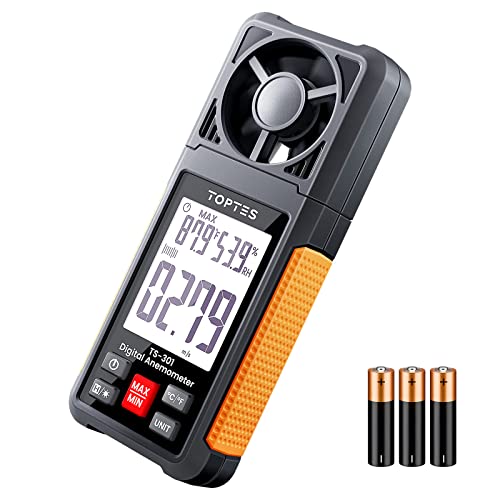
- Large backlit display
- Six wind-speed units
- Measures temperature and humidity
Best For: Outdoor activities and basic HVAC checks
Best Smart HVAC Anemometer

- Measures velocity, flow, and temperature
- Calculates volume flow
- Supports averaging and multiple probes
Best For: Professional HVAC airflow testing
Best Tripod-Mount Anemometer

- Five wind-speed units
- Includes wind chill and temperature
- Tripod hole for hands-free use
Best For: Portable HVAC and outdoor monitoring
Best Waterproof Anemometer

- Waterproof and floats
- Measures 100–5,500 ft/min
- Offers wind chill and averaging
Best For: Durable field and HVAC measurements
Best Value Handheld
HoldPeak 866B Digital Anemometer

- Measures light airflow and temperature
- MAX, MIN, and AVG wind readings
- Backlit, portable, and tripod-ready
Best For: Home HVAC checks and everyday outdoor wind measurements
Best for HVAC Flow
Extech AN300 Large Vane Thermo-Anemometer

- Measures velocity, airflow, and temperature
- 4-inch vane for larger ducts
- Reads airflow up to 99,999 CFM
Best For: HVAC assessments and larger ventilation systems
Best Connected Anemometer
BTMETER BT-100APP Bluetooth Meter

- Bluetooth app logging and data export
- Measures wind speed, temperature, and wind chill
- Tripod-ready for continuous testing
Best For: Logged HVAC tests and outdoor wind monitoring
Best Professional HVAC Anemometer

- Measures wind speed, temperature, and CFM/CMM
- Stores 600 data groups and exports to PC
- Extendable sensor with backlit display
Best For: HVAC balancing and recorded airflow analysis
Best Simple Portable Anemometer
Mcbazel 3-in-1 Digital Wind Meter

- Measures speed, temperature, and Beaufort level
- Five selectable wind-speed units
- Backlit display with MAX/MIN/AVG and hold
Best For: Quick HVAC, sailing, fishing, and outdoor checks
Best Simple Pick
testo 405i Wireless Hot-Wire Meter

- Measures velocity, temperature, and in-duct airflow
- 15-inch telescopic shaft for tight spaces
- Bluetooth app supports graphs and reports
Best For: Professional HVAC inspections and digital airflow reporting
Best All-Around Anemometer – TopTes TS-301
The TopTes TS-301 is a practical choice among anemometers for outdoor activities and everyday airflow checks. Its large backlit display, six wind-speed units, and compact design make readings easy to view and carry.
Best For: Sailing, drone flying, golf, shooting, hiking, and basic HVAC or vent checks.
Pros:
- Large 2.26-inch backlit LCD is easy to read.
- Measures wind speed in six units, including mph, knots, and m/s.
- Also measures relative humidity and temperature.
- Includes batteries, a storage pouch, and a three-year warranty.
Cons:
- Temperature and humidity sensors may need at least 30 minutes to adjust to a new environment.
- Automatic shutdown occurs after 10 minutes of inactivity.
Choose this model if you want a lightweight, versatile wind meter with environmental readings and simple one-handed operation. It is especially convenient for users who move between outdoor activities and basic indoor airflow checks.
Best Smart HVAC Anemometer – Testo 410i
Testo 0560 1410 410I Vane Anemometer Smart and Wireless Probe, 1" Height, 2" Width, 6" Length
Check Price On AmazonThe Testo 410i is a professional-leaning option among anemometers, combining vane-style airflow measurement with smartphone operation. It measures air velocity, volume flow, and temperature while supporting duct-dimension input and averaging functions.
Best For: HVAC technicians measuring ducts, registers, outlets, and system airflow balance.
Pros:
- Measures air velocity, volume flow, and temperature.
- Automatically calculates volume flow after duct dimensions are entered.
- Supports timed and multipoint averaging for airflow profiles.
- Multiple smart probes can be used to measure several outlets simultaneously.
Cons:
- Smartphone operation may be less convenient than a standalone display.
- Its feature set is more specialized for HVAC work than casual outdoor use.
This is a strong fit for users who need more than a simple wind-speed reading. Its averaging and volume-flow features are useful when diagnosing airflow and balancing HVAC systems.
Best Tripod-Mount Anemometer – BTMETER BT-100
The BTMETER BT-100 is a versatile handheld anemometer for wind-speed, temperature, and wind-chill readings. Its backlit screen, tripod mounting hole, and included carry case make it useful for both portable checks and hands-free monitoring.
Best For: HVAC work, drone and RC activities, shooting, sailing, and situations requiring tripod mounting.
Pros:
- Measures wind speed in five units and displays temperature in Celsius or Fahrenheit.
- Includes wind-chill readings and a bright backlit LCD.
- Tripod thread supports continuous hands-free measurements.
- Includes batteries, neck strap, carry bag, and a one-year warranty.
Cons:
- Temperature measurement is limited to -10°C to 60°C (14°F to 113°F).
- It uses two AAA batteries, so battery life depends on usage.
Consider the BT-100 if mounting flexibility matters as much as portability. Its stated accuracy, low-airflow sensitivity, and tripod hole make it suitable for both field activities and duct or vent measurements.
Best Waterproof Anemometer – Extech 45118
The Extech 45118 is a compact waterproof thermo-anemometer designed for portable air-velocity measurements. It covers 100 to 5,500 ft/min, includes wind-chill readings, and offers selectable averaging for field measurements.
Best For: HVAC and air-quality checks in demanding field environments.
Pros:
- Waterproof housing floats and is rated for a six-foot drop.
- Measures air velocity from 100 to 5,500 ft/min.
- Provides wind chill and 5-, 10-, or 13-second averaging.
- Compact design includes a 43-inch lanyard and CR2032 battery.
Cons:
- The supplied notes identify a temperature range of 0°F to 122°F, which is narrower than some alternatives.
- Its ft/min-focused specification may be less convenient for users wanting several selectable wind-speed units.
This model stands out when durability and weather resistance are priorities. The floating waterproof construction, drop rating, and averaging options make it a sensible choice for field technicians who need dependable portable readings.
Best Value Handheld – HoldPeak 866B Digital Anemometer
The HoldPeak 866B is a practical choice among anemometers for checking light airflow at HVAC vents, exhaust fans, and outdoor locations. Its handheld design, multiple wind-speed units, and temperature readings make it useful for everyday troubleshooting and basic wind checks.
Best For: Home HVAC checks, outdoor airflow measurements, and users who want a portable meter with a backlit display.
Pros:
- Measures wind speeds from 0.67 to 67.1 mph with ±5% accuracy.
- Includes MAX, MIN, and AVG readings, plus wind chill and temperature measurements.
- Backlit display, non-slip grips, wrist strap, carrying case, and tripod mounting support.
Cons:
- Tripod is not included.
- Backlight turns off after 15 seconds.
- CFM must be calculated using the airflow reading and vent area.
Choose the 866B if you want a straightforward anemometer for light-airflow comparisons and occasional outdoor use without carrying a larger professional kit.
Best for HVAC Flow – Extech AN300 Large Vane Thermo-Anemometer
The Extech AN300 is one of the more HVAC-focused anemometers in this group, combining air velocity, calculated air flow, and temperature measurements. Its large 4-inch vane is designed for readings in larger ducts and ventilation systems.
Best For: HVAC technicians and users measuring airflow in larger ducts, vents, and ventilation systems.
Pros:
- Measures air velocity from 40 to 5,900 ft/min and air flow up to 99,999 CFM.
- Large 4-inch vane suits larger ducts and ventilation areas.
- Displays air velocity or flow with temperature and includes MIN/MAX and data hold.
- Includes four AAA batteries and a hard carrying case.
Cons:
- The larger vane and 10.6-inch length make it less compact than handheld pocket-style meters.
- Its stated air-velocity range begins at 40 ft/min, so it is not specified for the lowest airflow levels.
The AN300 is the stronger fit when direct CFM measurement and a larger sensing vane matter more than minimal size or highly portable storage.
Best Connected Anemometer – BTMETER BT-100APP Bluetooth Meter
The BTMETER BT-100APP adds Bluetooth connectivity and app-based logging to a compact handheld anemometer. It measures low airflow, temperature, and wind chill while letting compatible phones and tablets record and export readings for longer testing sessions.
Best For: Users who want wireless data logging for HVAC checks, weather monitoring, sailing, shooting, or other outdoor activities.
Pros:
- Measures wind speed from 0.67 to 67.1 mph with ±5% accuracy.
- Bluetooth app supports data logging and export to Excel or TXT formats.
- Offers five wind-speed units, temperature readings, wind chill, and MAX/MIN/AVG functions.
- Includes a 1/4-inch metal tripod mount and adjustable power-off settings.
Cons:
- App functionality requires a compatible iPhone, iPad, Android phone, or tablet.
- CFM is calculated manually using air velocity and duct area.
- The supplied notes do not specify a warranty or included carrying case.
The BT-100APP is the best choice here for repeat measurements and record keeping, particularly when exporting test data is more useful than taking one-off readings.
Best Professional HVAC Anemometer – BTMETER Pro CFM Anemometer
For HVAC balancing and detailed airflow work, this professional anemometer combines wind-speed, temperature, and CFM/CMM readings with substantial data-recording capability. Its extendable separated sensor and backlit display are practical when checking vents, registers, or dust-collection systems.
Best For: HVAC troubleshooting, air balancing, and users who need stored data for later analysis.
Pros:
- Measures wind speed in five units, plus temperature and airflow in CFM/CMM.
- Stores up to 600 groups of readings and can export data to a PC.
- Supports current, maximum, minimum, 2/3 maximum, and average readings.
- Extendable sensor, replaceable vane, carrying case, and backlit LCD add practical versatility.
Cons:
- Its broader HVAC feature set may be more than casual users need.
- Automatic power-off occurs after five minutes without operation.
This is the most capable choice of the three for airflow documentation and balancing tasks. Choose it when CFM measurement, data export, and a separated sensor matter more than a minimalist design.
Best Simple Portable Anemometer – Mcbazel 3-in-1 Digital Wind Meter
This compact anemometer keeps everyday wind checks straightforward by displaying wind speed, temperature, and Beaufort level together. Multiple units, a backlight, and MAX/MIN/AVG functions make it useful across HVAC, sailing, fishing, and general indoor or outdoor measurements.
Best For: Portable wind checks where simple operation and simultaneous speed and temperature readings are priorities.
Pros:
- Measures wind speed, wind temperature, and Beaufort scale level.
- Offers m/s, km/h, knots, ft/s, and mph units.
- Displays speed and temperature together on a double-line LCD.
- Includes backlight, data hold, MAX/MIN/AVG functions, and low-battery indication.
Cons:
- AAA batteries are required but are not included.
- It does not list CFM measurement or data export capability.
The Mcbazel is a sensible pick for users who want a lightweight, easy-to-carry anemometer without specialized airflow-recording features. Its clear display and broad unit selection suit quick field measurements.
Best Simple Pick – testo 405i Wireless Hot-Wire Meter
The testo 405i is a smart hot-wire anemometer designed for HVAC inspections and in-duct measurements. Its hinged telescopic shaft extends up to 15 inches, while Bluetooth connectivity lets you view readings remotely and organize results through the Smart Probe App.
Best For: Professional HVAC technicians measuring airflow in ducts, vents, and other hard-to-reach spaces.
Pros:
- Measures air velocity, temperature, and in-duct airflow, with volume-flow calculations when duct dimensions are entered.
- Telescopic shaft extends up to 15 inches for confined or recessed measurement points.
- Bluetooth 4.0 supports remote readings from a smartphone or tablet.
- App provides tables, graphs, storage, retrieval, and custom reporting.
Cons:
- App-based operation requires a compatible smartphone or tablet for its wireless features.
- The listed response time is five seconds.
This is the strongest option for technicians who value remote operation and organized digital reporting. Its telescopic hot-wire probe is particularly useful when ducts or vents are difficult to access directly.
How We Picked These Anemometers
We selected models that cover a broad range of real-world needs rather than treating every meter as interchangeable. The lineup includes compact handheld units for quick outdoor readings, vane Anemometers for larger airflow streams, thermo-Anemometers that add temperature data, and smart probes designed to work with a phone.
Our comparison emphasizes useful specifications and features: measuring range, accuracy, airflow calculations, display readability, portability, durability, data storage, and suitability for HVAC or in-duct testing. We also considered whether each model is better suited to occasional home use, field work, or repeated professional measurements.
Quick Comparison
| Best for | Look for |
|---|---|
| General wind checks | Compact design, backlit display, and simple controls |
| HVAC airflow testing | CFM calculations, temperature readings, and a stable vane or probe |
| In-duct measurements | Telescoping shaft, remote probe, and flexible positioning |
| Data logging | Internal memory, Bluetooth, app support, or PC export |
| Outdoor recreation | Fast response, portability, and a readable screen in changing light |
Key Buying Factors for Anemometers
Measurement Type and Range
Check whether the meter measures wind speed only or also calculates air volume such as CFM. A vane design is useful for general airflow, while a hot-wire or thermo-anemometer can be more sensitive in ducts and confined spaces. Make sure the stated range covers your intended application.
Probe Design and Access
A handheld sensor works well for open-air readings, but HVAC technicians may benefit from a remote or telescoping probe. Longer shafts help reach registers, grilles, and ducts without placing the display in the airflow.
Readability and Controls
Backlighting, large digits, hold functions, and clear unit selection make field measurements easier. If you work outdoors or in dim mechanical rooms, screen visibility can matter as much as top-end accuracy.
Logging and Connectivity
For occasional checks, a basic display may be enough. Bluetooth, app integration, onboard memory, and PC export are more valuable when you need to document readings, compare multiple locations, or create service reports.
Durability and Operating Conditions
Consider water resistance, battery life, sensor protection, and the expected temperature range. Waterproofing can be especially helpful for outdoor use, but it does not replace careful handling of the sensor and controls.
Who Should Buy Which Anemometers?
Homeowners and hobbyists: Choose a compact, easy-to-read handheld meter for checking fans, vents, weather conditions, or recreational wind speeds.
HVAC technicians: Prioritize CFM measurement, temperature capability, a reliable vane or thermo probe, and a design that can reach registers or ducts.
Professionals documenting jobs: Select a model with data storage, Bluetooth, app support, or PC export so readings can be reviewed and shared later.
Sailors, drone operators, and outdoor users: Favor portability, quick response, a backlit display, and enough range for changing wind conditions. The best choice is the one whose sensor design and data features match how often and where you measure.