Choosing the right particle counter can make air quality testing faster, clearer, and far more useful. Whether you’re checking indoor dust, tracking HVAC performance, or monitoring a work area, the best unit depends on your measurement range and workflow.
This roundup covers 10 options with different strengths, from compact monitors to handheld tools with broader detection and data features.
Best 10 Particle Counters for Air Testing Picks for 2026
All-in-One Air Check
Temtop 7-in-1 Air Quality Monitor

- Tracks PM2.5, PM10, HCHO, TVOC, temp, humidity, and AQI
- 12-hour trend histogram helps spot pollution spikes
- USB export to Excel for reporting without an app
Best For: Renovation monitoring and portable home air testing
Cleanroom-Focused Counter
Cleanroom PDF Reporter Particle Counter

- Measures 6 particle sizes from 0.3μm to 10μm
- Counts and weighs particles for flexible testing
- One-click PDF export supports audits and reports
Best For: Cleanrooms, audits, and filter leak testing
Multi-Gas Sampling Hub
12-in-1 Active Sampling Monitor

- Measures PM1.0/2.5/10 plus CO2, CO, HCHO, and TVOC
- Built-in gas pump enables active sampling
- Stores up to 10,000 records with CSV export
Best For: Broad indoor air testing with logging and alarms
Compact Dust Counter
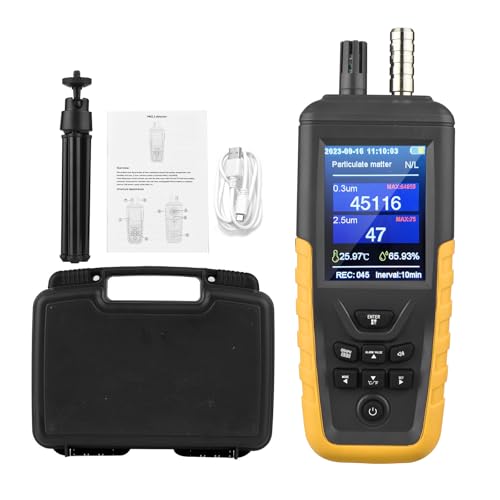
- Measures PM0.3, PM2.5, and PM10
- Rechargeable battery lasts up to 9 hours
- Tripod holes and 999-record memory aid inspections
Best For: Quick dust inspections and portable spot testing
Portable PM Monitor

- PM2.5 and PM10 visual readings
- 12-hour data histogram
- Handheld design with back stand
Best For: Portable indoor/outdoor PM checking with simple trend tracking
Multi-Size Dust Counter
PerfectPrime AQ9600 Particle Counter

- Measures 0.3µm, 2.5µm, and 10.0µm
- Custom sampling and alarm settings
- Semiconductor laser detection
Best For: Technical users needing adjustable multi-size particle measurements
Advanced Handheld Counter
Temtop Airing 2000 Particle Counter

- Counts 0.3µm, 0.5µm, and 1.0µm particles
- Logs data to 32GB memory
- Includes temperature and humidity sensors
Best For: Inspections and lab-style checks with logging and export
Cleanroom-Friendly Monitor
PM0.3/2.5/10 Air Tester with Tripod

- Tracks PM0.3, PM2.5, and PM10
- Stores up to 999 readings
- Includes tripod and PC transfer support
Best For: Hands-free indoor/outdoor air checks with logged readings
Pro Handheld Counter
- Measures 0.3 μm to 1.0 μm plus PM2.5/PM10/TSP
- Includes 32GB storage and USB transfer
- Handheld design with temp and humidity sensors
Best For: Field air-quality checks with onboard logging
Portable Data Logger
3-Channel Dust Particle Counter
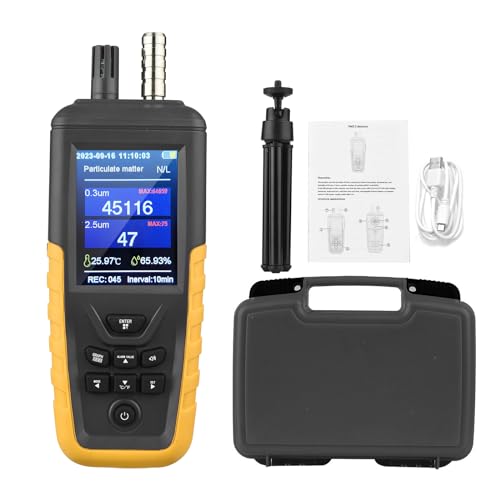
- Detects six particle sizes from 0.3 μm to 10 μm
- Stores 999 sets and shows data curves
- Runs up to 10 hours on a 2000mAh battery
Best For: Portable cleanroom and contamination monitoring
All-in-One Air Check – Temtop 7-in-1 Air Quality Monitor
If you want particle counters for air testing that also handle broader indoor air quality checks, this Temtop unit is built for practical monitoring. It tracks PM2.5 and PM10 plus formaldehyde, TVOC, temperature, humidity, and AQI, and it’s designed for trend detection with a 12-hour histogram rather than just one-off spot readings.
Best For: Renovation monitoring, home air checks, and users who want particle data plus gas and comfort readings in one portable device.
Pros:
- Measures 7 parameters, including PM2.5, PM10, HCHO, TVOC, temperature, humidity, and AQI
- Built-in 12-hour trend histogram helps reveal pollution spikes and ventilation changes
- USB data export to Excel supports longer-term reporting without an app or subscription
- Portable battery mode plus plug-in continuous monitoring for flexible use
Cons:
- Not intended for gas or CO leak detection
- Accuracy depends on following warm-up and contamination-avoidance guidance
This is a strong all-around option if you need particle counters for air testing that go beyond dust counts and into indoor source tracking. It balances portability, reporting, and easier everyday operation.
Cleanroom-Focused Counter – Cleanroom PDF Reporter Particle Counter
For particle counters for air testing in controlled environments, this handheld model focuses on multi-size particle measurement and documentation. It counts six particle sizes from 0.3μm to 10μm, supports both particle counting and mass weighing, and includes temperature and humidity readings for fuller validation.
Best For: Cleanroom checks, filter leak testing, and audit-ready documentation in industrial or laboratory settings.
Pros:
- Six-channel detection covers 0.3μm, 0.5μm, 1.0μm, 2.5μm, 5.0μm, and 10μm
- Supports both pcs/L counting and μg/m³ weighing modes
- One-click PDF export plus USB transfer makes recordkeeping easier
- Tripod mount, audible alarm, and 9+ hour battery life support longer inspections
Cons:
- More specialized than basic home air monitors
- Best value comes when you need reporting and cleanroom-style workflows
This is a purpose-built choice when your particle testing needs include formal documentation and multiple size channels. It’s especially useful if you need a portable instrument that can support cleanroom classification work.
Multi-Gas Sampling Hub – 12-in-1 Active Sampling Monitor
If you need particle counters for air testing along with broader environmental monitoring, this 12-in-1 unit covers a lot of ground. It measures PM1.0, PM2.5, and PM10 with six-channel particle counting, then adds CO2, CO, HCHO, TVOC, temperature, and humidity, plus active sampling through an integrated gas pump.
Best For: Users who want one monitor for particle counts, gas readings, data logging, and adjustable alert thresholds.
Pros:
- Six-channel particle counting with PM1.0/PM2.5/PM10 and AQI display
- Integrated gas pump supports active sampling
- Logs up to 10,000 records with CSV export and customizable intervals
- Alarm thresholds and calibration options add flexibility for ongoing testing
Cons:
- More complex than a basic dust meter
- Needs a 10-minute warm-up for stable readings
This model is a strong pick when you want one handheld device to cover more than just particles. It’s especially practical for users who value data logging, threshold alarms, and more active sampling behavior.
Compact Dust Counter – Portable 3-Channel Dust Meter
For straightforward particle counters for air testing, this handheld laser meter keeps the focus on dust and particle monitoring. It measures PM0.3, PM2.5, and PM10, shows data on a 3.2-inch TFT display, and includes temperature, humidity, and saved records for practical on-site checks.
Best For: Users who want a compact, rechargeable particle tester for quick inspections and industrial spot checks.
Pros:
- Detects PM0.3, PM2.5, and PM10 with clear real-time display
- Rechargeable 2000mAh battery provides up to 9 hours of use
- Tripod mounting holes support hands-free continuous measurement
- Stores 999 records and shows a data curve for review
Cons:
- Only three particle channels, so it’s less detailed than higher-end counters
- Does not include the broader gas monitoring found on multi-function units
This is a solid practical choice if your priority is a portable dust counter rather than a full air-quality station. It fits well for routine checks where ease of use and battery life matter most.
Portable PM Monitor – Temtop P600 PM2.5 Monitor
If you want a straightforward option in particle counters for air testing, the Temtop P600 focuses on PM2.5 and PM10 readings with a clear visual display. Its portable, handheld design makes it practical for quick checks indoors or outdoors, and the built-in histogram helps you review air trends over the past 12 hours.
Best For: Homeowners, renters, and field users who want a portable PM2.5/PM10 checker with trend tracking.
Pros:
- Measures PM2.5 and PM10 with color-coded health indicators.
- Stores and displays up to 12 hours of data in histogram form.
- Handheld design with a back stand for easy daily use.
- Industrial-grade sensor is rated for over 20,000 hours of lifespan.
Cons:
- Focuses on PM2.5 and PM10 rather than multiple particle size counts.
- No battery details are listed in the supplied notes.
Overall, the P600 is a practical pick if you care most about readable PM pollution data and simple trend monitoring. It is less specialized than a lab-style counter, but its portability and data history make it useful for everyday air checks.
Multi-Size Dust Counter – PerfectPrime AQ9600 Particle Counter
PerfectPrime AQ9600, PM 0.3/2.5/10 Μm Air Quality Particle/Dust Detector/Counter
Check Price On AmazonFor buyers comparing particle counters for air testing, the PerfectPrime AQ9600 stands out because it measures 0.3µm, 2.5µm, and 10.0µm particles. It also includes configurable sampling and alarm settings, which makes it more useful when you need a more technical dust or particle readout.
Best For: Users who need multi-size particle measurements and adjustable sampling settings.
Pros:
- Tests particle sizes at 0.3µm, 2.5µm, and 10.0µm.
- Uses semiconductor lasers for detection.
- Custom sampling time can be set from 1 second to 59 minutes 59 seconds.
- Alarm levels are configurable across broad ranges.
Cons:
- Battery is not included with the unit.
- The notes only specify an adapter in the included components list.
This model is a strong fit if your testing needs go beyond simple PM readings and require multi-size detection. The adjustable sampling options add flexibility, but it is still best for users comfortable with a more technical instrument.
Advanced Handheld Counter – Temtop Airing 2000 Particle Counter
The Temtop Airing 2000 is built for more detailed particle counters for air testing, measuring 0.3µm, 0.5µm, and 1.0µm particle counts alongside PM2.5, PM10, and TSP. With temperature and humidity sensors, onboard logging, and USB export, it is a strong choice when you need both particle data and easy recordkeeping.
Best For: Lab work, inspections, and environmental checks that need particle counts plus data logging.
Pros:
- Measures particle counts at 0.3µm, 0.5µm, and 1.0µm.
- Also tracks PM2.5, PM10, TSP, temperature, and humidity.
- 32GB internal memory logs data at user-set intervals.
- USB export lets you transfer records without software.
Cons:
- Heavier and more specialized than a basic handheld air monitor.
- Battery life is listed for over 4 hours of continuous monitoring, so very long sessions may need planning.
Overall, this is the most feature-rich option here for users who want particle counts plus environmental context and easy data export. It is better suited to inspection or industrial-style use than casual, quick spot checks.
Cleanroom-Friendly Monitor – PM0.3/2.5/10 Air Tester with Tripod
If you need particle counters for air testing that can track small dust changes and also log basic room conditions, this handheld-to-tripod monitor is built for practical spot checks. It measures PM0.3, PM2.5, and PM10, shows temperature and humidity, and stores readings for later review.
Best For: Long-duration indoor or outdoor air checks where you want live readings, basic data logging, and hands-free tripod use.
Pros:
- Detects PM0.3, PM2.5, and PM10 with claimed accuracy of ±12 μg/m³
- 3.2-inch TFT color display shows real-time data, trends, and history
- Stores up to 999 sets of data and supports PC transfer via included cable
- 2000mAh rechargeable battery plus optional direct USB power
Cons:
- Battery life is listed at up to 9 hours, so very long sessions may still need power planning
- Designed for general monitoring, not a dedicated high-end lab particle analyzer
Overall, this is a solid fit if you want a compact particle counter that balances visible live feedback, storage, and flexible powering. The included tripod is a useful touch for extended monitoring sessions.
Pro Handheld Counter – Pump-Suction Particle Meter
For buyers comparing particle counters for air testing in workshops, labs, or facility checks, this Temtop handheld unit focuses on broader particulate monitoring and straightforward field use. It measures 0.3 μm, 0.5 μm, and 1.0 μm particles, plus PM2.5, PM10, and TSP, while also showing temperature and humidity.
Best For: Professional handheld air-quality assessments where you want pump-suction sampling, data storage, and simple operation.
Pros:
- Measures 0.3 μm, 0.5 μm, 1.0 μm, PM2.5, PM10, and TSP
- Includes temperature and humidity sensing for broader environmental context
- Large display and simple button controls make it easy to use
- 32GB internal storage and USB data transfer support extended logging
Cons:
- Battery life is listed at over 4 hours, which is shorter than some monitor-style options
- Handheld format may be less convenient for long stationary checks without support
This model is best if you want a more professional-feeling handheld counter with pump suction and substantial onboard storage. It leans toward practical field assessment rather than desk-style monitoring.
Portable Data Logger – 3-Channel Dust Particle Counter
This particle counter for air testing is aimed at users who want detailed dust measurements in a compact, portable format. It uses laser scattering to detect multiple particle sizes, displays PM2.5 and air quality data clearly, and supports both handheld use and tripod mounting.
Best For: Portable monitoring in industrial, cleanroom, and contamination-check applications that benefit from data storage and a bright display.
Pros:
- Detects 0.3 μm, 0.5 μm, 1.0 μm, 2.5 μm, 5.0 μm, and 10 μm particles
- Stores 999 sets of data and supports viewing data curves
- 3.2-inch full-color TFT display helps make readings easy to review
- 2000mAh battery lasts up to 10 hours and recharges via USB
Cons:
- Accuracy is specified for PM2.5, so not every measurement is described with the same precision
- ABS construction and portable design are practical, but this is still a general-purpose monitor rather than a specialized lab system
For users who want a compact monitor with wide particle-size coverage and simple data review, this is a well-rounded option. The combination of storage, display quality, and tripod compatibility makes it especially useful for repeated checks.
How We Picked These Particle Counters for Air Testing
We focused on practical factors that matter in real-world use: particle size channels, detection sensitivity, portability, display clarity, data logging, rechargeable power, and whether the device is better suited to casual indoor monitoring or more serious spot-checking. For Particle Counters for Air Testing, the biggest advantage is getting a model that matches your expected particle sizes and measurement environment.
Quick Comparison
In general, simpler monitors are best for basic indoor awareness, while handheld counters with pump suction, broader particle channels, and exportable data are better for troubleshooting and repeated measurements. If you need fast checks around a room, a lighter monitor may be enough. If you need more consistent sampling, choose a more specialized handheld counter.
Key Buying Factors for Particle Counters for Air Testing
Particle Size Channels
Look at which particle sizes are measured, such as PM0.3, PM2.5, PM10, or broader micron ranges. More channels can help you understand fine dust versus larger particles, but only if those ranges match your testing needs.
Sampling Method
Some devices rely on passive monitoring, while others use a pump or active suction for more controlled sampling. For repeatable checks or worksite use, active sampling is usually more dependable.
Accuracy and Sensitivity
Higher sensitivity matters when you need to detect small changes or low-level contamination. For general indoor air awareness, a consumer-grade monitor may be sufficient, but for more detailed assessments, choose a model with stronger detection specs and stable reporting.
Data and Usability
Features like data logging, USB transfer, and readable historical trends can be valuable if you need to compare results over time. Temperature and humidity readings are also useful context because they can affect how airborne particles behave.
Who Should Buy Which Particle Counters for Air Testing?
Homeowners and renters should favor simple, easy-to-read monitors for everyday air checks. HVAC techs, facility managers, and inspection teams should lean toward handheld particle counters with more channels, active sampling, and data export. If you need portability first, choose a compact rechargeable model; if you need repeatable technical testing, prioritize measurement control and documentation.
The best choice is the one that fits how you’ll use it most. For occasional indoor checks, convenience matters most. For more serious air testing, consistency, sampling control, and data handling should lead the decision.