The best microcontroller kits make it easier to move from a wiring diagram to a working project. This lineup covers beginner-friendly Arduino bundles, Raspberry Pi Pico boards, ESP32 wireless platforms, and camera-focused development kits.
Use the guide below to compare included hardware, programming support, connectivity, and project potential before choosing a kit for learning, teaching, IoT, or hands-on prototyping.
Best 10 Microcontroller Kits Picks for 2026
Best Beginner Project Kit

- 22+ guided Arduino lessons
- Sensors, motors, displays, and controls included
- Solderless setup for beginners
Best For: First Arduino projects, STEM learning, and family builds
Best Wireless Development Board

- ESP32-S3 dual-core processor
- Wi-Fi and Bluetooth 5.0 built in
- USB-C, HID, and MicroPython support
Best For: IoT, wireless, and advanced embedded prototypes
Best for Large Arduino Builds
Mega 2560 Complete Starter Kit

- 54 digital I/O and 16 analog inputs
- 35+ projects and 200+ components
- RFID, RTC, sensors, motors, and displays
Best For: Larger multi-sensor projects and advancing makers
Best Guided IoT Learning Kit

- Original UNO R4 WiFi included
- 300+ components and 50+ projects
- 100+ video lessons for beginners
Best For: Video-led Arduino learning and beginner IoT projects
Best Pico Learning Kit
Raspberry Pi Pico Basic Starter Kit

- RP2040 board with LCD, servo, sensor, RGB LEDs, and buzzer
- Supports MicroPython, C/C++, and Piper Make
- Includes tutorials and sample code for guided projects
Best For: STEM beginners and Raspberry Pi Pico learners
Best Advanced ESP32 Kit
ESP32-S3 Camera Ultimate Starter Kit

- ESP32-S3 with camera, Wi-Fi, Bluetooth 5 LE, and USB-OTG
- Includes 243 components, memory card, and reader
- Covers MicroPython, C, Processing, and 121 guided projects
Best For: Makers exploring wireless and camera projects
Best Arduino-Compatible Kit
Mega2560 and Nano Project Starter Kit
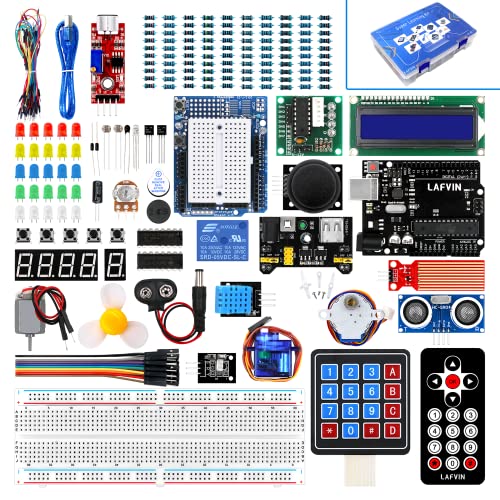
- Works with Arduino IDE and Mega2560/Mega328 Nano platforms
- Includes motors, LCDs, displays, sensors, and controls
- Provides 20-plus lessons with code, libraries, and datasheets
Best For: Arduino beginners learning through guided projects
Most Comprehensive Learning Kit
Raspberry Pi Pico W Ultimate Starter Kit

- 450+ components and 117 projects
- 27 expert-led video tutorials
- MicroPython, C/C++, and Piper Make support
Best For: Beginners wanting extensive IoT practice and guided instruction
Best Basic ESP32 Introduction
LAFVIN ESP32 Basic Starter Kit

- Beginner-focused ESP32 learning kit
- Includes OLED, DHT11, PIR, relay, and breadboard
- Tutorial includes lessons and code
Best For: Newcomers learning basic electronics with Arduino IDE
Best Step-by-Step ESP32 Projects
ELEGOO ESP-32 Super Starter Kit

- 30+ guided projects with code and diagrams
- Dual-core ESP-32 with Wi-Fi and Bluetooth 4.2
- 35+ modules for circuits and IoT builds
Best For: Learners progressing from basics to practical ESP32 applications
Best Beginner Project Kit – UNO R3 Super Starter Kit
For anyone comparing microcontroller kits for hands-on learning, the ELEGOO UNO R3 Super Starter Kit offers a structured introduction to Arduino projects. Its 22+ guided lessons cover LEDs, sensors, displays, motors, and input devices, while the solderless breadboard keeps early builds approachable.
Best For: Beginners, homeschool projects, coding clubs, family builds, and introductory STEM classrooms.
Pros:
- Includes 22+ guided projects with example code and a downloadable tutorial.
- Provides a broad mix of sensors, displays, motors, controls, and basic components.
- Solderless setup and a pre-soldered LCD help beginners focus on wiring and code.
Cons:
- The UNO R3 has modest 2 KB SRAM and a 16 MHz processor.
- The breadboard power module should not be used with input above 9V.
This is a practical all-in-one starting point for learning core Arduino concepts without buying components individually. It is better suited to guided entry-level projects than demanding wireless or memory-intensive applications.
Best Wireless Development Board – Arduino Nano ESP32
For microcontroller kits focused on connected devices, the Arduino Nano ESP32 combines an ESP32-S3 dual-core processor with Wi-Fi, Bluetooth 5.0, USB-C, HID support, and MicroPython compatibility. It is a compact board for developers moving beyond basic wired Arduino experiments.
Best For: IoT prototypes, wireless sensors, smart-home projects, wearables, HID devices, and MicroPython experimentation.
Pros:
- ESP32-S3 dual-core processor runs at up to 240 MHz.
- Built-in Wi-Fi and Bluetooth 5.0 support wireless project connections.
- Supports USB-C programming, HID applications, and MicroPython.
Cons:
- This listing is primarily a development board rather than a full component-filled starter kit.
- Its advanced features may be more than a first-time learner needs.
The Nano ESP32 is a strong choice when connectivity and processing capability matter more than a large assortment of sensors and parts. Plan to source project-specific components separately if you need a complete build kit.
Best for Large Arduino Builds – Mega 2560 Complete Starter Kit
Among microcontroller kits for larger multi-part projects, the ELEGOO Mega 2560 Starter Kit stands out with 54 digital I/O pins, 16 analog inputs, four hardware serial ports, and 256 KB of flash. Its 35+ guided projects and 200+ components support a broad learning path.
Best For: Students, coding clubs, robotics and electronics projects, and makers combining many sensors, displays, and motors.
Pros:
- Offers more I/O, memory, and serial ports than a typical UNO-class board.
- Includes 200+ components such as RFID, RTC, motion, distance, environmental, and motor modules.
- Provides 35+ guided lessons with a storage case and small-parts organization.
Cons:
- The large component count can feel overwhelming for absolute beginners.
- The recommended age is 13 years and up.
This kit makes sense when a standard UNO would run out of pins or project space. It offers considerable value for learners who want to progress from basic circuits into more involved monitoring, access-control, and interactive builds.
Best Guided IoT Learning Kit – UNO R4 WiFi Elite Explorer
For buyers seeking microcontroller kits with a structured video curriculum, the SunFounder Elite Explorer Kit pairs an original Arduino UNO R4 WiFi with 300+ components, 50+ projects, and more than 100 free video lessons. Built-in Wi-Fi and Bluetooth expand the kit from basic circuits into IoT experiments.
Best For: Beginners ages 8+, students, teachers, aspiring makers, and learners who prefer video-led Arduino and IoT instruction.
Pros:
- Includes 50 projects divided into basic, fun, and IoT activities.
- Offers 300+ components, open-source code, and compatibility with other Arduino boards.
- Combines an original UNO R4 WiFi with video lessons, support resources, and troubleshooting forums.
Cons:
- The extensive component and lesson count may be more than needed for simple projects.
- Its IoT capabilities depend on configuring wireless connections and related services.
This is an appealing choice for learners who want a guided route from introductory electronics to connected projects. The UNO R4 WiFi and generous parts selection also leave room for experimentation after the lessons are complete.
Best Pico Learning Kit – Raspberry Pi Pico Basic Starter Kit
The LAFVIN Raspberry Pi Pico kit is a practical entry point for anyone comparing microcontroller kits for STEM learning, programming instruction, or small embedded projects. It combines the RP2040 board with display, sensing, lighting, and motor-control modules, while supporting MicroPython, C/C++, and Piper Make graphical programming.
Best For: Beginners, students, and school labs building guided Raspberry Pi Pico projects.
Pros:
- Supports MicroPython, C/C++, and Piper Make graphical programming.
- Includes useful modules such as an LCD1602, SG90 servo, human-body sensor, WS2812 RGB LEDs, buzzer, and buttons.
- Provides project tutorials and sample code for circuit setup, programming, and testing.
Cons:
- Focused on Raspberry Pi Pico rather than Arduino-compatible boards.
- Its wireless compatibility is listed as Bluetooth, but the supplied notes do not describe onboard wireless project modules.
This is a well-rounded teaching kit for learning core inputs, outputs, sensing, and control. The multiple programming options also give learners room to progress from graphical tools to text-based coding.
Best Advanced ESP32 Kit – ESP32-S3 Camera Ultimate Starter Kit
The Freenove ESP32-S3 kit stands out among microcontroller kits for its combination of camera hardware, wireless connectivity, memory, and a large component collection. It is designed for learners who want to move from basic circuits into Wi-Fi, Bluetooth, camera, sensor, and actuator projects.
Best For: Advanced beginners and makers who want a broad ESP32-S3 project platform with extensive documentation.
Pros:
- ESP32-S3 board includes a dual-core 240 MHz processor, 8 MB flash, 8 MB PSRAM, Wi-Fi, Bluetooth 5 LE, USB-OTG, camera, and memory-card slot.
- Includes 243 components and a 1GB memory card with projects ranging from simple to complex.
- Offers MicroPython, C, and Processing examples plus an 828-page tutorial and step-by-step project guides.
Cons:
- The tutorial is provided online or as a download rather than as a paper manual.
- The extensive component count and project scope may be more than a first-time learner needs.
With camera support, wireless features, and unusually comprehensive project material, this kit is suited to long-term exploration. Its large inventory makes it a strong choice when you want one platform for many different experiments.
Best Arduino-Compatible Kit – Mega2560 and Nano Project Starter Kit
The LAFVIN Project Super Starter Kit is a broad Arduino-compatible option for shoppers seeking microcontroller kits with familiar components and structured lessons. It supports the Arduino IDE and includes displays, motors, sensors, controls, and connection hardware for hands-on electronics practice.
Best For: Beginners learning Arduino IDE programming through motor, display, sensor, and basic control projects.
Pros:
- Compatible with R3 Mega2560 and Mega328 Nano-style Arduino projects and the Arduino IDE.
- Includes servo, stepper, and DC motors along with LCD1602, seven-segment display, and other LCD components.
- Tutorial manual provides more than 20 lessons with code, libraries, and datasheets.
- LCD1602 includes a pin header, so it does not require soldering by the user.
Cons:
- The supplied notes do not specify the exact quantity of included components.
- Wireless compatibility is listed as infrared rather than Wi-Fi or Bluetooth.
This kit emphasizes accessible Arduino-style learning and a useful mix of motion and display projects. The included lessons and pre-equipped LCD module make it a practical starting point for learners who prefer a traditional Arduino IDE workflow.
Most Comprehensive Learning Kit – Raspberry Pi Pico W Ultimate Starter Kit
For shoppers seeking feature-rich microcontroller kits, the SunFounder Raspberry Pi Pico W Ultimate Starter Kit combines wireless connectivity with more than 450 components and 117 guided projects. It supports MicroPython, C/C++, and Piper Make, making it a flexible choice for beginners exploring programming and IoT.
Best For: Beginners aged 8 and up who want extensive project variety, video instruction, and multiple programming options.
Pros:
- Includes more than 450 components and 117 projects.
- Offers 27 video tutorials led by educator Paul McWhorter.
- Supports MicroPython, C/C++, and Piper Make.
- Provides Wi-Fi and Bluetooth connectivity through the Raspberry Pi Pico W.
Cons:
- The large component assortment may feel overwhelming for someone seeking a very basic introduction.
- Its projects are centered on the Raspberry Pi Pico W ecosystem.
This is the strongest pick for learners who want a broad, structured path from introductory circuits to connected IoT projects, especially if video guidance and ongoing support are priorities.
Best Basic ESP32 Introduction – LAFVIN ESP32 Basic Starter Kit
The LAFVIN ESP32 Basic Starter Kit is a straightforward entry point among microcontroller kits. It pairs an ESP32 development board with practical modules such as an OLED display, DHT11 sensor, PIR motion sensor, relay, buzzer, and breadboard, plus a tutorial with code and lessons.
Best For: Beginners who want to learn introductory electronics and Arduino IDE programming with a focused ESP32 component set.
Pros:
- Designed for introductory electronics and programming practice.
- Includes an ESP32 board with Wi-Fi and Bluetooth connectivity.
- Provides varied modules, including an OLED, temperature and humidity sensor, motion sensor, relay, and LEDs.
- Includes tutorial lessons and example code for assembly and learning.
Cons:
- The supplied notes do not specify the number of projects in the tutorial.
- It is more focused on basic learning than an extensive, advanced project library.
Choose this kit if you want a compact, approachable way to experiment with common sensors and outputs on an ESP32 without starting with an especially large parts collection.
Best Step-by-Step ESP32 Projects – ELEGOO ESP-32 Super Starter Kit
The ELEGOO ESP-32 Super Starter Kit gives makers a structured route into connected electronics. Its ESP-32 board has a dual-core processor, integrated Wi-Fi and Bluetooth 4.2, and Arduino IDE compatibility, while the kit adds more than 35 modules and components for hands-on projects.
Best For: Students, makers, engineers, and hobbyists who want guided ESP32 projects that progress from basic circuits to IoT applications.
Pros:
- Includes more than 35 modules and electronic components.
- Offers 30+ projects with code, circuit diagrams, and step-by-step instructions.
- Uses a dual-core ESP-32 board with Wi-Fi and Bluetooth 4.2.
- Supports projects involving weather stations, smart-home controllers, and remote-controlled devices.
Cons:
- The kit is centered on Arduino IDE and the ESP-32 platform.
- Its 35-module assortment is smaller than the 450-plus-component collection in the SunFounder kit.
This is a well-balanced option for learners who value organized instruction and a clear progression of projects, while still wanting the connectivity needed for practical IoT builds.
How We Picked These Microcontroller Kits
We selected these Microcontroller Kits for practical value across several skill levels and project types. Our comparison considers the controller board, included components, documentation, programming languages, wireless capabilities, expansion potential, and the quality of the learning path. Kits with tutorials, example projects, and broad Arduino IDE, MicroPython, or C/C++ support are especially useful because they reduce setup time and help beginners build confidence.
We also looked for variety. Some options emphasize classic Arduino learning and large component assortments, while others focus on Wi-Fi, Bluetooth, camera projects, compact development boards, or Raspberry Pi Pico experimentation.
Quick Comparison
- Best for first-time learners: Arduino UNO-style starter kits with LEDs, sensors, displays, motors, and guided tutorials.
- Best for wireless projects: ESP32 and Arduino Nano ESP32 kits with Wi-Fi and Bluetooth support.
- Best for larger builds: Mega 2560 kits, which provide more pins and memory than standard UNO boards.
- Best for MicroPython exploration: Raspberry Pi Pico and Pico W kits with structured online projects.
- Best for imaging projects: ESP32-S3 camera kits designed for connected vision and embedded experiments.
Key Buying Factors for Microcontroller Kits
Board and Connectivity
Choose the controller based on the projects you expect to build. UNO-compatible boards are approachable and have extensive community support. Mega boards offer more input/output pins for robotics and complex wiring. ESP32 boards add Wi-Fi and Bluetooth, while Pico W models are attractive for compact MicroPython and wireless projects. Check whether the board uses USB-C or Micro-USB and whether headers are already installed.
Included Components
Count the practical parts rather than focusing only on the headline item count. A useful kit should include a breadboard, jumper wires, resistors, LEDs, push buttons, sensors, displays, motors, and a reliable way to power projects. Extra modules are valuable only when tutorials explain how to use them.
Software and Tutorials
Documentation can matter as much as hardware. Beginners should favor step-by-step lessons, wiring diagrams, example code, and clear installation instructions. Confirm compatibility with the intended environment, such as Arduino IDE, MicroPython, or C/C++. Advanced users may prefer a board with broad library support and accessible expansion pins.
Project Scope and Safety
Consider whether the kit supports your intended applications, from classroom electronics to IoT, robotics, displays, or camera systems. Use suitable power supplies, avoid short circuits, and verify voltage levels before connecting modules.
Who Should Buy Which Microcontroller Kits?
Choose an UNO starter kit if you want the simplest path into electronics or need a versatile classroom bundle. Pick a Mega 2560 kit for projects requiring many sensors, motors, or simultaneous connections. Select an ESP32 kit when wireless control, web dashboards, Bluetooth devices, or IoT automation are priorities.
A Raspberry Pi Pico or Pico W kit is a strong choice for learners interested in MicroPython, low-cost embedded development, and structured project lessons. For compact wireless builds, the Arduino Nano ESP32 offers a smaller form factor and modern connectivity. If your goal involves image capture or connected vision, an ESP32-S3 camera kit is the more specialized option.