Choosing the right guide scope can improve tracking accuracy without adding unnecessary weight to your astrophotography rig. The best lightweight telescope guide scopes balance aperture, focal length, focusing control, mounting compatibility, and optical clarity.
This roundup compares 10 compact guide and finder scopes, from dedicated refractor-style guides to simple optical finders, so you can match the design to your mount, camera, and observing goals.
Best 10 Lightweight Telescope Guide Scopes Picks for 2026
Premium APO Guide Scope

- 50mm f/4.8 APO doublet with ED glass
- Includes finder stalk and Vixen-style rail
- Can become an astrograph with an optional adapter
Best For: Astrophotographers seeking versatile optics and mounting flexibility
Wide-Window Targeting
Celestron StarPointer Finderscope

- Dual-circle reticle for precise aiming
- Large 40mm optical window
- Tool-free dovetail connection
Best For: Fast visual target acquisition with a telescope
Compact Camera Guiding
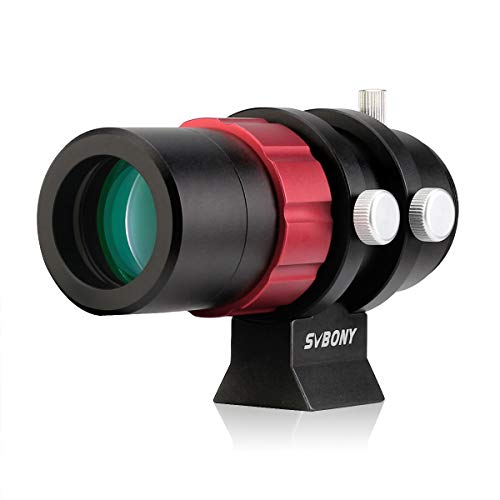
- 30mm f/4 achromatic optics
- Weighs 342g and has a 2.86° field of view
- 1.25-inch and M42 camera interfaces
Best For: Compact autoguiding setups using compatible astronomy cameras
Simple Red-Dot Alignment

- Ultra-light 2.6-ounce design
- Adjustable red LED and alignment thumbwheels
- Includes a slide-in dovetail bracket
Best For: Beginners seeking simple, low-weight visual alignment
Precision Helical Focusing
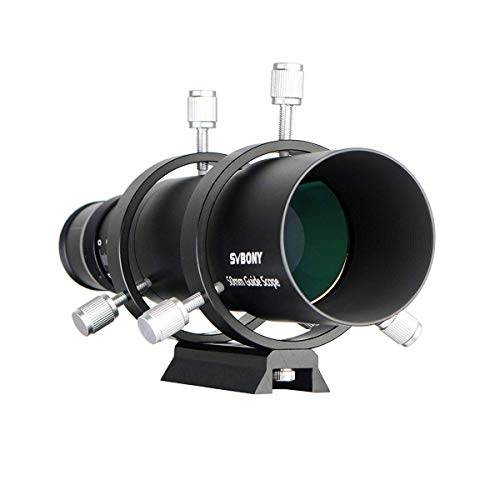
- 50mm objective for guiding and astrophotography
- 8mm helical focuser with locking thumbscrew
- Includes rings and a versatile dovetail bar
Best For: Astrophotographers wanting precise manual focus
Compact Finder Value

- Very light 7.4-ounce finder design
- 6x magnification with a 30mm objective
- Built-in crosshairs and three adjustment screws
Best For: Portable visual finding and telescope alignment
Wide-Aperture Dual Focus
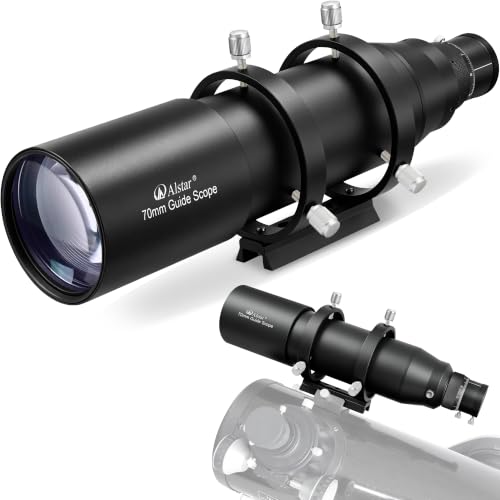
- 70mm aperture with 400mm focal length
- 88mm dual focusing range
- Supports 1.25-inch eyepieces and guide cameras
Best For: Bright dual-purpose finding and astrophotography
Best Right-Angle Pick

- 90-degree right-angle viewing
- Erect-image optics with crosshair
- Lightweight 295 g construction
Best For: Comfortable visual alignment and target finding
Best Light-Gathering Pick

- Bright 50mm objective lens
- 8x magnification with 7.3° field of view
- Illuminated correct-image reticle
Best For: Dark-sky alignment and brighter target finding
Best Budget Alignment Pick

- Ultra-lightweight 1.76-ounce design
- 5x magnification with crosshair reticle
- Three-screw XY alignment adjustment
Best For: Simple, lightweight initial telescope alignment
Premium APO Guide Scope – Sky-Watcher EvoGuide 50DX
For a lightweight telescope guide scopes setup that can also support visual observing, the Sky-Watcher EvoGuide 50DX combines a 50mm f/4.8 APO doublet design with a 242mm focal length. Its ED glass, helical focuser, and included mounting options make it a flexible choice for astrophotography and guiding.
Best For: Astrophotographers who want a versatile 50mm guide scope with strong optical performance and flexible mounting.
Pros:
- ED glass and APO doublet optics are designed for contrast-rich views.
- Includes a finder stalk and Vixen-style mounting rail.
- 1.25-inch helical focuser supports manual focus adjustments.
- Optional adapter can convert it into a low-focal-length astrograph.
Cons:
- At 2.7 pounds, it is heavier than compact mini guide scopes.
- The astrograph adapter is optional and not included.
- Manual focusing requires user adjustment.
The EvoGuide 50DX is the most optically capable option here, especially if you want one scope for guiding, observing, and possible astrograph use. Its additional weight is the tradeoff for the larger objective and APO design.
Wide-Window Targeting – Celestron StarPointer Finderscope
Although it is a reflex finderscope rather than a camera guide scope, the Celestron StarPointer is a lightweight telescope guide scopes accessory for quickly locating targets. Its dual-circle reticle, 40mm optical window, and tool-free dovetail connection emphasize fast, simple alignment.
Best For: Telescope users who prioritize quick visual target acquisition over magnified guiding or imaging.
Pros:
- Dual-circle reticle helps avoid obscuring the target.
- Large 40mm viewing window provides a broad sight picture.
- Bright adjustable LED can remain visible in daylight.
- Connects through a dovetail mount without tools.
Cons:
- It is a non-magnifying reflex finder, not a traditional optical guide scope.
- Requires one included lithium battery.
- Compatibility is focused on listed telescope and bracket styles.
The StarPointer is best viewed as a lightweight aiming aid, not an autoguiding solution. Choose it when easy visual alignment matters more than connecting a guide camera.
Compact Camera Guiding – SVBONY SV165 Mini Guide Scope
The SVBONY SV165 is a compact choice among lightweight telescope guide scopes, using 30mm achromatic optics, a 120mm focal length, and f/4 performance. Its 1.25-inch and M42 interfaces are designed for mainstream astronomy guide cameras, while 45mm back focus supports focusing adjustments.
Best For: Astrophotographers building a small, camera-based guiding setup with compatible ZWO, QHY, Orion, or SVBONY cameras.
Pros:
- Lightweight 342g design is well suited to compact rigs.
- Compatible with several mainstream autoguiding camera interfaces.
- Wide 2.86-degree field of view helps with target acquisition.
- Nylon-tipped thumbscrews help protect the tube during positioning.
Cons:
- Some cameras may need additional accessories to achieve focus.
- It is not compatible with a dielectric mirror star diagonal.
- Achromatic optics are less corrected than APO optics.
The SV165 offers a practical balance of low weight, broad field of view, and camera compatibility. Verify your camera and back-focus requirements before buying, since focusing can depend on the attached equipment.
Simple Red-Dot Alignment – Tydeux Red Dot Finderscope
The Tydeux Red Dot Finderscope is an especially light option for lightweight telescope guide scopes buyers who need basic visual aiming. It projects an adjustable red LED onto a non-magnifying window and includes a slide-in bracket for compatible dovetail mounting bases.
Best For: Beginners who want an affordable, straightforward way to align a telescope visually.
Pros:
- Very light 2.6-ounce design adds little to a telescope.
- Adjustable brightness helps tailor the red dot to viewing conditions.
- Thumbwheels allow horizontal and vertical alignment.
- Includes a bracket for many telescope dovetail bases.
Cons:
- Non-magnifying optics are unsuitable for camera autoguiding.
- Compatibility depends on the telescope’s mounting base.
- Requires a CR2032 lithium button-cell battery.
This is a basic finder rather than a guide-camera scope, but its low weight and simple controls make it useful for visual alignment. Confirm that the included bracket matches your telescope before ordering.
Precision Helical Focusing – SV106 50mm Guide Scope
For lightweight telescope guide scopes, the SVBONY SV106 stands out with a 50mm objective and a built-in helical focuser. Its all-metal construction, included mounting hardware, and camera-friendly threading make it a practical choice for astrophotographers who want controlled focusing and flexible installation.
Best For: Astrophotographers seeking precise manual focusing and a versatile 50mm guide scope.
Pros:
- 8mm helical focus travel supports fine adjustments with a locking thumbscrew.
- Provides up to 30mm of additional drawtube back-travel for setup flexibility.
- Includes guide scope rings and a dovetail mounting bar with multiple threaded sockets.
- Male T-threads support secure attachment of compatible guide cameras.
Cons:
- At 1.7 pounds, it is not the lightest option in this roundup.
- Manual focusing requires hands-on adjustment during setup.
The SV106 is a well-equipped option when focusing precision and mounting flexibility matter more than minimizing weight. Its 50mm aperture and included rings make it a straightforward addition to many astrophotography setups.
Compact Finder Value – Astromania 6×30 Finder Scope
For shoppers comparing lightweight telescope guide scopes, the Astromania 6×30 is a compact finder-style option with a 30mm aperture, 6x magnification, and built-in crosshairs. Its low 7.4-ounce weight makes it easy to add when quick visual alignment and portability are priorities.
Best For: Astronomers who need a lightweight finder for locating objects and aligning a main telescope.
Pros:
- Lightweight 7.4-ounce design adds minimal load to a telescope setup.
- Built-in crosshairs help with accurate object location.
- Fully multi-coated optics and a 30mm objective provide additional light gathering over naked-eye viewing.
- Three adjustment screws allow alignment with the main telescope.
Cons:
- Its 30mm aperture and 6x magnification are more suited to finding than dedicated autoguiding.
- The straight-through image is not corrected.
- Manual alignment and focusing require user adjustment.
The Astromania is the most portable choice here and works well as a simple finder. Buyers specifically seeking a dedicated astrophotography guide scope should confirm that its finder-oriented design matches their equipment and guiding needs.
Wide-Aperture Dual Focus – Alstar 70mm Guide Scope
The Alstar 70mm combines a wide 70mm aperture with a 400mm focal length, making it a substantial option among lightweight telescope guide scopes. Its dual focusing system, fully multi-coated optics, and compatibility with 1.25-inch eyepieces and autoguiding cameras support both visual finding and astrophotography.
Best For: Users wanting one all-metal scope for bright wide-field views, visual finding, and guiding.
Pros:
- 70mm aperture and 400mm focal length provide bright, wide-field views.
- Double helical focusing system offers 88mm total focusing range.
- Brass compression ring and dual thumb screws help secure eyepieces or cameras.
- Includes Synta-style mounting plates and pipe clamps for tool-free installation.
Cons:
- At 2.5 pounds, it is the heaviest product in this selection.
- Its larger aperture and longer focal length may be more scope than compact guiding setups require.
- Manual focusing requires setup adjustments.
The Alstar favors capability over minimum weight. It is a strong fit for users who value a bright, dual-purpose finder and guide scope, but those building an ultra-light rig may prefer a smaller model.
Best Right-Angle Pick – SV182 6x30mm Finder Scope
For a lightweight telescope guide scopes setup, the SVBONY SV182 combines a 30mm aperture with a comfortable 90-degree right-angle design. Its erect-image optics, crosshair reticle, and fully multi-coated lenses are practical for visual alignment and locating faint sky objects.
Best For: Visual observers who want a comfortable, lightweight right-angle finder with an erect image.
Pros:
- Lightweight 295 g design with a 30mm aperture and 6x magnification
- 90-degree right-angle viewing helps reduce neck bending and twisting
- Correct-image prism system and fully multi-coated lenses support clear target finding
- Includes a crosshair and mounting bracket
Cons:
- Designed for pure visual use and not recommended for external high-magnification eyepieces
- Fixed mount may require compatibility checking with your telescope
The SV182 is a sensible balance of portability, viewing comfort, and basic optical performance. Choose it when a relaxed viewing angle matters more than a larger objective lens or illuminated reticle.
Best Light-Gathering Pick – SV208 8×50 Finder Scope
Among lightweight telescope guide scopes, the SVBONY SV208 is the larger and more feature-rich option, using an 8×50 optical design to gather more light. It adds an erect image, illuminated reticle, and adjustable focusing features for more controlled alignment in dark observing conditions.
Best For: Observers who prioritize a brighter finder image, a large objective, and illuminated crosshair features.
Pros:
- 50mm objective and 8x magnification provide strong light-gathering capability
- 7.3-degree field of view makes it easier to scan the sky
- Correct-image roof prism provides right-side-up, left-to-right-correct views
- Dark-field red LED illumination helps show the reticle in very dark conditions
Cons:
- At 632 g, it is heavier than the other listed finder scopes
- Battery-powered illumination adds another component to manage
- Manual focus and reticle adjustments require setup for precise alignment
The SV208 is the strongest choice here for brightness and low-light aiming, but its larger objective and metal construction add weight. It suits users willing to trade some portability for a more capable illuminated finder.
Best Budget Alignment Pick – SVBONY 5×24 Finder Scope
For a simple lightweight telescope guide scopes setup, this SVBONY 5×24 finder offers low-power alignment in a compact 1.76-ounce package. Its crosshair reticle, three thumb screws, mounting bracket, and dust caps cover the essentials for initially locating objects with a telescope.
Best For: Beginners and lightweight setups needing a straightforward, low-power crosshair finder.
Pros:
- Very lightweight 1.76-ounce construction
- 5x magnification and 24mm objective suit initial target locating
- Three thumb screws provide XY positioning for alignment
- Includes a mounting bracket and dust caps
Cons:
- Its listed 1.15-degree field of view is narrower than the other options
- Bracket attaches with bolts or screws and does not slide into a dovetail base
- 24mm aperture offers less light-gathering capability than the 30mm and 50mm models
This model keeps weight and complexity low while providing the core functions needed to align a telescope. Confirm the two-hole bracket will work with your optical tube before buying.
How We Picked the Best Lightweight Telescope Guide Scopes
We evaluated these Lightweight Telescope Guide Scopes and finder-style alternatives by focusing on the factors that matter most in practical use: optical design, aperture, focal length, focusing adjustment, reticle or image orientation, mounting convenience, and overall suitability for guiding or alignment. Dedicated guide scopes generally offer better compatibility with guide cameras, while traditional finders may be more useful for visual star-hopping or basic target acquisition.
Because telescope setups vary widely, the list includes compact 30mm and 50mm models, larger 70mm options, straight-through finders, right-angle correct-image designs, and red-dot systems. Always confirm the included bracket, dovetail or shoe, tube-ring spacing, and camera-thread standard before purchasing.
Quick Comparison
- Smallest and lightest: 30mm mini guide scopes and red-dot finders are convenient for compact rigs.
- Best general-purpose range: 50mm guide scopes provide a useful balance of light gathering, focal length, and manageable weight.
- More optical reach: 70mm models can offer a brighter field and greater flexibility, but add bulk.
- Best for visual navigation: Correct-image and crosshair finders make star-hopping more intuitive.
- Best for simple alignment: Red-dot finders are fast to use but do not provide optical magnification.
Key Buying Factors for Lightweight Telescope Guide Scopes
Aperture and Focal Length
Larger apertures collect more light and can make guide-star selection easier, but they also increase size and weight. A compact 30mm or 50mm scope is often sufficient for portable astrophotography, especially when paired with a sensitive guide camera. Consider focal length alongside aperture, since the combination affects guiding scale and the number of suitable stars in the field.
Focusing and Camera Compatibility
A secure, adjustable focuser helps achieve a sharp guide-star image. Helical focusers can provide fine adjustment, while simpler finder designs may rely on threaded or sliding focus. Check whether the scope accepts your guide camera directly or requires an adapter, and verify that the available back focus is adequate.
Mounting, Orientation, and Weight
Weight placed far from the telescope’s dovetail can affect balance and create flexure. Favor rigid mounting hardware and keep the guide scope close to the main optical tube when possible. Straight-through finders are compact, while right-angle correct-image models are often more comfortable for visual use. A crosshair reticle can help with alignment, but it is not a substitute for a camera-ready guide scope.
Who Should Buy Which Lightweight Telescope Guide Scopes?
Portable astrophotographers should prioritize a compact 30mm or 50mm guide scope with secure mounting and camera compatibility. Deep-sky imagers using longer focal lengths may prefer a 50mm or larger model with precise focusing and a rigid bracket. Visual observers will usually benefit more from a right-angle, correct-image, or crosshair finder than from a dedicated guide scope. Beginners and casual users may find a red-dot finder the simplest option for quick alignment, provided they do not need optical magnification.
Before buying, compare the scope’s weight with your mount’s payload capacity, confirm the mounting interface, and decide whether you need true autoguiding or only a convenient way to locate targets.