Accurate guiding can make the difference between round, detailed stars and disappointing long-exposure images. The right guide scope must match your mount, imaging camera, main telescope, and available payload capacity.
This roundup compares 10 guide-scope and guide-camera options for astrophotographers, including lightweight mini scopes, larger finder-style models, and purpose-built camera combinations.
Best 10 Telescope Guide Scopes for Astrophotography Picks for 2026
Best Lightweight APO

- 50mm f/4.8 APO doublet with ED glass
- Includes finder stalk and V-style mounting rail
- Can become an astrograph with an optional adapter
Best For: Compact guiding and visual observing
Best High-Speed Guide Camera

- IMX662 sensor with low readout noise
- Captures 1080p at up to 107 FPS
- Includes ST4 guiding and USB 3.0
Best For: Computer-based guiding and planetary imaging
Best Adjustable 60mm Scope

- 60mm objective with 240mm focal length
- Helical focuser offers fine, rotation-free adjustment
- Includes rings, dovetail bar, and T-threads
Best For: Flexible guiding on telescopes up to 1500mm focal length
Best Compact Guide Camera

- 1.23MP color CMOS sensor with low read noise
- 1.25-inch body fits varied guide lenses
- ST4 interface supports common guiding software
Best For: Compact autoguiding and planetary imaging
Wide-Field Guiding
70mm Astromania Deluxe Guide Scope
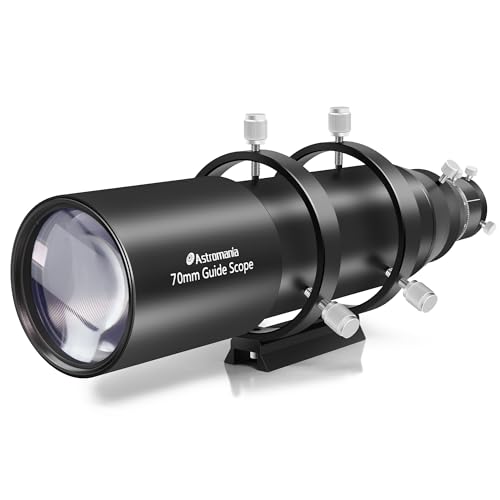
- 400mm focal length with bright, wide-field optics
- Precise helical focuser with 1.25-inch compatibility
- Includes rings and Synta-style mounting plate
Best For: Flexible guiding and visual finder use
Comfortable Finding
SVBONY SV182 6x30mm Finder Scope

- 30mm aperture with fully multi-coated optics
- 6x crosshair reticle for easier alignment
- 90-degree right-angle correct-image view
Best For: Visual target finding and alignment
Compact Autoguiding
SVBONY SV165 30mm Mini Guide Scope
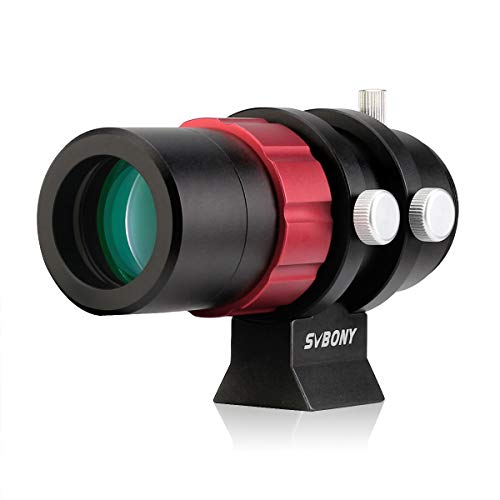
- 30mm f/4 optics with a 120mm focal length
- 1.25-inch and M42 camera interfaces
- 45mm back focus for adjustment flexibility
Best For: Lightweight deep-sky guiding with compatible cameras
Versatile Precision Pick
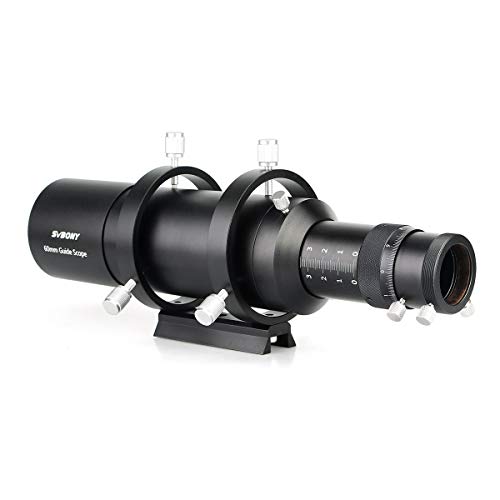
- 60mm aperture with built-in helical focuser
- Focus adjustment preserves field orientation
- Can double as a 1.25-inch finder scope
Best For: Astrophotographers seeking a versatile guide and finder scope
Compact Setup Choice

- Compact 40mm guide scope for OTAs up to 700mm
- Front focuser includes a focus-position scale
- Six-point guide ring enables alignment adjustment
Best For: Lightweight setups using compatible guide cameras
Complete Mounting Kit
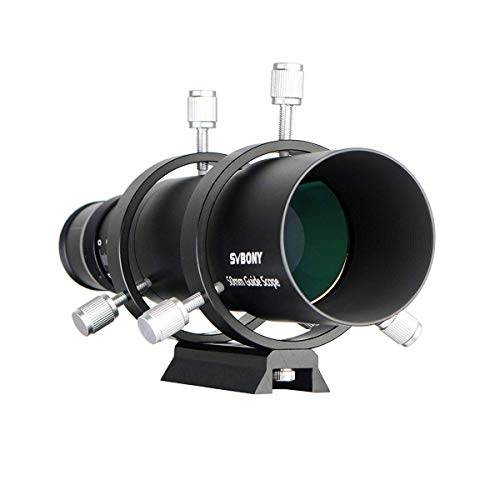
- 50mm guide scope with 8mm helical focus travel
- Includes guide rings and a dovetail mounting bar
- Adds up to 30mm of drawtube back-travel
Best For: Buyers wanting a guide scope with mounting hardware included
Best Lightweight APO – EvoGuide 50DX
The Sky-Watcher EvoGuide 50DX is a lightweight option for anyone comparing telescope guide scopes for astrophotography. Its 50mm f/4.8 apochromatic doublet uses ED glass, while the included finder stalk and V-style rail give you flexible mounting options.
Best For: Astrophotographers who want a compact guide scope that can also support visual observing and optional astrograph use.
Pros:
- 50mm APO doublet with matched ED glass for contrast-rich views
- Includes a finder stalk and Vixen-style mounting plate
- 242mm focal length and 1.25-inch helical focuser
- Built-in T-threads support conversion to an astrograph with an optional adapter
Cons:
- Astrograph conversion requires an optional adapter
- Manual focusing may require more hands-on adjustment
The EvoGuide 50DX stands out when low weight, adaptable mounting, and APO optics matter more than a ready-to-use camera bundle.
Best High-Speed Guide Camera – SV305C Pro
The SVBONY SV305C Pro is a USB guide camera rather than a guide scope, but it can be an important part of a telescope guide scopes for astrophotography setup. Its IMX662 sensor, ST4 interface, and high-speed USB 3.0 connection are aimed at planetary imaging and computer-based guiding workflows.
Best For: Computer-connected astrophotographers who want a fast planetary camera with ST4 guiding support and flexible ROI capture.
Pros:
- IMX662 sensor with high sensitivity and low readout noise
- 1920×1080 capture at up to 107 frames per second
- ST4 interface supports guiding software such as PHD2 and ASCOM
- 128MB buffer and USB 3.0 support continuous, fast transfers
Cons:
- Requires a computer and does not support iPad connection
- Camera alone does not provide the guide-scope optics
Choose this model when you already have compatible optics and need a responsive camera for guiding or high-frame-rate planetary work.
Best Adjustable 60mm Scope – Astromania 60mm Guide Scope
The Astromania 60mm Guide Scope is a versatile choice among telescope guide scopes for astrophotography, combining a 240mm focal length with a helical focuser. It includes guide rings, a dovetail mounting bar, and male T-threads for direct attachment of compatible guide cameras.
Best For: Astrophotographers who need a sturdier 60mm guide scope with precise focusing and broad mounting adjustability.
Pros:
- 60mm objective and 240mm focal length suit telescopes up to 1500mm focal length
- Helical focuser provides fine adjustment and prevents camera rotation
- Includes rings, T-threads, and a Synta-style mounting plate
- 2.7-degree field of view helps locate guide stars
Cons:
- Heavier and more substantial than compact guide-scope designs
- Manual focusing requires initial setup and adjustment
Its included hardware and extended focusing range make the Astromania a practical pick for users who want a complete, adjustable guide-scope assembly.
Best Compact Guide Camera – SV905C Guide Camera
The SVBONY SV905C is a compact color guide camera designed to pair with telescope guide scopes for astrophotography. Its 1.23MP CMOS sensor, 1.25-inch body, ST4 interface, and small pixels support autoguiding and planetary imaging in a straightforward package.
Best For: Users who want a small, sensitive color camera for autoguiding with compatible guide lenses or optical guide scopes.
Pros:
- 1/3-inch CMOS sensor with 3.75-micron pixels
- High peak QE and low read noise support faint guide stars
- 1.25-inch form factor fits guide lenses with different focal lengths
- ST4 interface works with several guiding software platforms
Cons:
- Uses USB 2.0 rather than USB 3.0
- Not compatible with ASI AIR
- Requires compatible guide optics for a complete guiding setup
The SV905C is a sensible compact option when low weight, a standard 1.25-inch form factor, and dedicated ST4 connectivity are priorities.
Wide-Field Guiding – 70mm Astromania Deluxe Guide Scope
For astrophotographers comparing telescope guide scopes for astrophotography, the Astromania 70mm stands out with a 400mm focal length and bright, wide-field optics. Its built-in helical focuser supports fine adjustments, while the included rings and mounting plate simplify installation.
Best For: Astrophotographers who want a versatile guide scope that can also function as a finder scope for visual observing.
Pros:
- 400mm focal length and wide field help keep potential guide stars in view.
- Built-in worm-driven helical focuser offers precise manual focusing.
- Supports 1.25-inch eyepieces and compatible autoguiding cameras.
- Includes matching tube rings and a Synta-style mounting plate.
Cons:
- At 2.5 pounds, it adds more weight than compact mini guide scopes.
- Manual focusing and setup require more adjustment than a fixed finder.
The 70mm aperture and dual guide-scope/finder-scope design make this a flexible choice, particularly for users who value a broad star field and precise focusing over minimum payload weight.
Comfortable Finding – SVBONY SV182 6x30mm Finder Scope
The SVBONY SV182 is primarily a visual finder rather than a dedicated guide scope for astrophotography. Its 30mm aperture, fully multi-coated optics, crosshair reticle, and 90-degree right-angle correct-image design make target acquisition more comfortable.
Best For: Visual observers who want a comfortable, upright-image finder to help center targets before imaging.
Pros:
- 30mm aperture provides useful light-gathering capability for faint objects.
- 6x magnification and crosshair reticle assist with target alignment.
- 90-degree right-angle viewing reduces neck and eye strain.
- Fully multi-coated optics are designed for a bright, sharp view.
Cons:
- It is intended for pure visual use and is not recommended for external high-magnification eyepieces.
- It is not presented as an autoguiding-camera guide scope.
Choose the SV182 as a comfortable alignment aid, not as the primary imaging guider. Its correct-image view and crosshair are practical for locating targets, but dedicated astrophotography guiding requires a more suitable camera-compatible model.
Compact Autoguiding – SVBONY SV165 30mm Mini Guide Scope
The SVBONY SV165 is a compact option for telescope guide scopes for astrophotography, with 30mm f/4 optics, a 120mm focal length, and 45mm of back focus. Its 1.25-inch and M42 interfaces are designed for compatibility with several mainstream autoguiding cameras.
Best For: Deep-sky astrophotographers seeking a lightweight mini guide scope for compatible ZWO, QHY, Orion, or SV305C Pro cameras.
Pros:
- 1.25-inch and M42 interfaces support a range of compatible guide cameras.
- f/4 optics provide a wide field for locating guide stars.
- 45mm back focus allows practical focus adjustment.
- Nylon-tipped thumbscrews help protect the tube during positioning.
Cons:
- Some camera combinations may require additional accessories to reach focus.
- It cannot be used with a dielectric mirror star diagonal for focusing.
- The image is inverted when used with an eyepiece.
With its compact 30mm optical design and broad camera-interface compatibility, the SV165 is a sensible lightweight guider for imaging setups. Confirm your camera and back-focus requirements before buying.
Versatile Precision Pick – SV106 60mm Guide Scope
For astrophotographers comparing telescope guide scopes for astrophotography, the SVBONY SV106 stands out for its versatile 60mm aperture and built-in helical focuser. Its focusing system helps maintain the field orientation while making precise adjustments, and it can also serve as a straight-through finder scope with a compatible 1.25-inch eyepiece.
Best For: Astrophotographers who want one guide scope that can also function as a flexible finder scope.
Pros:
- 60mm aperture provides a versatile guide-scope platform.
- Helical focuser offers 8mm of precise travel without rotating the field.
- Telescoping drawtube adds up to 35mm of back-travel for compatible autoguiders.
- Supports threaded guide-camera attachment and 1.25-inch accessories.
Cons:
- At 790g, it is heavier than the compact mini guide scope options.
- A 1.25-inch eyepiece is optional for finder-scope use.
The SV106 60mm is a strong choice when focusing flexibility and multi-use capability matter more than minimizing equipment weight. Its threaded connections and extra back-travel also make it adaptable to different guiding setups.
Compact Setup Choice – SV165 40mm Mini Guide Scope
The SVBONY SV165 is a compact option for shoppers comparing telescope guide scopes for astrophotography on telescopes with focal lengths up to 700mm. Its fully multi-coated achromatic optics, front focuser with scale, and six-point guide ring are designed to support clear views, repeatable focusing, and alignment adjustment.
Best For: Compact telescope setups using compatible guide cameras and an OTA with a focal length within 700mm.
Pros:
- Compact 40mm mini guide-scope design weighs 450g.
- Fully multi-coated achromatic optics support clear, sharp views.
- 1.25-inch and M42 interfaces support compatible SV305 Pro, Orion, ZWO, and QHY cameras.
- Front focuser scale and locking ring help repeat and maintain focus.
Cons:
- Recommended for telescope focal lengths within 700mm.
- Some setups may require focus adjustment or tube-length reduction when using an eyepiece.
The SV165 favors a lightweight, compact guiding arrangement with practical alignment controls. Its six-point fixation system can help adjust coaxiality between the guide scope and main telescope, while the included interfaces broaden camera compatibility.
Complete Mounting Kit – SV106 50mm Guide Scope
For telescope guide scopes for astrophotography, the SVBONY SV106 50mm model combines a helical focuser with a ready-to-mount ring-and-dovetail package. The 8mm focuser travel, additional drawtube adjustment, and threaded camera connection make it practical for achieving a sharp guide-star view.
Best For: Astrophotographers who want a 50mm guide scope with included rings and a dovetail mounting bar.
Pros:
- 50mm objective and fully multi-coated optics support guiding and finder use.
- Helical focuser provides 8mm of fine adjustment and includes a lock.
- Telescoping drawtube adds up to 30mm of back-travel for autoguider setup flexibility.
- Includes two guide rings, six metal thumbscrews, and a 3.5-inch dovetail bar.
Cons:
- At 1.7 pounds, it is not the lightest option for a portable rig.
- The included mounting hardware may be more than needed for setups with an existing guide-scope mount.
This version is appealing when mounting hardware and fine focusing are priorities. The included rings and dovetail bar simplify attachment, while the threaded focuser collar supports compatible guide cameras with female T-threads.
How We Picked These Telescope Guide Scopes for Astrophotography
We focused on the practical factors that affect guiding performance: aperture, focal length, optical design, focusing hardware, mounting compatibility, camera connectivity, and overall weight. The selection includes complete guide scopes, guide cameras, finder-style instruments, and combinations that can be matched to different imaging rigs.
Because no single model suits every telescope, we considered how each option fits common use cases, from portable star trackers and small refractors to heavier equatorial mounts and longer focal-length imaging systems.
Quick Comparison
| Setup type | Best match | What to prioritize |
|---|---|---|
| Portable or travel rig | 30mm–40mm mini guide scope | Low weight, simple mounting, adequate sensitivity |
| General-purpose imaging | 50mm–60mm guide scope | Balanced focal length, stable focus, flexible camera pairing |
| Longer focal-length telescope | 60mm–70mm model | Higher resolving power and rigid mounting |
| Existing guide scope | Dedicated guide camera | Sensor performance, USB connection, software support |
| Visual alignment and guiding | Finder-style scope | Correct-image optics, comfortable focusing, versatile mounting |
Key Buying Factors for Telescope Guide Scopes for Astrophotography
Match the Guide Scope to Your Imaging Focal Length
A larger aperture and longer focal length can provide more guide stars and finer tracking measurements, but they also add weight. Compact 30mm or 40mm scopes are often sufficient for short refractors and wide-field imaging. Larger 50mm–70mm models make more sense when the primary telescope has a longer focal length or when your imaging location offers fewer bright guide stars.
Check Camera and Sensor Compatibility
A guide scope is only half of the guiding system. Confirm that the camera uses a connection supported by your computer and guiding software, such as USB 3.0 where high transfer speed is useful. Sensor size, pixel size, monochrome or color operation, and low-light sensitivity influence how easily software can detect stars. A dedicated guide camera is usually preferable to a basic visual eyepiece when automated guiding is the priority.
Do Not Overlook Focus and Mounting Rigidity
Helical focusers make fine adjustments easier, while a fixed or poorly supported scope can introduce differential flexure. Use solid rings or a rigid bracket, keep the guide scope aligned with the main telescope, and verify that the focuser holds position throughout an imaging session. A lightweight scope with secure mounting can outperform a larger model that flexes.
Consider Payload and Field of View
Every added component consumes mount capacity. Choose the smallest guide scope that provides a suitable field of view and enough guide stars. Also check tube diameter, mounting shoe style, thread standards, and whether the supplied accessories fit your existing bracket.
Who Should Buy Which Telescope Guide Scopes for Astrophotography?
Choose a Compact Mini Guide Scope for Portability
Travel astrophotographers, star-tracker users, and owners of small refractors should start with a 30mm or 40mm model. These options keep the payload low and simplify balancing without sacrificing basic guiding capability.
Choose a 50mm or 60mm Scope for Versatility
A 50mm–60mm guide scope is the safest all-around choice for many deep-sky imaging systems. It offers a useful balance of sensitivity, focal length, and manageable size, especially when paired with a suitable guide camera.
Choose a 70mm Model for Demanding Setups
Longer focal-length instruments and mounts used for narrower-field imaging may benefit from a 70mm guide scope, provided the mount can carry it securely. Prioritize rigid rings and precise focusing.
Choose a Dedicated Guide Camera When Automation Matters
If you already own a compatible guide scope, upgrade the camera first when star detection or connectivity is limiting performance. Verify software support and sensor specifications before buying.