Remote access is most useful when it works before the operating system loads. The best KVM over IP switches for desktops let you view a computer’s display, control its keyboard and mouse, and troubleshoot BIOS or boot problems from another location.
This roundup covers compact IP KVM devices, PoE and Wi-Fi models, multi-port options, and established enterprise hardware. Compare video support, network access, remote control features, and installation requirements before choosing the right fit.
Best 10 Kvm Over Ip Switches for Desktops Picks for 2026
Best Wireless Flexibility
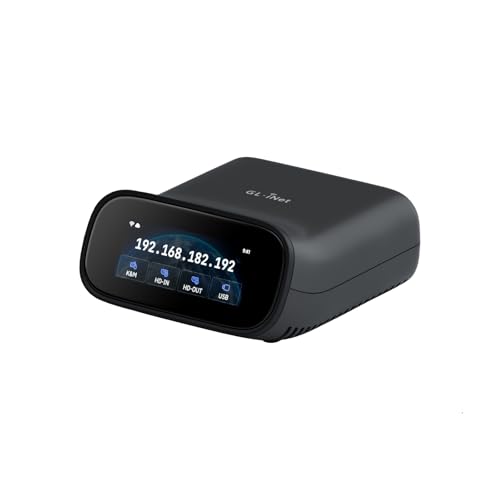
- Dual-band Wi-Fi 6 and wired connectivity
- 4K@30FPS passthrough with two-way audio
- Tailscale and optional self-hosted cloud
Best For: Flexible home labs, offices, and remote desktop recovery
Best Open-Source Value

- 1080p@60FPS streaming with 30–60 ms latency
- Local, cloud, and Wake on LAN access
- Linux/Golang open-source platform
Best For: Developers, IT support, and home-lab troubleshooting
Best PoE Deployment

- PoE and USB-C dual-power options
- 4K@30Hz streaming with two-way audio
- 32GB eMMC for stored system images
Best For: PoE-equipped offices, server rooms, and home labs
Best Simple Remote Rescue

- Driver-free browser setup with onboard IP display
- 1080p@60FPS streaming and low latency
- Optional cloud, Wake on LAN, and expansion
Best For: Desktop troubleshooting, BIOS access, and home labs
Best Remote BIOS Access

- BIOS-level remote control without host software
- 4K 30Hz video with remote audio
- Compact single-host design with file transfer
Best For: Remote IT support and single-computer access
Best Long-Range KVM Extension

- Extends 4K signals up to 390 feet over Cat5e
- USB KVM control for PCs, servers, and consoles
- Supports up to 16 paired extender sets
Best For: Distributed workstations and server-room installations
Best Four-Computer KVM over IP

- Switches among four HDMI-connected host systems
- PoE powered with 5V Type-C backup
- HTTPS remote access and 4K 30Hz loop-out
Best For: Home labs and rack-based multi-system management
Compact BIOS Access

- BIOS-level remote control
- 63g portable metal design
- Watchdog recovery support
Best For: Portable desktop recovery and remote technician workflows
Redundant 4K DisplayPort Control
ATEN CN9950 DisplayPort KVM Over IP

- 4K DCI at 30Hz locally and remotely
- Dual LAN and dual power backup
- Relay/DI monitoring support
Best For: Professional 4K DisplayPort infrastructure
Legacy VGA Server Access

- 1920 × 1200 at 60Hz
- Virtual media support
- TLS 1.2 login encryption
Best For: Legacy VGA and mixed-platform remote access
Best Wireless Flexibility – Comet Pro Remote KVM
The GL.iNet GL-RM10 Comet Pro is one of the more flexible kvm over ip switches for desktops, combining wired and dual-band Wi-Fi 6 connectivity with 4K passthrough. It provides browser-based access across Windows, macOS, and Linux, while the companion app extends control to mobile devices.
Best For: Home labs, offices, and desktop users who want wireless flexibility, 4K passthrough, and secure remote BIOS or recovery access.
Pros:
- Supports 2.4 GHz and 5 GHz Wi-Fi 6 plus wired connectivity.
- Provides 4K@30FPS passthrough, H.264 streaming, and two-way audio.
- Includes built-in Tailscale and optional self-hosted cloud deployment.
- Supports remote recovery tasks, with optional ATX Board or Fingerbot support.
Cons:
- Power control accessories are sold separately.
- Its 4K passthrough is limited to 30 FPS.
- The compact desktop unit has an IP30 protection rating.
The Comet Pro is a strong choice when a desktop KVM needs more than basic browser control. Its wireless options, touchscreen, audio support, and self-hosting capabilities make it especially appealing for flexible home-lab or support setups.
Best Open-Source Value – JetKVM Ethernet IP KVM
The JetKVM Ethernet IP KVM is a compact option for buyers comparing kvm over ip switches for desktops and wanting straightforward browser access. Connect it through USB-C and HDMI, attach Ethernet, and use the displayed IP address to control the target computer remotely.
Best For: Developers, IT support users, and home-lab operators who want low-latency 1080p control with open-source customization.
Pros:
- Offers local browser access, optional cloud access, and Wake on LAN.
- Streams 1080p at 60 FPS with stated 30–60 ms latency.
- Open-source Linux and Golang foundation supports SSH customization.
- Expansion options include ATX, DC power, and RS-232 control.
Cons:
- Video resolution is limited to 1080p at 60 FPS.
- Remote power control requires compatible extensions.
- Its compact interface uses HDMI and USB-C connections that may require careful cable planning.
JetKVM is a practical pick for remote troubleshooting and system rescue. Its adjustable bitrate, optional WebRTC cloud, and open architecture give it useful flexibility without requiring software on the controlled computer.
Best PoE Deployment – Comet PoE Remote KVM
The GL.iNet Comet PoE GL-RM1PE is designed for desktop and server installations where simplified cabling matters. As one of the more convenient kvm over ip switches for desktops, it can receive power over Ethernet or USB-C while providing 4K streaming and remote system-management features.
Best For: Offices, server rooms, and home labs with PoE infrastructure that need remote BIOS access and recovery support.
Pros:
- PoE reduces the need for a separate power adapter and cable.
- Supports simultaneous PoE and Type-C power for added stability.
- Includes 32GB eMMC storage for storing system images.
- Provides 4K@30Hz streaming, two-way audio, and optional ATX or Fingerbot control.
Cons:
- PoE requires a compatible PoE switch or network setup.
- Power-control accessories are sold separately.
- Streaming is limited to 30 Hz at 4K.
The Comet PoE stands out when the installation already includes Ethernet power. Its onboard storage and remote reinstallation support add practical value for systems that may need repeated recovery or image deployment.
Best Simple Remote Rescue – JetKVM Open-Source IP KVM
This JetKVM model keeps setup simple: connect HDMI for video, USB-C for keyboard and mouse signals and power, then use Ethernet and the onboard LCD to find its IP address. It is a practical entry among kvm over ip switches for desktops for browser-based access without drivers or extra software.
Best For: Home-lab users and IT teams needing 1080p remote BIOS access, crash recovery, and optional cloud connectivity.
Pros:
- Installs without drivers and supports browser access over a local LAN.
- Offers 1080p@60FPS H.264 streaming with 30–60 ms latency.
- Includes optional WebRTC cloud access and Wake on LAN.
- Open-source Linux firmware supports SSH customization and expansion modules.
Cons:
- HDMI carries video only; it does not transfer audio.
- The non-PoE model is powered by the host USB-C connection.
- It cannot control a fully powered-off target without optional ATX or DC modules.
For straightforward desktop troubleshooting, this JetKVM offers a clear setup path and useful remote-rescue features. Buyers should account for its lack of HDMI audio and the need for optional power-control hardware when managing completely powered-off systems.
Best Remote BIOS Access – GL.iNet Comet GL-RM1
For buyers comparing kvm over ip switches for desktops, the GL.iNet Comet GL-RM1 is a compact remote KVM for controlling one computer or server over the internet. It provides BIOS-level access, remote rebooting, operating-system installation, file transfer, and 4K video at 30Hz without requiring software on the host computer.
Best For: IT professionals, remote workers, smart-home users, and anyone who needs secure off-site access to a single desktop, laptop, or server.
Pros:
- Supports remote power-on, rebooting, and BIOS-level control.
- Works with desktops, laptops, servers, and other compatible computers without host-side software.
- Provides 3840×2160 video at 30Hz, remote audio, and H.264 hardware encoding.
- Includes file transfer and a compact 85-gram design.
Cons:
- Designed for one host system rather than multi-computer switching.
- PD adapters cannot be used.
- Requires Windows 10 or later according to the listed minimum operating-system requirement.
The GL-RM1 is a strong choice when remote BIOS access matters more than switching among multiple desktops. Its small footprint and software-free host setup make it practical for home labs and remote troubleshooting, while the single-port design limits it to one controlled system at a time.
Best Long-Range KVM Extension – AV Access 4KIP100-KVM
The AV Access 4KIP100-KVM is a practical option among kvm over ip switches for desktops when the computer and workstation need to be separated by distance. It sends 4K video, audio, keyboard, mouse, and USB signals over Cat5e or better cabling, using an existing IP network for flexible installation.
Best For: Distributed workstations, server rooms, control centers, classrooms, studios, and gaming or AV setups requiring long-distance USB and HDMI extension.
Pros:
- Extends 4K video, audio, and USB up to 390 feet over Cat5e, or up to 492 feet over Cat6/6A/7.
- Supports keyboard, mouse, controllers, flash drives, printers, and other USB peripherals.
- Works with Windows, macOS, and Linux without drivers.
- Allows up to 16 extender sets on the same network through DIP-switch pairing.
Cons:
- This is an extender pair rather than a standalone multi-host KVM switch.
- Requires separate transmitter and receiver units, network cabling, and power.
- Maximum video performance is 4K at 30Hz.
Choose this model when reliable remote workstation placement and long cable runs are the priority. Its network-based design can reduce rewiring, but buyers should confirm that their Gigabit network infrastructure can provide the bandwidth needed for stable video and USB transmission.
Best Four-Computer KVM over IP – GL.iNet Comet X
For managing several desktops or servers, the GL.iNet Comet X is a feature-rich choice among kvm over ip switches for desktops. Its four HDMI inputs and four USB Type-C device connections support switching among up to four host systems through the front button, touchscreen, or browser-based HTTPS interface.
Best For: Home labs, IT professionals, small server rooms, and rack deployments that need local and remote control of four systems.
Pros:
- Controls up to four host systems with dedicated HDMI and USB connections.
- Supports PoE operation with 5V Type-C backup power.
- Offers browser-based remote access over HTTPS without client software.
- Includes 4K 30Hz HDMI loop-out, a touchscreen, rack brackets, and 64GB eMMC storage.
Cons:
- Video output is limited to 4K at 30Hz.
- Its 4-port rack-ready design may be more equipment than needed for a single desktop.
- Operating temperature is listed as 25°C to 40°C.
The Comet X stands out for buyers who need centralized access to multiple systems rather than a single remote connection. PoE, local controls, HTTPS access, onboard storage, and included rack hardware make it well suited to organized home-lab and IT environments.
Compact BIOS Access – Q1 Remote KVM Over IP
For desktops that may need recovery before the operating system loads, the Q1 is a compact choice among kvm over ip switches for desktops. It provides BIOS-level control, software-free access to the controlled device, and support for Windows, macOS, iOS, and Android systems.
Best For: Technicians and remote IT workflows needing portable, pre-boot desktop access.
Pros:
- Provides BIOS-level control, including remote reboot and recovery when the OS is down.
- Compact 75 × 45.05 × 17mm metal design weighs about 63g.
- Built-in watchdog supports automatic recovery during system failures.
- Uses Ethernet, HDMI output, and USB-C power for flexible setups.
Cons:
- Listed operating temperature tops out at 40 °C.
- Requires separate Ethernet and USB-C power connections.
The Q1 stands out when portability and BIOS access matter more than a traditional rack-mounted installation. Its watchdog and software-free operation make it particularly practical for unattended or hard-to-reach desktops.
Redundant 4K DisplayPort Control – ATEN CN9950 DisplayPort KVM Over IP
ATEN 1-Local/Remote Share Access Single Port 4K DisplayPort KVM Over IP Switch
Check Price On AmazonThe ATEN CN9950 is a robust option among kvm over ip switches for desktops that require DisplayPort video, local and remote sharing, and infrastructure redundancy. It supports 4K DCI output at both consoles and includes features aimed at monitoring and remote reboot control.
Best For: Professional desktop or server environments needing 4K DisplayPort access and backup connectivity.
Pros:
- Supports DisplayPort resolutions up to 4096 × 2160 at 30Hz locally and remotely.
- FPGA graphics processing is designed to improve image quality and frame throughput.
- Dual power supply and dual LAN provide backup options.
- 5-pin relay/DI terminal supports environmental monitoring and reboot control.
Cons:
- Supports 4K DCI at 30Hz rather than 60Hz.
- At 3.4 pounds, it is less portable than compact desktop-focused units.
Choose the CN9950 when uptime, DisplayPort quality, and redundant network or power connections are priorities. Its feature set is better suited to structured IT installations than casual home use.
Legacy VGA Server Access – ATEN CN8000A VGA KVM Over IP
Aten 1-Local/Remote Share Access Single Port VGA KVM Over IP Switch (1920 x 1200)
Check Price On AmazonThe ATEN CN8000A is a practical option among kvm over ip switches for desktops and servers that still use VGA or legacy interfaces. It provides remote access at up to 1920 × 1200 at 60Hz, plus virtual media, TLS 1.2 encryption, and support for several platform and connection types.
Best For: Mixed-platform environments with VGA, PS/2, USB, serial, or legacy Sun-connected equipment.
Pros:
- Supports up to 1920 × 1200 at 60Hz with 24-bit color for local and remote sessions.
- Includes virtual media support for remote workflows.
- TLS 1.2 encryption helps protect login passwords.
- Supports Windows, Mac, Sun, Linux, and VT100-based serial devices.
Cons:
- VGA limits it to lower resolution than newer DisplayPort or HDMI solutions.
- Its broad legacy connectivity may be unnecessary for modern-only desktops.
The CN8000A makes the most sense for organizations maintaining older systems or mixed hardware. Its virtual media and legacy-interface support add flexibility, while 1920 × 1200 video remains suitable for many administrative desktops.
How We Picked These Kvm Over Ip Switches for Desktops
We focused on devices that provide genuine out-of-band desktop control rather than software-only remote access. The selection represents several use cases: managing a single home server, supporting a workstation remotely, extending KVM signals across a building, and controlling multiple computers in a home lab or professional environment.
We compared video input and output standards, maximum resolution and refresh rate, BIOS-level access, network connectivity, remote-management features, power options, and installation complexity. We also considered whether each product is best suited to occasional remote troubleshooting or continuous administrative use.
Quick Comparison
| Best for | Look for | Typical advantage |
|---|---|---|
| Single desktop or server | One HDMI or DisplayPort input, USB control | Lower cost and simpler setup |
| Home lab | Open-source features, Tailscale, multiple ports | Flexible remote access |
| Remote office support | Stable Ethernet, secure access, BIOS control | Reliable troubleshooting |
| Building-wide extension | TCP/IP transport and Cat6 compatibility | Long-distance installation |
| Enterprise deployment | Local/remote sharing and centralized administration | Predictable management |
Key Buying Factors for Kvm Over Ip Switches for Desktops
Video Standard and Resolution
Match the switch to the computer’s output. HDMI models are convenient for many modern desktops, while DisplayPort and VGA models target different generations of hardware. A stated 4K maximum does not always mean 4K at 60Hz, so check the supported refresh rate and whether passthrough preserves your local monitor experience.
BIOS and Pre-Boot Control
Choose a hardware KVM if you need to enter BIOS, watch startup diagnostics, reinstall an operating system, or recover from a failed boot. Software remote-desktop tools generally cannot help when the operating system or network services are unavailable.
Network Access and Security
Ethernet is usually the dependable choice for fixed desktops and servers. Wi-Fi can simplify installation but may be less predictable in crowded environments. Review authentication, encryption, VPN or mesh-network support, firmware updates, and whether the device should be exposed directly to the internet. A private VPN or zero-trust overlay is preferable to simple port forwarding.
Power, USB, and Installation
Confirm the required power adapter, PoE compatibility, USB connector type, and cable lengths. Some units need both video and USB connections; extenders may require matched transmitters, receivers, or network infrastructure. Also verify that the included cables fit your computer and monitor.
Who Should Buy Which Kvm Over Ip Switches for Desktops?
Choose a compact single-port model for one desktop, workstation, or server where remote BIOS access matters. Home-lab users should prioritize open-source-friendly controls, Tailscale or comparable secure networking, and multi-port expansion. Select a PoE model when centralized power and cleaner cabling are important.
For long cable runs between rooms or buildings, a TCP/IP KVM extender is the more appropriate choice. Businesses that need local and remote sharing, established support, and predictable administration may prefer an ATEN-class solution. Finally, verify connector compatibility before buying: HDMI, DisplayPort, and VGA versions are not interchangeable without the right adapters, and adapters may limit resolution or control features.