The best handheld optical spectroscopes make it easier to examine light, compare emission lines, and inspect gemstones without carrying laboratory-sized equipment. This roundup covers compact models designed for classrooms, hobbyists, jewelers, and gemology work.
Because designs vary from simple diffraction viewers to adjustable-focus instruments with marked wavelength ranges, choosing the right spectroscope depends on your intended use, viewing comfort, optical format, and measurement expectations.
Best 10 Handheld Optical Spectroscopes Picks for 2026
Best Quantitative Pick
EISCO Premium Quantitative Spectroscope

- 400–700 nm measurement range
- 500 lines/mm diffraction grating
- +/- 5 nm stated accuracy
Best For: Classroom and light-source wavelength measurements
Best Pocket Gemology Tool
Handheld Diffraction Spectroscope
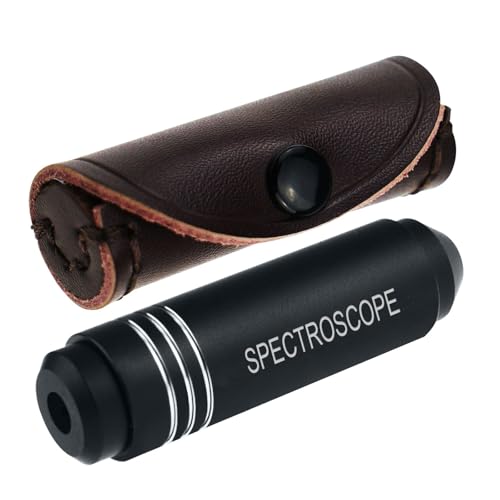
- Pocket-sized aluminum construction
- High-quality diffraction grating
- Made for gemstone absorption-line checks
Best For: Traveling jewelers and gemology hobbyists
Best Educational Direct-View Model
Eisco Labs Direct Vision Spectroscope

- Direct-view spectrum observation
- 400–700 nm graduated scale
- Includes three cuvettes
Best For: STEM and physics classroom demonstrations
Best Adjustable Gem Tester
Focusing Handheld Spectroscope

- Adjustable focal length
- Heavy-duty aluminum housing
- Compact design for field use
Best For: Portable gemstone and jewelry identification
Classroom Spectrum Viewer
Portable Educational Spectroscope

- Direct spectrum viewing for lessons
- No complex imaging setup required
- Compact, lightweight classroom tool
Best For: Physics classrooms and light-spectrum demonstrations
Gemology Field Tester
Adjustable-Focus Gem Spectroscope

- Adjustable focus for varied gem sizes
- 400–700 nm stated wavelength range
- Lightweight optical-glass construction
Best For: Gemstone identification and portable gemological testing
Jeweler’s Pocket Tool
55mm Diffraction Spectroscope with Loupe

- Compact 55mm portable design
- Built-in jeweler’s eye loupe
- Useful across gems and collectibles
Best For: Portable jewelry, gem, and collectible inspection
Best Adjustable-Focus Pick
Compact Gemstone Focusing Spectroscope

- Adjustable focus for gemstone absorption spectra
- Optical glass and aluminum-alloy construction
- Compact design with carrying bag
Best For: Portable gemstone analysis and education
Best Prism Option
Handheld Full-Spectrum Gem Spectroscope

- Prism beam splitter for visual spectrum analysis
- Portable design for fairs and trade shows
- Optical glass and aluminum construction
Best For: Quick gemstone checks and learning
Best Ultralight Pick
TEKCOPLUS Pocket Diffraction Spectroscope

- Pocket-sized 55 mm-class design
- Diffraction analysis for gems and other objects
- Aircraft-aluminum body with fine optics
Best For: Traveling jewelers and collectors
Best Quantitative Pick – EISCO Premium Quantitative Spectroscope
For shoppers comparing handheld optical spectroscopes for classroom experiments, light-source studies, or basic astronomy, the EISCO Premium Quantitative Spectroscope stands out for its defined measurement range and readable scale. It covers 400–700 nm and is rated for accuracy of +/- 5 nm.
Best For: Measuring visible wavelengths from gas tubes, flame tests, and other light sources.
Pros:
- Measures wavelengths across the visible 400–700 nm range.
- 500 lines/mm diffraction grating supports detailed spectra.
- Integrated grating and scale help provide clearer readings without taping components in place.
- Metal enclosure and achromatic objective lens contribute to a sturdy design.
Cons:
- Its +/- 5 nm accuracy is suited to practical measurement rather than highly precise laboratory analysis.
- The corded-electric power specification may be less convenient for field use.
This is a sensible choice when quantitative wavelength readings matter more than pocket portability. Its broad visible-range coverage and purpose-built scale make it especially useful for structured educational or exploratory measurements.
Best Pocket Gemology Tool – Handheld Diffraction Spectroscope
This pocket-sized option is a practical entry in handheld optical spectroscopes for gem markets, trade shows, and field identification. Its aluminum body, compact dimensions, and grating-based viewing make it convenient for examining absorption lines in gemstones.
Best For: Portable gemstone identification and quick jewelry or gemological checks.
Pros:
- Small 5.5 cm extended length and approximately 0.04 kg weight make it easy to carry.
- Aircraft aluminum construction is designed for durability.
- High-quality grating helps reveal absorption lines used in gemstone identification.
- Designed to help distinguish stones such as YAG and cubic zirconia.
Cons:
- The supplied notes focus on gemological use rather than general wavelength measurement.
- Identifying a stone depends on interpreting its absorption spectrum, so it requires user familiarity.
Choose this model when portability is the priority. It is tailored to quick gemological observations rather than broad laboratory-style spectroscopy, making its compact format particularly useful for traveling jewelers and hobbyists.
Best Educational Direct-View Model – Eisco Labs Direct Vision Spectroscope
The Eisco Labs Direct Vision Spectroscope is a straightforward choice among handheld optical spectroscopes for STEM instruction and demonstrations. Its direct-view optical system superimposes the spectrum on a graduated 400–700 nm scale so users can observe and measure spectral-line displacement.
Best For: Physics and STEM demonstrations involving visible spectra and graduated-scale observations.
Pros:
- Direct-view design lets the user observe the decomposed spectrum through the instrument.
- Graduated scale covers the visible 400–700 nm range.
- Metal case provides a durable housing.
- Includes three cuvettes for compatible educational activities.
Cons:
- The listed dimensions make it less pocketable than compact gem testers.
- The supplied notes describe a guided viewing process involving manual tilting to locate spectral lines.
This model fits buyers seeking an accessible teaching instrument rather than a specialized jewelry tool. Its direct-view presentation and included cuvettes support hands-on lessons in light, color, and spectroscopy.
Best Adjustable Gem Tester – Focusing Handheld Spectroscope
For buyers seeking handheld optical spectroscopes with a gem-testing focus, this adjustable model combines a compact aluminum housing with adjustable focus and a built-in grating. It is designed for examining stones and jewelry in laboratory or field settings.
Best For: Hobbyist and professional gemstone or jewelry identification where adjustable viewing is useful.
Pros:
- Adjustable focal length helps users fine-tune the view.
- Optical glass prisms and precision design are intended to support stable performance.
- Heavy-duty aluminum housing is suited to laboratory and field applications.
- Compact, lightweight form is easy to carry.
Cons:
- The supplied notes do not state a measurement accuracy or graduated wavelength scale.
- Its stated purpose is primarily gemstone and jewelry identification rather than general light analysis.
This is a useful fit when focusing flexibility and portability are more important than documented quantitative specifications. The adjustable design may appeal to gem testers who need a compact instrument for repeated inspections.
Classroom Spectrum Viewer – Portable Educational Spectroscope
For schools comparing handheld optical spectroscopes, this compact glass model is designed for direct spectrum viewing during physics lessons, laboratory activities, and classroom demonstrations. Its internal slit and no-extra-setup design make it straightforward to use.
Best For: Physics classrooms, student demonstrations, and basic light-spectrum observation.
Pros:
- Provides direct viewing of light spectra.
- Useful for physics labs, school science activities, and sodium spectrum observation.
- Compact and lightweight at 3.74 x 0.94 x 0.94 inches and 1.06 ounces.
- Requires no complex imaging setup.
Cons:
- Designed primarily for educational demonstrations rather than specialized gem testing.
- Its small size may be less comfortable for extended viewing sessions.
This is a practical choice when ease of use and classroom portability matter most. It offers a simple way to introduce students to spectrum inspection without adding complicated equipment.
Gemology Field Tester – Adjustable-Focus Gem Spectroscope
Among handheld optical spectroscopes, this adjustable-focus gem model is aimed at users who need a portable tool for gemstone identification and gemological testing. Its optical glass construction, prism beam splitter, and stated 400–700 nm range support field or lab use.
Best For: Gemologists, jewelers, students, hobbyists, and antique-fair gemstone inspection.
Pros:
- Adjustable manual focus accommodates different gem sizes.
- Optical glass and prism beam splitter support clear spectrum readings.
- Lightweight 40 g design is convenient for portable testing.
- Suitable for gemological testing, education, antiques, and gemstone identification.
Cons:
- Manual focusing requires user adjustment.
- Its specialized gemology focus may be less suitable for general classroom spectrum demonstrations.
Choose this model if portability and adjustable focus are more important than a fixed, classroom-oriented design. It is the most purpose-built option here for gemstone-related work.
Jeweler’s Pocket Tool – 55mm Diffraction Spectroscope with Loupe
This compact option gives buyers of handheld optical spectroscopes a durable, pocket-friendly tool for examining gems, jewelry, rocks, coins, stamps, watches, and antiques. Its diffraction design is paired with a built-in jeweler’s eye loupe for closer inspection.
Best For: Jewelers, collectors, hobbyists, and portable inspection of gems and small objects.
Pros:
- Compact 55mm length makes storage and transport easy.
- Diffraction technology supports analysis of emitted or absorbed light spectra.
- Built-in jeweler’s loupe helps examine fine details.
- Aluminum construction is designed for everyday durability.
Cons:
- The listed magnification strength is 1x.
- Its compact form may offer fewer handling features than larger spectroscopes.
- Best suited to hobby and jewelry inspection rather than advanced laboratory analysis.
This is a sensible pick for collectors and jewelers who value minimal size and multipurpose inspection. The integrated loupe adds practical utility when spectrum viewing and visual detail checks are needed together.
Best Adjustable-Focus Pick – Compact Gemstone Focusing Spectroscope
For shoppers comparing handheld optical spectroscopes, this compact focusing model stands out for its adjustable-focus design and stated 400–700 nm range. Its optical glass and aluminum-alloy construction make it suitable for portable gem analysis in field or educational settings.
Best For: Gemologists, jewelry appraisers, students, and enthusiasts who want a pocket-sized spectroscope for gemstone identification.
Pros:
- Adjustable focus is designed to help reveal gemstone absorption spectra.
- Optical glass and an aluminum-alloy body support durability.
- Compact 18 x 18 x 75.4 mm design includes a carrying bag.
Cons:
- Its stated use is focused on gemstone analysis rather than broad laboratory spectroscopy.
- Manual focusing may require additional setup compared with a fixed-focus tool.
This is a practical choice when portability and focusing flexibility matter most. The carrying bag and compact form make it especially convenient for trade shows, appraisals, and lessons.
Best Prism Option – Handheld Full-Spectrum Gem Spectroscope
This handheld optical spectroscope uses a prism beam splitter and optical glass construction to help users observe absorption lines in gemstones. Its pocket-sized design is convenient for antique fairs, jewelry work, trade shows, and educational use.
Best For: Jewelers, gem enthusiasts, and students seeking a portable prism spectroscope for quick gemstone identification.
Pros:
- Shows absorbed wavelengths as vertical black lines in the spectrum.
- High-quality prism and optical glass are intended to provide clear readings.
- Pocket-sized format is easy to carry in a bag or pocket.
Cons:
- The supplied information does not specify a wavelength range.
- It is designed for visual gemstone analysis, so readings depend on user interpretation.
Choose this model if you prefer a traditional prism-based tool and need something easy to bring to markets or fairs. Its simple, portable format suits quick field checks and learning applications.
Best Ultralight Pick – TEKCOPLUS Pocket Diffraction Spectroscope
Among handheld optical spectroscopes, the TEKCOPLUS model emphasizes extremely compact carrying convenience and diffraction-based analysis. Its aircraft-aluminum body, fine optics, and high-quality grating are suited to examining gems and other objects while traveling.
Best For: Jewelers, gemologists, collectors, and travelers who prioritize a very small diffraction spectroscope.
Pros:
- Compact 55 mm-class design fits easily in a pocket or bag.
- Diffraction technology supports analysis of light spectra from gems, rocks, stamps, coins, and watches.
- Aircraft-aluminum construction and fine optics are designed for durability and accurate results.
Cons:
- The very small form factor may be less convenient for users who prefer a larger viewing tool.
- The supplied details do not state a wavelength range or include a carrying case.
This model is a strong fit for portability-focused buyers who want diffraction capability beyond gemstone testing. Its stated applications and ultralight construction make it convenient for markets, vacations, and trade shows.
How We Picked These Handheld Optical Spectroscopes
We selected models across the main handheld formats: direct-vision spectroscopes, diffraction-grating viewers, prism-based instruments, and gemological loupe designs. We compared their stated wavelength coverage, focusing features, portability, construction, viewing format, and suitability for education or gemstone inspection. Models advertising a 400–700 nm range are especially useful for visible-spectrum demonstrations, while compact loupe-style products prioritize fast inspection in the field.
Specifications can vary by seller and production batch, so treat stated accuracy and wavelength ranges as practical guidance rather than a substitute for calibrated laboratory equipment.
Quick Comparison
- For classroom demonstrations: Choose a straightforward optical spectroscope with a visible-spectrum range and an easy-to-use viewing design.
- For gemology: Look for a gem spectroscope with an eyepiece, focusing control, and a compact form that works over a stone or jewelry setting.
- For more controlled observation: Select an adjustable-focus model, particularly one that specifies a 400–700 nm range or wavelength accuracy.
- For portability: Pocket-sized diffraction and loupe-style spectroscopes are convenient for field kits, appraisals, and quick comparisons.
Key Buying Factors for Handheld Optical Spectroscopes
Optical Design
Diffraction-grating models separate wavelengths into a spectrum and are often compact and bright. Prism instruments provide a different dispersion effect and may appeal to traditional classroom or demonstration use. Direct-vision designs can be easier to hold and view because the incoming and outgoing light paths are arranged for convenient observation.
Wavelength Range and Accuracy
A stated range near 400–700 nm covers much of the visible spectrum and is suitable for many light-source and educational applications. If you need to identify narrow spectral lines or record reliable measurements, prioritize a model with a defined accuracy specification and verify results against a known reference.
Focus and Viewing Comfort
Adjustable focus helps compensate for different users, viewing distances, and gemstone sizes. Check whether the eyepiece, slit, or focusing mechanism is adjustable, and consider whether you will use the instrument for seconds at a time or extended observation.
Build, Case, and Accessories
Metal cases and protective bags can improve durability during transport. A lightweight body is useful for fieldwork, but very small instruments may have tighter viewing windows or less convenient controls. Confirm what accessories are included before buying.
Who Should Buy Which Handheld Optical Spectroscopes?
Teachers and students should favor simple, clearly labeled instruments that make spectra easy to observe. Jewelers and gem enthusiasts will generally benefit from compact loupe-style or focusing spectroscopes designed for quick stone inspection. Advanced hobbyists should consider models with adjustable focus, a specified visible-spectrum range, and better control over viewing conditions. Professionals requiring documented analysis should use these Handheld Optical Spectroscopes as screening or educational tools, then confirm important findings with calibrated laboratory equipment.