Choosing the right filter wheel can make monochrome astrophotography faster, cleaner, and more consistent. The best models provide dependable filter changes while matching your camera, telescope, and preferred 1.25-inch or 2-inch filter format.
This roundup compares 10 manual filter wheels and filter-holder options, including compact five-position designs, higher-capacity nine-position wheels, and bundles with LRGB filters.
Best 10 Telescope Filter Wheels for Monochrome Cameras Picks for 2026
Best LRGB Starter Wheel
Astromania 9-Position 1.25-inch Filter Wheel

- Includes LRGB filters in metal cells
- Nine numbered 1.25-inch positions
- Light-tight aluminum housing
Best For: 1.25-inch LRGB astrophotography setups
Best 2-Inch Option
SVBONY SV133 2-Inch Filter Wheel

- Five numbered 2-inch positions
- Includes camera and focuser adapters
- Sturdy, light-tight aluminum housing
Best For: 2-inch DSLR, CCD, and CMOS imaging setups
Best Versatile 1.25-Inch Wheel
Astromania 9-Position Filter Wheel

- Stores up to nine 1.25-inch filters
- Supports visual and camera use
- Includes eyepiece adapter and T-thread
Best For: Mixed lunar, planetary, nebula, and visual observing
Best Compact 1.25-Inch Choice

- Short design suits limited back focus
- Five numbered 1.25-inch positions
- Includes T2 adapter and locking ring
Best For: Compact Newtonian or Dobson imaging setups
Flexible 1.25-inch Control
Astromania 5-Position Filter Wheel

- Five numbered positions for 1.25-inch filters
- Includes nosepiece, eyepiece, and T2 adapters
- Requires approximately 23mm of inward focus travel
Best For: Manual planetary, lunar, and tricolor imaging
High-Capacity Manual Wheel
MEOPTEX 1.25-inch Filter Wheel

- Holds up to nine standard 1.25-inch filters
- Numbered positions make selection easy
- Includes T2 and 1.25-inch telescope-side connections
Best For: Imagers needing a broad manual filter selection
Ready-Made LRGB Imaging
Astromania 5-Position LRGB Wheel

- Includes red, green, blue, and luminance filters
- Five-position aluminum wheel for 1.25-inch filters
- Requires about 20mm of additional focus travel
Best For: Monochrome-camera LRGB astrophotography
High-Capacity Pick
MEOPTEX 9-Position 1.25-inch Filter Wheel

- Stores up to nine 1.25-inch filters
- Fast rotary filter selection
- Designed for observing or photography
Best For: Large 1.25-inch filter collections
Heavy-Duty 2-inch Option
Astromania 5-Position 2-inch Filter Wheel

- Accepts five standard 2-inch filters
- Aluminum housing supports heavy cameras
- Light-tight interior reduces stray light
Best For: 2-inch imaging systems and short-back-focus setups
Complete 1.25-inch Kit
CASYDYEN 5-Position Manual Filter Wheel
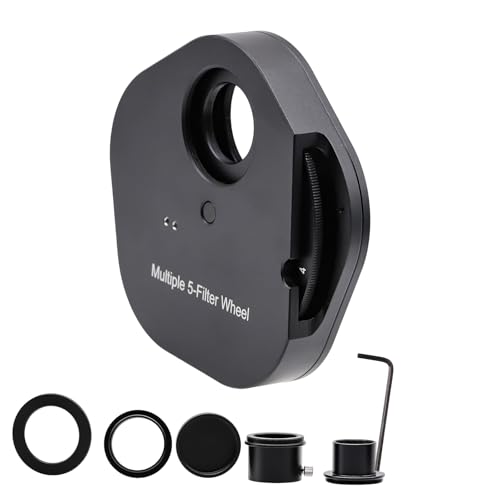
- Switches between five 1.25-inch filters
- Includes camera and eyepiece adapters
- Numbered wheel simplifies filter selection
Best For: Mixed visual and camera setups
Best LRGB Starter Wheel – Astromania 9-Position 1.25-inch Filter Wheel
Astromania 1.25" Multiple 9-Position Filter Wheel for Telescope - with LRGB Filter Set
Check Price On AmazonFor photographers comparing telescope filter wheels for monochrome cameras, this Astromania model is a practical 1.25-inch option with an included LRGB set. Its nine-position design leaves room for additional filters while allowing quick, numbered changes without removing the camera or eyepiece.
Best For: Beginners and intermediate imagers building an LRGB setup around 1.25-inch filters.
Pros:
- Includes red, green, blue, and luminance filters in metal cells.
- Nine positions provide room for up to five additional 1.25-inch filters.
- Aluminum construction is designed to support heavier cameras.
- Light-tight interior helps limit reflections and stray light.
Cons:
- Limited to 1.25-inch filters and accessories.
- Filter changes are manual rather than motorized.
This is a convenient all-in-one choice when an LRGB starter set and broad filter capacity matter more than automated operation or a larger 2-inch format.
Best 2-Inch Option – SVBONY SV133 2-Inch Filter Wheel
If your monochrome camera rig uses 2-inch filters or needs a sturdier larger-format accessory, the SVBONY SV133 offers five numbered positions. It includes a 2-inch eyepiece adapter, focuser nosepiece, conversion interface, M48 camera adapter, and rotation lock ring for flexible setup options.
Best For: Imagers using 2-inch accessories with DSLR, CCD, or CMOS cameras.
Pros:
- Supports five 2-inch filter positions.
- Includes multiple adapters and a rotation lock ring.
- Sturdy aluminum housing is suitable for heavier cameras.
- Light-tight construction is intended to reduce reflections and stray light.
Cons:
- Larger 2-inch format may be more than compact setups need.
- The listed M48-to-M42 adapter is excluded.
- It has fewer positions than nine-filter alternatives.
Choose this wheel when a 2-inch optical path and broad camera compatibility are priorities. Confirm your thread and back-focus requirements before ordering.
Best Versatile 1.25-Inch Wheel – Astromania 9-Position Filter Wheel
This Astromania wheel is aimed at observers and imagers who want to keep several 1.25-inch filters installed and switch among them quickly. Its nine-position layout works with planetary, lunar, narrowband, nebula, and other filters, while the included eyepiece adapter and T-thread support both visual and camera use.
Best For: Mixed visual observing and 1.25-inch lunar, planetary, or nebula imaging.
Pros:
- Holds up to nine 1.25-inch filters.
- Works with eyepieces, Barlow lenses, and planetary CCD cameras.
- Includes a 1.25-inch adapter and T-thread connection.
- Numbered positions and a light-tight interior simplify operation.
Cons:
- Filters are not included.
- Manual rotation is required for every change.
- Compatibility depends on the telescope adapter and camera threads.
Its strong point is flexibility: it can serve an observing setup and an imaging rig without requiring a separate wheel for every filter type. Budget separately for the filters you need.
Best Compact 1.25-Inch Choice – SVBONY SV133 Filter Wheel
For compact telescope filter wheels for monochrome cameras, the SVBONY SV133 combines five 1.25-inch positions with a short design suited to systems with limited back focus. Its T2 adapter, locking ring, eyepiece adapter, and focuser nosepiece support both visual use and DSLR or CCD imaging.
Best For: Compact Newtonian or Dobson setups using 1.25-inch filters and short back focus.
Pros:
- Short design is intended for limited-back-focus devices.
- Five numbered positions allow quick filter changes.
- Includes T2 camera adapter, locking ring, and eyepiece adapter.
- Light-tight aluminum housing helps control stray light.
Cons:
- Holds fewer filters than nine-position models.
- Filters are not included.
- Limited to the 1.25-inch format.
This is a sensible space-conscious choice when a camera-mounted wheel must fit a compact optical train. Its five-position capacity is enough for a focused filter set without adding the bulk of a larger wheel.
Flexible 1.25-inch Control – Astromania 5-Position Filter Wheel
For telescope filter wheels for monochrome cameras, this Astromania model offers five numbered positions for quickly switching among 1.25-inch filters during planetary, lunar, or tricolor imaging. It includes a 1.25-inch nosepiece, eyepiece adapter, and T2 camera adapter for visual and astrophotography setups.
Best For: Observers and imagers who want a compact manual wheel for 1.25-inch filters, eyepieces, or planetary cameras.
Pros:
- Five filter positions with numbered indexing for repeatable selection.
- Supports connection through either a 1.25-inch nosepiece or T-thread.
- Includes adapters for eyepieces, planetary cameras, and T-ring-equipped cameras.
- Comes with an M42 locking ring for distance adjustment and a storage case.
Cons:
- Requires about 23mm of inward focus travel.
- May be problematic with some Newtonian reflector setups.
- Filters are not included with this model.
Its included adapters make it versatile for visual and imaging work, while the focus-travel requirement deserves a compatibility check before purchase. The five-position format is useful when a smaller, straightforward manual wheel is sufficient.
High-Capacity Manual Wheel – MEOPTEX 1.25-inch Filter Wheel
This MEOPTEX model is a practical option among telescope filter wheels for monochrome cameras when you want quick access to a broad selection of standard 1.25-inch filters. Its numbered positions and telescope-side T2 and 1.25-inch connections support straightforward camera, eyepiece, and telescope use.
Best For: Users who need a larger filter capacity and quick manual changes with standard 1.25-inch filters.
Pros:
- Provides space for up to nine 1.25-inch filters once mounted.
- Filters can be changed in seconds without removing the setup.
- Numbered positions from 1 through 9 help identify the selected filter.
- Offers both T2 and 1.25-inch telescope-side connections.
Cons:
- Supplied notes do not indicate that filters are included.
- The larger capacity may be unnecessary for simpler observing sessions.
- Manual operation requires rotating the wheel for each filter change.
The nine-position capacity is the main reason to choose this wheel over smaller alternatives. Confirm the filter and camera clearances in your setup, but its standard connections and numbered layout make it a flexible manual solution.
Ready-Made LRGB Imaging – Astromania 5-Position LRGB Wheel
For telescope filter wheels for monochrome cameras, this Astromania package combines a five-position 1.25-inch wheel with red, green, blue, and luminance filters. Rotating the wheel places the selected filter in the light path without removing the camera or eyepiece, supporting a simple workflow for RGB astrophotography.
Best For: Monochrome-camera users who want a manual filter wheel with a supplied LRGB set for color imaging.
Pros:
- Includes red, green, blue, and luminance filters for LRGB imaging.
- Five-position wheel leaves room for an additional 1.25-inch filter.
- Sturdy aluminum construction is described as suitable for heavy cameras.
- Attaches through either the supplied 1.25-inch nosepiece or T-thread.
Cons:
- Requires approximately 20mm of additional focus travel.
- The wheel is manually rotated between exposures.
- Its included filter set is limited to the listed LRGB configuration.
This is the most directly imaging-oriented option in the group because the LRGB filters are included and ready to install. Check back-focus requirements before ordering, especially if your telescope has limited focusing range.
High-Capacity Pick – MEOPTEX 9-Position 1.25-inch Filter Wheel
For astronomers comparing telescope filter wheels for monochrome cameras, this MEOPTEX model prioritizes filter capacity. Its rotary design holds up to nine standard 1.25-inch filters, making it practical when you want several imaging or observing options ready without repeated filter changes.
Best For: Users who need maximum 1.25-inch filter capacity for observing or photography.
Pros:
- Holds up to nine standard 1.25-inch filters.
- Rotary operation enables quick switching between filters.
- Supports common 1.25-inch filter setups.
Cons:
- Limited to 1.25-inch filters.
- Manual operation requires rotating the wheel to select a filter.
- Not water resistant.
The main advantage is straightforward: nine positions provide more room for a varied filter set than smaller wheels. Check that your camera and telescope accessories are designed for 1.25-inch filters before choosing it.
Heavy-Duty 2-inch Option – Astromania 5-Position 2-inch Filter Wheel
Among telescope filter wheels for monochrome cameras, this Astromania model stands out for its 2-inch format, aluminum housing, and light-tight interior. It provides five numbered positions for changing between lunar, planetary, and nebula filters while supporting camera and telescope connections.
Best For: Astrophotographers using 2-inch filters, heavier cameras, or setups that benefit from a short filter-wheel design.
Pros:
- Accepts five standard 2-inch telescope filters.
- Sturdy aluminum housing is intended to support heavy cameras.
- Light-tight interior helps limit reflections and stray light.
- Includes a 2-inch telescope adapter and uses M48x0.75 male accessory threads.
Cons:
- Requires about 22.5 mm of inward focusing travel.
- Only provides five filter positions.
- Adapters for some camera configurations, such as an M48-to-T2 adapter, are not included.
This is a versatile choice when your imaging train uses 2-inch filters and needs firm support. Before buying, confirm available inward focus and plan any additional camera adapters required by your setup.
Complete 1.25-inch Kit – CASYDYEN 5-Position Manual Filter Wheel
For buyers seeking telescope filter wheels for monochrome cameras with connection hardware included, this CASYDYEN wheel offers five 1.25-inch positions plus camera and eyepiece adapters. Its numbered slots and knurled rotation wheel simplify selecting a preloaded filter during planetary, lunar, or deep-sky imaging.
Best For: Beginners and mixed visual/imaging users who want a 1.25-inch filter wheel with a broad accessory package.
Pros:
- Quickly switches between five 1.25-inch filters.
- Includes camera adapter, eyepiece adapter, nosepiece, lock ring, end cap, and wrench.
- Numbered positions make filter selection easier to track.
- Precision-machined aluminum housing provides a durable structure.
Cons:
- Holds fewer filters than a nine-position wheel.
- Limited to 1.25-inch filters.
- No warranty is listed in the supplied details.
The included accessories make this a practical starting point for users moving between visual observing and camera work. Its five-position capacity is best suited to a focused filter set rather than a large collection.
How We Picked the Best Telescope Filter Wheels for Monochrome Cameras
We focused on the features that matter most in practical imaging setups: filter capacity, supported filter size, camera and telescope compatibility, mechanical convenience, and overall value. We also separated standard filter wheels from models sold with LRGB sets, since a bundle can be useful for beginners but may be less suitable if you already own a preferred filter set.
Manual wheels are generally simpler and more affordable than motorized models. They can work well for planetary, lunar, and deep-sky imaging when you can reach the equipment safely between exposures. However, users running automated sequences should confirm whether a selected wheel supports their planned control system before buying.
Quick Comparison
| Best For | Recommended Capacity | Filter Format | What to Look For |
|---|---|---|---|
| Basic monochrome imaging | 5 positions | 1.25 inches | Compact size and simple manual operation |
| RGB and narrowband setups | 9 positions | 1.25 inches | Room for LRGB, luminance, and specialty filters |
| Larger sensors or wider fields | 5 positions | 2 inches | Clear aperture, spacing, and camera compatibility |
| New astrophotographers | 5 or 9 positions with filters | 1.25 inches | Complete bundle and straightforward installation |
Key Buying Factors for Telescope Filter Wheels for Monochrome Cameras
Filter Size and Optical Path
Match the wheel to your filters first. A 1.25-inch wheel is usually more compact and economical, while 2-inch filters can reduce vignetting with larger sensors and faster optical systems. Check the wheel’s clear aperture rather than relying only on the outside thread size.
Capacity
Five positions may cover luminance plus red, green, and blue filters with one spare slot. Nine positions are more useful if you plan to add hydrogen-alpha, oxygen-III, sulfur-II, or multiple luminance and calibration options.
Backfocus and Connections
Review the included adapters, threads, and optical thickness. The wheel must fit between the telescope and camera without exceeding your available backfocus. Also verify whether the package includes the camera adapter or whether it must be purchased separately.
Manual Versus Automated Use
Manual wheels are affordable and quick to install, but they require physical access during filter changes. For unattended imaging, prioritize a motorized, software-compatible wheel instead of assuming a manual model can be upgraded.
Who Should Buy Which Telescope Filter Wheels for Monochrome Cameras?
Choose a five-position 1.25-inch wheel if you want a compact, budget-friendly setup for LRGB imaging. Select a nine-position model if you expect to combine broadband and narrowband filters or want to avoid repeatedly opening the imaging train. A 2-inch wheel is the better starting point for larger cameras, fast telescopes, or systems where 1.25-inch filters may vignette. If you are building your first monochrome rig, an LRGB bundle can simplify the initial purchase, while experienced imagers may prefer a wheel-only option that matches their existing filters.