The best globes for children make geography easier to explore through touch, play, storytelling, and hands-on discovery. This roundup compares traditional rotating globes with talking, light-up, and app-enhanced options.
Whether you need a first globe for a preschooler, an engaging learning tool for an older child, or a decorative classroom model, these picks cover a range of ages, features, and budgets.
Best 10 Globes for Children Picks for 2026
Best Illuminated Pick
SMART WALLABY 9" Educational Globe

- World map plus illuminated 88-constellation mode
- Includes STEM flags, card game, and constellation guide
- Spinning 9-inch design for home or classroom use
Best For: Hands-on geography and astronomy learning with display lighting
Best Interactive Video Globe
LeapFrog Magic Adventures Globe
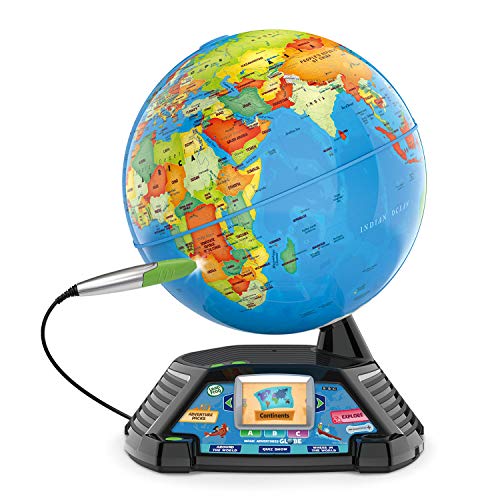
- 2.8-inch screen with BBC videos and animations
- Stylus activates facts, games, and activities
- Designed for children ages 5–12
Best For: Screen-based geography and world-culture learning
Best Simple Desk Globe
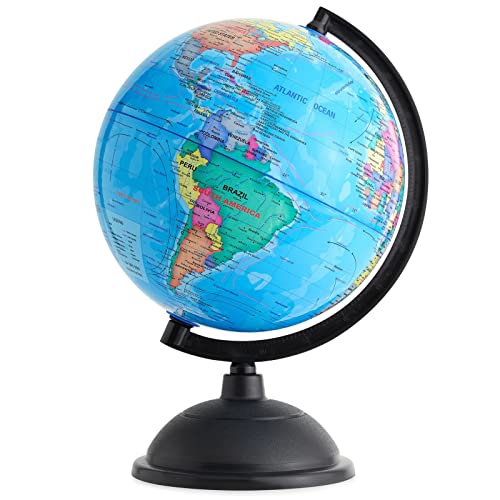
- Rotating multicolor map of countries and oceans
- Compact 8-inch format for desks and classrooms
- Plastic design made for frequent handling
Best For: Straightforward, battery-free geography exploration
Best Talking Globe
Little Experimenter Interactive Globe

- Smart pen provides spoken geography facts
- Covers capitals, languages, currencies, climate, and more
- Includes 300 trivia questions for ages 8–12
Best For: Audio-supported geography practice and trivia
Best Classic Globe
KISEER 8-Inch Rotating World Globe

- Colorful political map with detailed labels
- Rotating design encourages hands-on learning
- Removable stand suits home or classroom use
Best For: Traditional geography practice and classroom demonstrations
Best Interactive Globe
LeapFrog LeapGlobe Light-Up Globe

- Features 48 touch points and three play modes
- Teaches animals, landmarks, languages, and music
- Designed for children ages 3 and up
Best For: Hands-on, multimedia geography play for preschoolers
Best Compact Globe

- Space-saving 6-inch design for desks or shelves
- 360-degree rotating stand supports exploration
- Shows countries, capitals, and geographic borders
Best For: Small study spaces and introductory geography learning
Interactive Pick
Orboot Earth Explorer AR Globe

- AR learning with 400+ wonders and 1,000+ facts
- 60+ constellation mode plus magic stylus
- Includes games, quizzes, passport, and sticker book
Best For: Children ages 4+ who enjoy interactive geography and STEM play
Simple Learning Choice

- 360-degree rotating political globe
- Compact 6.1-inch desktop design
- Non-toxic materials and sturdy base
Best For: Basic geography practice at home, school, or a classroom
Hands-On STEM Pick

- Three openable Earth layers reveal a glowing core
- AR facts cover geography, fossils, minerals, and geology
- No subscriptions, ads, or Wi-Fi after initial setup
Best For: Ages 4–10 exploring Earth science through hands-on STEM play
Best Illuminated Pick – SMART WALLABY 9" Educational Globe
For families seeking globes for children that work as both learning tools and room décor, the SMART WALLABY combines a political world map with an illuminated constellation mode. Its 9-inch size, spinning design, STEM flags, country card game, and constellation guide support hands-on geography and astronomy learning.
Best For: Children, homeschoolers, classrooms, and families wanting an educational globe that doubles as a night-light-style display.
Pros:
- Offers both a world map and a glowing display of 88 constellations.
- Includes a constellation guide and interactive geography card game.
- Spinning design and easy-to-read details encourage hands-on exploration.
Cons:
- Its 9-inch size may provide less detail than a larger globe.
- The illuminated feature requires maintenance or bulb replacement over time.
This is a versatile choice for buyers who want geography, astronomy, and decorative lighting in one desktop globe. The added activities make it more engaging than a basic map globe.
Best Interactive Video Globe – LeapFrog Magic Adventures Globe
The LeapFrog Magic Adventures Globe is one of the more feature-rich globes for children, pairing a globe, stylus, and 2.8-inch video screen. It goes beyond countries and capitals with BBC videos, games, animations, and facts about cultures, animals, habitats, landmarks, and geography.
Best For: Children ages 5–12 who learn well through videos, quizzes, guided activities, and interactive exploration.
Pros:
- Provides BBC video content, animations, facts, and three interactive games.
- Covers cultures, animals, habitats, landmarks, flags, and physical geography.
- Includes a stylus and supports quiz-based exploration.
Cons:
- Requires four AA batteries for regular use.
- The electronic features may be more involved than needed for buyers seeking a simple globe.
- Its larger desktop footprint may need dedicated space.
Choose this model when interactive media matters more than a traditional globe-only experience. It offers an especially broad range of learning topics for elementary-age children.
Best Simple Desk Globe – Juvale 8-Inch World Globe
For shoppers who prefer straightforward globes for children without batteries or electronic extras, the Juvale 8-inch World Globe offers a rotating multicolor map of countries, continents, and oceans. Its compact plastic construction suits desks, classroom shelves, and smaller learning spaces.
Best For: Young learners, classrooms, and families wanting an affordable-looking, portable desktop globe for basic geography exploration.
Pros:
- Rotating design encourages hands-on exploration.
- Displays countries, continents, and oceans on a multicolor world map.
- Compact 8-inch size is easy to place, transport, and store.
- Plastic construction is designed for frequent handling.
Cons:
- It does not include interactive electronics, games, or lighting.
- The smaller format may limit map detail.
This is a practical pick for buyers who want a simple world map that children can spin and examine independently. Its compact footprint also makes it suitable for classrooms and shared desks.
Best Talking Globe – Little Experimenter Interactive Globe
The Little Experimenter Interactive 9-inch globe adds spoken feedback to geography practice through a smart pen. Children can touch countries and locations to hear information about capitals, languages, populations, currencies, climates, and more, while 300 trivia questions provide additional challenges.
Best For: Children ages 8–12 who enjoy guided audio learning, geography facts, and trivia at home or in the classroom.
Pros:
- Smart pen delivers real-time spoken information through a built-in speaker.
- Covers countries, capitals, languages, anthems, populations, currencies, and climate.
- Includes 300 trivia questions for review and challenge.
- Suitable for home learning, classrooms, and group play.
Cons:
- The interactive functions depend on the included smart pen.
- Its 9-inch format may not show as much detail as a larger globe.
This model is a strong fit when children benefit from hearing facts rather than only reading map labels. The combination of touch-activated audio and trivia can make independent geography practice more engaging.
Best Classic Globe – KISEER 8-Inch Rotating World Globe
If you want straightforward globes for children, the KISEER 8-inch model offers a traditional, easy-to-explore format. Its colorful political map identifies countries, continents, capitals, oceans, islands, rivers, and deserts, while the rotating design encourages hands-on geography practice.
Best For: Children, classrooms, and homes needing a traditional educational globe with a larger 8-inch display.
Pros:
- Detailed, colorful political map with clear geographic labels
- Rotates for interactive exploration and demonstrations
- Removable base and frame support storage or classroom use
- Plastic construction is designed for regular use
Cons:
- It does not include electronic lighting, sounds, or interactive quiz modes
- The blue, glossy design may be more educational than decorative for some rooms
This is a practical pick for learners who benefit from seeing and physically turning a conventional world map. Its 8-inch size balances readable detail with manageable storage.
Best Interactive Globe – LeapFrog LeapGlobe Light-Up Globe
Among globes for children, the LeapFrog LeapGlobe stands out for its touch controls, lights, sounds, and built-in activities. With 48 touch points and multiple play modes, it turns geography lessons into an interactive experience for children ages 3 and up.
Best For: Young children who prefer guided, multimedia exploration over a traditional static map.
Pros:
- Offers 48 touch points for exploring the world
- Includes Exploration, Music, and Find-It modes
- Covers animals, landmarks, languages, foods, and world music
- Light-up features add visual feedback during play
Cons:
- Requires two AA batteries; demo batteries are included, but new ones are recommended for regular use
- At 2.4 pounds, it is heavier than a basic plastic globe
- Its electronic format may be less suitable for quiet, map-focused study
The LeapGlobe is the strongest choice here for entertainment-led learning. Its age guidance, touch points, and varied modes can help hold a young learner’s attention while introducing geography concepts.
Best Compact Globe – 6-Inch Geographic World Globe
For shoppers seeking affordable, space-conscious globes for children, this 6-inch geographic model keeps the essentials simple. It shows countries, water bodies, capitals, continental borders, and regional borders, with a 360-degree rotating stand for interactive exploration.
Best For: Desks, kids’ rooms, small study areas, and children who need a compact introductory globe.
Pros:
- Compact 6-inch size is easy to place on a desk or shelf
- 360-degree rotation supports geography games and exploration
- Detailed printing includes countries, capitals, and borders
- Black stand and colorful map create a decorative academic look
Cons:
- The smaller size may provide less visual detail than a larger globe
- It has no electronic, light-up, or audio features
- Its plastic construction may feel more basic than premium alternatives
This globe offers a sensible balance of learning and decoration when space is limited. It is best suited to basic world geography practice rather than advanced, highly detailed study.
Interactive Pick – Orboot Earth Explorer AR Globe
For families seeking globes for children that combine geography with active play, the PlayShifu Orboot Earth Explorer adds app-based augmented reality, games, quizzes, and more than 1,000 facts. The 10-inch globe also includes a constellation mode and a magic stylus for hands-on exploration.
Best For: Children ages 4 and up who enjoy interactive, game-based STEM and geography learning.
Pros:
- AR app brings the globe to life with 400+ wonders and 1,000+ facts.
- Includes constellation mode with more than 60 constellations.
- Magic stylus, passport, stickers, quizzes, quests, and games add variety.
- Large 10-inch globe provides an engaging display.
Cons:
- A compatible device is required but is not included.
- The experience depends on using the companion app.
This is a strong choice when you want a globe to feel like an activity rather than a static reference tool. Its combination of AR content, star exploration, and physical accessories offers plenty to revisit.
Simple Learning Choice – 6-Inch Spinning World Globe
If you prefer straightforward globes for children without app requirements, this compact 6.1-inch political globe offers a simple way to explore countries and continents. It rotates 360 degrees and sits on a sturdy base for use at a desk, bookshelf, classroom, or learning center.
Best For: Children, students, and classrooms needing an accessible desktop globe for basic geography exploration.
Pros:
- Rotates around its axis for hands-on exploration.
- Compact size suits desks, shelves, classrooms, and learning centers.
- Made with non-toxic materials according to the supplied notes.
- Sturdy base is designed to resist tipping or tilting.
Cons:
- It is a basic political globe rather than an interactive model.
- Its 6.1-inch diameter provides less map area than larger globes.
This model is best when simplicity, portability, and a modest footprint matter more than digital features. It can serve as an everyday visual aid for early geography practice at home or school.
Hands-On STEM Pick – Orboot Core Interactive Globe
For families looking for globes for children that go beyond country names, the PlayShifu Orboot Core reveals the planet’s interior through three openable layers. Its AR app adds facts about geography, animals, fossils, minerals, and geology, while the setup supports offline use without subscriptions or ads.
Best For: Children ages 4 to 10 who are ready to explore Earth science, geology, geography, and hands-on STEM concepts.
Pros:
- Three-layer design lets children explore the surface, crust, mantle, and glowing core.
- Offers more than 1,000 facts across geography, culture, science, and Earth topics.
- App access has no subscriptions or in-app purchases, with no Wi-Fi needed after setup.
- Smooth arc-free rotation and included passport, stamp, and sticker book support repeated play.
Cons:
- The app requires an initial setup with a compatible device.
- Its multiple layers may require careful handling during hands-on play.
Orboot Core is the most science-focused option in this group. It offers lasting value for children whose interests are moving from naming places toward understanding fossils, minerals, and how Earth is structured.
How We Picked the Best Globes for Children
We evaluated these Globes for Children by looking at age suitability, educational value, ease of use, construction, display size, and the type of interaction each model provides. Traditional spinning globes can support basic location skills, while electronic and augmented-reality models may add pronunciation, facts, quizzes, games, and visual layers.
We also considered whether a globe is best suited to independent play, guided learning, classroom use, or bedroom and desk display. Features are most useful when they match a child’s age and attention span rather than simply adding complexity.
Quick Comparison
| Globe type | Best for | What to expect |
|---|---|---|
| Traditional rotating globe | Early geography and décor | Simple, screen-free exploration |
| Light-up globe | Visual learning and night display | Maps may show additional details when illuminated |
| Talking or touch globe | Interactive fact learning | Audio content, quizzes, and touch-based activities |
| AR globe | Hands-on digital exploration | Requires a compatible device and app |
Key Buying Factors for Globes for Children
Age and Learning Level
Preschool children generally benefit from large labels, colorful maps, sturdy stands, and simple controls. Older elementary-age children may get more from political boundaries, physical geography, country facts, STEM content, or interactive challenges. Always check the listed age range, especially for models with small accessories.
Interactive Features
Talking pens, touch controls, games, and AR apps can make geography more engaging, but they also introduce batteries, software, volume, and compatibility considerations. For regular independent use, choose controls that are easy to understand and content that does not require constant adult help.
Size, Stability, and Durability
An 6- to 9-inch globe is usually compact enough for a desk while remaining readable for a child. Look for a stable base, smooth rotation, and materials that can handle frequent handling. A larger globe can improve visibility but needs more shelf or table space.
Map Detail and Display Style
Choose colorful, simplified maps for younger learners and more detailed political or physical maps for older children. Illuminated models can provide a useful second view, but confirm whether the light is intended for learning, decoration, or both.
Who Should Buy Which Globes for Children?
- For preschoolers: Choose a sturdy, colorful globe with simple labeling and minimal setup.
- For ages 4 to 7: A light-up, touch, or beginner-friendly interactive globe can turn short play sessions into guided exploration.
- For ages 8 to 12: Look for talking, STEM-focused, detailed, or app-connected models with deeper facts and quizzes.
- For screen-free learning: Select a traditional rotating globe with clear political or physical map details.
- For technology-loving kids: An AR or electronic globe offers the richest interactive experience, provided the required app and device are convenient.
- For classrooms or shared spaces: Prioritize readable labeling, a stable stand, easy controls, and a design that can withstand frequent handling.
The right choice depends less on the number of features than on how naturally the globe fits a child’s age, interests, and learning routine.