The best electronic component kits for Arduino projects make it easier to move from simple LED experiments to sensors, displays, motors, and connected devices. The right kit should include a compatible controller board, a useful selection of components, dependable documentation, and enough room to keep learning.
We compared 10 popular Arduino-compatible kits across beginner usability, included hardware, project variety, expansion potential, and platform compatibility. Whether you want a basic UNO setup, a larger Mega kit, or Wi-Fi-enabled ESP32 and UNO R4 hardware, this roundup helps narrow the choices.
Best 10 Electronic Component Kits for Arduino Projects Picks for 2026
Best Component Variety
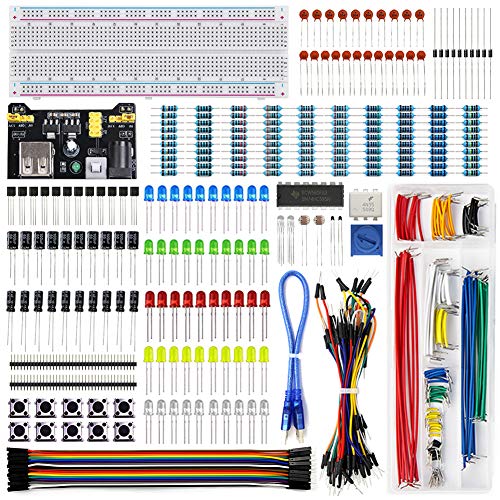
- More than 400 components and sensors
- Labeled parts in a sturdy storage box
- Includes power module, USB cable, and breadboard
Best For: Existing Arduino, Raspberry Pi, or STM32 owners
Best Guided Starter Kit
ELEGOO UNO R3 Super Starter Kit

- Includes UNO R3 controller and 22-plus lessons
- Broad mix of sensors, motors, displays, and inputs
- Solderless setup with pre-soldered LCD header
Best For: Beginners and STEM learning environments
Best Standalone Component Set

- 235 parts for breadboard experiments
- Selectable 3.3V and 5V power module
- Includes 74HC595, optocoupler, transistors, and diodes
Best For: Arduino owners building repeatable circuit exercises
Best Value Complete Bundle
REXQualis UNO R3 Super Starter Kit
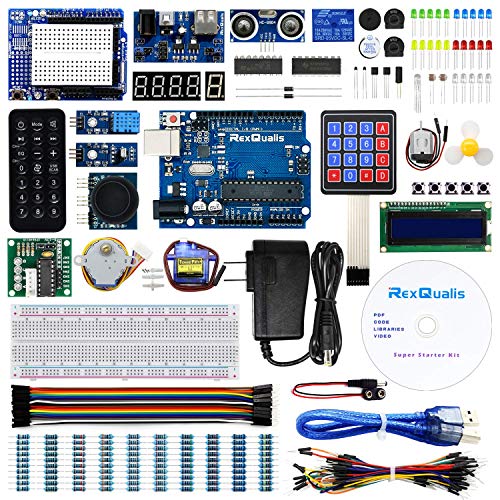
- Includes UNO R3-compatible controller board
- Adds 9V 1A power adapter and pre-headered LCD
- Labeled components come in a storage box
Best For: Beginners wanting a complete Arduino-compatible bundle
Most Complete Mega Kit

- 35+ guided projects and 200+ components
- Mega board supports larger, I/O-heavy builds
- Includes sensors, displays, motors, and storage
Best For: STEM learners and makers building varied Arduino projects
Guided Learning Pick

- 34 lessons plus 40+ video courses
- Original Uno R3 with 200+ components
- Includes a multimeter and breadboard holder
Best For: Beginners seeking structured, hands-on instruction
Versatile Beginner Bundle
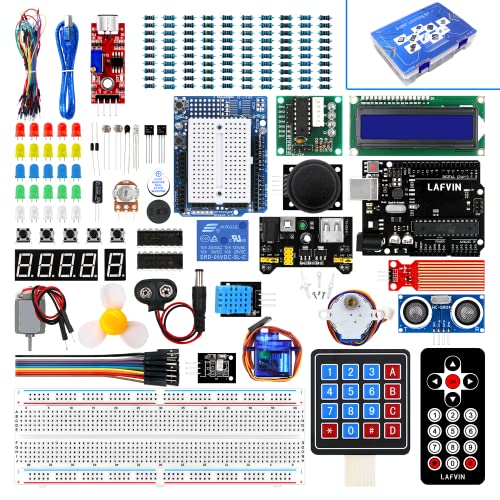
- 20+ lessons with code, libraries, and datasheets
- Supports Mega2560, Mega328, and Nano boards
- Includes motors, LCDs, displays, and sensors
Best For: Beginners exploring core Arduino hardware
Premium IoT Learning Pick

- Original Arduino UNO R4 WiFi board
- 300+ components and 50 guided projects
- 100+ video lessons with IoT support
Best For: Beginners and makers pursuing Arduino, electronics, and IoT skills
Best Basic Foundation
ELEGOO UNO R3 Basic Starter Kit

- UNO R3-compatible board for Arduino IDE
- Breadboard and practical beginner components
- Guided projects for circuits and coding
Best For: First-time learners building core electronics skills
Best for Connected Builds
ELEGOO ESP-32 Super Starter Kit

- Dual-core ESP-32 with Wi-Fi and Bluetooth
- 35+ modules for sensors, displays, and motors
- 30+ guided Arduino IDE projects
Best For: Makers developing IoT and smart-device projects
Best Component Variety – REXQualis Electronics Fun Kit
The REXQualis Electronics Component Fun Kit is a strong option for shoppers comparing electronic component kits for Arduino projects and other beginner electronics work. With more than 400 components, an 830 tie-point breadboard, power supply module, jumper wire, and individually labeled parts, it is suited to experimenting across many simple circuits. Note that the controller board is not included.
Best For: Makers who already own an Arduino, Raspberry Pi, or STM32 board and want a broad, organized component collection.
Pros:
- Includes more than 400 sensors and components for varied projects.
- Parts such as resistors, LEDs, transistors, and ICs are individually packaged and labeled.
- Includes an 830 tie-point breadboard and a breadboard power supply with USB cable.
- Datasheets and tutorials are available for download.
Cons:
- Controller board is not included.
- The large component assortment may be more than beginners need for a first project.
This is a practical expansion kit when variety and organized storage matter more than getting a complete programmable starter bundle. Pair it with a compatible controller board for Arduino-based builds.
Best Guided Starter Kit – ELEGOO UNO R3 Super Starter Kit
The ELEGOO UNO R3 Project Super Starter Kit is designed for beginners who want structured electronic component kits for Arduino projects. Its UNO R3 controller, solderless breadboard, sensors, motors, display modules, and 22-plus guided lessons provide a clear path from basic LED circuits to temperature, distance, motion, and display projects.
Best For: Beginners, families, homeschoolers, coding clubs, and STEM classrooms seeking an all-in-one, no-solder project kit.
Pros:
- Includes an UNO R3 controller board and a broad set of sensors, motors, displays, and components.
- Offers 22-plus guided lessons with downloadable tutorials and example code.
- Pre-soldered LCD header and plug-in modules help beginners avoid soldering.
- Supports projects involving LEDs, sensors, servos, stepper motors, LCDs, joysticks, and IR input.
Cons:
- The power-module input should not exceed 9V.
- Beginners need to verify component polarity, breadboard rows, board selection, and computer port during setup.
Among these electronic component kits for Arduino projects, this is the most complete learning-oriented choice because it combines the controller board with a progression of guided builds. It is especially suitable when instructional support is as important as the parts list.
Best Standalone Component Set – ELEGOO 235-Item Fun Kit
The ELEGOO Electronic Fun Kit is a focused choice for electronic component kits for Arduino projects when you already have a compatible controller. Its 235 parts cover common breadboard experiments, including LEDs, buttons, RGB effects, buzzer alarms, light-sensitive circuits, and output expansion with a 74HC595.
Best For: Arduino owners who want a compact component assortment for repeatable breadboard practice and basic circuit experiments.
Pros:
- Includes 235 components for varied beginner electronics exercises.
- Provides a 400-tie-point solderless breadboard and selectable 3.3V or 5V power module.
- Includes useful learning parts such as the 74HC595, 4N35 optocoupler, PN2222 transistors, and 1N4007 diodes.
- Jumper wires and female-to-male Dupont leads support quick rewiring.
Cons:
- Controller board, programming cable, and wall power adapter are not included.
- The power module requires a suitable 6.5–9V DC input and should not exceed 9V.
This kit is a good middle ground between a small parts box and a full starter bundle. It offers enough component variety for hands-on circuit learning, but buyers should budget for a compatible microcontroller and power accessories.
Best Value Complete Bundle – REXQualis UNO R3 Super Starter Kit
The REXQualis Super Starter Kit is a value-oriented option for electronic component kits for Arduino projects, especially for first-time builders who need both a compatible controller and project parts. It combines an UNO R3-based board with sensors, servo and motor components, an LCD1602 with a pre-installed header, a ULN2003 driver, labeled parts, and a 9V 1A power adapter.
Best For: Beginners who want a complete Arduino-compatible starting bundle with an included power adapter and storage box.
Pros:
- Includes an Arduino UNO R3-compatible controller board.
- Comes with a 9V 1A power adapter, avoiding the need to start with a 9V battery.
- LCD1602 header is already installed, so it does not require user soldering.
- Components and integrated circuits are individually packaged and labeled in a plastic box.
Cons:
- The board is compatible with Arduino IDE but is not presented as an official Arduino board.
- Beginners may need to download the PDF tutorial and datasheets before starting.
This is a sensible pick when convenience and included essentials matter. Compared with component-only kits, it gets beginners closer to a first working project by including the controller, power adapter, and a selection of motors, sensors, and display hardware.
Most Complete Mega Kit – Mega 2560 Project Starter Kit
For shoppers comparing electronic component kits for Arduino projects, the ELEGOO Mega 2560 kit stands out for its large collection of sensors, displays, motors, and guided exercises. Its 35+ projects provide a structured path from basic circuits to more involved automation and monitoring builds.
Best For: STEM learners, coding clubs, and makers who want extensive components and more I/O for larger projects.
Pros:
- Includes 200+ components and 35+ guided electronics projects.
- Mega 2560 offers 54 digital I/O pins, 15 PWM outputs, 16 analog inputs, and four hardware serial ports.
- Includes useful modules such as RFID, RTC, environmental, motion, distance, motor, and display components.
- Pre-soldered modules, a breadboard, storage case, and small-parts box simplify setup.
Cons:
- The extensive component selection may feel overwhelming for complete beginners.
- The kit is recommended for ages 13 and up, so it is not aimed at younger learners.
This is the strongest choice when project variety and expansion room matter more than keeping the kit minimal. The included tutorial and broad hardware selection can support repeated builds as skills develop.
Guided Learning Pick – SunFounder Inventor Lab Kit
Among electronic component kits for Arduino projects, the SunFounder Inventor Lab emphasizes guided learning with an original Arduino Uno R3, 34 lessons, 40+ video courses, and practical circuit-building resources. It also adds a multimeter and breadboard holder for a more organized learning setup.
Best For: Beginners and younger learners who want step-by-step instruction, video support, and real-world projects.
Pros:
- Includes an original Arduino Uno R3, 34 lessons, and 40+ free video courses.
- Provides 200+ components, including RFID, ultrasonic, LCD, servo, and power-supply modules.
- Multimeter and RAB breadboard holder add practical testing and organization tools.
- Projects include smart trash cans, automatic soap dispensers, and remote-controlled lights.
Cons:
- Its Uno R3 platform has less expansion capacity than a Mega-based kit for very large builds.
- The broad lesson and component lineup may require substantial time to work through.
SunFounder is a well-rounded option when learning support is a priority. The combination of printed guidance, video instruction, community resources, and practical projects makes it approachable without limiting hands-on experimentation.
Versatile Beginner Bundle – LAFVIN Super Starter Kit
The LAFVIN Super Starter Kit is a practical entry point for electronic component kits for Arduino projects, combining more than 20 tutorial lessons with common displays, motors, sensors, and input components. Its Arduino IDE compatibility supports experimentation across several Arduino-compatible boards.
Best For: Beginners who want a broad selection of basic modules and hands-on practice with motors, displays, and sensors.
Pros:
- Includes a tutorial manual with more than 20 lessons, code, libraries, and datasheets.
- Works with R3 Mega2560, Mega328, and Nano platforms and the Arduino IDE.
- Includes servo, stepper, and DC motors plus LCD, seven-segment, and 1602 display modules.
- The LCD1602 module includes a pin header, so it does not require soldering by the buyer.
Cons:
- The supplied notes do not specify a component count or detailed inventory.
- Its tutorial offers more than 20 lessons, fewer than the 34 or 35+ projects listed for the other kits.
This kit makes sense for beginners who want to explore several Arduino-compatible boards and core hardware categories. Its mix of tutorials, motors, displays, and sensors offers a flexible foundation for learning by building.
Premium IoT Learning Pick – SunFounder Elite Explorer Kit
For shoppers seeking electronic component kits for Arduino projects with room to grow, the SunFounder Elite Explorer Kit combines an original Arduino UNO R4 WiFi board with more than 300 components and 50 guided projects. Its built-in Wi-Fi and Bluetooth make it especially useful for learning connected electronics alongside core Arduino programming.
Best For: Beginners, students, teachers, and aspiring makers who want a comprehensive Arduino and IoT learning path.
Pros:
- Includes an original Arduino UNO R4 WiFi with built-in Wi-Fi and Bluetooth.
- Provides 300+ components, sensors, and 50 projects across basic, fun, and IoT categories.
- Offers 100+ video lessons, step-by-step tutorials, open-source code, and technical support.
Cons:
- The broad component and project selection may feel extensive for someone seeking only basic circuits.
- Its beginner-focused course structure may be less necessary for experienced Arduino users.
This is the most complete option in the group for structured learning and connected projects. Compatibility with other Arduino boards, including Uno R3 and Nano, also gives learners flexibility as their skills develop.
Best Basic Foundation – ELEGOO UNO R3 Basic Starter Kit
The ELEGOO UNO R3 Basic Starter Kit is a straightforward choice among electronic component kits for Arduino projects. It focuses on core circuits, including LEDs, buttons, a photoresistor, buzzer, tilt switch, and shift register, with a breadboard and tutorial for solderless practice.
Best For: Beginners, STEM learners, homeschool activities, classroom demonstrations, and introductory Arduino coding.
Pros:
- Includes the essential board, breadboard, USB cable, components, and jumper wires for basic experiments.
- The tutorial provides wiring guidance and example code for hands-on learning.
- Supports practice with digital input, analog sensing, PWM, LEDs, buttons, buzzers, and a 74HC595 shift register.
Cons:
- It is centered on foundational projects rather than Wi-Fi, Bluetooth, or advanced IoT applications.
- The included controller is UNO R3-compatible rather than an original Arduino board.
This kit keeps the learning curve manageable and makes it easy to assemble and revise circuits without soldering. It is a sensible starting point for building confidence with Arduino IDE programming and basic electronics.
Best for Connected Builds – ELEGOO ESP-32 Super Starter Kit
For electronic component kits for Arduino projects that emphasize connectivity, the ELEGOO ESP-32 Super Starter Kit provides an ESP-32 development board with integrated Wi-Fi and Bluetooth. More than 35 modules and components support projects involving displays, sensors, motors, keypads, and other interactive hardware.
Best For: Students, makers, engineers, and hobbyists progressing from basic circuits to IoT and smart-device projects.
Pros:
- Dual-core ESP-32 board includes integrated Wi-Fi, Bluetooth 4.2, and Arduino IDE compatibility.
- Includes more than 35 modules and components, including an OLED screen, servo motor, sensors, and keypad.
- Provides 30+ projects with code, circuit diagrams, and step-by-step online instructions.
Cons:
- The ESP-32 platform may be more advanced than a basic UNO-focused starter kit.
- Its emphasis on connected devices may be unnecessary for simple LED and button exercises.
This is a strong fit for learners who want to move beyond introductory circuits into Wi-Fi- and Bluetooth-enabled builds. The staged tutorial lets users begin with fundamentals while retaining a path toward weather stations, smart-home controllers, and other IoT concepts.
How We Picked the Best Electronic Component Kits for Arduino Projects
We evaluated each kit by looking at the controller board, component range, documentation, project support, compatibility with common Arduino tools, and suitability for the intended user. Kits with breadboards, jumper wires, resistors, LEDs, sensors, displays, and other reusable parts generally offer more learning value than packages built around only a few demonstrations.
We also considered whether a kit is best for first-time builders, experienced Arduino users, classroom work, or connected-device experiments. Product listings can vary by revision, so confirm the included board and component count before ordering.
Quick Comparison
| Kit type | Best for | What to check |
|---|---|---|
| UNO R3 starter kit | First projects and general learning | Tutorial quality, board authenticity, and core components |
| Basic component kit | Users who already own a board | Whether a controller board is included |
| Mega 2560 kit | Larger projects and more I/O | Peripheral variety and project instructions |
| UNO R4 WiFi or ESP32 kit | IoT, wireless, and advanced projects | Wireless features, voltage requirements, and software support |
Key Buying Factors for Electronic Component Kits for Arduino Projects
Board and Software Compatibility
UNO R3 boards are the simplest starting point because they have extensive community support and work with many beginner tutorials. Mega 2560 boards provide more pins for larger builds. UNO R4 WiFi and ESP32 options add modern connectivity, but may require different libraries, setup steps, and power practices.
Component Selection
Look for a practical mix of LEDs, resistors, potentiometers, push buttons, buzzers, sensors, motors, displays, and jumper wires. A breadboard and a stable power module are especially useful. A high item count is not automatically better if many parts are duplicates or poorly documented.
Tutorials and Learning Support
Clear project guides can matter more than an extra handful of components. Beginners should prioritize step-by-step instructions, wiring diagrams, example code, and video lessons. More experienced users may prefer a broad parts assortment with fewer restrictions on project design.
Build Quality and Expansion
Check the quality of the included breadboard, cables, headers, and controller board. Choose a kit that leaves room to add shields, sensors, servos, displays, or communication modules later. Keep voltage levels in mind when combining 5V Arduino hardware with 3.3V devices.
Who Should Buy Which Electronic Component Kits for Arduino Projects?
Choose a UNO R3 super starter kit if you are new to electronics and want a guided path from basic circuits to sensors and displays. These kits usually balance price, documentation, and compatibility well.
Choose a basic component bundle if you already own an Arduino board and mainly need breadboard parts, wires, and common components for experimentation.
Choose a Mega 2560 kit for projects that need many input/output connections or several peripherals operating together. It is a better fit for larger builds than a standard UNO.
Choose an UNO R4 WiFi or ESP32 kit for wireless control, web-connected projects, Bluetooth experiments, or more advanced embedded work. Verify library support and tutorials for your exact board before buying.