The best electronic component kits for students make abstract circuit concepts easier to understand through hands-on experiments. The options in this roundup range from guided Arduino learning systems to large assortments of resistors, LEDs, capacitors, transistors, breadboards, and jumper wires.
Use the comparison and buying advice below to match a kit with the student’s experience level, preferred projects, and need for structured instruction or component variety.
Best 10 Electronic Component Kits for Students Picks for 2026
Guided STEM Learning

- Interactive lessons support electronics and programming fundamentals.
- Includes sensors, motors, LEDs, and a breadboard.
- Built around beginner-friendly hands-on projects.
Best For: Students and educators wanting structured Arduino learning
Project Variety Starter

- Includes 22-plus guided Arduino projects.
- Covers sensors, displays, motors, and inputs.
- Solderless setup supports beginner-friendly building.
Best For: Beginners and STEM classes seeking project variety
Large Parts Assortment

- Provides 1780 assorted electronic components.
- Includes breadboards, PCBs, wires, and connectors.
- Supports solderless testing and broader circuit experimentation.
Best For: Learners needing a large standalone parts assortment
Advanced Arduino Expansion

- Offers 35-plus guided electronics projects.
- Mega board provides extensive I/O and memory.
- Includes 200-plus components, sensors, displays, and motors.
Best For: Older students building larger multi-sensor projects
Large Arduino Assortment
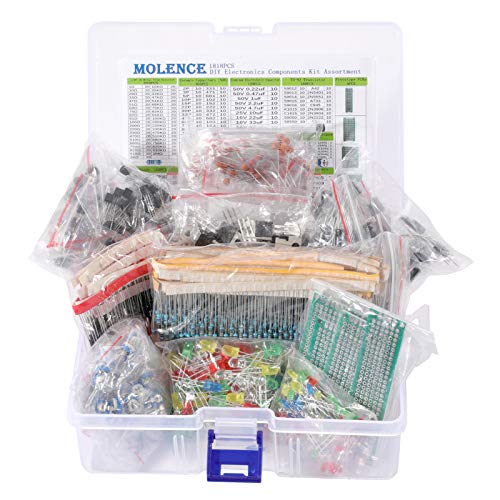
- Includes 1,818 assorted components
- Has prototype PCBs and adjustable parts
- Packed in a reusable storage case
Best For: Students starting broad Arduino and Raspberry Pi experiments
Organized Essentials

- Covers six common component types
- Separately bagged for easier storage
- Resistor values are stamped
Best For: Beginners learning basic component identification and circuits
Project-Ready Starter Set
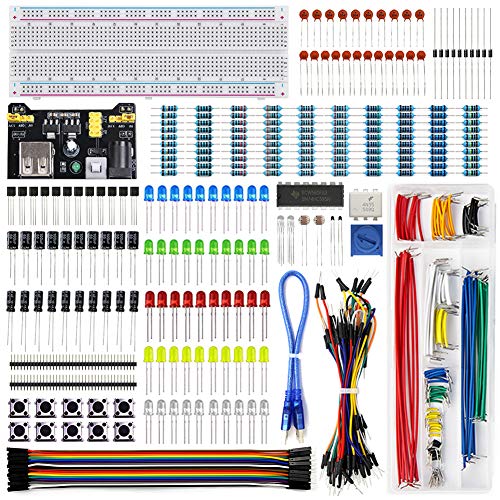
- Includes 400-plus sensors and components
- Adds breadboard, jumper wire, and power module
- Datasheets and tutorials are available
Best For: Hands-on breadboard projects with a separate controller board
Best Value Component Assortment
1400-Piece Electronics Basics Kit

- 1,400 parts across six core component types
- Labeled bags simplify sorting and storage
- Useful for Arduino and DIY practice
Best For: Students who already own prototyping equipment
Best Ready-to-Build Kit
1530-Piece Electronics Lab Starter Set

- Includes an 830-tie solderless breadboard
- Provides Dupont leads and pre-formed jumpers
- Supports beginner LED, RC, and transistor projects
Best For: Students starting breadboard labs without soldering
Most Complete Project Box
2300-Piece DIY Electronics Assortment

- Includes parts, boards, connectors, and accessories
- Adds motors, speakers, ICs, and potentiometers
- Stores components in a compartmented transparent box
Best For: Students building varied DIY and engineering projects
Guided STEM Learning – Arduino Student Kit
The Arduino Student Kit is a structured entry point for students exploring electronic component kits for students, combining a microcontroller, breadboard, sensors, and beginner-friendly projects. Its interactive curriculum helps learners connect circuit building with Arduino programming through guided, practical exercises.
Best For: Students, educators, and beginners who want step-by-step STEM lessons with hands-on projects.
Pros:
- Includes guided projects such as a traffic light, light-sensitive lamp, and motion-activated alarm.
- Combines written instructions, video tutorials, and online learning resources.
- Provides LEDs, resistors, capacitors, motors, sensors, and a breadboard for experimentation.
Cons:
- The curriculum-led format may feel less suitable for learners seeking a large assortment of loose components.
- The listed recommended age range ends at 14 years, so older users may want more advanced hardware.
This is a strong choice when clear instruction matters as much as the components themselves. It prioritizes foundational understanding and guided experimentation over sheer parts quantity.
Project Variety Starter – ELEGOO UNO R3 Project Kit
The ELEGOO UNO R3 Project Super Starter Kit gives beginners a broad set of electronic component kits for students without requiring soldering. Its 22-plus guided lessons cover sensing, displays, inputs, and motors, making it practical for classroom, homeschool, coding-club, or weekend projects.
Best For: First-time Arduino builders who want many guided projects and plug-in components.
Pros:
- Offers 22-plus lessons involving LEDs, temperature, distance, motors, LCDs, joysticks, and IR control.
- Includes a UNO R3 board, sensors, motors, relay, display, breadboard, wires, and numerous discrete components.
- Solderless construction and a pre-soldered LCD help beginners focus on wiring and code.
Cons:
- The breadboard power module should not be used above 9V.
- First-time users need to verify polarity, breadboard rows, board selection, and computer port during setup.
- Younger learners should work with an experienced adult.
With its unusually wide project range and included tutorial, this kit is a versatile starting point for learning Arduino basics. It is especially appealing if you want to move quickly from simple LED circuits to motors, sensors, and displays.
Large Parts Assortment – 1780-Piece Electronics Kit
This 1780-piece assortment is a parts-focused option among electronic component kits for students, with resistors, capacitors, LEDs, transistors, diodes, wires, breadboards, PCBs, and more. It is designed for repeated circuit experiments rather than a curriculum built around a particular controller.
Best For: Students, hobbyists, and makers who need a broad supply of through-hole and surface-mount components for experimentation.
Pros:
- Includes a large mix of passive components, semiconductors, connectors, boards, motors, speakers, buzzers, and switches.
- Two breadboards and jumper wires support solderless circuit testing.
- Categorized, labeled packaging is intended to make parts easier to find and carry.
Cons:
- It does not list a microcontroller or a guided project curriculum.
- The large assortment may require students to identify and organize many individual component types.
This kit makes the most sense for learners who already have, or plan to add, a power source and controller or who want to study component-level circuits. Its strength is quantity and variety, not step-by-step instruction.
Advanced Arduino Expansion – ELEGOO Mega 2560 Starter Kit
The ELEGOO Mega 2560 starter kit is an expansive choice for electronic component kits for students who are ready to combine many sensors, displays, and controls in larger Arduino projects. Its Mega board supplies more I/O and memory than a basic UNO setup, while the tutorial provides 35-plus guided builds.
Best For: Students and makers progressing to larger, multi-sensor Arduino and robotics-style projects.
Pros:
- The Mega 2560 provides 54 digital I/O pins, 15 PWM outputs, 16 analog inputs, four hardware serial ports, and 256 KB of flash.
- Includes 35-plus projects covering RFID, clocks, motion, distance, environmental sensing, motors, and displays.
- Supplies more than 200 components, including an RFID reader, RTC, PIR sensor, keypad, joystick, motors, and storage case.
Cons:
- The larger component count and broader feature set may be more than a complete beginner needs.
- The kit is listed for ages 13 and up, so younger students may need supervision and simplified projects.
This is the strongest fit of the four for learners who have outgrown basic blinking-light exercises. It offers room to build increasingly complex systems while retaining guided lessons and organized storage.
Large Arduino Assortment – 1818-Piece Electronics Kit
For students building a broad parts supply, this 1818-piece kit is one of the more comprehensive electronic component kits for students. It combines common resistors, capacitors, LEDs, diodes, transistors, potentiometers, voltage regulators, and prototype PCBs in a reusable storage case. The assortment is listed as compatible with Arduino UNO, MEGA, Raspberry Pi, PLCs, and microcontrollers.
Best For: Students who want a large variety of through-hole components for Arduino, Raspberry Pi, and general electronics experiments.
Pros:
- Includes 1,818 components across several useful categories.
- Offers 820 metal-film resistors, 300 ceramic capacitors, 120 electrolytic capacitors, LEDs, diodes, and transistors.
- Includes four prototype PCBs plus adjustable potentiometers and voltage regulators.
- Components are assorted in a reusable storage case for carrying and organization.
Cons:
- The kit does not list a controller board, so one must be supplied separately.
- The large assortment may require time to sort and learn.
This is a strong choice when breadth matters more than a project-specific selection. Its labeled categories and included prototype boards give students plenty of parts to explore, although beginners may benefit from a separate tutorial or project guide.
Organized Essentials – 1390-Piece Component Kit
This 1,390-piece assortment focuses on common parts in a compact, organized package, making it a practical option among electronic component kits for students. It includes resistors, diodes, transistors, LED diodes, electrolytic capacitors, and ceramic capacitors. Individual plastic bags and stamped resistor values can make component identification and storage more manageable.
Best For: Students and beginners who need a straightforward collection of frequently used through-hole components.
Pros:
- Provides 1,390 components across six common categories.
- Includes metal-film resistors, common diodes, transistors, LEDs, and two capacitor types.
- Each component type is packaged separately, while resistor values are stamped for easier identification.
- Compact box measures approximately 6.42 by 4.61 inches.
Cons:
- The assortment does not mention prototype boards, jumper wires, or a power supply.
- The notes do not specify a controller board or project tutorials.
Choose this kit if you already have a breadboard or other basic tools and mainly need a selection of replacement and practice components. Its organization and emphasis on common parts suit classroom exercises and introductory circuit work.
Project-Ready Starter Set – REXQualis Electronics Fun Kit
Students who want to build circuits immediately may prefer this project-oriented option among electronic component kits for students. The REXQualis kit includes more than 400 sensors and components, an 830 tie-point breadboard, a breadboard power supply module, jumper wire, a USB cable, precision potentiometers, resistors, LEDs, transistors, and integrated circuits. The controller board is not included.
Best For: Students making hands-on Arduino, Raspberry Pi, or STM32 projects who already have, or plan to buy, a compatible controller board.
Pros:
- Includes more than 400 sensors and components for simple electronics projects.
- Provides an 830 tie-point breadboard, jumper wire, and breadboard power supply module.
- Includes a USB power cable, which supports powering the breadboard supply module.
- Parts are individually packaged and labeled in a sturdy box, with datasheets and tutorials available to download.
Cons:
- The controller board is not included.
- It has fewer total components than the larger 1,818-piece assortment.
This kit is especially appealing for guided, breadboard-based learning because it supplies several setup essentials in one package. Confirm that you have a compatible controller before purchasing, since the included power and prototyping hardware does not replace the board.
Best Value Component Assortment – 1400-Piece Electronics Basics Kit
For students looking for electronic component kits for students, this 1,400-piece assortment provides a broad selection of through-hole parts for introductory Arduino and DIY projects. It focuses on core components rather than complete prototyping hardware, making it a straightforward option for practicing identification and basic circuit building.
Best For: Students and beginners who already have prototyping equipment and need a large supply of basic components.
Pros:
- Includes LEDs, metal-film resistors, electrolytic and ceramic capacitors, common diodes, and transistors.
- Provides 1,400 total pieces for repeated experiments and replacement parts.
- Components are labeled and packed in separate bags for easier sorting and storage.
Cons:
- Does not list a breadboard, jumper wires, or other prototyping accessories.
- The assortment is less immediately ready for no-solder classroom projects than a kit with a breadboard.
This is a practical bulk component collection for learning basic circuit parts and supporting Arduino-related projects. Pair it with a breadboard and jumper set for a more complete student workstation.
Best Ready-to-Build Kit – 1530-Piece Electronics Lab Starter Set
This 1,530-piece set is one of the more complete electronic component kits for students because it combines common parts with an 830-tie solderless breadboard, jumper wires, and pre-formed leads. It is designed to help learners begin simple circuits without soldering and supports 3.3V and 5V microcontroller labs.
Best For: STEM students, makers, and beginners who want to start breadboard projects immediately.
Pros:
- Combines resistors, capacitors, LEDs, diodes, and transistors in a 1,530-piece assortment.
- Includes a full-size breadboard, 60 Dupont leads, and 65 pre-formed jumpers.
- Supports beginner projects such as LED lighting, RC delay circuits, and transistor switches.
- Parts are organized in a storage case, with resistors paper-taped by value.
Cons:
- Students must observe polarity for electrolytic capacitors and diodes.
- Static-sensitive parts require appropriate handling.
For learners who want a practical, day-one setup, this kit offers a strong balance of component variety and prototyping hardware. Its stated compatibility with Arduino, Raspberry Pi, and ESP32 also leaves room for more advanced exercises.
Most Complete Project Box – 2300-Piece DIY Electronics Assortment
Students seeking electronic component kits for students with broad project coverage may appreciate this 2,300-piece assortment. Along with standard parts, it includes ICs, PCBs, breadboards, jumpers, potentiometers, motors, speakers, buzzers, switches, power connectors, and a 30X magnifying glass.
Best For: Beginners, college engineering students, and hobbyists who want a wide mix of components and tools in one box.
Pros:
- Offers a broad selection, including ICs, PCBs, breadboards, motors, speakers, and potentiometers.
- Includes a magnifying glass with jewelry attachments for viewing component markings.
- Large transparent storage box uses multiple compartments to organize small parts.
- Supports circuit learning, breadboard work, DIY projects, and PCB-related practice.
Cons:
- The extensive assortment may be more than a beginner needs for simple starter circuits.
- Supplied notes do not specify the values or quantities of each individual component type.
- At 3.34 pounds, it is less lightweight than a basic component-only kit.
This is the broadest all-in-one option of the three, especially for students planning to explore beyond basic resistor-and-LED exercises. Its compartmented box and included accessories make it suitable for a growing electronics bench.
How We Picked the Best Electronic Component Kits for Students
We focused on kits that support practical learning rather than simply offering the largest parts count. Our evaluation considers the quality and range of included components, compatibility with common Arduino boards, breadboard and jumper-wire provisions, documentation, project guidance, power options, and suitability for beginners.
Structured curriculum matters for students who need a clear starting point, while broad assortments are more useful for learners who already understand basic circuits and want to design their own experiments. We also favored kits that can support progressive learning, from simple LED and resistor circuits to sensor projects, displays, motors, and microcontroller programming.
Quick Comparison
| Kit type | Best for | What to prioritize |
|---|---|---|
| Guided Arduino kit | Complete beginners and classroom learning | Curriculum, tutorials, board compatibility, project support |
| UNO starter kit | Introductory coding and electronics | Common sensors, breadboard, cables, and clear documentation |
| Mega-based kit | Larger or more advanced projects | Expanded I/O, shields, motors, displays, and power accessories |
| Component assortment | Experimenters and replacement parts | Part variety, labeled storage, quantity, and organization |
| Lab-style set | Students building independent projects | Power module, precision components, breadboard capacity, and reusable parts |
Key Buying Factors for Electronic Component Kits for Students
Learning Support
Beginners usually benefit from a printed or digital tutorial with wiring diagrams, code examples, and progressively harder projects. A large parts box without instructions may be less useful for a first-time learner.
Board and Project Compatibility
Check whether the kit includes an Arduino-compatible controller or only passive components. UNO boards are a practical starting point for most introductory projects; Mega-based kits provide more pins and memory for larger builds. Verify that included libraries, sample code, and tutorials match the board.
Component Selection and Organization
Look for a balanced supply of LEDs, resistors, capacitors, diodes, transistors, potentiometers, sensors, switches, integrated circuits, and jumper wires. Labeled compartments or a storage case can save considerable time and reduce misplaced parts.
Power and Prototyping Hardware
A full-size solderless breadboard, USB cable, breadboard power module, and dependable jumper wires make experimentation easier. If the kit includes motors or displays, confirm that its power accessories are suitable for those loads and that students understand basic voltage and polarity limits.
Who Should Buy Which Electronic Component Kits for Students?
First-time learners: Choose a guided Arduino or UNO starter kit with step-by-step projects and clear documentation.
Students moving beyond basics: Consider a Mega-based kit or a broader assortment that adds more sensors, modules, and expansion capacity.
Independent experimenters: A large, organized component assortment offers flexibility for custom circuits, repairs, and repeated prototyping.
Classrooms and clubs: Prioritize durable, reusable components, plentiful common parts, labeled storage, and tutorials that can support multiple learners. Before buying, confirm board version, included accessories, operating-system requirements, and whether a power adapter or batteries must be purchased separately.