Healthy pond water depends on adequate dissolved oxygen, but oxygen levels can change with temperature, algae activity, weather, stocking density, and aeration. A reliable meter helps you measure conditions before fish become stressed.
We compare 10 dissolved oxygen testing options for ponds, aquariums, and aquaculture use, with attention to accuracy, measurement range, calibration, portability, probe design, and long-term convenience.
Best 10 Dissolved Oxygen Meters for Ponds Picks for 2026
Best Flexible-Use Pick
Portable DO Meter with Long Probe

- Reads mg/L and percentage saturation
- 3.77-foot cable for deeper water
- Includes calibration supplies and Bluetooth logging
Best For: Pond, aquarium, hydroponics, and brewing users
Best Multi-Parameter Kit

- Measures DO, pH, EC, salt, and temperature
- Supports calibration and app data management
- Includes replacement membranes and carrying case
Best For: Aquaculture and comprehensive pond water checks
Best Budget Test Kit

- Provides 60 manual tests
- Works with freshwater and marine water
- Measures 0–15 ppm with 0.5 ppm resolution
Best For: Occasional, economical pond oxygen checks
Best Proven Portable Meter
Milwaukee MW600 Economy DO Meter

- 0.0–19.0 mg/L range with 0.1 resolution
- 3-meter polarographic probe cable
- Manual two-point calibration with ATC
Best For: Dedicated pond, aquaculture, and environmental DO testing
Best Bluetooth Floating Meter

- Bluetooth app supports DO and temperature data tracking
- Floating, IP67 waterproof design for outdoor use
- 0–40 mg/L range with automatic temperature compensation
Best For: Connected pond monitoring and hands-free outdoor testing
Best Long-Running Value Meter

- Measures 0–40 mg/L and 0–300% dissolved oxygen
- Two-point automatic calibration with a large LCD
- Includes spare caps, electrolyte, and extra batteries
Best For: Routine pond testing and extended field or facility use
Best Portable Smart Kit

- Bluetooth app stores up to 1,000 readings
- Includes salinity and altitude compensation settings
- Protective carrying case with complete testing accessories
Best For: Field monitoring, data logging, and varied pond conditions
Best Overall
EZTOCH Digital Dissolved Oxygen Meter

- Measures DO from 0.0-40.0 mg/L and 0.0-300.0%.
- Includes cable, calibration solution, electrolyte, and six membranes.
- Backlit display with two-point calibration and auto shutoff.
Best For: Routine pond, aquarium, aquaculture, and hydroponic testing
Best Easy-Use Option

- Measures dissolved oxygen from 0.0-40.00 mg/L.
- Automatic temperature compensation covers 0-50°C.
- Lightweight design with backlit display and low-battery alert.
Best For: Simple pond and aquarium testing across changing temperatures
Best Simple Pick
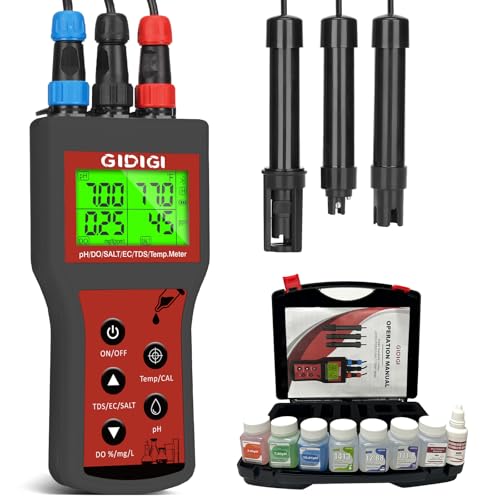
- Measures DO, pH, salinity, TDS, EC, and temperature.
- Adds Bluetooth logging plus salinity and altitude adjustments.
- Includes solutions, six DO membranes, tools, and rugged case.
Best For: Comprehensive pond, aquaculture, aquarium, and hydroponic monitoring
Best Flexible-Use Pick – Portable DO Meter with Long Probe
For shoppers comparing dissolved oxygen meters for ponds, this portable tester offers a practical balance of flexible measurement and field usability. It reads dissolved oxygen in mg/L or percentage saturation, includes a 3.77-foot probe cable, and supports temperature, salinity, and altitude adjustments.
Best For: Pond owners, aquariums, hydroponics, brewing, and users who need occasional deep-water or outdoor testing.
Pros:
- Measures in both mg/L and percentage saturation.
- Long probe cable helps reach deeper tanks and ponds.
- Includes calibration supplies, a backlit display, data hold, and Bluetooth data logging.
Cons:
- Salinity and altitude compensation require manual adjustment.
- The listed cable length may be limiting for especially deep ponds.
This is a versatile choice when you want pond oxygen monitoring plus broader water-quality applications. Its included calibration accessories and replaceable parts make routine maintenance more convenient.
Best Multi-Parameter Kit – YINMIK Smart 6-in-1 DO Meter
The YINMIK is a broad water-testing option for shoppers who want more than dissolved oxygen readings. Along with DO, it measures pH, salt, conductivity, and temperature, while its app supports calibration adjustments and saving, sharing, or printing results.
Best For: Aquaculture operators, koi pond owners, laboratories, and users monitoring several water-quality parameters.
Pros:
- Combines DO, pH, EC, salt, and temperature testing.
- Supports 0% and 100% DO calibration with automatic temperature compensation.
- Includes zero solution, electrolyte, six replacement membranes, batteries, and a carrying case.
Cons:
- Its 6-in-1 design may be more equipment than users who only need pond oxygen readings require.
- Salinity and altitude values are entered manually through the app.
- The listed package weight is relatively substantial for a handheld kit.
This is the most comprehensive option in the group for managing multiple pond or aquaculture measurements. Choose it when consolidated testing and data management matter more than a minimalist setup.
Best Budget Test Kit – 60-Test Dissolved Oxygen Kit
Monitor DISSOLVED Oxygen Test KIT (60 Tests) - Monitor Aquarium and aquaculture Water Quality
Check Price On AmazonThis chemical test kit is a straightforward alternative to electronic dissolved oxygen meters for ponds. It provides up to 60 tests, covers freshwater and marine applications, and measures dissolved oxygen from 0 to 15 ppm with 0.5 ppm resolution.
Best For: Budget-conscious pond, aquarium, aquaculture, groundwater, or drinking-water checks.
Pros:
- Provides 60 individual dissolved oxygen tests.
- Suitable for freshwater, marine aquarium, aquaculture, and pond water.
- Compact, lightweight, and economical for periodic testing.
Cons:
- Offers 0.5 ppm resolution, which is less fine than the electronic meters listed here.
- Does not provide digital readings, automatic compensation, or data logging.
- Testing is limited to dissolved oxygen rather than multiple water parameters.
For occasional pond checks, this kit can keep recurring testing costs and equipment complexity low. It is less suitable for users who need rapid digital readings or detailed long-term records.
Best Proven Portable Meter – Milwaukee MW600 Economy DO Meter
The Milwaukee MW600 is a focused portable instrument for shoppers seeking dissolved oxygen meters for ponds without extra water-quality functions. It offers a 0.0–19.0 mg/L range, 0.1 mg/L resolution, automatic temperature compensation, and a 3-meter polarographic probe cable.
Best For: Aquaculture, educational work, environmental analysis, and pond users who prefer a dedicated DO meter.
Pros:
- Provides 0.1 mg/L resolution across a 0.0–19.0 mg/L range.
- Uses two-point manual calibration and automatic temperature compensation.
- Long 3-meter cable supports testing away from the meter.
Cons:
- Calibration is manual rather than app-assisted.
- Temperature compensation is specified from 0 to 30°C.
- It measures dissolved oxygen rather than additional parameters such as pH or salinity.
This model suits buyers who want a dedicated DO instrument with a notably long cable and clear resolution specifications. It is a focused choice for routine aquatic, educational, and environmental measurements.
Best Bluetooth Floating Meter – Smart Floating DO Meter
For pond owners who want convenient, connected testing, this floating dissolved oxygen meter for ponds combines Bluetooth data tracking with temperature-compensated readings. Its floating design and IP67 waterproof rating are practical for outdoor water monitoring.
Best For: Pond, pool, aquarium, aquaculture, and hydroponic users who want app-based data management and hands-free testing.
Pros:
- Bluetooth connectivity supports logging, tracking, and analyzing dissolved oxygen and temperature readings in a dedicated app.
- Floats on the water and has an IP67 waterproof design for added convenience in deep ponds and pools.
- Measures dissolved oxygen from 0 to 40 mg/L and includes automatic temperature compensation from 0°C to 50°C.
- Includes a magnetic charging cable, calibration powder, and two probe protective covers.
Cons:
- App-based features require pairing with a smartphone.
- The supplied notes do not specify battery runtime or app compatibility details.
This is a versatile choice if wireless recordkeeping and a floating, waterproof design matter more than a traditional cabled probe setup. The included accessories also make it convenient to start testing right away.
Best Long-Running Value Meter – Easy-Calibrate DO Tester
This dissolved oxygen meter for ponds is a practical option for users who prefer a conventional cabled probe, a large LCD, and straightforward two-point calibration. It measures both dissolved oxygen and temperature while including maintenance supplies and spare batteries.
Best For: Koi ponds, aquariums, aquaculture, wastewater work, brewing, and users who need extended battery life.
Pros:
- Measures dissolved oxygen from 0 to 40 mg/L or 0.0% to 300.0%.
- Built-in temperature sensor and automatic temperature compensation cover 0°C to 50°C.
- Two-point automatic calibration at 0% and 100% is designed for simpler setup.
- Includes electrolyte, six spare membrane caps, and three extra LR44 batteries; stated runtime is up to 2,000 hours.
Cons:
- The 1.1-meter probe cable is less compact than a floating meter design.
- Calibration and probe maintenance require consumables such as electrolyte and membrane caps.
With its broad application range, long stated battery life, and included replacement supplies, this meter suits routine pond checks and more frequent testing. It is especially appealing when simple LCD operation is preferred over Bluetooth features.
Best Portable Smart Kit – YINMIK Pond DO Monitor
For pond keepers who also test other water environments, the YINMIK is a portable dissolved oxygen meter for ponds with Bluetooth logging, compensation settings, and a protective carrying case. It offers both mg/L and percentage readings for flexible monitoring.
Best For: Koi ponds, aquaculture, outdoor environmental testing, reef or saltwater aquariums, and users who want stored readings.
Pros:
- Measures 0–30 mg/L with 0.01 mg/L resolution, or 0–300% with 1% resolution.
- Bluetooth app stores up to 1,000 readings and can display DO changes via Excel.
- Supports automatic temperature compensation plus salinity and altitude compensation settings through the app.
- Includes a portable case, 3.6-foot electrode cable, electrolyte, zero-oxygen water, and protective caps.
Cons:
- Its 0–30 mg/L range is narrower than some meters that reach 40 mg/L.
- Advanced compensation and data features depend on using the app.
- The kit weighs 1.76 pounds, making it less minimal than a basic handheld tester.
This model stands out for organized field work: the case protects the kit, while Bluetooth storage helps reveal changes over time. Its compensation settings are also useful when pond conditions vary or when testing saltwater systems.
Best Overall – EZTOCH Digital Dissolved Oxygen Meter
For shoppers comparing dissolved oxygen meters for ponds, the EZTOCH digital tester offers a practical combination of broad measurement range, portable use, and included maintenance supplies. It measures dissolved oxygen in mg/L and saturation percentage, with a 3.6-foot electrode cable for reaching smaller ponds and tanks.
Best For: Pond, aquarium, aquaculture, and hydroponic users who want a straightforward DO meter with calibration and replacement supplies included.
Pros:
- Measures 0.0-40.0 mg/L and 0.0-300.0% dissolved oxygen.
- Includes a 3.6-foot electrode cable, zero-oxygen calibration solution, electrolyte solution, and six membranes.
- Supports 0% and 100% two-point calibration for accuracy.
- Backlit display and five-minute auto shutoff add convenience.
Cons:
- Its five-minute auto shutoff may be brief during extended testing.
- The supplied notes do not mention automatic temperature compensation.
This is a versatile choice for routine pond monitoring and related water-quality tasks. Its included consumables make it especially convenient for buyers who want to begin testing without assembling a separate accessory kit.
Best Easy-Use Option – DO Meter with ATC
Among dissolved oxygen meters for ponds, this model is a compact option for users who prioritize simple operation and temperature-adjusted readings. Its automatic temperature compensation works across 0-50°C, while the digital backlit display keeps measurements easy to read.
Best For: Pond and aquarium owners seeking a lightweight DO meter with automatic temperature compensation and a simple electrode workflow.
Pros:
- Measures dissolved oxygen from 0.0-40.00 mg/L.
- Automatic temperature compensation operates from 0-50°C.
- The electrode can be used without removing its protective cover.
- Includes electrode filling fluid, low-battery indication, and a backlit LCD.
Cons:
- Requires three LR44 batteries.
- Eight-minute auto power-off can interrupt longer testing sessions.
- The supplied notes do not list replacement membranes or calibration solutions.
This meter focuses on accessible pond and aquarium testing rather than extensive multi-parameter monitoring. ATC is a useful advantage when water temperature changes, and its small 12.3-ounce body should be easy to carry between test locations.
Best Simple Pick – GIDIGI 6-in-1 Water Tester
For buyers who need more than dissolved oxygen meters for ponds, the GIDIGI combines DO testing with pH, salinity, TDS, EC, and temperature readings. Bluetooth data logging, salinity and altitude adjustments, and a rugged case make it suited to more involved pond, aquarium, and hydroponic monitoring.
Best For: Aquaculture, koi pond, saltwater aquarium, hydroponic, and water-quality users who want six measurements in one handheld kit.
Pros:
- Displays DO, pH, salinity, TDS, EC, and temperature.
- Offers Bluetooth data logging, printing, and sharing through the app.
- Includes calibration solutions, six replacement DO membranes, tools, and a rugged case.
- Supports salinity correction from 0-50 g/L and altitude adjustments.
Cons:
- Its broader feature set may be more than needed for basic DO checks.
- App-based compensation and logging add setup complexity compared with a single-purpose meter.
- The listed DO range is 0-20 mg/L, narrower than some competing options.
This is the most capable choice for users managing several water parameters at once. The included membranes and solutions support ongoing testing, while the case and sunlight-readable display are helpful for field work.
How We Picked the Best Dissolved Oxygen Meters for Ponds
We evaluated these meters and test kits according to the features that matter most in real pond monitoring. The comparison considers dissolved oxygen range and resolution, temperature compensation, calibration methods, probe and cable design, display readability, power options, portability, and included accessories. We also separated electronic meters from chemical test kits because they serve different needs: meters are better for repeat measurements and trend tracking, while reagent kits can be useful as a compact backup.
Because pond conditions vary, no single model is ideal for every owner. A casual hobbyist may prioritize simple operation and low cost, while fish keepers, aquaculture users, and pond managers may need broader ranges, replaceable consumables, or data-friendly features such as Bluetooth.
Quick Comparison
- Best for routine monitoring: Choose a portable digital meter with automatic temperature compensation and a straightforward calibration process.
- Best for convenience: Bluetooth-enabled models can make it easier to view, record, or share readings from a phone.
- Best for deeper or larger ponds: Look for a long probe cable and a durable, water-resistant design.
- Best budget backup: A chemical dissolved oxygen test kit can provide multiple tests without batteries or electronic calibration.
- Best for demanding users: Select a meter with a wide 0–40 mg/L range, dependable calibration accessories, and replaceable probe support.
Key Buying Factors for Dissolved Oxygen Meters for Ponds
Measurement Range and Resolution
Most pond readings fall well within common meter ranges, but a broader range can be useful in heavily aerated systems, aquaculture, or unusual water conditions. Finer resolution helps you spot smaller changes, although displayed precision should not be confused with laboratory-grade accuracy.
Temperature Compensation
Dissolved oxygen varies with temperature, so automatic temperature compensation can make field measurements more consistent. Check whether the meter uses an integrated temperature sensor and whether compensation is automatic or requires manual input.
Calibration and Maintenance
Calibration requirements differ widely. Two-point calibration can improve confidence across a wider range, while simpler meters may be quicker to use. Probe filling solution, membranes, storage caps, and replacement parts are important for keeping readings dependable over time.
Probe Reach and Field Usability
For ponds, cable length matters. A longer cable lets you sample away from the bank or at different depths. Also consider screen visibility, button layout, battery life, charging method, and resistance to splashes. Do not assume a meter is fully waterproof unless the manufacturer clearly states its rating.
Who Should Buy Which Dissolved Oxygen Meters for Ponds?
Choose a simple portable meter if you maintain a backyard pond and want quick readings during seasonal changes or suspected oxygen stress. Pick a smart or Bluetooth model if you monitor several locations, want easier recordkeeping, or regularly compare readings over time. A wide-range meter with calibration accessories is a better fit for aquaculture, stocked ponds, and users who need more control over maintenance. Finally, choose a chemical test kit if you only test occasionally, need an inexpensive backup, or prefer a tool that does not depend on batteries or electronic sensors.