Healthy oxygen levels are essential for fish, shrimp, plants, and beneficial bacteria, but visual checks cannot reveal when dissolved oxygen is falling. The right testing tool helps aquarium keepers identify problems before fish show signs of stress.
This roundup compares 10 dissolved oxygen meters for aquariums, from portable digital meters with temperature compensation to straightforward chemical test kits and models designed for ponds or aquaculture.
Best 10 Dissolved Oxygen Meters for Aquariums Picks for 2026
Smart App Pick
UIUZMAR Smart Dissolved Oxygen Meter

- App records, manages, and shares readings
- Automatic temperature compensation
- Six spare membrane caps included
Best For: Aquarium and pond users wanting connected testing
Value Meter Pick

- Measures 0–40 mg/L and 0–300%
- Automatic temperature compensation
- Includes spare caps and extra batteries
Best For: Routine aquarium and koi-pond monitoring
Portable Smart Pick

- Stores 1,000 readings through the app
- Portable protective carrying case
- Salinity and altitude compensation
Best For: Reef tanks and field water monitoring
Simple Test-Kit Pick
Monitor Dissolved Oxygen Test Kit

- Provides 60 water tests
- Works with freshwater and marine aquariums
- No batteries or probe maintenance
Best For: Economical occasional aquarium testing
Professional Precision Pick

- 0.00–20.00 mg/L range with 0.01 mg/L resolution
- Measures oxygen, saturation, and temperature
- Manual pressure/salinity and automatic temperature compensation
Best For: Detailed aquarium and aquaculture water-quality testing
Deep-Water Maintenance Pick
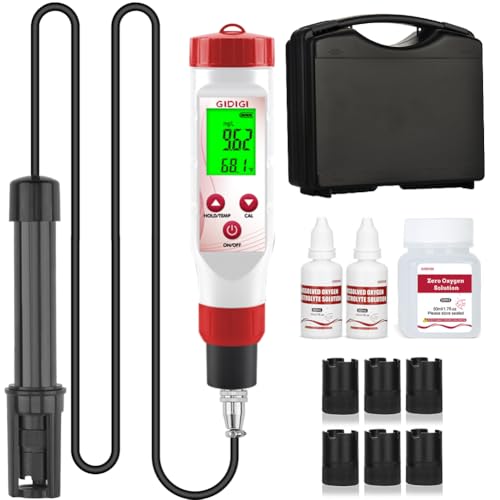
- 1.2-meter cable for deeper tanks, ponds, and outdoor testing
- Measures 0.0–40.0 mg/L and percentage saturation
- Includes six membrane caps, electrolytes, and calibration solution
Best For: Ongoing aquarium and pond testing with extended probe reach
Compact BOD-Probe Pick
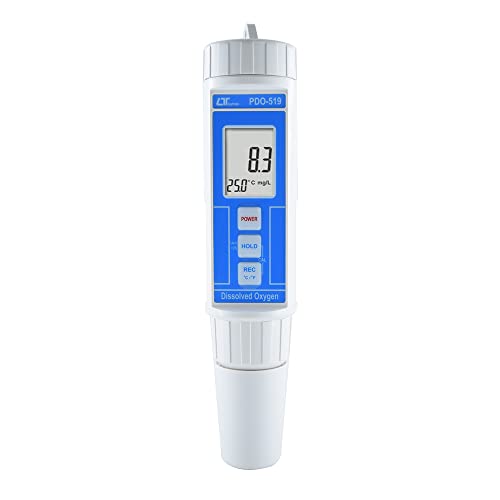
- Lightweight pen-style design with BOD-bottle-compatible probe
- Simultaneous oxygen and temperature display with ATC
- Includes spare diaphragm, electrolyte, case, and calibration certificate
Best For: Portable aquarium, hatchery, and educational water testing
Professional Choice
High-Precision Aquarium DO Meter
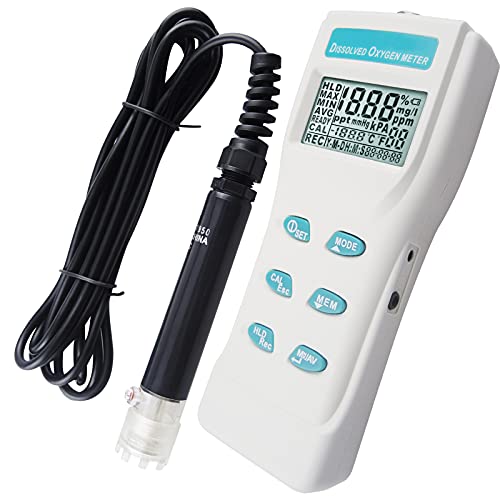
- Measures DO, temperature, salinity, and pressure
- Stores up to 99 readings
- Includes long cable and maintenance kit
Best For: Aquarists and aquaculture users needing multi-parameter testing
Simple Value Pick

- Measures 0.0–40.00 mg/L
- Automatic temperature compensation
- Backlit display with auto shutoff
Best For: Routine aquarium and pond oxygen checks
Connected Monitoring Pick
Portable DO Meter with Long Probe

- Offers mg/L and saturation readings
- Supports Bluetooth logging and data export
- Includes long cable and calibration accessories
Best For: Aquarium, pond, hydroponic, and brewing users tracking water quality
Smart App Pick – UIUZMAR Smart Dissolved Oxygen Meter
For aquarium owners who want more than a basic reading, this UIUZMAR model is a versatile choice among dissolved oxygen meters for aquariums. Its reinforced polarographic probe, automatic temperature compensation, and app-based salinity and barometric-pressure settings support consistent testing in freshwater or other demanding setups.
Best For: Aquarium keepers, koi pond owners, fish farmers, educators, and users who want app-based data management.
Pros:
- App connectivity supports compensation settings plus recording, managing, and sharing test data.
- Automatic temperature compensation helps maintain performance across different conditions.
- Includes six spare membrane caps, electrolytes, and calibration supplies.
- Offers slope and zero-oxygen calibration with an automatic identification program.
Cons:
- Requires app use for some advanced settings, including salinity and barometric pressure.
- Regular slope calibration is recommended before each use.
The UIUZMAR stands out for its combination of replaceable probe components, app features, and broad application range. It is a practical fit if you want a reusable meter with more detailed data handling than a simple test kit.
Value Meter Pick – Yewhick DO Meter with ATC
This Yewhick meter is a straightforward option among dissolved oxygen meters for aquariums, with readings in both mg/L and percentage formats. Its built-in temperature sensor, automatic temperature compensation, large LCD, and included replacement supplies make it convenient for routine tank and pond checks.
Best For: Aquarium, fish-tank, and koi-pond owners who want a portable meter with a broad 0–40 mg/L range.
Pros:
- Measures dissolved oxygen from 0–40 mg/L or 0–300%.
- Built-in temperature sensing and automatic temperature compensation support consistent readings.
- Two-point automatic calibration uses 0% and 100% points.
- Includes six spare membrane caps, electrolyte, calibration materials, and three extra LR44 batteries.
Cons:
- Uses LR44 batteries, which may be less convenient than larger common battery types.
- Its 1.1-meter probe cable may limit reach in larger or deeper setups.
With a wide measurement range and a useful accessory package, this Yewhick model is a practical everyday tester. It is especially appealing for users who prefer a traditional handheld meter and clear LCD readout over app connectivity.
Portable Smart Pick – YINMIK Bluetooth DO Meter
The YINMIK is a strong choice for shoppers comparing dissolved oxygen meters for aquariums and outdoor water monitoring. It combines Bluetooth app support, a portable protective case, automatic temperature compensation, and salinity and altitude settings for aquarium, reef, pond, and field applications.
Best For: Reef-tank owners, aquarists who track readings over time, and users testing water both at home and outdoors.
Pros:
- Stores up to 1,000 readings and displays changes through the app and Excel.
- Measures 0–30 mg/L or 0–300% with 0.01 mg/L and 1% resolution.
- Includes a durable carrying case, 3.6-foot electrode cable, electrolyte, and calibration supplies.
- Offers automatic temperature compensation plus app-based salinity and altitude settings.
Cons:
- Bluetooth and app access are needed for the smart data-management features.
- Zero-oxygen calibration is recommended for solutions below 2 mg/L for greater accuracy.
The YINMIK is well suited to users who need portable testing and a record of changing oxygen levels. Its protective case and data-storage features make it more flexible than a meter designed only for occasional bench testing.
Simple Test-Kit Pick – Monitor Dissolved Oxygen Test Kit
Monitor DISSOLVED Oxygen Test KIT (60 Tests) - Monitor Aquarium and aquaculture Water Quality
Check Price On AmazonThis chemical test kit offers a simple alternative to electronic dissolved oxygen meters for aquariums. It provides up to 60 tests for freshwater and marine aquariums, aquaculture systems, ponds, groundwater, and drinking water, making it useful for periodic checks without batteries or probe maintenance.
Best For: Aquarium and aquaculture owners who want an economical, easy-to-use option for occasional dissolved oxygen testing.
Pros:
- Provides enough materials for up to 60 tests.
- Suitable for freshwater and marine aquariums, ponds, and aquaculture.
- Measures dissolved oxygen from 0–15 ppm with 0.5 ppm resolution.
- Designed as a fast, economical water-quality test.
Cons:
- Its 0.5 ppm resolution is less fine than the digital meters in this roundup.
- Does not provide automatic temperature compensation, app logging, or digital readings.
- Testing is limited to a 0–15 ppm range.
This kit is a sensible low-cost choice when you only need periodic oxygen checks and do not want to calibrate or maintain an electronic probe. Choose a digital meter instead if you need finer resolution, temperature compensation, or stored readings.
Professional Precision Pick – LOHAND LH-D701 DO Meter
For shoppers comparing dissolved oxygen meters for aquariums, the LOHAND LH-D701 offers a broad 0.00–20.00 mg/L measurement range, 0.01 mg/L resolution, and readings for oxygen concentration, saturation, and temperature. Its compensation controls and portable design make it suitable for aquarium checks as well as broader water-quality work.
Best For: Aquarium owners and aquaculture users who want detailed readings and manual control over pressure and salinity compensation.
Pros:
- Measures dissolved oxygen, saturation, and temperature in one instrument.
- Offers manual atmospheric-pressure and salinity compensation plus automatic temperature compensation.
- Includes a backlit LCD, data switching and saving, IP65 protection, and a long 9.84-foot electrode cable.
- Includes electrolyte, a spare membrane head and rubber ring, charging cable, and other setup accessories.
Cons:
- Manual pressure and salinity compensation may require more setup than a basic aquarium meter.
- At 2.76 pounds, it is heavier than a compact pen-style tester.
The LH-D701 is a strong fit when measurement detail and environmental adjustment matter more than minimal size. Its included accessories and rugged housing also support repeated field or aquarium testing.
Deep-Water Maintenance Pick – Replaceable-Test-Kit DO Meter
This dissolved oxygen meter for aquariums is designed for flexible testing, with mg/L and percentage-saturation modes, a temperature display, and a 1.2-meter electrode cable. The replaceable membrane caps and included calibration supplies make it practical for ongoing aquarium, pond, and water-monitoring use.
Best For: Aquarium and pond users who value extra probe reach and convenient replacement supplies.
Pros:
- Tests 0.0–40.0 mg/L and 0.0–300.0% saturation.
- Uses automatic temperature compensation and displays temperature in Celsius or Fahrenheit.
- Includes six replaceable membrane caps, two electrolytes, and zero-oxygen water solution.
- Backlit LCD, data hold, and the 1.2-meter cable support field or low-light testing.
Cons:
- The supplied notes do not specify the meter’s accuracy or resolution.
- The longer cable may be more equipment than needed for a small aquarium.
Choose this model if maintenance convenience is a priority. Its unusually wide stated measurement range and bundled replacement materials can reduce interruptions during repeated testing.
Compact BOD-Probe Pick – PDO-519 Aquarium DO Analyzer
Among dissolved oxygen meters for aquariums, the PDO-519 stands out as a lightweight, pen-style analyzer with simultaneous dissolved-oxygen and temperature displays. Its heavy-duty probe can connect to a BOD bottle, while data hold, min/max recall, and IP65 water resistance add practical testing features.
Best For: Aquarium keepers, fish hatcheries, and students seeking a compact meter with BOD-bottle compatibility.
Pros:
- Compact 6.2-ounce design with a heavy-duty BOD-compatible probe.
- Displays dissolved oxygen and temperature together, with automatic temperature compensation from 0 to 50°C.
- Provides data hold, maximum/minimum recall, selectable temperature units, and automatic shutoff.
- Includes a spare probe diaphragm, filling electrolyte, carrying case, and factory calibration certificate.
Cons:
- Its 0.1 mg/L resolution is less fine than the LOHAND model’s stated 0.01 mg/L resolution.
- The stated protection ratings vary in the notes between IP65 and IP67, so buyers should verify the exact specification.
The PDO-519 is a sensible choice when portability and straightforward operation matter. Its BOD-probe connection and memory functions broaden its usefulness beyond routine aquarium checks.
Professional Choice – High-Precision Aquarium DO Meter
For shoppers comparing dissolved oxygen meters for aquariums, this model offers broad measurement coverage and useful logging features. It measures dissolved oxygen in percentage, ppm, or mg/L, along with temperature, salinity, and barometric pressure.
Best For: Aquarists, aquaculture users, and field testers who want multi-parameter readings, a long probe cable, and included maintenance supplies.
Pros:
- Measures DO, temperature, salinity, and barometric pressure.
- Includes automatic temperature compensation, 99-data memory, and data hold.
- 11.48-foot cable supports testing in larger or deeper setups.
- Comes with membranes, O-rings, electrolyte, batteries, and a carrying case.
Cons:
- Its broader feature set may be more than needed for occasional aquarium checks.
- Maintenance supplies and electrode care are required for the stated sensor life.
This is a strong fit when you need more than a basic oxygen reading. The combination of extended reach, multiple compensation settings, memory, and a complete kit makes it practical for regular aquarium or aquaculture monitoring.
Simple Value Pick – ATC Dissolved Oxygen Tester
If you want dissolved oxygen meters for aquariums that are straightforward to operate, this compact tester focuses on essential DO and temperature measurements. Its automatic temperature compensation and backlit display are useful for routine checks in aquariums, ponds, and fish tanks.
Best For: Home aquarium owners and pond keepers who want an uncomplicated, portable meter with a clear display.
Pros:
- Measures dissolved oxygen from 0.0 to 40.00 mg/L.
- Automatic temperature compensation works across 0–50°C.
- Backlit LCD, low-battery indicator, and automatic shutoff improve convenience.
- Includes electrode filling fluid and batteries.
Cons:
- It does not list data memory, salinity measurement, or barometric-pressure measurement.
- The 8-minute automatic shutoff may interrupt longer testing sessions.
This model is best viewed as a focused everyday tester rather than a feature-heavy monitoring instrument. It covers the core oxygen measurement task while keeping operation and transport simple.
Connected Monitoring Pick – Portable DO Meter with Long Probe
Among dissolved oxygen meters for aquariums, this portable tester stands out for its dual display modes, long probe cable, and Bluetooth app support. It measures in mg/L or saturation percentage and includes compensation options for temperature, salinity, and altitude.
Best For: Aquarists, pond owners, hydroponic growers, brewers, and other users who want portable testing with data logging and export options.
Pros:
- Displays dissolved oxygen in both mg/L and percentage modes.
- Automatic temperature plus manual salinity and altitude compensation.
- Long probe cable supports deeper tanks, ponds, and field measurements.
- Includes calibration accessories, Bluetooth app connectivity, and a 365-day warranty.
Cons:
- Bluetooth logging may be unnecessary for users who only need occasional readings.
- Manual salinity and altitude adjustments require additional setup when conditions vary.
This is the most versatile option of the three for users who want to document readings over time. Its long cable and compensation controls also make it suitable for larger, outdoor, or changing-water environments.
How We Picked the Best Dissolved Oxygen Meters for Aquariums
We focused on the features that matter during routine aquarium testing: measurement range, probe design, temperature compensation, calibration controls, display readability, cable length, memory functions, and portability. We also included both electronic meters and a chemical test kit because each suits different budgets, maintenance routines, and accuracy expectations.
Product descriptions and listed specifications were compared for aquarium, pond, hatchery, and aquaculture use. Because probe-based meters require preparation and calibration, buyers should also consider replacement parts, filling solution, and the availability of clear instructions.
Quick Comparison
- Best for frequent testing: A digital meter with ATC, a reusable probe, data hold, and memory functions.
- Best for simple occasional checks: A dissolved oxygen test kit with a defined number of tests.
- Best for larger tanks or ponds: A model with a long probe cable and a portable handheld body.
- Best for varied water conditions: A meter offering manual salinity adjustment, calibration controls, and temperature readings.
- Best for value: A basic ATC meter with a suitable measurement range and included electrode supplies.
Key Buying Factors for Dissolved Oxygen Meters for Aquariums
Measurement Range and Resolution
Most aquarium applications need readings around the freshwater saturation range, but a broader range can be useful for ponds, marine systems, or low-oxygen troubleshooting. Resolution is not the same as accuracy, so do not choose solely because a display shows more decimal places.
Probe Type, Cable, and Maintenance
Probe-based meters are reusable, but membranes, electrodes, and filling solutions may need periodic care or replacement. Check whether supplies are included and whether the cable is long enough to reach the deepest part of your aquarium, sump, pond, or sampling container.
Temperature and Salinity Compensation
Temperature affects dissolved oxygen readings. Automatic temperature compensation can make routine testing easier, while manual salinity adjustment is valuable for saltwater aquariums and brackish systems. Confirm which compensation features are actually supported rather than assuming every ATC label means the same thing.
Calibration and Usability
Look for clear calibration instructions, a readable display, stable readings, data hold, and memory storage if you track water quality over time. Chemical kits avoid electronic calibration but require careful dosing, timing, and color interpretation.
Who Should Buy Which Dissolved Oxygen Meters for Aquariums?
Choose a portable digital DO meter if you test frequently, manage multiple tanks, or need readings in a pond, quarantine system, or hatchery. A long cable and durable case are especially useful outside a standard aquarium.
Choose a basic ATC model if you want reusable electronic testing without advanced logging features. It is a practical fit for hobbyists who are comfortable calibrating and maintaining a probe.
Choose a chemical test kit if you test infrequently, want a lower upfront cost, or prefer a compact option that does not require batteries or electrode care. For any meter, follow the calibration procedure and confirm readings with additional water-quality checks when fish behavior changes unexpectedly.