A compact telescope focuser can make the difference between a soft, frustrating view and a crisp, confidently focused image. The right choice depends on your telescope’s optical tube, drawtube size, available travel, and whether you focus manually or electronically.
We selected 10 options spanning replacement focusers, helical designs, rack-and-pinion mechanisms, electronic focusing systems, and telescope packages with portability in mind. Use the guide below to narrow the list by compatibility, control, and observing goals.
Best 10 Compact Telescope Focusers Picks for 2026
Best Manual Rack-and-Pinion Pick
SV181 1.25-Inch Reflector Focuser

- 65mm travel with gear fine adjustment
- Brass ring helps protect eyepiece barrels
- Threaded interior reduces reflections
Best For: Newtonian reflector users needing precise 1.25-inch manual focusing
Best Electronic Upgrade

- Computer-controlled hands-free focusing
- Backlash compensation and multiple speeds
- Compatible with select SCT and EdgeHD tubes
Best For: Celestron owners seeking remote, low-vibration focusing
Best Full-Metal Value
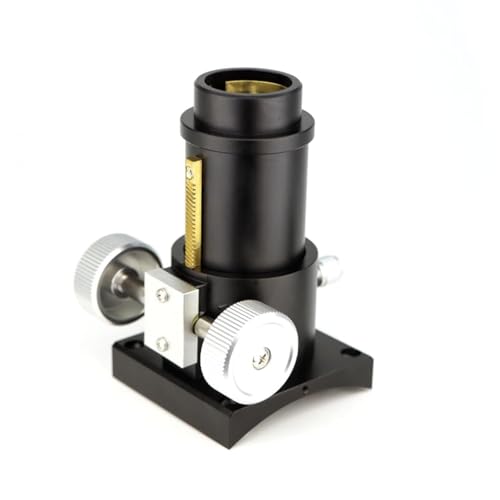
- All-metal rack-and-pinion construction
- Designed for 6- to 8-inch Newtonians
- Threaded interior helps reduce reflections
Best For: Newtonian users needing a basic manual replacement focuser
Best Alignment Companion
Astromania 1.25-Inch Laser Collimator

- Fits standard 1.25-inch reflector focusers
- Seven adjustable red-laser brightness levels
- Compact metal body with included battery
Best For: Newtonian owners needing portable laser collimation
Best for Deep-Sky Imaging

- Low-light-leakage design for astrophotography
- Quick-release two-speed components
- Large wheels with 360-degree rotation
Best For: Deep-space photography and rotational composition control
Best Complete Telescope Option
Heritage 150 Tabletop Dobsonian

- 150mm aperture with 750mm focal length
- Integrated 1.25-inch helical focuser
- Collapsible, portable tabletop design
Best For: Beginners seeking a portable visual-observing telescope
Best Compact Guide-Scope Upgrade
Astromania 1.25-inch Helical Focuser

- 10mm stroke with stated 0.05mm accuracy
- Fixed orientation prevents accessory rotation
- Compact 46–56mm all-metal design
Best For: Guide scopes, finder scopes, and autoguider cameras
Portable Starter Scope

- 80mm fully coated optics
- Includes phone adapter and finder scope
- Backpack and tripod included
Best For: Beginners and families seeking a portable observing setup
Vibration-Free Upgrade

- Motorized, vibration-reduced focusing
- Coarse-to-fine speed adjustment
- Includes mounting brackets and hardware
Best For: Owners of compatible telescopes wanting smoother focus control
Versatile Electronic Control

- Supports equatorial and altazimuth mounts
- Pushbutton, vibration-reduced focusing
- Includes brackets, tools, and cable
Best For: Users seeking electronic focus control across common mount types
Best Manual Rack-and-Pinion Pick – SV181 1.25-Inch Reflector Focuser
The SVBONY SV181 is a practical choice when you need compact telescope focusers for a Newtonian reflector. Its manual rack-and-pinion design offers 65mm of travel, dual-knob adjustment, and a fine-tuning gear for more precise focusing.
Best For: Newtonian reflector owners using 1.25-inch eyepieces, particularly with compatible 114mm or 150mm optical tubes.
Pros:
- 65mm focuser travel with gear-assisted fine adjustment
- Internal brass ring helps avoid marks on eyepiece barrels
- Fully threaded interior helps minimize reflections
- Includes a 1.25-inch dust cover
Cons:
- Manual operation rather than motorized focusing
- Designed for 1.25-inch eyepieces, limiting accessory compatibility
With its metal rack-and-pinion mechanism and protective brass ring, the SV181 offers useful precision in a compact manual format. Confirm your telescope’s mounting requirements and eyepiece size before buying.
Best Electronic Upgrade – Celestron SCT Focus Motor
The Celestron Focus Motor is an electronic alternative among compact telescope focusers, designed for hands-free control on compatible Schmidt-Cassegrain and EdgeHD systems. It supports computer operation or control through a Celestron computerized mount hand controller.
Best For: Celestron SCT, EdgeHD, and compatible Rowe-Ackermann Schmidt Astrograph users who want remote or vibration-reducing electronic focusing.
Pros:
- Enables computer-controlled and hands-free focusing
- Offers multiple speed rates and automatic GoTo
- Includes indexed focuser position and backlash compensation
- Can draw power from a compatible mount or computer USB connection
Cons:
- Compatibility is limited to supported Celestron optical tubes
- Requires a computer or compatible computerized mount for electronic operation
This motor is best viewed as a system-specific focusing upgrade rather than a universal focuser. Check Celestron’s compatibility list before purchase, especially if your telescope is not an SCT or EdgeHD model.
Best Full-Metal Value – 1.25-Inch Newtonian Focuser
This full-metal unit is a straightforward option for shoppers comparing compact telescope focusers for Newtonian reflectors. It uses a 1.25-inch rack-and-pinion format and includes a curved base plate for installation on compatible telescope tubes.
Best For: Owners of 6- to 8-inch Newtonian reflector telescopes seeking a manual 1.25-inch replacement or upgrade.
Pros:
- Full-metal construction
- Rack-and-pinion manual focusing design
- Fully threaded interior helps minimize reflections
- Includes a 1.25-inch dust cover
Cons:
- Compatibility is specified for certain 6- to 8-inch Newtonian telescopes
- Manual focusing lacks electronic control
- Specific mounting dimensions should be checked before installation
The Skyoptikst focuser keeps the feature set simple while adding a durable all-metal body and internally threaded design. Verify the curved base plate and telescope dimensions carefully to avoid fit issues.
Best Alignment Companion – Astromania 1.25-Inch Laser Collimator
The Astromania Laser Collimator is an alignment accessory for standard 1.25-inch reflector focusers, making it a useful companion when evaluating compact telescope focusers and Newtonian setups. Its red laser provides a quick way to check and adjust optical alignment.
Best For: Newtonian reflector owners with a 1.25-inch focuser who want a portable tool for faster telescope collimation.
Pros:
- Fits standard 1.25-inch reflector focusers
- Seven brightness levels for different observing environments
- Metal body with anodized aluminum construction
- Includes a CR2032 battery and German-English instructions
Cons:
- It is a collimation tool, not a focuser
- Requires careful adjustment and laser-safety awareness
- Designed specifically for reflective telescopes with 1.25-inch focusers
For Newtonian users, accurate collimation is essential for getting the best performance from the telescope and focuser. Its compact body is easy to carry, but buyers should follow the included adjustment instructions carefully.
Best for Deep-Sky Imaging – 16-Bearing Travel Focuser
Telescope Focuser 16-Bearing Travel with Convex Adapter Ring for Astrophotography
Check Price On AmazonFor astrophotographers comparing compact telescope focusers, this manual model combines a 16-bearing travel design with a convex adapter ring and a claimed low-light-leakage build. Its large adjustment wheels, quick-release two-speed components, and 360-degree rotation are aimed at precise, convenient setup.
Best For: Deep-space photography and users who need rotational composition control with a manual focuser.
Pros:
- Designed for almost no light leakage during deep-space photography.
- High interface precision with a locking ring intended to improve coaxial alignment and secure locking.
- Quick-release two-speed components can be removed without taking off the entire focuser.
- Large 38mm coarse and 28mm fine adjustment wheels, plus 360-degree rotation.
Cons:
- Manual operation does not provide electronic focusing.
- The supplied information does not specify telescope or camera thread compatibility beyond the included convex adapter ring.
- Its feature set is geared toward photography, which may be more than needed for basic visual observing.
With its large controls and rotation capability, this focuser is a practical choice for photography-focused setups where composition and fine manual adjustment matter. Verify the adapter fit and available back focus before purchasing.
Best Complete Telescope Option – Heritage 150 Tabletop Dobsonian
Although it is a complete telescope rather than a replacement unit, the Sky-Watcher Heritage 150 is worth considering among compact telescope focusers and portable observing setups because it includes a 1.25-inch helical focuser. Its collapsible tube and tabletop format make storage and transport straightforward.
Best For: Beginners and visual observers who want a portable 150mm telescope with an integrated helical focuser.
Pros:
- 150mm aperture and a fast f/5, 750mm focal length optical system.
- Includes a 1.25-inch helical focuser for manual focusing.
- Collapsible tube design supports portability and easy storage while retaining collimation.
- Tabletop design has rubber feet intended to reduce vibration and improve stability.
Cons:
- This is a complete 23-pound tabletop telescope, not a standalone focuser upgrade.
- The tabletop format requires a suitable stable surface for use.
- The included focuser is 1.25-inch, which may not suit users seeking a different accessory format.
The Heritage 150 makes sense when the goal is a compact observing package rather than a focuser component alone. Choose it for its aperture, collapsible design, and integrated helical focuser, not as a direct replacement for an existing telescope focuser.
Best Compact Guide-Scope Upgrade – Astromania 1.25-inch Helical Focuser
This Astromania model is a strong fit for shoppers seeking compact telescope focusers for guide scopes, finder scopes, or telephoto lenses. Its double-helical mechanism provides a 10mm focusing stroke with stated 0.05mm accuracy, while the fixed orientation helps keep cameras and eyepieces from rotating during focusing.
Best For: Guide-scope focusing, autoguider cameras, and compact astrophotography optical trains.
Pros:
- Compact 46–56mm focuser length and light 3.2-ounce weight.
- 10mm focusing stroke with a stated 0.05mm precision scale.
- Fixed orientation keeps mounted cameras or eyepieces from rotating.
- All-metal construction is intended to minimize flexure and thermal expansion.
Cons:
- Compatibility requires attention to the included M31x0.5 female and M42x0.75 male interfaces.
- An M42x0.75 female-to-female adapter for some R&P focuser upgrades is not included.
- The 1.25-inch format may be limiting for larger accessories.
For a small, precise focusing adjustment at the guide scope or finder scope, this Astromania focuser offers useful travel without adding much bulk. Confirm the telescope’s thread standard and accessory diameter before ordering.
Portable Starter Scope – 80mm Travel Telescope
If you want compact telescope focusers in a beginner-friendly setup, this portable EACONN refractor combines a manual focus system with an 80mm aperture and travel-oriented accessories. Its backpack, adjustable tripod, finder scope, and phone adapter make it practical for basic lunar, planetary, landscape, and bird-watching use.
Best For: Beginners and families who want a portable telescope for home observation or travel.
Pros:
- 80mm aperture and fully coated optics are designed to provide bright, clear images.
- Includes K20mm and K9mm eyepieces, a 5×24 finder scope, and a smartphone adapter.
- Backpack and adjustable tripod support convenient transport and setup.
Cons:
- Manual focusing requires hands-on adjustment rather than electronic control.
- Included eyepieces provide a stated 30x-66x magnification range, which may limit higher-power viewing.
This is a well-equipped entry-level option when portability and straightforward setup matter more than motorized focusing. It is especially suitable for casual observing and family use.
Vibration-Free Upgrade – AccuFocus Electronic Focuser
For observers comparing compact telescope focusers, the AccuFocus Electronic Telescope Focuser adds motorized adjustment to compatible telescopes. Its pushbutton controller and adjustable speed knob are designed to make fine focusing easier while reducing vibration from manual adjustments.
Best For: Telescope users who want smoother electronic focusing with coarse-to-fine speed control.
Pros:
- Motorized focusing supports smooth, precise adjustments without vibration.
- Adjustable speed control ranges from coarse movement to very fine focusing.
- Includes brackets for Crayford and rack-and-pinion focusers, plus installation hardware.
- Compact motor assembly weighs 12.3 ounces.
Cons:
- Requires one 9-volt battery, which is not included.
- Compatibility depends on the telescope and focuser configuration.
This focuser is a practical accessory for users who already have a compatible telescope and want more controlled focusing. Verify the mounting arrangement before ordering.
Versatile Electronic Control – AccuFocus Telescope Focuser
This AccuFocus model is worth considering among compact telescope focusers if you use either an equatorial or altazimuth mount. It provides electronic, manually controlled focusing through a pushbutton hand controller, with adjustable speed for both broad positioning and precise final adjustments.
Best For: Telescope owners using equatorial or altazimuth mounts who want electronic focusing.
Pros:
- Works with telescopes using equatorial or altazimuth mounts, according to the supplied details.
- Pushbutton control is designed for smooth, precise focusing without vibration.
- Adjustable speed control supports coarse-to-fine adjustment.
- Includes a motor assembly, cable, coupler, brackets, tools, and installation hardware.
Cons:
- Needs one 9-volt battery, not included.
- Requires installation and compatibility checking for the existing focuser.
Choose this version when mount flexibility and a complete installation kit are priorities. Its electronic control can make focusing more convenient, but the correct bracket and focuser fit remain essential.
How We Picked These Compact Telescope Focusers
We focused on practical fit and use cases rather than treating every product as interchangeable. The selection covers common 1.25-inch accessories, Newtonian reflector upgrades, guide-scope focusers, motorized focusing, and portable telescope setups. We also considered construction, focusing travel, adjustment precision, installation requirements, portability, and the likelihood that a product serves a specific telescope configuration rather than a universal audience.
Before buying, verify the product’s dimensions and mounting pattern against your optical tube. A focuser described as 1.25-inch may refer to the eyepiece interface, not the diameter or spacing of the base.
Quick Comparison
| Best suited for | Look for | Typical priority |
|---|---|---|
| Newtonian reflectors | Compatible base, smooth travel, rigid mounting | Fit and stability |
| Guide scopes | Fine adjustment and low backlash | Precise control |
| Astrophotography | Repeatable movement, adequate load capacity, motor compatibility | Consistency |
| Portable visual observing | Low weight and simple installation | Convenience |
| Motorized systems | Correct telescope compatibility and controller support | Remote operation |
Key Buying Factors for Compact Telescope Focusers
Compatibility and Mounting
Check whether the focuser is designed for a Newtonian, Schmidt-Cassegrain, EdgeHD, refractor, guide scope, or a specific telescope model. Confirm screw spacing, base curvature, back focus, and the required adapter. A well-built focuser is not useful if it cannot reach focus or cannot be mounted securely.
Focusing Travel and Precision
More travel is not automatically better. You need enough movement to reach focus with your eyepiece, camera, or diagonal, while shorter and finer adjustments can be easier to control. Rack-and-pinion systems generally suit robust general-purpose use; helical designs can provide fine adjustment in compact guide-scope applications.
Load Capacity and Rigidity
Visual accessories are forgiving, but cameras, filter wheels, and adapters place more demand on the mechanism. Look for a rigid drawtube, minimal flex, and a locking feature when imaging. Avoid assuming that an electronic motor improves a weak or poorly aligned mechanical focuser.
Manual Versus Electronic Control
Manual focusers are simple, inexpensive, and easy to troubleshoot. Electronic options are more useful when the telescope is remote-controlled, used for repeatable imaging sessions, or affected by vibration from touching the tube. Confirm power, controller, and installation requirements before choosing a motor.
Who Should Buy Which Compact Telescope Focusers?
Choose a replacement rack focuser if your Newtonian has excessive play, a damaged mechanism, or difficult coarse adjustment. A helical guide-scope focuser is better for users who need small, controlled corrections while guiding. Astrophotographers should prioritize rigidity, repeatability, and motor compatibility over the lowest price.
For beginners and casual visual observers, a simple 1.25-inch focuser or a portable telescope package may be the most practical route. Buyers who already have a compatible Schmidt-Cassegrain or EdgeHD telescope can consider a dedicated focus motor for hands-off adjustment. If you are uncertain, measure the existing focuser and optical tube first; compatibility is the deciding factor among Compact Telescope Focusers.