Large, readable screens make wind-speed measurements easier to check at a glance, especially outdoors, in bright conditions, or while wearing work gloves. The models in this roundup range from compact handheld meters to complete wireless weather stations.
We compared display visibility, measurement functions, portability, stated ranges, and practical features such as backlighting, temperature readings, humidity data, and wireless sensors.
Best 10 Anemometers with Large Displays Picks for 2026
Best Color Display Pick

- Large backlit three-color LCD
- Measures wind, temperature, and humidity
- Six wind-speed units and 12 Beaufort levels
Best For: Portable outdoor, HVAC, and fan-speed checks
Best Full Weather Station

- 8.5-inch adjustable-brightness color LCD
- Tracks wind, rain, temperature, and pressure
- Wireless range up to 328 feet
Best For: Home and environmental weather monitoring
Best for HVAC Checks

- Sensitive eight-blade impeller
- MAX, MIN, and AVG airflow readings
- Backlit display with tripod mount
Best For: HVAC vent and fan airflow testing
Best Home Weather Display
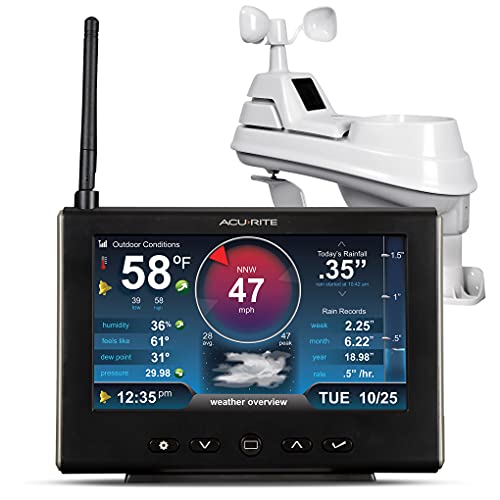
- HD display with wireless wind readings
- Shows more than 25 weather data points
- Custom alerts and weather history
Best For: At-a-glance home weather monitoring
Best Value Large-Display Anemometer
Proster Digital Wind Speed Meter

- Backlit LCD with max/min/hold functions
- Five wind-speed units plus CFM, CMM, and CMS
- Includes 9V battery and low-battery indicator
Best For: Flexible handheld wind-speed and airflow measurements
Best 360-Degree Reading

- Cup sensor measures wind from any direction
- Large display shows current, average, and maximum values
- Tripod thread supports hands-free monitoring
Best For: HVAC testing and changing outdoor wind conditions
Best Compact Option
BTMETER BT-816B Wind Speed Meter

- Lightweight 53g body with backlit LCD
- Adds temperature and real-time wind chill
- Current, max, and average measurement modes
Best For: Portable wind, temperature, and wind-chill checks
Versatile 3-in-1 Choice

- Shows wind speed and temperature simultaneously
- Measures wind, temperature, and Beaufort level
- Backlight, data hold, and MAX/MIN/AVG modes
Best For: HVAC, sailing, fishing, and everyday wind checks
Compact Travel Pick
Clatoon Lightweight Digital Anemometer
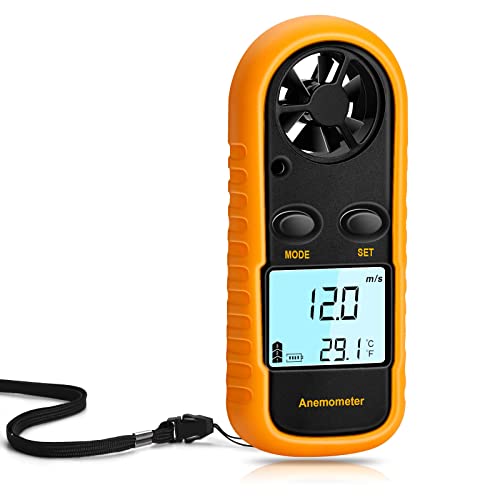
- Measures wind speed, temperature, air volume, and wind chill
- Supports five wind-speed units up to 65 mph
- Includes case, lanyard, battery, and backlit LCD
Best For: Portable outdoor activities and occasional airflow checks
Industrial-Use Option

- Displays wind speed and temperature together
- Measures wind, temperature, and Beaufort level
- Includes five units and MAX/MIN/AVG functions
Best For: HVAC, ventilation, and industrial wind testing
Best Color Display Pick – Anemometer Wind Speed Meter
RISEPRO Anemometer Wind Speed Meter, Large Backlit Color Display with Temp and Humidity
Check Price On AmazonFor shoppers seeking anemometers with large displays, this handheld model combines a clear, backlit three-color LCD with wind speed, temperature, and humidity readings. It supports six wind-speed units and is compact enough for one-handed outdoor or HVAC checks.
Best For: Portable wind measurements, outdoor activities, and basic fan or HVAC testing.
Pros:
- Large, backlit color screen is easy to read in dim conditions.
- Measures wind speed in six units with 12 Beaufort levels.
- Adds switchable Celsius/Fahrenheit temperature and humidity readings.
- Compact design includes three AAA batteries.
Cons:
- The plastic handheld design may be less suited to rugged job-site use.
- It does not offer wireless data transmission or weather-station features.
This is a practical choice when display readability and multifunction measurements matter more than advanced logging or remote monitoring.
Best Full Weather Station – Wireless Weather Station
This wireless weather station is a strong option for buyers who want anemometers with large displays plus broader home weather information. Its adjustable-brightness 8.5-inch color LCD shows wind speed and direction alongside rainfall, temperature, humidity, pressure, and related readings.
Best For: Home weather monitoring, environmental observation, and users who want a large central display.
Pros:
- Large 8.5-inch color screen presents extensive weather data.
- Wireless outdoor sensor measures wind speed, direction, rainfall, temperature, and humidity.
- Includes wind chill, dew point, moon phase, UV index, and barometric pressure information.
- Wireless transmission reaches up to 328 feet and includes mounting hardware.
Cons:
- This is a full weather station rather than a pocket-sized handheld anemometer.
- No Wi-Fi connectivity is provided.
- The display and outdoor sensor require a more involved installation than a standalone meter.
Choose it when an oversized display and continuous, multi-sensor monitoring are more useful than simple spot-checking wind speed.
Best for HVAC Checks – HoldPeak 866B Anemometer
The HoldPeak 866B is a practical handheld choice among anemometers with large displays for checking airflow at vents, grilles, and fans. Its backlit screen, sensitive eight-blade impeller, and MAX, MIN, and AVG functions help make changing airflow easier to evaluate.
Best For: HVAC airflow checks, vent comparisons, and portable wind measurements for outdoor activities.
Pros:
- Measures air velocity from 0.67 to 67.1 mph with stated ±5% accuracy.
- Supports mph, m/s, km/h, ft/min, and knots.
- MAX, MIN, and AVG readings help track gusts and airflow variation.
- Backlight, non-slip grips, wrist strap, tripod mount, and carrying case support field use.
Cons:
- The backlight turns off after 15 seconds.
- The compatible tripod is not included.
- Temperature measurement is limited to 14–113°F (-10–45°C).
Its useful airflow functions and secure handling make this a better fit for practical HVAC diagnostics than for broad home weather monitoring.
Best Home Weather Display – AcuRite Iris Weather Station
The AcuRite Iris is designed for shoppers who want anemometers with large displays integrated into a home weather station. Its HD indoor display presents wireless wind speed and direction alongside temperature, humidity, rainfall, barometric pressure, and other household weather data.
Best For: Homeowners who want a broad, always-available view of indoor and outdoor conditions.
Pros:
- HD display clearly shows wind speed and direction with more than 25 data points.
- Wireless outdoor sensor also tracks temperature, humidity, rainfall, and pressure.
- Custom alerts cover temperature, humidity, wind speed, and rainfall.
- Includes forecast information, weather history, clock functions, and a mounting bracket.
Cons:
- It is a home weather station, not a compact handheld wind meter.
- The system uses a wireless sensor and requires installation on a pole or post.
- An optional lightning sensor is sold separately.
This model suits users who value a readable home console and historical weather context as much as the wind readings themselves.
Best Value Large-Display Anemometer – Proster Digital Wind Speed Meter
For shoppers comparing anemometers with large displays, the Proster offers a backlit LCD that is easy to read in darker conditions. It measures wind speed in five units and also supports CFM, CMM, and CMS air-volume readings, making it useful for both outdoor checks and basic airflow work.
Best For: Buyers who want broad wind-speed and air-volume measurement in a portable handheld meter.
Pros:
- Large backlit LCD with maximum, minimum, and hold functions.
- Measures wind speed from 0.40 to 30 m/s across five selectable units.
- Supports CFM, CMM, and CMS air-volume readings.
- Includes a 9V battery and low-battery indicator.
Cons:
- Uses a relatively large 9V battery rather than smaller AAA cells.
- Its plastic, compact handheld design may be less suited to permanent outdoor installation.
The Proster is a practical pick when display readability and measurement flexibility matter more than specialized features. Its max/min/hold functions and air-volume modes give it useful versatility for general outdoor and airflow measurements.
Best 360-Degree Reading – 93MPH Wind Cup Anemometer
This cup-style model is a strong option among anemometers with large displays when you need readings without carefully aligning the sensor with the wind. Its large backlit LCD shows current, average, and maximum wind values together, while the Beaufort scale bargraph adds a quick visual reference.
Best For: HVAC checks, outdoor wind monitoring, and activities where wind direction can change frequently.
Pros:
- 360-degree cup design measures wind from any direction when held vertically.
- Large backlit display shows current, average, and maximum readings.
- Measures 0.7 to 42 m/s in four units with ±4% accuracy.
- Includes a tripod thread for hands-free monitoring.
Cons:
- Uses two AAA batteries, which must be replaced separately when depleted.
- Auto power-off after 15 minutes may interrupt longer unattended sessions.
The cup sensor and simultaneous current/average/maximum display make this model especially convenient for HVAC diagnostics and variable outdoor conditions. Its tripod compatibility also adds flexibility for stationary measurements.
Best Compact Option – BTMETER BT-816B Wind Speed Meter
The BTMETER BT-816B is a compact choice for shoppers seeking anemometers with large displays without carrying a bulky instrument. Its backlit LCD provides current, maximum, and average wind readings, along with temperature and real-time wind-chill measurements.
Best For: Portable outdoor activities, HVAC spot checks, and users who want wind speed and temperature in one small meter.
Pros:
- Lightweight 53g design with a backlit LCD for low-light use.
- Measures wind speed from 0.3 to 30 m/s with ±5% reading accuracy.
- Displays temperature and real-time wind chill.
- Offers manual or automatic power-off and five wind-speed units.
Cons:
- Its small body may provide less viewing area than larger handheld meters.
- Wind-speed range is narrower than the 42 m/s cup-anemometer option in this roundup.
The BT-816B stands out for portability and added environmental information. It is a sensible everyday carry option when wind chill and temperature are useful alongside basic wind-speed readings.
Versatile 3-in-1 Choice – Mcbazel Handheld Anemometer
For shoppers comparing anemometers with large displays, the Mcbazel offers a practical double-line LCD that shows wind speed and temperature simultaneously. It measures wind speed, wind temperature, and Beaufort wind level, with a backlight for easier reading in low-light conditions.
Best For: HVAC checks, sailing, fishing, and general indoor or outdoor wind measurements.
Pros:
- Displays wind speed and temperature together on a double-line LCD.
- Measures wind speed, temperature, and Beaufort scale levels.
- Supports m/s, km/h, knots, ft/s, and mph.
- Includes MAX, MIN, AVG, data hold, backlight, and low-battery functions.
Cons:
- AAA batteries are required but not included.
- Its feature set may be more than needed for basic spot checks.
The Mcbazel is a well-rounded option when simultaneous readings and flexible units matter. Its compact ABS body and auto power-off function also make it convenient to carry and use regularly.
Compact Travel Pick – Clatoon Lightweight Digital Anemometer
If portability is a priority when shopping for anemometers with large displays, the lightweight Clatoon is easy to carry and includes a protective yellow case, lanyard, and battery. Its backlit LCD reports wind speed, temperature, air volume, and wind chill, while a six-blade rotor supports its wind measurements.
Best For: Kite flying, drones, sailboats, outdoor activities, and compact HVAC or airflow checks.
Pros:
- Measures wind speed up to 65 mph or 30 m/s.
- Reports current, maximum, and average wind speed.
- Supports five units: mph, m/s, km/h, ft/min, and knots.
- Includes a backlight, protective case, lanyard, and CR2032 battery.
Cons:
- Specified wind-speed accuracy is approximately 5%.
- The temperature range is limited to -40°C to 45°C.
- Its small body may offer less display area than larger handheld meters.
The Clatoon stands out for grab-and-go use. It combines a compact design with several measurement modes and a backlight, making it suitable for recreational users and occasional airflow testing.
Industrial-Use Option – Soonkoda 3-in-1 Wind Meter
The Soonkoda is a practical choice for buyers seeking anemometers with large displays and multiple readings in one view. Its liquid crystal double-line display shows wind speed and temperature together, while the meter also measures Beaufort wind level and supports five speed units.
Best For: HVAC and duct ventilation, industrial facilities, power and steel work, aviation, and outdoor wind testing.
Pros:
- Measures wind speed, wind temperature, and wind level.
- Offers a 0.06–30.0 m/s wind-speed measuring range.
- Supports m/s, km/h, knots, ft/s, and mph.
- Includes MAX, MIN, AVG, data hold, backlight, and low-battery indicator.
Cons:
- The supplied notes provide limited information about dimensions and portability.
- It is focused on core wind measurements rather than air-volume readings.
With simultaneous speed and temperature display plus useful hold and averaging functions, the Soonkoda fits routine professional testing. Its broad application range makes it a flexible meter for ventilation and industrial environments.
How We Picked These Anemometers with Large Displays
We focused on products that make measurements easy to read and interpret, rather than simply choosing the highest-rated or most feature-heavy models. Selection criteria included screen size and backlighting, wind-speed range, measurement units, response and hold functions, portability, and the usefulness of additional readings such as temperature, humidity, airflow, or wind direction.
We also included both handheld meters and full weather stations because they serve different needs. A handheld unit is usually the better choice for spot checks, while a wireless station is more suitable for continuous monitoring around a home, workshop, or property.
Quick Comparison
| Type | Best suited to | Features to prioritize |
|---|---|---|
| Handheld anemometer | HVAC, fieldwork, sailing, and equipment checks | Backlit display, multiple units, hold function, compact design |
| Weather station | Continuous home or property monitoring | Wireless sensor, wind direction, rain data, clock, indoor display |
| High-range wind meter | Strong-wind conditions and outdoor testing | Wide measurement range, durable housing, clear maximum readings |
| Multi-function meter | Users who need environmental context | Temperature, humidity, airflow, and wind-speed modes |
Key Buying Factors for Anemometers with Large Displays
Display Readability
A large display is most useful when it also has strong contrast, clear digits, and a backlight. If you work outside or in dim mechanical spaces, prioritize a backlit screen and controls that are easy to operate without navigating complicated menus.
Measurement Range and Units
Check the stated minimum and maximum wind speeds before buying. HVAC users may need accurate low-speed airflow readings, while sailing, flying, roof work, or storm monitoring can call for a broader range. Multiple units, including MPH, knots, meters per second, kilometers per hour, and CFM, reduce the need for conversions.
Extra Measurements
Temperature and humidity can help put a reading into context, while airflow and CFM modes are more useful for duct and ventilation work. Weather stations add wind direction, rainfall, wind chill, and historical data for a broader view of conditions.
Portability and Power
Handheld meters should be light enough for repeated use and compact enough to carry in a tool bag. Consider battery type, automatic shutoff, sensor protection, and whether the display remains visible at the angle you normally hold the instrument.
Who Should Buy Which Anemometers with Large Displays?
Choose a handheld model if you need quick readings for HVAC diagnostics, workshop projects, outdoor recreation, or equipment testing. A model with multiple units and a backlight is the most versatile option for general use.
Choose a weather station if you want ongoing readings without standing outside, or if wind direction and rainfall matter as much as wind speed. For stronger wind conditions, prioritize a model with a higher stated range and a clear maximum-reading function. Buyers who need broader environmental information should look for three-in-one models that combine wind speed with temperature or humidity.