Accurate airflow readings are essential for HVAC balancing, ventilation checks, duct diagnostics, and equipment commissioning. The best anemometers with data logging make it easier to capture measurements, review trends, and document results without relying on handwritten notes.
This roundup compares ten options, from SD-card and USB dataloggers to compact Bluetooth-enabled meters. Use the guide below to match the sensing method, airflow functions, and data-transfer options to your work.
Best 10 Anemometers with Data Logging Picks for 2026
Portable Vane Logging Kit
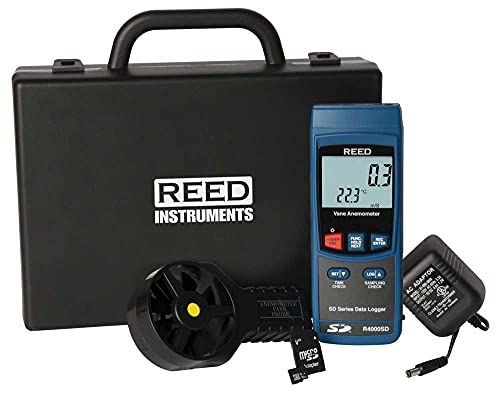
- Vane thermo-anemometer in a complete kit
- Includes 16GB micro SD card and adapter
- Includes 110V AC power adapter
Best For: Ready-to-use logging with included accessories
Versatile HVAC Data Logger

- Measures velocity or volume airflow
- Adds RH and temperature readings
- Flexible vane and backlit display
Best For: HVAC checks involving multiple measurements
High-Capacity Hot-Wire Logger

- Time-stamps 20,000 data points
- Sensitive hot-wire sensor with ±3% accuracy
- Includes USB software and hard case
Best For: Interval-based airflow monitoring and records
SD Card Vane Datalogger

- Logs to SD card in Excel format
- Metal vane handles up to 6900 ft/min
- Displays velocity and temperature together
Best For: PC-friendly airflow logging with removable storage
Best HVAC Data Logger

- Stores up to 600 groups of readings
- USB connection for PC monitoring and export
- Measures speed, temperature, and CFM/CMM airflow
Best For: Routine HVAC airflow inspections and duct measurements
Best High-Capacity Logger
Extech AN340 CMM/CFM Anemometer

- Stores up to 12,000 readings
- Measures velocity, volume, temperature, RH, and dew point
- Includes a telescoping vane and case
Best For: Extended HVAC surveys with psychrometric measurements
Best Connected Option
Elitech ANE-200W HVAC Anemometer
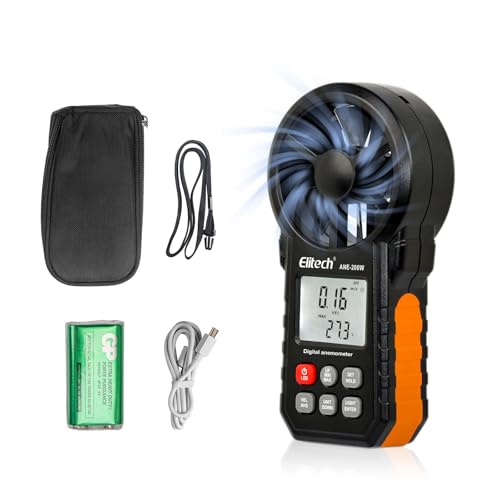
- Bluetooth app monitoring with data curves
- USB software supports logging and Excel export
- Includes airflow, temperature, and multiple velocity modes
Best For: Connected HVAC testing and report-ready data analysis
HVAC Duct Diagnostic Hot Wire Meter

- Hot-wire sensing for low-velocity airflow
- CFM/CMM calculations with telescopic bendable probe
- MAX/MIN/AVG, data hold, and USB PC connectivity
Best For: HVAC duct balancing and ventilation diagnostics
High-Capacity HVAC Data Logger

- Stores up to 600 groups of measurements
- Measures velocity, temperature, and CFM/CMM airflow
- Extended 79-inch cable and telescopic reach
Best For: HVAC inspections requiring substantial onboard data storage
Bluetooth HVAC Reporting Meter

- App saves records, shows trends, and exports XLS files
- Hot-wire measurement for velocity, temperature, and CFM/CMM
- Rotatable retractable probe with alarms and adjustable sampling
Best For: Connected HVAC reporting and mobile airflow analysis
Portable Vane Logging Kit – REED R4000SD-KIT
REED Instruments R4000SD-KIT Data Logging Vane Thermo-Anemometer with Power Adapter and SD Card
Check Price On AmazonThe REED R4000SD-KIT is a practical choice when you want anemometers with data logging in a ready-to-use package. It includes the R4000SD data-logging vane thermo-anemometer, a 16GB micro SD card with adapter, and a 110V AC adapter.
Best For: Users who want a bundled vane thermo-anemometer with included storage and power accessories.
Pros:
- Includes a 16GB micro SD card and adapter.
- Comes with a 110V AC power adapter.
- Combines vane anemometer and thermo-anemometer functions.
Cons:
- The included AC adapter is specified for 110V power.
- The product’s listed dimensions make it less compact than some handheld meters.
Choose this kit if included accessories matter as much as the meter itself. It reduces the need to purchase compatible storage and an adapter separately.
Versatile HVAC Data Logger – Amprobe TMA40-A
The Amprobe TMA40-A combines air velocity or air volume measurement with relative humidity and temperature readings. For buyers comparing anemometers with data logging, its RS232 output supports data-result usage, while the backlit display and flexible vane help with field measurements.
Best For: HVAC and maintenance users who need airflow, humidity, and temperature measurements in one meter.
Pros:
- Measures air velocity in FPM or air volume in CFM.
- Also measures relative humidity and temperature.
- Flexible vane helps access difficult areas.
- Large digital display includes a backlight.
Cons:
- The notes list RS232 output rather than a newer wireless connection.
- No warranty is specified in the supplied product details.
This model stands out for measurement versatility rather than bundled accessories. It is a sensible fit when one meter needs to cover airflow, RH, and temperature checks.
High-Capacity Hot-Wire Logger – General Tools CIH20DL
General Tools CIH20DL Hot Wire Data Logging Anemometer with Cfm/Cmm & 8: 1 Irt Thermometer
Check Price On AmazonThe General Tools CIH20DL is built for detailed airflow tracking, making it a strong option among anemometers with data logging. It time-stamps up to 20,000 data points at user-selected intervals and includes USB connectivity, PC logging software, an AC adapter, battery, and carrying case.
Best For: Technicians who need interval-based airflow records and sensitive hot-wire measurement.
Pros:
- Logs and time-stamps up to 20,000 data points.
- Hot-wire sensor detects air movement as low as 2 feet per minute with ±3% accuracy.
- Measures air speed or airflow volume in multiple Imperial and metric units.
- Includes USB cable, PC software, AC adapter, battery, and hard case.
Cons:
- Its 2.6-pound listed weight is relatively substantial for a handheld meter.
- Auto power-off behavior differs between battery and AC operation.
This is the most data-focused option in the group, especially for repeated measurements at defined intervals. The included software and accessories make it better suited to organized logging than quick spot checks alone.
SD Card Vane Datalogger – Extech SDL300
The Extech SDL300 offers straightforward anemometers with data logging through SD card storage and Excel-format files with date and time stamps. Its metal vane measures air velocity up to 6900 ft/min, while the large display shows air velocity and temperature simultaneously.
Best For: Users who want durable vane sensing and easy PC-transferable measurement records.
Pros:
- Saves logged readings in Excel format with date and time stamps.
- Supports up to 20 million readings with a 2GB SD card.
- Displays air velocity and temperature simultaneously.
- Includes Type K/J thermocouple input and MIN/MAX recall.
Cons:
- The supplied notes specify a 2GB SD card capacity, not an included card.
- Its metal vane is rated to 158°F (70°C), which limits use in hotter environments.
The SDL300 is a strong choice for users who value removable storage and spreadsheet-friendly files. Its metal vane and high stated air-velocity range add useful durability and measurement flexibility.
Best HVAC Data Logger – BTMETER Pro CFM Anemometer
For practical HVAC work, the BTMETER BT-856A is a capable choice among anemometers with data logging. It measures wind speed, temperature, and airflow in CFM or CMM, while storing up to 600 groups of readings. USB connectivity also lets you monitor and export wind data to a Windows PC.
Best For: HVAC technicians measuring duct airflow, air conditioners, blowers, and computer fans.
Pros:
- Measures wind speed, temperature, and airflow in multiple selectable units.
- Stores up to 600 groups of readings and connects to a PC through USB.
- Displays maximum, minimum, and average readings, with a backlit display and carrying case.
Cons:
- PC connectivity is specified for Windows 7, XP, and 10.
- Automatic shutoff occurs after five minutes without operation.
The BT-856A offers a useful balance of airflow measurement, onboard storage, and computer-based recording. Its 600-reading capacity is more suited to routine inspections than very long-term logging, but the USB export adds practical value for HVAC reports.
Best High-Capacity Logger – Extech AN340 CMM/CFM Anemometer
The Extech AN340 is the strongest fit here for users prioritizing a large logging capacity. Listed with a 12,000-reading logger, it measures air velocity and volume while also covering temperature, relative humidity, wet bulb, and dew point measurements.
Best For: HVAC professionals who need extensive stored readings alongside psychrometric measurements.
Pros:
- Provides a 12,000-reading data logger for substantial measurement sessions.
- Measures air velocity, air volume, temperature, RH, wet bulb, and dew point.
- Includes a telescoping vane and protective case.
Cons:
- The supplied notes do not specify a USB or Bluetooth export method.
- Its broader psychrometric feature set may be more than needed for simple airflow checks.
Choose the AN340 when measurement capacity and environmental data matter more than a simple handheld readout. Its 12,000-reading logger gives it a clear advantage for repeated HVAC surveys, although the supplied information does not detail how stored data is transferred.
Best Connected Option – Elitech ANE-200W HVAC Anemometer
The Elitech ANE-200W is a modern option among anemometers with data logging, combining Bluetooth app monitoring with USB PC software. It measures velocity, airflow, and temperature, and supports stored records, adjustable intervals, data curves, and Excel export for professional reporting.
Best For: HVAC users who want app-based monitoring and organized computer analysis.
Pros:
- Bluetooth supports real-time monitoring and data curves through the Anemometer26 app.
- USB PC software enables data logging, analysis, and Excel export.
- Offers real-time, average, maximum, and minimum velocity modes plus CFM/CMM airflow.
- Includes a backlit LCD, LED work light, data hold, and adjustable recording intervals.
Cons:
- The supplied notes do not state the device’s maximum storage capacity.
- Using the app or PC reporting features adds a setup and software requirement.
The ANE-200W is the most connectivity-focused pick in this group. Its Bluetooth and USB workflow is well suited to technicians who need to review trends or create Excel-based reports, while its adjustable area settings support airflow calculations in HVAC applications.
HVAC Duct Diagnostic Hot Wire Meter – AM-286 Airflow Tester
The AM-286 is a practical choice among anemometers with data logging for technicians who need to check airflow inside ducts, vents, and exhaust systems. Its hot-wire sensor is suited to low-velocity ventilation measurements, while CFM/CMM calculations, a bendable telescopic probe, and USB PC connectivity support field documentation and reporting.
Best For: HVAC commissioning, duct balancing, ventilation inspections, and low-airflow diagnostics.
Pros:
- Measures air velocity, temperature, and calculated CFM/CMM airflow.
- Telescopic, bendable probe reaches ducts and ceiling diffusers while keeping the display accessible.
- Offers MAX/MIN/AVG, data hold, backlit LCD, and USB PC connectivity for monitoring and reporting.
Cons:
- Its feature set is oriented toward HVAC airflow work rather than general-purpose wind monitoring.
- The supplied notes describe USB connectivity for exporting data but do not specify onboard memory capacity.
Choose the AM-286 when low-speed HVAC airflow sensitivity and probe access matter more than a compact vane-style design. It is especially useful for technicians who want readings that can be reviewed or documented through a computer.
High-Capacity HVAC Data Logger – AIOMEST 846A CFM Meter
For shoppers specifically comparing anemometers with data logging, the AIOMEST AI-846A stands out for its stated memory capacity of up to 600 groups of wind measurements. It combines air velocity, temperature, and CFM/CMM airflow readings with MAX, MIN, average, and other measurement modes for HVAC and vent maintenance work.
Best For: Technicians who need stored measurement records for repeated HVAC inspections and airflow monitoring.
Pros:
- Stores up to 600 groups of wind measurement data.
- Measures air velocity, wind temperature, and CFM/CMM airflow with multiple units.
- Includes an extensible 79-inch USB cable, telescopic rod, tripod-mount thread, case, and 365-day warranty.
Cons:
- At 2 pounds, it is heavier than the other listed meters.
- The supplied notes describe a wind-vane sensor rather than a hot-wire sensor, which may be less suited to very low airflow.
The AI-846A is a strong fit when onboard record storage is the priority. Its large memory, extended reach, and broad airflow ranges make it practical for documenting multiple readings across ducts, vents, and other HVAC locations.
Bluetooth HVAC Reporting Meter – Smart Hot Wire Anemometer
This smart hot-wire meter is one of the more connected options among anemometers with data logging. Bluetooth links it to the Intelligent Meter app, where readings can be saved, viewed as trend curves, and exported as XLS files, making it useful for technicians who want digital records without manually transcribing every measurement.
Best For: HVAC professionals who want app-based logging, trend tracking, and shareable airflow reports.
Pros:
- Bluetooth app supports historical records, trend curves, and XLS export by email or cloud.
- Hot-wire sensor measures velocity, temperature, and CFM/CMM airflow, including low-flow scenarios.
- Retractable, rotatable probe, alarms, adjustable sampling, MAX/MIN tracking, and a rechargeable battery add field flexibility.
Cons:
- App-based logging depends on a compatible phone and Bluetooth connection.
- The stated continuous operating time is 6–7 hours, so extended jobs may require recharging.
The smart meter is the best choice of this group for connected reporting and data review. Its app features go beyond simple data hold, while the adjustable probe and hot-wire sensing keep it practical for ducts, ceiling vents, and other difficult measurement points.
How We Picked the Best Anemometers with Data Logging
We focused on meters that can record measurements rather than only display live readings. The selection includes vane and hot-wire designs, HVAC-oriented CFM/CMM meters, psychrometers, telescoping probes, and models with SD-card, USB, or Bluetooth connectivity. We also considered practical factors such as temperature measurement, display readability, portability, probe access, and suitability for field documentation.
Because airflow applications vary, no single instrument is ideal for every job. Vane meters are generally useful for larger openings and grilles, while hot-wire probes can be more convenient in ducts, registers, and confined spaces. Always confirm the manufacturer’s stated accuracy, range, and logging method before purchase.
Quick Comparison
| Feature | What to look for | Best suited to |
|---|---|---|
| Sensing method | Vane or hot-wire probe | Different duct, grille, and low-airflow measurements |
| Logging format | SD card, USB export, or Bluetooth | Reports, spreadsheets, and remote review |
| Airflow units | CFM and CMM, plus velocity units | HVAC commissioning and ventilation checks |
| Extra readings | Temperature, humidity, or psychrometric data | Comfort, balancing, and troubleshooting work |
Key Buying Factors for Anemometers with Data Logging
Choose the Right Probe Style
Vane anemometers use a rotating impeller and are often straightforward for face-of-grille or open-air measurements. Hot-wire models use a small heated sensor and are typically better when you need to reach through a register or measure in a narrow duct. Telescoping probes can improve access, but check their extension length and durability.
Check Logging and Export Workflow
SD-card logging is convenient for long-term recording and transferring files to a computer. USB models may offer a simpler direct-export process, while Bluetooth can streamline short-range collection on a phone or tablet. Verify whether software is included, how timestamps are handled, and whether readings can be exported in a useful format.
Look Beyond Headline Accuracy
Review the operating range, resolution, response time, and stated accuracy for both airflow and temperature. CFM or CMM calculations may require entering duct dimensions or area, so an intuitive interface matters. Automatic or manual averaging can also improve results when airflow is turbulent.
Consider Field Usability
A backlit display, protective case, stable stand, hold function, and accessible controls can make repeated measurements easier. For professional work, battery life, calibration support, included accessories, and the ability to document readings are often as important as the sensor specification.
Who Should Buy Which Anemometers with Data Logging?
Choose a vane datalogger if you primarily measure grilles, vents, fans, or larger air openings and want a durable, simple setup. A hot-wire model is a better fit for technicians working in tight ducts, low-velocity airflow, or hard-to-reach registers. Select a unit with temperature or psychrometric functions when you need broader HVAC diagnostics rather than airflow alone.
For teams producing inspection records, prioritize SD-card or USB export. Bluetooth is attractive for technicians who prefer mobile workflows and quick sharing. Occasional home or workshop users can save money with a simpler CFM/CMM meter, while contractors and commissioning professionals should favor stronger logging controls, probe access, and documented accuracy.