Workshops can generate dust, fumes, and stale air fast, especially when sanding, cutting, finishing, or running a lot of people in one space. A good monitor helps you spot problems early and make smarter ventilation decisions.
Below, we’ve rounded up the best air quality monitors for workshops in 2026, focusing on useful readings, visibility, and features that matter in real shop conditions.
Best 10 Air Quality Monitors for Workshops Picks for 2026
Workshop-Ready Multi-Sensor Monitor

- Tracks CO2, PM, VOC, and HCHO levels
- 7-inch color screen with audible alarms
- Rechargeable for cordless shop use
Best For: Woodshops and garages needing quick visual air alerts
App-Connected Indoor Monitor

- Tracks CO2, PM, TVOC, HCHO, temp, and humidity
- App offers remote readings and 90-day history
- Rechargeable with up to 6 hours of use
Best For: Users who want app monitoring and data export
Data-Logging Professional Analyzer

- NDIR CO2 plus particle and HCHO sensing
- USB export and built-in calibration
- Color display with audio alarm
Best For: Users who want exportable data and calibration control
Portable High-Precision Air Tester

- Tracks PM, TVOC, HCHO, temp, and humidity
- Simple one-button operation with quiet mode
- Type-C charging with 4-5 hour runtime
Best For: Portable checks in rooms, cars, and small indoor spaces
Connected workshop monitor
AcuRite Wi-Fi Indoor Air Quality Monitor

- Tracks PM1.0, PM2.5, PM10, CO2, HCHO, and TVOC
- Color-coded IAQ meter gives quick status at a glance
- Audible alert can be disabled in the app
Best For: Workshop users who want broad IAQ monitoring with app connectivity
Large-screen workshop monitor
7" 16-in-1 Air Quality Monitor

- 7-inch display is easy to read from a distance
- Monitors CO2, PM1.0, PM2.5, PM10, HCHO, TVOC, temp, and humidity
- Seven AQI alert buzzers with mute option
Best For: Workshop spaces needing a big, easy-to-read monitor
Data-friendly workshop meter

- Measures PM2.5, PM10, HCHO, VOCs, temp, humidity, and AQI
- 12-hour trend histogram helps spot pollution peaks
- Exports up to 3 months of data to Excel
Best For: Workshop users who want portable monitoring with exportable data
Workshop-ready visibility
16 in 1 Air Quality Monitor Indoor High-Precision CO2 Monitor & HD Screen
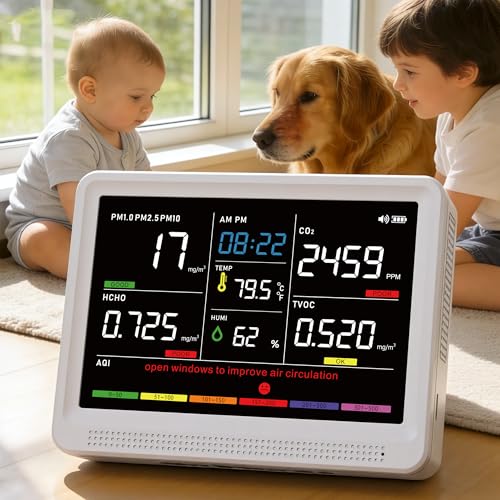
- Monitors CO2, PM levels, HCHO, TVOC, temp, humidity, and AQI.
- 5.5-inch HD display with adjustable brightness.
- 7 AQI alerts and mute option for noisy work areas.
Best For: People who want a portable, full-featured workshop air monitor with clear alerts.
Fast-reading portable pick

- Samples air data every 1.5 seconds for quick updates.
- Tracks PM1.0, PM2.5, PM10, CO2, TVOC, HCHO, temp, and humidity.
- Single-button control with optional audio prompt off.
Best For: Buyers who want a compact monitor with fast updates and simple controls.
Lightweight quiet option

- Lightweight at 11.3 ounces for easy moving around.
- Tracks PM levels, CO2, TVOC, HCHO, temp, and humidity.
- Quiet sampling mode and audio prompt control.
Best For: Users who want a lightweight, quiet monitor for flexible indoor use.
Workshop-Ready Multi-Sensor Monitor – POWERTEC 7" Color LCD
For workshops that generate sawdust, fumes, and heat, this air quality monitor for workshops gives you a clear read on CO2, PM levels, VOCs, and formaldehyde in one place. The 7-inch color LCD and audible alarms make it practical for spotting changing air conditions while cutting, sanding, or finishing.
Best For: Woodshops, garages, and industrial spaces that need visible, real-time air alerts.
Pros:
- Tracks CO2, PM1.0, PM2.5, PM10, HCHO, TVOC, temperature, and humidity.
- Color-coded readings plus audible alarms help flag unsafe air quickly.
- Rechargeable battery supports cordless use, with use while charging also available.
- Large 7-inch display is easy to read in a busy shop setting.
Cons:
- Continuous plugged-in use may slightly affect temperature accuracy.
- Requires a short 2-minute warm-up when first powered on.
- Battery life is limited to about 6 hours on a charge.
This is a strong pick if you want a shop-focused monitor with broad sensor coverage and simple visual alerts. It leans more toward practical day-to-day monitoring than app-based trend analysis.
App-Connected Indoor Monitor – BREATHE Airmonitor Plus Gen 2
If you want air quality monitors for workshops that can also help you study trends over time, the BREATHE Airmonitor Plus Gen 2 adds app connectivity and data history to multi-sensor readings. It tracks particulate matter, CO2, TVOC, formaldehyde, temperature, and humidity, while the app lets you review stored data and export it.
Best For: Users who want remote readings, history, and exportable air quality data.
Pros:
- Measures CO2, PM1, PM2.5, PM10, TVOC, HCHO, temperature, and humidity.
- Free app supports Wi-Fi remote readings, alerts, and data export.
- Stores up to 90 days of history for trend review.
- Rechargeable design offers up to 6 hours of portable use.
Cons:
- Wi-Fi app features require a 2.4 GHz network.
- Portable battery runtime is limited compared with always-plugged units.
- Best suited to indoor monitoring rather than heavy industrial use.
This model stands out if you want more than live readings and prefer to compare air changes over time. It is a good fit for organized users who value app-based monitoring and historical records.
Data-Logging Professional Analyzer – Temtop M2000 2nd Gen
The Temtop M2000 is a practical choice if you need an air quality monitor for workshops with strong logging and calibration features. It combines CO2, particle, HCHO, temperature, and humidity monitoring with a colorful display, audio alarm, and USB data export for deeper indoor analysis.
Best For: Users who want a portable analyzer with data export and built-in calibration tools.
Pros:
- Uses SenseAir NDIR CO2 sensing plus HCHO and particle sensors.
- Audio alarm and color display make readings easy to notice at a glance.
- USB data export supports analysis of CO2, PM2.5, PM10, HCHO, particles, temperature, and humidity.
- Built-in calibration program for CO2 and HCHO.
Cons:
- Larger form factor than some compact handheld monitors.
- No app-based remote monitoring is listed.
- Best fit is indoor or portable use, not continuous fixed installation.
Choose this model if you care about logging, exporting, and calibrating measurements rather than app convenience. It is a solid analytical option for people who want more control over their air-quality data.
Portable High-Precision Air Tester – Mica Dusk 16-in-1 Monitor
This portable monitor is built for quick checks when you need air quality monitors for workshops, cars, offices, or small indoor spaces. It covers the main comfort and pollutant indicators—PM1.0, PM2.5, PM10, TVOC, HCHO, temperature, and humidity—with a high-definition color screen for fast reading.
Best For: Portable day-to-day air checks across rooms, vehicles, and shared spaces.
Pros:
- Measures seven core indicators with continuous 1.5-second sampling.
- HD color screen shows color-coded readings clearly.
- One-button control and optional audio prompt off mode keep operation simple.
- Type-C fast charging and 4-5 hour runtime support mobile use.
Cons:
- No app connectivity or data export is listed.
- Runtime is shorter than plug-in-only monitors.
- Coverage focuses on core indoor indicators rather than advanced logging features.
This is a straightforward, portable tester for people who want quick sampling without extra setup. It makes the most sense when ease of use and compact size matter more than historical tracking.
Connected workshop monitor – AcuRite Wi-Fi Indoor Air Quality Monitor
If you need air quality monitors for workshops, this AcuRite unit is a practical choice for keeping an eye on the space where dust, fumes, and poor ventilation can build up. It tracks particulate matter, CO2, formaldehyde, TVOC, temperature, and humidity, while the color-coded IAQ meter makes it easy to get a quick read at a glance.
Best For: Workshop owners who want a connected monitor with broad IAQ coverage and easy visual alerts.
Pros:
- Measures PM1.0, PM2.5, PM10, CO2, formaldehyde, and TVOC
- Quick-glance green, orange, or red indoor air quality status
- Audible unhealthy-air alert can be disabled in the app
- Also shows indoor temperature and humidity
Cons:
- Designed for indoor use only
- Alert sound may be unnecessary in a quiet workspace unless disabled
For a workshop where you want broad pollutant tracking and simple status feedback, this monitor covers the essentials without making the interface complicated. The app-based alerts and remote monitoring add convenience when you are not standing right beside the unit.
Large-screen workshop monitor – 7" 16-in-1 Air Quality Monitor
Among air quality monitors for workshops, this large-display option stands out if you want readings that are easy to see across the room. It monitors CO2, PM1.0, PM2.5, PM10, HCHO, TVOC, temperature, humidity, AQI, and time, and it uses alert buzzers plus a mute button so you can react quickly when conditions change.
Best For: Busy workshop spaces that benefit from a large, easy-to-read screen and audible alerts.
Pros:
- 7-inch LED display is easy to read at a glance
- Tracks 9 key parameters including CO2, particulates, HCHO, and TVOC
- Seven AQI alert buzzers plus mute button for flexible alerting
- External high-precision sensors sample air directly
Cons:
- Bulky compared with smaller portable monitors
- Alert buzzers may be more intrusive in quiet work areas
This model makes sense when visibility matters more than portability. The large screen and direct-sampling sensors are useful for keeping an eye on changing conditions in a shop, garage, or studio-style workspace.
Data-friendly workshop meter – Temtop Portable AQI Tester
If you want air quality monitors for workshops that do more than show a single reading, this Temtop model is built for tracking trends. It measures PM2.5, PM10, HCHO, VOCs, humidity, temperature, and AQI, and it adds a 12-hour trend histogram plus Excel export for documenting changes over time.
Best For: Users who need portable spot checks and data they can export for longer-term review.
Pros:
- Tracks 7 parameters with real-time AQI calculation
- 12-hour trend histogram helps spot peaks and ventilation effects
- Exports up to 3 months of data to Excel via USB
- Battery mode supports portable room-to-room checks
Cons:
- Does not detect gas or CO leaks
- Needs warm-up time after moving between hot and cold environments
This is a strong fit when you care about documenting what happens in the workshop, not just seeing a snapshot. The combination of portable use, continuous plug-in operation, and exportable data makes it especially useful for renovation projects or repeated air-quality checks.
Workshop-ready visibility – 16 in 1 Air Quality Monitor Indoor High-Precision CO2 Monitor & HD Screen
If you need air quality monitors for workshops, this model is built for broad, real-time indoor tracking rather than a single-purpose reading. It monitors CO2, PM2.5, PM1.0, PM10, HCHO, TVOC, temperature, humidity, AQI, and time, with a large display that makes it easy to check conditions at a glance while you work.
Best For: Workshop users who want a portable, full-featured monitor with clear alerts and a large screen.
Pros:
- Tracks 9 key parameters, including CO2, particulates, HCHO, TVOC, temperature, humidity, and AQI.
- External high-precision sensors are designed for direct air sampling and fast response to changes.
- 7 AQI alert functions plus a mute option help you notice air changes without constant monitoring.
- 5.5-inch HD display with 3 brightness levels is easy to read in different lighting conditions.
Cons:
- Battery life is listed at up to 10 hours, so it is not a true all-day cordless solution.
- The notes caution against touching the sensors or exposing them to perfumes or strong odors.
This is a practical pick if you want a workshop-friendly monitor with wide coverage and simple at-a-glance visibility. The combination of alerts, portability, and a large screen makes it useful for checking air conditions during active projects.
Fast-reading portable pick – 16-in-1 Indoor Air Quality Monitor, High-Precision Multi-Parameter Smart Air Quality Tester with HD Real-Time Color Screen, Portable Air Quality Monitor for Home, Office, Cars, School, Bedroom
For buyers comparing air quality monitors for workshops, this unit stands out for its quick 1.5-second sampling and straightforward operation. It tracks the main indoor indicators you’d want to watch in a work area, and the color screen makes the readings easier to interpret during routine ventilation checks.
Best For: Users who want a simple, portable monitor with fast updates and quiet operation.
Pros:
- Measures PM1.0, PM2.5, PM10, CO2, TVOC, HCHO, temperature, and humidity.
- Automatic sampling every 1.5 seconds delivers continuous real-time updates.
- Single-button control and adjustable audio prompt make it easy to use.
- HD color screen uses color-coded readings for quick visual checks.
Cons:
- Runtime is listed at 4-5 hours per charge, which may require frequent recharging.
- The feature set is practical, but it does not include dedicated workshop-specific mounting or enclosure details.
This is a strong fit if you want a compact monitor that prioritizes fast readings and simple handling. It is especially useful when you need to move the device between different indoor spaces and check air conditions quickly.
Lightweight quiet option – 16-in-1 Indoor Air Quality Monitor, High-Precision Multi-Parameter Smart Air Quality Tester with HD Real-Time Color Screen, Portable Air Quality Monitor for Home, Office, Cars, Bedroom (Pure White)
This version is another practical option among air quality monitors for workshops, especially if you want the same monitoring layout in a lighter package. It provides the core indoor readings you need for ventilation decisions, and the quiet sampling mode can be helpful in spaces where constant beeping would get in the way.
Best For: Workshop and indoor users who want a lightweight monitor with quiet operation.
Pros:
- Tracks the same core indicators: PM1.0, PM2.5, PM10, CO2, TVOC, HCHO, temperature, and humidity.
- Automatic 1.5-second sampling keeps readings current.
- Double-tap audio prompt control supports quieter use in offices, bedrooms, and vehicles.
- Lightweight design at 11.3 ounces makes it easy to move around.
Cons:
- Battery life is still limited to about 4-5 hours per charge.
- It appears to overlap heavily with the other model, so the main difference is the finish and weight.
If you want the same broad air-tracking approach in a slightly lighter body, this is a sensible alternative. It is best for users who value portability and quiet monitoring over extra bells and whistles.
How We Picked These Air Quality Monitors for Workshops
We focused on monitors that are practical for shop environments: clear displays, multiple pollutant readings, useful alarms, and sensors that can help track dust, CO2, VOCs, formaldehyde, temperature, and humidity. For workshops, usability matters as much as specs, so we favored models that are easy to read at a glance and appropriate for continuous use in busy spaces.
Quick Comparison
The most useful workshop monitors generally fall into three groups: particulate-focused models for dust-heavy tasks, multi-parameter units for broad indoor air tracking, and connected monitors with app or Wi-Fi features for remote checking. If your shop has sanding, sawdust, or finishing chemicals, choose a monitor that includes PM2.5 or PM10 plus VOC or HCHO. If occupancy and ventilation are the main concern, CO2 monitoring becomes especially important.
Key Buying Factors for Air Quality Monitors for Workshops
Particles, Gases, or Both
Many workshop hazards are particulate, but some come from fumes and solvents. A strong monitor for workshops should ideally track particulate matter and at least one gas-related metric such as CO2, TVOC, or formaldehyde.
Display and Readability
Large color screens are helpful in noisy, active spaces where you need to check readings quickly. If the monitor will sit across the room, prioritize screen size, brightness, and obvious alert indicators.
Alarm Features
Audible or visual alarms can be useful when you are focused on a machine and may not notice a creeping air-quality issue. Adjustable thresholds are a plus if you want the device to match your own shop standards.
Connectivity and Logging
Wi-Fi or app support can be helpful if you want to track conditions over time, compare before-and-after ventilation changes, or monitor a workshop remotely. For many users, though, a dependable standalone display is enough.
Placement and Portability
In workshops, placement affects what the monitor tells you. Put it near breathing height, away from direct tool exhaust, and not right next to an open door or fan. Portable units are useful if you move between zones or want to test different parts of the shop.
Who Should Buy Which Air Quality Monitors for Workshops?
Choose a particulate-heavy monitor if your main problem is sawdust, sanding dust, or fine debris. Choose a CO2-focused or multi-sensor monitor if your workspace has limited ventilation or a lot of people. Choose a Wi-Fi-enabled model if you want long-term tracking or app alerts. If you do finishing, adhesive work, or resin projects, prioritize VOC and formaldehyde readings alongside particle counts.
In short, the best choice depends on the hazards in your shop and how you plan to use the data. For most buyers, the most practical Air Quality Monitors for Workshops combine clear readings, broad sensor coverage, and alarms that make it easier to act fast.