Air quality can affect attention, comfort, and attendance in busy classrooms, especially when ventilation is limited and occupancy is high. The right monitor makes it easier to spot rising CO2, particle levels, and other conditions before they become a problem.
Below, we’ve rounded up the best options for schools and learning spaces, from simple CO2-focused units to feature-rich multi-parameter monitors.
Best 10 Air Quality Monitors for Classrooms Picks for 2026
Classroom CO2 Watcher

- Tracks CO2, temperature, and humidity
- Fast 5-second refresh with NDIR sensing
- Portable design with long standby life
Best For: Classrooms that need simple CO2 monitoring with temp and humidity
Smart PM2.5 Classroom Monitor

- Tracks PM2.5, temperature, and humidity
- 2-second updates with LED status display
- Wi-Fi app support and data export
Best For: Fixed classrooms that want PM2.5 tracking and smart-home integration
Wireless CO2 Classroom Meter
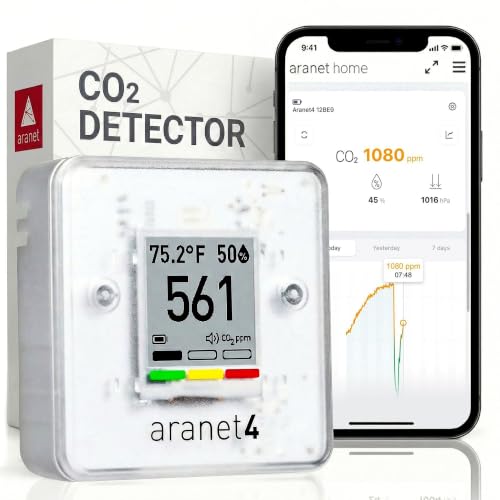
- Wireless CO2 monitor with e-ink display
- Up to 4 years of battery life
- App shows up to 90 days of data
Best For: Cable-free classrooms that want reliable CO2 tracking and long battery life
Alexa Classroom Air Monitor

- Tracks PM2.5, VOCs, CO, humidity, and temperature
- Alexa alerts, scores, and routines
- Plug-in design with quick setup
Best For: Classrooms already using Alexa that want broad air-quality tracking
Classroom-Friendly Basic Monitor

- Tracks CO2, PM2.5, TVOCs, temp, and humidity
- Up to 60 days of battery life
- Bluetooth app support with hourly logging
Best For: Teachers and schools needing simple, quiet classroom monitoring
Advanced Data Monitor

- 8-in-1 tracking with CO2, PM, VOC, and HCHO
- Wi-Fi app alerts with 90-day history
- USB-C powered for continuous monitoring
Best For: Classrooms needing detailed readings and trend analysis
Portable Analyzer
Temtop M2000 2nd Gen Air Quality Monitor

- Measures CO2, PM2.5, PM10, HCHO, temp, and humidity
- Audio alarm plus colorful level indicator
- USB export and rechargeable portable design
Best For: Staff who need a portable classroom monitor with exportable data
Classroom-Ready Full-Spectrum Pick
16-in-1 Indoor Air Quality Monitor for School Use

- Tracks PM1.0, PM2.5, PM10, CO2, TVOC, HCHO, temp, and humidity
- Real-time updates every 1.5 seconds
- HD color screen with color-coded readings
Best For: Classrooms and shared school spaces needing broad, portable monitoring
Long-Run Portable Choice
LifeBasis 11-in-1 Indoor Air Monitor

- Tracks 11 readings including CO2, PM, HCHO, TVOC, temp, and humidity
- Visual and audible alerts for out-of-range conditions
- Up to 11-12 hours of battery life
Best For: Teachers and staff who want long battery life and simple alerts
Large-Screen Alert Pick
7-Inch 16-in-1 Classroom Air Monitor

- 7-inch LED display with three brightness settings
- Tracks CO2, PM2.5, PM1.0, PM10, HCHO, TVOC, temp, humidity, and AQI
- Seven alert buzzers plus mute button
Best For: Classrooms that need a big, easy-to-read monitor with audible alerts
Classroom CO2 Watcher – Temtop CO2 Monitor
For air quality monitors for classrooms, the Temtop CO2 Monitor is a straightforward way to track CO2, temperature, and humidity in real time. It uses a Swiss-engineered NDIR sensor with a fast 5-second refresh rate, so you can keep an eye on ventilation changes during the school day.
Best For: Classrooms and learning spaces that need simple, portable CO2 tracking with temperature and humidity in one compact device.
Pros:
- Measures CO2, temperature, and humidity in one unit
- NDIR sensor offers high-precision CO2 readings with 1 ppm resolution
- 70-day standby battery life for flexible use
- Can be mounted or carried between rooms
Cons:
- CO cannot be detected by this monitor
- For real-time monitoring, it is recommended to keep it plugged in
- Fewer advanced smart features than app-connected models
Overall, this is a practical pick if your priority is reliable CO2 awareness without extra setup. Its portability and simple alert options make it well suited to classrooms, but it stays focused on core air-quality basics rather than networked controls.
Smart PM2.5 Classroom Monitor – GoveeLife H5106
If you want air quality monitors for classrooms that focus on particulates, the GoveeLife Smart Air Quality Monitor is built around PM2.5, temperature, and humidity tracking. Its 2-second updates and LED air-quality indicator make it easy to glance at conditions throughout the day, and the Wi-Fi connection supports remote viewing and data history.
Best For: Classrooms where PM2.5 monitoring, app access, and smart device automation are important.
Pros:
- Measures PM2.5, temperature, and humidity
- 2-second refresh helps show recent changes quickly
- Supports Bluetooth/Wi-Fi monitoring and data export
- Can connect with GoveeLife smart appliances for automation
Cons:
- No built-in battery; must stay powered
- 2.4G Wi-Fi required for time display
- Works with specific GoveeLife devices for automation
This is a strong choice when you want a classroom monitor that does more than display a number. The app tools and data history are useful for keeping tabs on trends, while the wired design makes it best for a fixed location.
Wireless CO2 Classroom Meter – Aranet4 Indoor Monitor
Among air quality monitors for classrooms, the Aranet4 stands out for wireless CO2 monitoring with a long battery life and a clear e-ink display. It also tracks temperature, relative humidity, and atmospheric pressure, giving teachers a simple way to watch indoor conditions without needing a corded setup.
Best For: Classrooms that need a cable-free CO2 meter with long battery life and easy-to-read data.
Pros:
- Measures CO2, temperature, humidity, and atmospheric pressure
- Wireless design with up to 4 years of battery life
- NDIR sensor technology for precise CO2 readings
- App stores up to 90 days of historical data
Cons:
- Uses AA batteries rather than a rechargeable internal battery
- Does not track PM2.5 or VOCs
- Basic on-device display compared with full smart dashboards
For classrooms that need dependable CO2 visibility without cables, this is an appealing option. The combination of long battery life, an e-ink display, and historical data makes it especially practical for rooms where you want low-maintenance monitoring.
Alexa Classroom Air Monitor – Amazon Smart Monitor
The Amazon Smart Air Quality Monitor is a broad-coverage option for air quality monitors for classrooms, checking PM2.5, VOCs, carbon monoxide, humidity, and temperature in one plug-in device. It pairs with Alexa for alerts, air-quality scores, and routines, which can be helpful if you already use Amazon’s ecosystem in the building.
Best For: Classrooms that want multi-sensor air monitoring with Alexa alerts and automation.
Pros:
- Tracks five factors: PM2.5, VOCs, CO, humidity, and temperature
- Alexa app shows an air-quality score and detailed readings
- Real-time notifications and Echo announcements are supported
- Can trigger compatible Alexa routines and devices
Cons:
- Requires Alexa for the full smart experience
- Needs to be plugged in
- Works best in homes or buildings already using Amazon devices
This model makes sense when you want a classroom monitor that covers more than just CO2 and integrates into a smart workflow. Its biggest advantage is the combination of multi-factor sensing and Alexa-based alerts, but it is less of a stand-alone device than some simpler monitors.
Classroom-Friendly Basic Monitor – Temtop M10+ 6-in-1 CO2 Meter
If you want air quality monitors for classrooms that are simple to place and easy to check throughout the day, the Temtop M10+ covers the essentials without adding complexity. It tracks CO2, PM2.5, TVOCs, temperature, and humidity, while the e-ink display and long battery life make it practical for daily classroom use.
Best For: Teachers and schools that want a compact, quiet monitor for basic classroom ventilation and comfort tracking.
Pros:
- Tracks CO2, PM2.5, TVOCs, temperature, and humidity in one device
- Up to 60 days of battery life helps reduce frequent charging
- Quiet, bedroom-friendly design with a muteable alarm
- Bluetooth app support with hourly data logging for nearby monitoring
Cons:
- Bluetooth model requires close-range phone access for app viewing
- Fewer advanced history and export features than some Wi-Fi models
- Best suited to straightforward monitoring rather than deep data analysis
The M10+ is a strong fit if your priority is dependable day-to-day classroom monitoring with minimal setup. It is especially appealing for spaces where quiet operation, portability, and simple readings matter more than advanced reporting tools.
Advanced Data Monitor – BREATHE Airmonitor Plus Gen 2
For air quality monitors for classrooms that need more than a basic readout, the BREATHE Airmonitor Plus Gen 2 offers broad sensing and stronger data tools. It tracks CO2, PM1, PM2.5, PM10, TVOC, formaldehyde, temperature, and humidity, plus Wi-Fi app access, alerts, and a 90-day history for reviewing patterns over time.
Best For: Classrooms and school spaces that need detailed pollutant tracking and app-based trend review.
Pros:
- 8-in-1 monitoring includes CO2, particle levels, VOCs, formaldehyde, temperature, and humidity
- Wi-Fi app support with configurable alerts and 90-day data history
- Data export helps with deeper analysis and recordkeeping
- USB-C power support allows continuous use when needed
Cons:
- Portable battery life is limited to about 6 hours
- May be more feature-rich than needed for basic classroom checking
- Relies on 2.4 GHz Wi-Fi for remote app features
This model makes sense when you want classroom air quality data you can actually review and compare over time. Its mix of broader sensing and app-based history is a better fit for schools that care about trend tracking, not just instant readings.
Portable Analyzer – Temtop M2000 2nd Gen Air Quality Monitor
If you need air quality monitors for classrooms that can also move between rooms, the Temtop M2000 2nd Gen is built like a portable analyzer. It measures CO2, PM2.5, PM10, HCHO, temperature, and humidity, and adds an audio alarm, colorful level indicator, and USB data export for longer-term review.
Best For: School staff who want a portable monitor with exportable data and quick visual alerts.
Pros:
- 8-in-1 monitoring covers CO2, PM2.5, PM10, HCHO, temperature, and humidity
- Audio alarm and colorful display make readings easy to notice
- USB data export supports classroom analysis and recordkeeping
- Rechargeable design and carry case improve portability
Cons:
- Bulkier than compact classroom-only monitors
- No app connectivity is listed in the supplied details
- More analyzer-style than simple wall-side classroom monitor
The M2000 stands out when portability and fuller air quality visibility matter more than a small always-on display. It is a good pick for schools that want to sample multiple rooms and keep records without giving up on easy-at-a-glance alerts.
Classroom-Ready Full-Spectrum Pick – 16-in-1 Indoor Air Quality Monitor for School Use
If you need air quality monitors for classrooms that give a broad picture of indoor conditions, this 16-in-1 unit is built to cover the basics and then some. It tracks PM1.0, PM2.5, PM10, CO2, TVOC, HCHO, temperature, and humidity in real time, which can help staff decide when to ventilate or check for stale air.
Best For: Classrooms, school offices, and shared learning spaces that need comprehensive everyday air monitoring.
Pros:
- Tracks 16 parameters, including key classroom concerns like CO2, PM, TVOC, and HCHO.
- Real-time sampling every 1.5 seconds supports quick checks during the school day.
- HD color screen uses color-coded readings for easier at-a-glance monitoring.
- Type-C charging and portable design make it easy to move between rooms.
Cons:
- Battery life is only 4-5 hours on a full charge.
- Not designed as a fixed wall-mounted classroom monitor.
For schools that want one portable device to watch several air indicators at once, this model offers the widest coverage in the group. It is a practical choice when the goal is to keep an eye on ventilation, particulates, and comfort conditions from one screen.
Long-Run Portable Choice – LifeBasis 11-in-1 Indoor Air Monitor
For classrooms that need a portable monitor with strong runtime, this LifeBasis option keeps an eye on 11 key readings including AQI, CO2, PM1.0, PM2.5, PM10, particles, HCHO, TVOC, temperature, and humidity. It uses visual and audible alerts, so teachers or staff can see and hear when conditions move outside the normal range.
Best For: Staff who want a lightweight classroom monitor with longer battery life and clear alerts.
Pros:
- Monitors 11 key indexes for a solid classroom air snapshot.
- Dual alert system includes both visual and audible warnings.
- Adjustable LCD brightness makes the display easier to read in different lighting.
- 2500mAh battery supports up to 11-12 hours of continuous use.
Cons:
- It has a smaller screen than some large-display competitors.
- Fewer total tracked parameters than the 16-in-1 models.
This is a practical pick if you want a classroom air monitor that can stay on longer through the school day without frequent charging. The alert system and portable size make it easy to move between rooms or keep near a teacher’s desk.
Large-Screen Alert Pick – 7-Inch 16-in-1 Classroom Air Monitor
When visibility matters, this 7-inch air quality monitor gives classrooms a large LED display that makes readings easy to check from across the room. It monitors nine key parameters, including CO2, PM2.5, PM1.0, PM10, HCHO, TVOC, temperature, humidity, and AQI, while adding multiple alert buzzers for fast attention.
Best For: Classrooms that need a large display and audible alerts for quick air checks.
Pros:
- 7-inch LED screen offers clear, easy-to-read air quality data.
- Monitors key classroom concerns like CO2, particulates, HCHO, and TVOC.
- Seven alert buzzers provide distinct warning functions.
- Three brightness settings help adapt the display to different rooms.
Cons:
- The battery/runtime details are not highlighted in the supplied notes.
- It focuses on 9 detectable parameters rather than a fuller multi-sensor list.
This model stands out when teachers need a monitor that is easy to glance at and quick to alert. The large screen and built-in buzzer system make it especially useful in active classroom environments where fast feedback is important.
How We Picked These Air Quality Monitors for Classrooms
We focused on classroom-friendly monitors that balance accuracy, ease of use, and practical alerts. Priority went to models that clearly display key readings, offer useful app or notification support where available, and are simple enough for staff to check at a glance. We also considered power options, portability, and whether the sensor set matches common school needs such as CO2, PM2.5, temperature, and humidity.
Quick Comparison
For most classrooms, CO2 monitoring is the first priority because it is a fast proxy for ventilation quality. If your space has whiteboards, printers, or frequent outdoor pollution, PM2.5 tracking becomes more useful. Multi-sensor models are best for schools that want a broader snapshot, while simpler units can work well when the main goal is just keeping ventilation in the safe zone.
Key Buying Factors for Air Quality Monitors for Classrooms
Accuracy and Sensor Stability
Look for monitors that use a proven CO2 sensor type and provide consistent readings over time. In classrooms, small errors can lead to poor ventilation decisions, so stability matters more than flashy features.
Display Visibility and Alerts
A large, easy-to-read screen helps teachers and staff check conditions quickly. Audible alerts, color indicators, or app notifications can be useful if the monitor is mounted across the room.
What It Measures
For most schools, CO2, temperature, and humidity are the essentials. Adding PM2.5 is helpful in areas affected by wildfire smoke, nearby traffic, dust, or art and science activities. VOC monitoring may also be useful in rooms with strong cleaning products or new materials.
Power, Placement, and Maintenance
Battery-powered or wireless units are easier to move between rooms, while plugged-in monitors are better for fixed installation. Make sure the device can be placed at breathing height and away from vents, windows, and direct sunlight. Also check whether it needs calibration, app setup, or periodic sensor replacement.
Who Should Buy Which Air Quality Monitors for Classrooms?
If you want a straightforward option for one classroom, choose a simple CO2 monitor with clear alerts and temperature/humidity readings. If you oversee multiple rooms or need more than ventilation data, a multi-parameter model can give a fuller picture. Schools dealing with smoke, dust, or indoor pollutants should prioritize monitors that include PM2.5, while budget-conscious buyers may prefer a reliable core CO2 model over extra features they won’t use.
In short, the best Air Quality Monitors for Classrooms are the ones teachers will actually use every day: readable, dependable, and matched to the conditions in the room.