Moisture can turn an otherwise successful classroom 3D print into a lesson in stringing, popping, weak layers, and wasted filament. The right dryer helps schools protect materials and make printing more predictable.
We’ve selected 10 filament dryers for schools with different capacities, heating designs, storage features, and budgets—from compact single-spool units to models built for busy makerspaces.
Best 10 Filament Dryers for Schools Picks for 2026
Best for Dual-Zone Capacity

- Two independently controlled drying zones
- Holds up to four 1kg spools
- Supports annealing and humidity control
Best For: Busy school makerspaces using multiple filament types
Best for Dry-Store-Print Workflow

- Dries, stores, and feeds filament directly
- Built-in hygrometer for condition monitoring
- Supports common PLA, PETG, TPU, and nylon types
Best For: Classrooms prioritizing sealed storage for one spool
Best for High-Volume Basic Drying

- Dries four 1kg spools together
- Eight outlets support multiple printers
- Three fans and 35–70°C control
Best For: School makerspaces with several everyday filament jobs
Best for Dual-Chamber Storage
Creality Space Pi X4 Filament Dryer

- Holds four 1kg or two 2kg spools
- Two independent chambers reach 85°C
- Sealed storage helps limit re-absorption
Best For: High-volume labs needing drying and protected storage
Easy-Use Pick

- Fan-assisted drying with a visible LCD
- Adjustable 35°C–55°C temperature range
- Supports multiple filament diameters and materials
Best For: Classrooms drying one spool of common filament at a time
High-Capacity Pick
Creality Space Pi X4 Filament Dryer
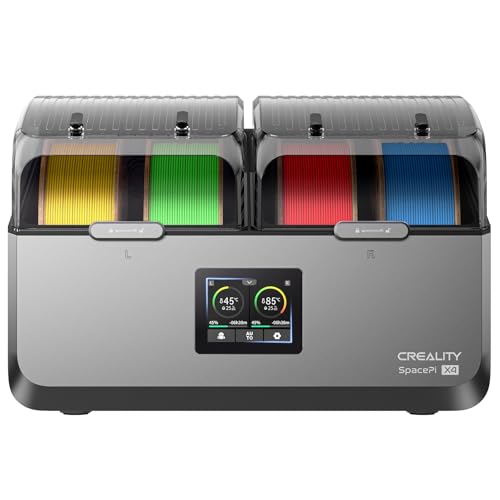
- Dries and prints up to four spools
- Independent dual-chamber temperature control
- Reaches up to 85°C for engineering filaments
Best For: Busy school makerspaces serving multiple printers
Safety-Focused Pick
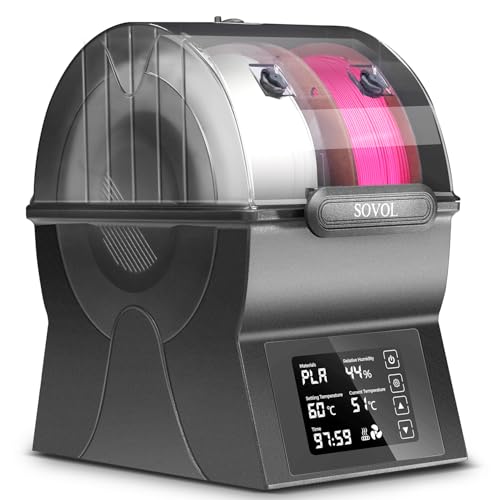
- Dries two 1 kg spools simultaneously
- Preset settings cover nine filament types
- Includes heating and fan safety protection
Best For: Classrooms wanting guided two-spool drying
Best Dual-Spool Pick
Creality Space Pi Filament Dryer Plus
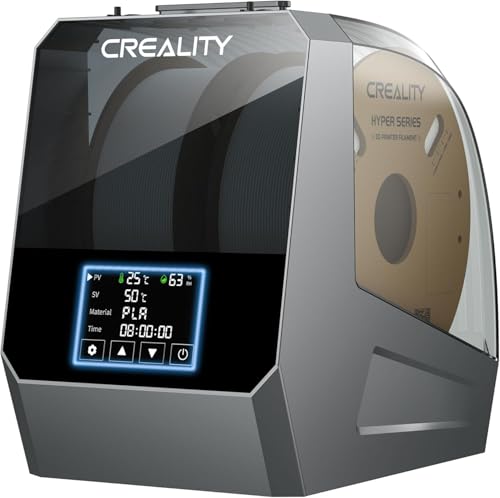
- Dries two 1 kg spools simultaneously
- 160W 360° PTC hot-air heating
- Touchscreen presets for 12 filament types
Best For: School makerspaces supporting multiple printers
Best Sealed Storage Option
Comgrow SH01 Filament Dryer Box

- Stores two 1 kg spools
- Monitors temperature and humidity
- Feeds filament while maintaining a sealed environment
Best For: Classrooms focused on storage and standard filaments
Best Programmable Dryer
Creality Space Pi Filament Dryer

- Runs drying cycles for up to 48 hours
- 110W 360° PTC hot-air heating
- Remembers settings after power loss
Best For: Labs needing flexible, scheduled drying cycles
Best for Dual-Zone Capacity – SUNLU S4 Pro Filament Dryer
For schools managing several printers and mixed materials, the SUNLU S4 Pro is a high-capacity option among filament dryers for schools. Its two independently controlled chambers can dry different filaments at temperatures from 45–85°C, while supporting drying during printing.
Best For: School labs that need simultaneous drying for up to four 1-kilogram spools and support for advanced materials.
Pros:
- Dual-zone temperature control allows different filament types or settings to run at once.
- Holds up to four 1-kilogram spools and supports 1.75mm, 2.85mm, and 3.00mm filament.
- Includes annealing and automatic humidity-control modes, with temperatures up to 85°C.
- 380W PTC heating supports efficient drying.
Cons:
- Its larger 458 × 218 × 340mm footprint may require dedicated bench space.
- The dual-zone controls and additional modes may be more capability than a small classroom needs.
The S4 Pro stands out when a school wants capacity, material flexibility, and independent chamber control in one unit. It is especially suitable for shared makerspaces with multiple printers and varied projects.
Best for Dry-Store-Print Workflow – Polymaker PolyDryer
The Polymaker PolyDryer combines heated drying, sealed storage, and direct feeding in a modular setup. For schools comparing filament dryers for schools, this design can reduce handling between classes and help keep filament protected between print sessions.
Best For: Classrooms that want one-spool drying and storage with direct printing without breaking the seal.
Pros:
- Supports a dry, store, and print workflow without opening the storage environment.
- Built-in hygrometer helps staff and students monitor conditions.
- Uses controlled heating, 360° airflow, sealing, and desiccant support.
- Works with PA Nylon, PLA, PVB, PETG, ABS, ASA, and TPU in common filament diameters.
Cons:
- Its listed configuration is centered on one spool rather than a multi-spool school lab setup.
- The modular dock and storage-box design may require more setup than a basic dryer.
PolyDryer is a practical choice when moisture protection needs to continue after drying. Its sealed, direct-feed approach is well suited to classrooms where filament may sit between lessons or projects.
Best for High-Volume Basic Drying – SUNLU S4 Filament Dryer
The SUNLU S4 is designed for school labs that need to dry several spools at once without moving between multiple small units. Its four-spool capacity, eight filament outlets, and three circulation fans make it a practical high-volume option among filament dryers for schools.
Best For: Makerspaces running multiple printers with common materials and needing straightforward multi-spool drying.
Pros:
- Dries up to four 1-kilogram spools simultaneously.
- Eight filament outlets accommodate multiple printers and loading angles.
- Three fans and 360° surround heating promote more even drying.
- Offers a 35–70°C temperature range and a timer up to 99 hours.
Cons:
- The 70°C maximum is lower than the S4 Pro’s 85°C maximum for some advanced drying needs.
- Its 460 × 220 × 310mm size requires substantial workspace.
- The product’s customization options may involve additional modification work.
The S4 is a strong fit for schools that value capacity and simple operation over dual-zone control. It covers common materials and can keep several printers supplied from one drying station.
Best for Dual-Chamber Storage – Creality Space Pi X4 Filament Dryer
The Creality Space Pi X4 combines four-spool storage with two independent heating chambers and moisture-resistant storage. For schools evaluating filament dryers for schools, it offers a way to dry filament and help protect it during printing pauses.
Best For: High-volume school labs that need dual-chamber drying and sealed storage for standard or larger spools.
Pros:
- Holds four standard 1-kilogram spools or two larger 2-kilogram spools.
- Dual independent 200W chambers reach up to 85°C.
- Silicone sealing helps prevent moisture re-absorption during storage and pauses.
- Touch controls and an illuminated viewing window support monitoring without opening the enclosure.
Cons:
- The supplied details do not specify a timer or humidity readout.
- Its larger capacity may be unnecessary for small classrooms with one or two printers.
The Space Pi X4 is compelling for shared labs that need both active drying and ongoing storage. Its dual chambers also make it easier to organize different filament loads while keeping the enclosure closed.
Easy-Use Pick – SUNLU S1 Plus Filament Dryer
For schools seeking filament dryers for schools, the SUNLU S1 Plus offers a straightforward way to dry and condition common 3D-printing materials. Its fan-assisted design, adjustable controls, and compact single-spool format suit classrooms that need a simple shared solution.
Best For: Classrooms using one spool at a time and a broad mix of PLA, PETG, ABS, TPU, and other supported filaments.
Pros:
- Fan design helps speed moisture removal while filament is drying.
- Two-inch LCD displays temperature, time, and humidity.
- Adjustable temperature from 35°C to 55°C and drying while printing.
- Supports 1.75 mm, 2.85 mm, and 3.00 mm filament sizes.
Cons:
- Its listed capacity is limited to one spool.
- The 55°C maximum may be less suitable for higher-temperature materials than some alternatives.
The S1 Plus is a practical entry point for a school makerspace prioritizing simple operation, visible settings, and compatibility with many mainstream filament types.
High-Capacity Pick – Creality Space Pi X4 Filament Dryer
Among filament dryers for schools, the Creality Space Pi X4 stands out for shared labs that need to handle several spools and printers. Its four-spool capacity, dual chambers, and high maximum temperature are designed for higher-throughput workflows.
Best For: School makerspaces running up to four spools and printers, especially when different filament types need separate temperature settings.
Pros:
- Dries and prints with up to four spools at once.
- Eight filament holes and PTFE tubing support multiple printer connections.
- Dual chambers provide independent temperature control for two filament types.
- Reaches up to 85°C for engineering materials such as PA, PAHT, PC, and flexible filament.
Cons:
- Its larger four-spool design may be more capacity than a small classroom needs.
- The notes advise checking that other brands’ plastic trays are heat resistant.
- Running two chambers uses more power than single-chamber operation.
The Space Pi X4 is the strongest choice here for a busy school lab where several printers operate simultaneously and material variety matters more than compactness.
Safety-Focused Pick – Sovol SH02 Dual-Spool Dryer
The Sovol SH02 is a useful middle ground for filament dryers for schools, combining two-spool capacity with guided settings and safety features. Its sealed design can also help protect stored filament from moisture and dirt when the unit is not powered on.
Best For: Classrooms that need to dry two spools at once while keeping operation simple for students and staff.
Pros:
- Holds two 1 kg spools and supports printing to two printers.
- 150 W PTC heater reaches 50°C in about seven minutes and 70°C in about 25 minutes.
- One-key presets cover nine filament types, including PLA, TPU, PETG, ABS, and PA.
- Includes automatic heating protection and an alert if the fan stops.
Cons:
- Desiccant bags are not included.
- The adjustable temperature range tops out at 70°C, below the Creality model’s maximum.
- It is designed for two spools rather than the four-spool capacity of the larger alternative.
With quick heating, improved sealing, material presets, and protective monitoring, the SH02 is a strong fit for supervised classroom use and shared school work areas.
Best Dual-Spool Pick – Creality Space Pi Filament Dryer Plus
For schools comparing filament dryers for schools, the Creality Space Pi Plus stands out when multiple printers or larger material rotations need support. Its two-spool design, 160W PTC heating, and guided controls suit shared classroom workflows.
Best For: School makerspaces running two 1 kg spools or two printers at once.
Pros:
- Holds two 1 kg spools and includes four filament outlets.
- Uses 360° circulating hot air and a 160W PTC heater for more even warming.
- Offers one-key settings for 12 filament types and a 4-inch touchscreen.
- Supports common and composite materials, including PLA, PETG, ABS, TPU, PA, PC, and carbon-fiber blends.
Cons:
- At 5.5 pounds, it is less convenient to move between classrooms.
- The temperature range is limited to 45°C–70°C.
The large capacity and straightforward touchscreen make this a strong shared-equipment option, particularly where students use different filament types throughout the day.
Best Sealed Storage Option – Comgrow SH01 Filament Dryer Box
The Comgrow SH01 is a practical choice among filament dryers for schools when keeping filament protected during printing matters as much as removing moisture. Its sealed enclosure, humidity monitoring, and two-spool capacity support organized classroom storage.
Best For: Classrooms that need dry storage and continuous filament feeding for standard materials.
Pros:
- Stores two 1 kg spools and accommodates 1.75 mm and 2.85 mm filament.
- Provides internal heating while printing to help maintain a dry environment.
- Includes real-time temperature and humidity monitoring on a 2-inch LCD.
- Uses a sealed cover, silicone cable sheath, and Teflon outlet tube.
Cons:
- The maximum temperature is 50°C, limiting use with some higher-temperature materials.
- Drying times are limited to 6–12 hours.
- Its operating procedure requires the work state to appear on the screen.
This model emphasizes containment and monitoring rather than high-temperature drying, making it a sensible fit for schools primarily using PLA, ABS, and similar standard filaments.
Best Programmable Dryer – Creality Space Pi Filament Dryer
For schools seeking filament dryers for schools with flexible scheduling, the Creality Space Pi combines 360° PTC heating with a timer that can run for up to 48 hours. Its presets and power-off memory can reduce setup work when equipment is shared across classes.
Best For: School labs needing programmable drying for varied filament types and long unattended cycles.
Pros:
- Circulates hot air 360° with a 110W PTC heater.
- Supports one-key settings for up to 12 filament types.
- Offers a 0–48-hour timer and remembers settings after a power outage.
- Works with 1.75 mm and 2.85 mm filaments, including PLA, PETG, TPU, ABS, nylon, and composite materials.
Cons:
- Its 110W heater is less powerful than the Space Pi Plus model listed above.
- It is designed for one spool, limiting simultaneous drying capacity.
- The 3.7-inch screen is smaller than the Plus model’s display.
The long timer and saved settings are useful in school environments where drying can begin after class and continue before the next session, while the broad material support accommodates varied projects.
How We Picked the Best Filament Dryers for Schools
We focused on features that matter in real classrooms and school makerspaces: usable spool capacity, temperature range, drying consistency, storage performance, controls, noise, portability, and overall value. We also considered whether a unit can support common materials such as PLA, PETG, TPU, ABS, and nylon without requiring complicated setup.
For school use, convenience and repeatability are especially important. A dryer that is easy for students and staff to load, monitor, and store is often more useful than a technically advanced model that requires constant adjustment.
Quick Comparison
| Best for | Look for | Why it matters |
|---|---|---|
| Small classrooms | Single- or dual-spool capacity | Uses less space and power |
| Busy makerspaces | Four-spool or multi-zone drying | Processes more filament at once |
| Nylon and moisture-sensitive materials | Higher temperatures and sealed storage | Improves drying and prevents reabsorption |
| Shared student use | Simple controls and clear displays | Reduces operating mistakes |
Key Buying Factors for Filament Dryers for Schools
Capacity and Classroom Workflow
Choose capacity based on how many printers run at the same time. A compact dryer may suit a single classroom, while a four-spool model can reduce queues in a central makerspace. Check spool width and diameter before buying, especially if students use larger or specialty reels.
Temperature Control
PLA generally needs gentler drying than nylon, so adjustable temperature settings are more useful than a single high-heat mode. Dual-zone or independently controlled chambers can help when different materials need separate treatment.
Storage and Moisture Protection
Drying is only half the job. Look for sealed storage, reliable lids, humidity monitoring, and ports that let filament feed directly to a printer. These features help keep dried filament usable between classes.
Safety and Maintenance
Prioritize stable construction, overheat protection, accessible controls, and clear operating instructions. Place dryers on a level, ventilated surface and establish a staff-approved routine for loading, unloading, and checking hot spools.
Who Should Buy Which Filament Dryers for Schools?
Choose a compact SUNLU, Sovol, or Comgrow dryer when space, portability, and a modest budget matter most. For schools running several printers, the SUNLU S4, SUNLU S4 Pro, Creality Space Pi X4, or Polydryer can make batch drying and storage more efficient.
If students regularly print with nylon or other moisture-sensitive materials, prioritize higher-temperature capability, dependable sealing, and precise controls over the lowest purchase price. For introductory programs using mostly PLA and PETG, a straightforward single- or dual-spool unit may provide the best balance of simplicity and value.