Moisture-sensitive filament can cause stringing, popping, weak layers, and inconsistent extrusion. The right compact filament dryer helps prepare material before printing while taking up less space than a full-size drying cabinet.
We compared 10 current options from Creality, SUNLU, Sovol, Comgrow, and Polymaker, focusing on heating performance, spool capacity, controls, storage practicality, and fit for common 1 kg filaments.
Best 10 Compact Filament Dryers Picks for 2026
Best All-Around Compact Filament Dryer

- 45–65°C adjustable temperature range
- 0–24-hour timer and humidity display
- Fits most 1KG spools
Best For: Single-spool users who want flexible drying controls
Best High-Temperature Compact Filament Dryer

- 35–70°C adjustable temperature range
- 0–99-hour customizable timer
- Rotating spindle for even drying
Best For: Users needing extended cycles and broad filament compatibility
Best Dual-Spool Compact Filament Dryer
Comgrow SH01 Filament Dryer Box

- Holds two 1kg spools
- Temperature and humidity monitoring
- Sealed outlet with Teflon tube
Best For: Users who need higher capacity and enclosed filament feeding
Best Simple Compact Filament Dryer

- Fan-assisted moisture removal
- 35–55°C adjustable temperature range
- Supports three filament diameters
Best For: Everyday drying of common materials while printing
Best Dual-Spool Value
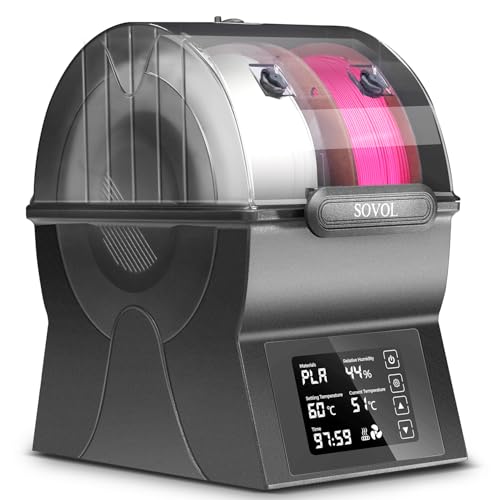
- Dries two 1 kg spools at once
- 150W PTC heating with 40–70°C control
- Presets for nine filament types
Best For: Multi-material users needing two-spool drying
Best Touchscreen Controls
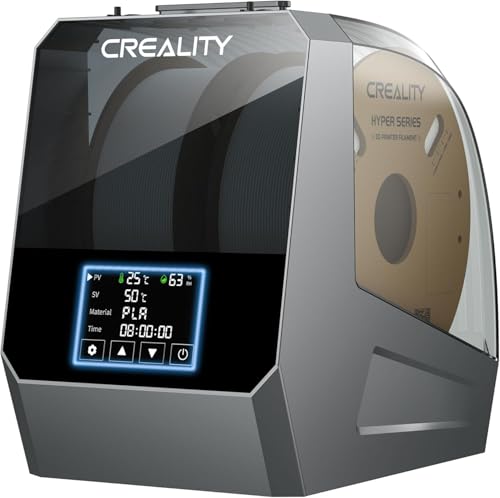
- Two-spool design with four filament holes
- 160W double PTC 360° heating
- Touchscreen presets for 12 materials
Best For: Advanced users drying varied filament types
Best Simple Storage Option

- Stores two narrow or one wide spool
- Real-time temperature and humidity display
- Sealed storage with basic 40–50°C settings
Best For: Simple drying and long-term filament storage
Best Integrated Storage

- Dries, stores, and feeds filament without breaking the seal
- Supports 1.75, 2.85, and 3.00 mm filament
- Adds airflow, hygrometer, sealing, and desiccant support
Best For: Makers wanting a complete drying and storage routine
Best Touchscreen Control

- 110W PTC heater circulates 360° hot air
- Presets cover up to 12 filament types
- 3.7-inch screen shows humidity and temperature
Best For: Users who prioritize guided settings and live monitoring
Best Timer Flexibility

- Offers a 0–48-hour adjustable timer
- Uses 110W PTC and 360° hot-air heating
- Retains settings after a power interruption
Best For: Users needing longer, programmable drying cycles
Best All-Around Compact Filament Dryer – Creality Space Pi SE
For makers seeking compact filament dryers with flexible controls, the Creality Space Pi SE offers adjustable heat and drying time for common 3D-printing materials. Its 360-degree hot-air circulation, insulation, and quick heating are useful when you want to dry filament while keeping the setup straightforward.
Best For: Users who want precise temperature and timer controls for single 1KG spools.
Pros:
- Heats to 65°C within 15 minutes, according to the supplied specifications.
- Adjustable temperature from 45°C to 65°C and drying time from 0 to 24 hours.
- Supports 1.75mm and 2.85mm filament, including PLA, PETG, ABS, ASA, TPU, and nylon.
- Displays humidity and drying progress, with no assembly required.
Cons:
- Designed for most 1KG spools rather than two-spool storage.
- Its maximum temperature is lower than the SUNLU S2’s stated 70°C maximum.
The Space Pi SE is a well-rounded pick among compact filament dryers, especially if you value fast warm-up, broad material compatibility, and detailed settings in a single-spool format.
Best High-Temperature Compact Filament Dryer – SUNLU Filament Dryer S2
The SUNLU S2 is one of the more versatile compact filament dryers for users who need a wider temperature range and extended timer settings. It can dry filament during printing, continuously rotate the spool for even drying, and accommodate several standard filament diameters.
Best For: Makers who want a large control range and support for 1.75mm, 2.85mm, and 3.00mm filament.
Pros:
- Offers adjustable temperatures from 35°C to 70°C and drying times from 0 to 99 hours.
- Built-in spindle rotates the filament for even drying.
- Can function as a spool holder while drying during printing.
- Large translucent lid and touch screen make monitoring and operation convenient.
Cons:
- Its listed weight of 1.51kg makes it heavier than some alternatives here.
- The larger stated capacity may take more space than a single-spool dryer.
Choose the S2 when temperature flexibility, long drying cycles, and broad diameter compatibility matter more than having the lightest possible dryer.
Best Dual-Spool Compact Filament Dryer – Comgrow SH01 Filament Dryer Box
The Comgrow SH01 stands out among compact filament dryers for its ability to hold two 1kg spools. It combines sealed storage, temperature and humidity monitoring, and filament outlets designed for feeding material during printing, though its lower heat range is best suited to users who do not need high-temperature drying.
Best For: 3D-printing setups that need two-spool storage and in-printer dry feeding.
Pros:
- Inner space is listed as 9.29 × 6.49 × 9.13 inches and accommodates two 1kg spools.
- Supports standard 1.75mm and 2.85mm filament diameters.
- Provides real-time temperature and humidity monitoring on a 2-inch LCD screen.
- Sealed cover, silicone cable sheath, and Teflon tube help protect and guide filament.
Cons:
- Temperature range is limited to 40–50°C.
- Timer settings are limited to 6–12 hours.
- The supplied instructions require opening the sealing hole during drying so moisture can escape.
The SH01 is a practical choice when capacity and enclosed storage are priorities, but its modest temperature range makes it less flexible than the other dryers in this roundup.
Best Simple Compact Filament Dryer – SUNLU S1 Plus
The SUNLU S1 Plus is a straightforward option among compact filament dryers, with fan-assisted moisture removal and a visual LCD readout for temperature, time, and humidity. Its moderate 35–55°C range suits common materials and everyday filament maintenance.
Best For: Users who want a simple, fan-equipped dryer for common filament types and printing while drying.
Pros:
- Fan design helps discharge excess moisture during drying.
- Displays temperature, time, and humidity on a 2-inch LCD screen.
- Supports 1.75mm, 2.85mm, and 3.00mm filament, including PLA, PETG, ABS, TPU, and nylon.
- Designed for drying while printing and includes a stated one-year warranty.
Cons:
- Its 35–55°C temperature range is narrower than the S2’s range.
- The supplied notes do not specify a customizable maximum drying time.
- Its listed capacity is for one spool up to 210 × 89mm.
The S1 Plus is a sensible everyday dryer for common materials, particularly if you prefer clear controls and fan-assisted drying without needing the highest temperatures or largest capacity.
Best Dual-Spool Value – Sovol SH02 Filament Dryer
For makers comparing compact filament dryers, the Sovol SH02 stands out by drying two 1 kg spools at once while keeping the controls straightforward. Its 150W PTC heater, circulating fan, and improved sealing make it a practical choice for regular multi-material printing.
Best For: Users who want dual-spool drying, quick warm-up, and one-button presets for common filament types.
Pros:
- Dries two 1 kg filament rolls simultaneously.
- 150W PTC heater reaches 50°C in about 7 minutes and supports 40–70°C settings.
- One-key presets cover nine filament types, including PLA, PETG, TPU, ABS, and nylon.
- Improved sealing helps protect filament even when the unit is powered off.
Cons:
- Desiccant bags are not included.
- The listed safety cutoff activates above 130°C, which may matter to users seeking more detailed temperature controls.
The SH02 is a well-rounded compact filament dryer for a two-printer workspace or anyone rotating through multiple materials. Its capacity and preset controls offer convenience without requiring separate drying cycles.
Best Touchscreen Controls – Creality Space Pi Plus Dryer
The Creality Space Pi Plus is one of the more feature-rich compact filament dryers for users who want clear controls and broad material support. It combines dual-spool capacity with 160W double PTC 360° hot-air heating and a 4-inch LCD touchscreen.
Best For: Advanced FDM users who want touchscreen operation, wide filament compatibility, and drying for two printers.
Pros:
- Holds two 1 kg rolls and provides four filament holes for flexible printer placement.
- 160W double PTC heating circulates hot air 360° for more uniform drying.
- One-key settings support 12 filament types, including carbon-fiber composites.
- 4-inch touchscreen supports temperature adjustments from 45–70°C and Celsius/Fahrenheit switching.
Cons:
- Its feature set may be more than needed for users who only dry basic PLA.
- The supplied details list a 5.5-pound item weight, so it may be less convenient to move frequently.
Choose the Space Pi Plus when control flexibility and material coverage matter as much as compact dual-spool capacity. The touchscreen and presets make it especially suitable for users working with specialty and composite filaments.
Best Simple Storage Option – Sovol SH01 Filament Dryer
The Sovol SH01 is a straightforward option among compact filament dryers for users who want moisture removal and sealed storage without extensive controls. It supports two narrower rolls or one wider roll and displays the box’s temperature and humidity in real time.
Best For: Budget-minded makers who need simple drying, sealed storage, and basic monitoring for common filaments.
Pros:
- Stores two rolls under 70 mm wide or one roll under 150 mm wide.
- Displays internal temperature and humidity in real time.
- Offers 40°C, 45°C, and 50°C temperature settings with six- to 12-hour timers.
- Silicone and PTFE sealing supports unpowered storage and desiccant use.
Cons:
- Temperature settings are more limited than newer models.
- The unit may not reach 50°C in rooms below 16°C.
- PTFE seals should be opened during heating so moisture can escape.
The SH01 makes sense when you prioritize basic drying and storage over fast heating or advanced presets. Its real-time readings and flexible spool capacity provide useful everyday functionality, provided you follow the ventilation guidance during heating.
Best Integrated Storage – Polymaker PolyDryer
For shoppers comparing compact filament dryers, the Polymaker PolyDryer stands out as a connected drying, storage, and feeding system. It combines controlled heating, airflow, sealing, desiccant support, and humidity monitoring to help reduce moisture exposure before and during printing.
Best For: Makers who want one compact setup for drying, sealed storage, and direct filament feeding across multiple filament types.
Pros:
- Combines drying, storage, and printing without breaking the seal.
- Supports 1.75 mm, 2.85 mm, and 3.00 mm filament sizes.
- Works with materials including PLA, PETG, PA Nylon, ABS, ASA, TPU, and PVB.
- Uses 360° airflow, a hygrometer, sealing, and desiccant support.
Cons:
- The system weighs about 1.3 kg, so it may not be the lightest option for frequent relocation.
- Its broader storage-and-drying design may be more than needed for buyers seeking a basic dryer only.
The PolyDryer is a strong choice when ongoing moisture control matters as much as the initial drying cycle. Its integrated design is especially useful for users who want filament ready to print while minimizing repeated exposure to ambient air.
Best Touchscreen Control – Creality Space Pi
Among compact filament dryers, the official Creality Space Pi emphasizes easy control and even heating. Its 110W PTC heater and fan circulate hot air at 360°, while the touchscreen provides temperature, humidity, and drying-status information.
Best For: Users who want broad material compatibility, guided temperature presets, and real-time monitoring in a touchscreen dryer.
Pros:
- Uses 110W PTC heating with 360° hot-air circulation for more uniform heating.
- Offers one-key settings for up to 12 filament types.
- Supports adjustable temperatures from 45°C to 70°C.
- Displays internal humidity and temperature on a 3.7-inch touchscreen.
Cons:
- The supplied notes do not specify a drying timer range.
- It weighs about 3 pounds, which may matter when desk space or portability is limited.
The Space Pi is a practical fit for users who prefer visible controls instead of guesswork. Its preset support covers common and composite materials, while the live readings make it easier to follow the drying process.
Best Timer Flexibility – Creality Space Pi Dryer
This Creality Space Pi is one of the more feature-focused compact filament dryers for users who want flexible cycle control. It combines 110W PTC heating and 360° hot-air circulation with a touchscreen, a 0–48-hour timer, and power-off memory.
Best For: 3D printing users who want programmable drying cycles and automatic retention of material and temperature settings.
Pros:
- Provides a freely adjustable 0–48-hour timer.
- Uses 110W PTC heating and 360° hot-air circulation.
- Offers one-key settings for up to 12 filament types.
- Remembers material and temperature settings after a power outage.
Cons:
- The supplied specifications list compatibility with 1.75 mm and 2.85 mm filament, not 3.00 mm.
- The notes identify a 110V input, which may limit use in regions with different electrical standards.
The main advantage here is scheduling flexibility. The long timer range suits extended drying routines, while power-off memory reduces setup work when interruptions occur. It is a sensible pick for users who want more automation than a basic dryer provides.
How We Picked the Best Compact Filament Dryers
We evaluated these Compact Filament Dryers by looking at the features that matter during everyday 3D printing: temperature range, heating method, drying consistency, spool compatibility, capacity, controls, and ease of feeding filament directly to a printer. We also considered whether each unit is best suited to occasional moisture removal, ongoing dry storage, or running one or two spools at once.
Because filament types respond differently to heat, models with adjustable temperature control are generally more versatile than units designed around a single preset. We also favored practical details such as clear displays, sealed storage, stable spool holders, ventilation or feed-through ports, and compact footprints.
Quick Comparison
| Best For | Look For | Why It Matters |
|---|---|---|
| Single-spool drying | Compact body and adjustable heat | Uses less desk space while handling common PLA, PETG, and similar materials |
| Two-spool workflows | Dual capacity and even airflow | Lets you prepare or feed more than one spool |
| Long-term storage | Sealed enclosure and dry-box features | Helps protect filament after the drying cycle ends |
| Nylon and other demanding materials | Higher temperature range and accurate sensing | Provides more control for moisture-sensitive engineering filaments |
Key Buying Factors for Compact Filament Dryers
Capacity and Spool Fit
Check whether the dryer accepts standard 1 kg spools and whether its internal width accommodates larger or wider rolls. A single-spool design is usually easier to place beside a printer, while a dual-spool model can be more efficient for multi-material projects.
Temperature Control
Choose a model with a useful adjustable range rather than relying only on maximum temperature. PLA, PETG, TPU, ABS, and nylon have different drying needs, so accurate settings and a reliable sensor are more valuable than raw heating power alone.
Airflow and Drying Consistency
PTC heating and circulating fans can help distribute warm air around the spool. Look for designs that promote even heating and avoid exposing filament to uncontrolled hot spots. Drying time still depends on the material, spool size, and moisture level.
Storage and Feeding
If you print directly from the dryer, confirm that it has a suitable filament outlet and a stable spool path. A well-sealed box is also useful for keeping filament dry between prints, although it may not replace airtight bags or desiccant for extended storage.
Controls, Noise, and Footprint
A readable display and straightforward controls make repeated drying cycles easier to manage. Measure the available shelf or printer-table space, and consider noise if the dryer will operate near a workstation or living area.
Who Should Buy Which Compact Filament Dryers?
Choose a compact single-spool dryer if you mainly print PLA or PETG and need an affordable, space-conscious solution for one roll at a time. A dual-spool Creality or similar design is better for users who change materials frequently or want to prepare two spools in one cycle.
Users working with nylon, TPU, or other moisture-sensitive filaments should prioritize adjustable temperature, dependable sensing, and strong airflow over the smallest possible footprint. If storage is your main concern, consider a sealed dry-box design from Sovol, Comgrow, Polymaker, or a comparable model that supports feeding filament while it remains enclosed.
Whichever dryer you choose, follow the filament manufacturer’s recommended temperature and duration. Drying too aggressively can deform a spool or damage material, while proper dry storage helps preserve the results after the cycle is complete.