TPU is especially sensitive to moisture, which can lead to stringing, popping, rough surfaces, and inconsistent extrusion. A dependable filament dryer helps restore damp spools and keep flexible filament ready for more reliable printing.
We compare 10 popular dryer and storage solutions, from compact single-spool units to dual-chamber models. The right choice depends on your temperature needs, spool capacity, drying controls, and whether you plan to print directly from the box.
Best 10 Filament Dryer for Tpu Picks for 2026
Best Balanced TPU Dryer

- 45–65°C adjustable drying range
- 360° circulation and humidity monitoring
- Fits most 1 kg spools and supports TPU
Best For: Single-spool TPU printing with flexible controls
Best High-Temperature TPU Dryer

- 35–70°C temperature range
- 0–99-hour timer for extended drying
- Rotating spindle and touch-screen controls
Best For: Long drying cycles and flexible filament-size support
Best Multi-Spool TPU Dryer
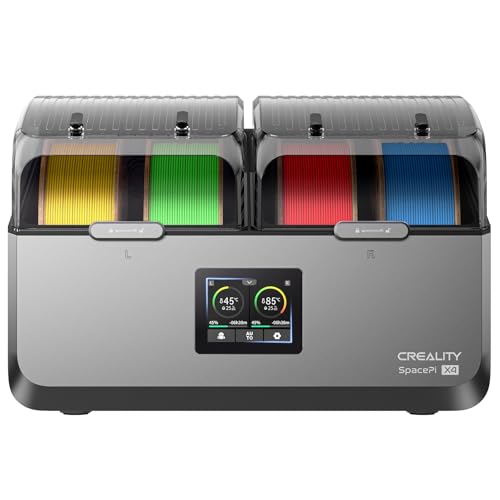
- Dries and prints up to four spools
- Dual independent temperature chambers
- Reaches 85°C for engineering materials
Best For: High-volume and multi-printer workflows
Best Simple TPU Dry Box

- Fan-assisted moisture discharge
- Displays temperature, time, and humidity
- Supports common 1.75–3.00 mm filament sizes
Best For: Beginners and everyday single-spool TPU drying
Best Dual-Spool Pick
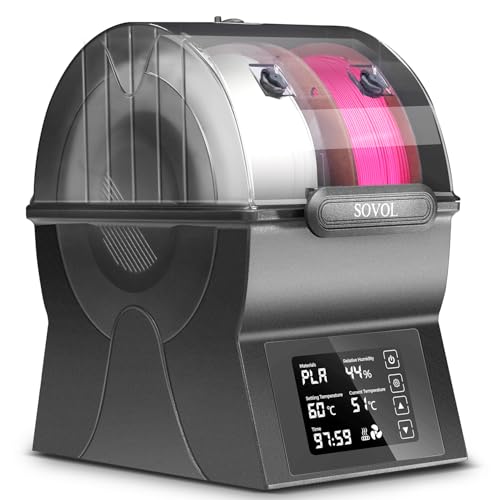
- Dries two 1 kg spools at once
- 40–70°C control with TPU preset
- Improved sealing and safety protection
Best For: Dual-spool TPU drying and multi-printer work
Best High-Capacity Pick

- Fits four 1 kg spools
- Heats up to 70°C with three fans
- Automatic humidity control
Best For: Multi-printer setups and long TPU projects
Best Budget-Friendly Pick
Comgrow SH01 Filament Dryer Box

- Stores two 1 kg spools
- 40–50°C adjustable heating
- LCD temperature and humidity display
Best For: Basic two-spool moisture control at moderate temperatures
Best Integrated Storage

- Dries, stores, and feeds filament without breaking the seal
- Supports TPU and multiple filament diameters
- Uses 360° airflow, heat, sealing, and desiccant support
Best For: TPU users prioritizing sealed storage and direct printing
Best for Two Spools

- Dries two 1kg spools simultaneously
- Uses 160W dual PTC 360° hot-air heating
- Offers touchscreen controls and 12 material presets
Best For: Multi-spool TPU workflows and two-printer setups
Best Single-Spool Value

- Provides 110W PTC 360° hot-air heating
- Includes a 0–48-hour timer and power-off memory
- Supports TPU with 12 material presets
Best For: Single-spool TPU drying with flexible timed cycles
Best Balanced TPU Dryer – Creality Space Pi SE
For shoppers seeking a practical filament dryer for TPU, the Creality Space Pi SE combines adjustable heat, circulating airflow, and a one-kilogram spool capacity. Its 45–65°C range and real-time humidity display make it easy to tailor drying to TPU and other common materials.
Best For: Users who want a straightforward, adjustable dryer for one 1 kg spool while printing.
Pros:
- Heats to 65°C in about 15 minutes with 360° air circulation.
- Adjustable temperature from 45–65°C and drying time from 0–24 hours.
- Supports 1.75 mm and 2.85 mm filament, including TPU, PLA, PETG, ABS, and nylon.
- Displays humidity and drying time, with thermal insulation on the inner wall.
Cons:
- Capacity is limited to most 1 kg spools.
- Its maximum temperature is lower than some engineering-filament dryers.
The Space Pi SE is a well-rounded choice when you need TPU compatibility, simple controls, and dependable single-spool drying without a complicated setup.
Best High-Temperature TPU Dryer – SUNLU Filament Dryer S2
The SUNLU S2 is a strong filament dryer for TPU when you want a broad temperature range and generous time controls. It can dry while printing, uses a rotating spindle for even heating, and accommodates several filament diameters.
Best For: Makers who want a user-friendly dryer with high-temperature capability and long programmable drying cycles.
Pros:
- Adjustable temperature from 35–70°C and drying time from 0–99 hours.
- Rotating spindle helps provide even drying during operation.
- Large touch screen simplifies temperature and time adjustments.
- Supports 1.75 mm, 2.85 mm, and 3.00 mm filament and can dry while printing.
Cons:
- The supplied notes do not specify a humidity display.
- Its larger 265 × 274 × 118 mm capacity may require more workspace.
Choose the S2 if extended drying times, a 70°C maximum, and easy touch controls matter more than having a compact enclosure.
Best Multi-Spool TPU Dryer – Creality Space Pi X4
For high-volume users, the Creality Space Pi X4 is a filament dryer for TPU designed to dry and feed up to four spools at once. Its two independent chambers allow different filament types to be dried at separate temperatures, while the 85°C maximum suits demanding materials.
Best For: Multi-printer setups that need simultaneous four-spool drying and printing.
Pros:
- Dries and prints with up to four spools simultaneously.
- Two chambers provide independent temperature control for different materials.
- Dual 200W PTC heaters reach up to 85°C for engineering filaments.
- Single-chamber operation can save up to 40% energy compared with dual-chamber use.
Cons:
- Its multi-spool design is likely excessive for occasional single-spool TPU use.
- Creality advises checking that other brands’ plastic trays are heat resistant.
The Space Pi X4 is the most capable option here for production-oriented workflows, especially when TPU must run alongside other materials or across several printers.
Best Simple TPU Dry Box – SUNLU S1 Plus
The SUNLU S1 Plus is a compact, approachable filament dryer for TPU that adds fan-assisted drying and drying-while-printing support. Its 35–55°C range, visual display, and broad filament-size compatibility suit everyday moisture management.
Best For: Beginners and casual users who want a simple dry box for common filament sizes.
Pros:
- Fan design helps discharge excess moisture during drying.
- 2-inch LCD displays temperature, time, and humidity.
- Supports 1.75 mm, 2.85 mm, and 3.00 mm filament, including TPU.
- Can dry while printing and offers a 35–55°C adjustable range.
Cons:
- Its 55°C maximum is lower than the other listed dryers.
- The 210 × 89 mm capacity may not suit larger spools.
The S1 Plus makes sense when you prioritize simple operation, fan-assisted drying, and compatibility with common spool sizes over high-temperature or multi-spool capacity.
Best Dual-Spool Pick – Sovol SH02 Filament Dryer
The Sovol SH02 is a practical filament dryer for TPU when you want to dry two 1 kg spools at once. Its 150W PTC heater reaches up to 70°C, while preset controls simplify drying for TPU and other common materials.
Best For: Makers who need dual-spool drying, faster warm-up, and preset filament-type settings.
Pros:
- Dries two 1 kg spools simultaneously.
- Adjustable 40–70°C range with a preset TPU mode.
- Improved sealing helps protect filament when powered off.
- Built-in fan circulates heat for more even drying.
Cons:
- Desiccant bags are not included.
- Its two-spool capacity may be more than needed for occasional users.
The SH02 stands out for TPU printing setups that regularly need more than one spool ready. Its safety cutoff and fan alarm add useful protection, while the dual feed holes support different printer layouts.
Best High-Capacity Pick – SUNLU S4 Filament Dryer
The SUNLU S4 is a high-capacity filament dryer for TPU and other FDM materials, holding four 1 kg spools simultaneously. It combines heating up to 70°C with humidity control and three circulation fans for larger, multi-printer workflows.
Best For: Multi-printer users and larger projects that require several dry spools ready at once.
Pros:
- Holds four 1 kg spools for simultaneous drying.
- Supports common 1.75mm, 2.85mm, and 3.0mm filament diameters.
- Humidity control starts at 30–50% RH and stops below 25% RH.
- Triple fans provide 360° air circulation.
Cons:
- The large 18.03-inch-wide design requires substantial workspace.
- Its 10.56-pound weight makes it less convenient to move.
For users running multiple printers or color-heavy projects, the S4 offers substantially more capacity than typical two-spool dryers. Its humidity automation and triple-safe system make it a strong choice when continuous drying matters.
Best Budget-Friendly Pick – Comgrow SH01 Filament Dryer Box
The Comgrow SH01 is a straightforward filament dryer for TPU and standard 3D printer materials, with room for two 1 kg spools. Its 40–50°C temperature range, timer, and LCD monitoring suit users who want simple moisture control during printing.
Best For: Budget-conscious makers who need two-spool storage and basic drying at moderate temperatures.
Pros:
- Stores two 1 kg spools and supports 1.75mm and 2.85mm filament.
- Provides adjustable 40–50°C heating and six- to 12-hour timing.
- LCD screen displays temperature and humidity information.
- Sealed design helps keep filament dry between uses.
Cons:
- Its 50°C maximum is lower than the other listed dryers.
- The drying outlet must be opened while operating and closed for storage.
- The supplied notes specifically list PLA, ABS, and SILK compatibility rather than TPU.
The SH01 is best considered a basic, moderate-temperature drying box. It can be useful for routine spool storage and moisture management, but buyers seeking a clearly specified TPU preset or higher temperatures may prefer the Sovol or SUNLU models.
Best Integrated Storage – Polymaker PolyDryer
If you want a filament dryer for TPU that also helps protect the spool between prints, the Polymaker PolyDryer combines heated drying, sealed storage, and direct feeding in one modular setup. Its built-in hygrometer and desiccant support make moisture management easier to monitor.
Best For: TPU users who want an integrated drying, storage, and print-feeding solution.
Pros:
- Supports TPU along with PLA, PETG, ABS, ASA, PA Nylon, and PVB.
- Works with 1.75mm, 2.85mm, and 3.00mm filament sizes.
- Combines heat, sealing, desiccant support, and 360° airflow.
Cons:
- Its 1kg capacity and modular storage design may be more than needed for a single-spool setup.
- The supplied notes do not specify a temperature range or drying timer.
The PolyDryer is a strong choice when ongoing moisture protection matters as much as the initial drying cycle. It is especially practical for users who want to move from drying to printing without repeatedly exposing TPU to room air.
Best for Two Spools – Creality Space Pi Plus
For printing setups that need a filament dryer for TPU with higher capacity, the Creality Space Pi Plus holds two 1kg rolls and uses dual 360° hot-air drying. Its 160W PTC heater, touchscreen controls, and preset material profiles make it suited to multi-spool workflows.
Best For: Makers drying two TPU or other filament spools at the same time, including users running two printers.
Pros:
- Holds two 1kg spools and provides four filament holes with two PTFE pipes.
- Supports TPU and a broad range of materials, including PA, PC, ASA, and composite filaments.
- Offers one-key settings for up to 12 filament types and adjustable temperatures from 45°C to 70°C.
- Includes a 4-inch LCD touchscreen and dual PTC 360° heating.
Cons:
- Its two-spool capacity creates a larger, heavier unit than a single-spool dryer.
- The supplied notes do not mention a timer or power-off memory function.
The Space Pi Plus stands out for throughput and convenience. Choose it if you regularly prepare multiple spools or want a dryer that can support two printer feeds, rather than simply treating occasional TPU moisture.
Best Single-Spool Value – Creality Space Pi Dryer
This Creality Space Pi is a practical filament dryer for TPU when you need a straightforward single-spool unit with flexible controls. It combines 110W PTC 360° heating with a touchscreen, a 0–48-hour timer, and material presets for repeatable drying sessions.
Best For: Single-spool TPU users who want adjustable timing, preset temperatures, and compact everyday operation.
Pros:
- Supports TPU, PLA, PETG, ABS, Nylon, and composite materials.
- Provides 360° hot-air circulation with a 110W PTC heater.
- Includes one-key settings for up to 12 filament types and adjustable temperatures from 45°C to 70°C.
- Offers a 0–48-hour timer and power-off memory for retained settings.
Cons:
- It is designed as a single-spool dryer rather than a two-roll system.
- Its 3.7-inch touchscreen is smaller than the Plus model’s 4-inch display.
The Space Pi balances useful automation with a simpler single-spool format. Its timer and power-off memory are particularly helpful for TPU users who want to start a longer drying cycle and maintain consistent settings.
How We Picked the Best Filament Dryer for Tpu
We focused on features that matter when drying and printing with moisture-sensitive flexible filament. The selection includes models with adjustable heat, active air circulation, enclosed storage, and support for common spool sizes. We also considered chamber capacity, independent controls, display quality, power efficiency, and the practicality of feeding filament directly to a printer.
Because TPU can soften or deform when overheated, temperature control was treated as more important than maximum heat alone. A good filament dryer should provide stable, usable settings rather than simply reaching a high advertised temperature.
Quick Comparison
| Priority | Look for | Best suited to |
|---|---|---|
| Compact drying | Single-spool chamber and simple controls | Occasional TPU users |
| Higher capacity | Two or more spool positions | Multi-material or frequent printing |
| Separate materials | Dual independent chambers | Users drying different filaments at once |
| Print-from-box use | Sealed feed ports and spool holders | Long TPU jobs |
| Material flexibility | Adjustable temperature and timer | TPU, PLA, PETG, ABS, and nylon users |
Key Buying Factors for a Filament Dryer for Tpu
Temperature Control
Choose a dryer with a controllable, stable low-to-moderate temperature range. TPU requirements vary by formulation, so follow the filament manufacturer’s drying instructions instead of relying only on the dryer’s maximum rating.
Capacity and Spool Fit
Confirm that the chamber accepts your spool diameter, width, and weight. A single-spool dryer is usually easier to manage, while larger or dual-chamber models make sense for regular printing and multiple materials.
Airflow and Drying Consistency
Circulating warm air can help reduce uneven drying, but heat distribution matters. Features such as internal fans, 360-degree heating, and precision sensors can improve consistency when used with sensible temperature settings.
Storage and Direct Feeding
For TPU, look for a sealed enclosure, moisture-resistant design, and smooth filament feed path. Direct feeding is useful during long prints, but check that the outlet does not add excessive drag to flexible filament.
Controls, Timer, and Energy Use
A clear display and adjustable timer make repeatable drying easier. Consider power draw if the dryer will run for several hours, especially with high-wattage dual-spool units.
Who Should Buy Which Filament Dryer for Tpu?
Choose a compact single-spool dryer if you print TPU occasionally or want a straightforward recovery tool. A larger single-chamber model is a better fit for frequent users who need room for heavier spools or longer drying sessions. Dual-spool and independently controlled units suit workshops that prepare multiple materials at once. If you regularly print directly from the dryer, prioritize sealed storage, stable spool rotation, and low-friction feed ports over maximum temperature.
Before buying, compare the dryer’s actual temperature range with your TPU manufacturer’s recommendations, then verify spool compatibility and available space beside your printer. Those checks usually matter more than extra presets or headline heating speed.