The best chemistry sets turn curiosity into hands-on learning with safe, guided experiments involving reactions, color changes, crystals, gases, and more. The 10 kits in this roundup range from simple introductory activities to extensive lab-style collections for experienced young scientists.
Use the comparison and buying advice below to match a chemistry kit with a child’s age, attention span, experience, supervision needs, and interest in open-ended experimentation.
Best 10 Chemistry Sets Picks for 2026
Best All-Around Chemistry Set
National Geographic Amazing Chemistry Set

- 100+ experiment ideas
- 15 experiments include supplied materials
- Includes test tubes, beakers, and pipettes
Best For: Kids ages 8+ wanting varied hands-on chemistry activities
Best Lab-Station Design

- 57-piece chemistry setup
- Built-in station with clip-on experiment cards
- Non-hazardous chemicals; no borax
Best For: Younger kids who want an organized, colorful lab workspace
Best Starter Set for Younger Kids
National Geographic Junior Chemistry Set

- Recommended for ages 4+
- 50 guided experiments
- 20+ kid-friendly lab tools
Best For: Young beginners learning basic chemistry through illustrated activities
Best for Serious Young Scientists

- 125 experiments in 10 themed chapters
- 80-page full-color lab manual
- Real equipment and seven chemicals
Best For: Ages 10+ seeking a structured, supervised chemistry introduction
Best All-Around Pick
National Geographic 45-Experiment Chemistry Set

- 45 hands-on experiments, including volcanoes, geysers, and rockets
- Illustrated, kid-friendly guide explains the science
- Designed for ages 8 and up with no batteries required
Best For: Young beginners who want varied, engaging STEM activities
Advanced Home Lab
Thames & Kosmos CHEM C3000 Chemistry Set

- More than 333 experiments across 27 chapters
- Includes real lab equipment, chemicals, and safety goggles
- 192-page manual covers foundational and advanced chemistry
Best For: Students 12+ and aspiring chemists working with adult supervision
Best for Science Shows
National Geographic Magic Chemistry Set
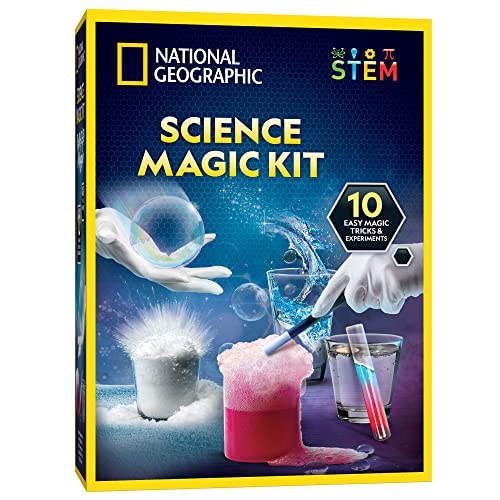
- Ten experiments designed as magic tricks
- Includes wand, gloves, tools, and illustrated guide
- Features effects such as floating coins and instant snow
Best For: Kids who enjoy performing science experiments for family and friends
Classic Chemistry Starter

- 28 guided introductory experiments
- Explores acids, bases, gases, and invisible ink
- Includes a 48-page illustrated manual
Best For: Beginning chemists ages 10–15
Action-Packed STEM Pick

- Includes 66 guided and DIY activities
- Features volcanoes, glow lava, slime, and reactions
- Designed for kids ages 8 and up
Best For: Visual, activity-focused STEM exploration
Best Simple Pick
CHEM C2000 Intermediate Chemistry Set

- Includes 250 experiments and a 128-page manual
- Covers electrochemistry, chromatography, gases, and food chemistry
- Adds real lab equipment and an alcohol burner
Best For: Supervised intermediate learners ages 11+
Best All-Around Chemistry Set – National Geographic Amazing Chemistry Set
For families seeking chemistry sets with plenty of variety, the National Geographic Amazing Chemistry Set combines 15 supplied-material experiments with a bonus guide featuring 85 additional activities using common household items. Kids can explore crystal growing, color-changing reactions, glowing projects, bouncy-ball making, and more with hands-on lab tools.
Best For: Kids ages 8 and up who want a broad mix of chemistry activities and STEM projects.
Pros:
- Offers more than 100 total experiment ideas.
- Includes materials for 15 experiments, including crystal growing and chemical reactions.
- Uses hands-on tools such as test tubes, beakers, and pipettes.
- Bonus activities use common household items.
Cons:
- The included materials cover 15 experiments; the remaining 85 require household items.
- Recommended for ages 8 and up, so it may not suit younger children.
This is a versatile choice for gift-giving or ongoing at-home science exploration, especially when you value a large activity count and colorful visual results.
Best Lab-Station Design – Ooze Labs Chemistry Station
Among chemistry sets, the Ooze Labs Chemistry Station stands out for its dedicated, colorful workspace. The large station holds a 57-piece assortment of vessels and tools, while experiment cards and a full-color manual guide activities such as glowing slime, fizzing reactions, bubbles, and chromatography.
Best For: Children ages 6 and up who benefit from an organized, play-oriented chemistry setup.
Pros:
- Includes a large chemistry station for keeping activities organized.
- Provides 57 pieces, including beakers, test tubes, flasks, pipettes, and more.
- Experiment cards clip onto the station for convenient reference.
- Uses non-hazardous chemicals and does not contain borax.
Cons:
- The kit is recommended for ages 6 and up, so older students may want more advanced coverage.
- The station’s larger format may require more storage space than a basic kit.
Choose this set when presentation and easy access matter as much as the experiments themselves. Its built-in station makes it especially appealing for repeated, supervised play.
Best Starter Set for Younger Kids – National Geographic Junior Chemistry Set
For younger children beginning with chemistry sets, the National Geographic Junior Chemistry Set offers 50 hands-on experiments with illustrated, step-by-step instructions. It includes more than 20 child-safe lab tools and introduces chemistry through activities involving familiar household items such as baking soda and vinegar.
Best For: Young learners ages 4 and up who need simple, guided introductions to STEM and chemistry.
Pros:
- Designed for children ages 4 and up.
- Includes 50 interactive experiment ideas.
- Illustrated instructions support easier independent following.
- Provides more than 20 kid-friendly lab tools, including test tubes and goggles.
Cons:
- Many activities use common household items, so not every experiment relies solely on included materials.
- Its early-learning focus may be less challenging for older children.
This is a practical first chemistry kit for preschool and early elementary learners, particularly when clear visuals and accessible materials are priorities.
Best for Serious Young Scientists – Thames & Kosmos Chem C1000
For families looking beyond introductory chemistry sets, the Thames & Kosmos Chem C1000 provides a more structured first laboratory experience for ages 10 and up. Its 125 experiments are organized into 10 themed chapters and supported by an 80-page color manual, real lab equipment, seven chemicals, safety guidance, and scientific explanations.
Best For: Older children, homeschool families, and aspiring young scientists ready for more formal chemistry activities.
Pros:
- Includes 125 experiments across 10 themed chapters.
- Provides an 80-page, full-color manual with step-by-step explanations.
- Includes real lab equipment, safety goggles, and seven chemicals.
- Covers topics such as chromatography, electrochemistry, crystals, indicators, and electrolysis.
Cons:
- Adult supervision is required.
- Recommended for ages 10 and up, making it unsuitable for younger beginners.
- Its chemical materials and safety procedures require more careful setup and cleanup.
This is the strongest fit for a child who wants to move beyond simple kitchen experiments. The detailed manual and safety information make it better suited to supervised, deliberate study than casual play.
Best All-Around Pick – National Geographic 45-Experiment Chemistry Set
If you’re looking for approachable chemistry sets for children ages 8 and up, this National Geographic kit offers a broad selection of hands-on activities. Kids can explore reactions through projects such as volcanoes, geysers, and rockets, with illustrated instructions designed for independent learning with appropriate supervision.
Best For: Young beginners who want a varied STEM science kit with engaging, action-oriented experiments.
Pros:
- Includes 45 experiments covering fizzing, bubbling, volcano, geyser, and rocket activities.
- Kid-friendly, illustrated instructions explain both procedures and chemical reactions.
- Introduces scientific process, chemistry fundamentals, and safe experiment practices.
- No batteries are required.
Cons:
- The recommended age begins at 8, so it may be too basic for older students seeking advanced chemistry.
- Some activities may require careful adult guidance to ensure safe setup and use.
With its large experiment count and accessible presentation, this is a strong general-purpose choice for families seeking an entertaining introduction to chemistry and STEM.
Advanced Home Lab – Thames & Kosmos CHEM C3000 Chemistry Set
Among chemistry sets for serious students, the Thames & Kosmos CHEM C3000 stands out for its depth and laboratory-style equipment. It includes more than 333 experiments across inorganic, organic, and electrochemistry, supported by a 192-page manual and a substantial collection of glassware, tools, and chemicals.
Best For: Students ages 12 and up, homeschoolers, and aspiring chemists ready for structured, advanced experimentation.
Pros:
- Offers more than 333 experiments organized into 27 subject-focused chapters.
- Covers advanced topics including chemical bonding, acids and bases, redox reactions, electrolysis, and organic chemistry.
- Includes authentic lab equipment such as beakers, test tubes, an Erlenmeyer flask, tripod, alcohol burner, and safety goggles.
- The detailed manual includes safety rules, first-aid guidance, labeling information, and disposal instructions.
Cons:
- Adult supervision is required throughout experimentation.
- Its advanced content may be overwhelming for younger or casual learners.
- Some experiments require common household additions beyond the included components.
This is the most comprehensive option in the group for building a home chemistry experience, but its complexity and safety requirements make it better suited to committed learners than beginners.
Best for Science Shows – National Geographic Magic Chemistry Set
For children who are drawn to performance and surprises, this National Geographic kit gives chemistry sets a magic-show twist. It includes 10 experiments that can be presented as tricks, such as making a coin float, changing liquid colors, and producing instant snow, along with a wand, gloves, and a full-color guide.
Best For: Kids ages 8 and up who enjoy entertaining friends and family while learning basic science concepts.
Pros:
- Ten experiments are specifically designed to be performed as magic tricks.
- Includes a magic wand and white gloves for themed presentations.
- Kid-friendly illustrated instructions explain the science behind each effect.
- All tools needed for the listed experiments are included, and no batteries are required.
Cons:
- With 10 activities, it offers fewer experiments than the other National Geographic chemistry set in this roundup.
- The magic-focused format may be less suitable for children seeking a deeper chemistry curriculum.
This compact kit is a particularly approachable choice when the goal is to make science social, visual, and entertaining rather than build a full home laboratory.
Classic Chemistry Starter – Chemistry C500
For shoppers comparing chemistry sets for younger learners, the Thames & Kosmos Chemistry C500 offers a structured introduction through 28 guided experiments. Children can explore acids and bases, fizzy reactions, invisible ink, and the behavior of solids, liquids, and gases with the included equipment and 48-page manual.
Best For: Beginners ages 10–15 who want clearly explained, hands-on chemistry activities.
Pros:
- Includes 28 classic, guided experiments.
- Covers colorful acid-base reactions, foaming effects, and invisible ink.
- The full-color manual combines setup instructions with explanations of results.
- Includes useful starter equipment such as beakers, test tubes, pipettes, and stoppers.
Cons:
- Offers fewer experiments than the larger Thames & Kosmos C2000 set.
- Designed as an introductory kit, so advanced learners may outgrow it.
The C500 is a sensible entry point for families seeking an approachable chemistry set with a manageable number of activities and an emphasis on understanding what happens during each experiment.
Action-Packed STEM Pick – Super Reactions Science Kit
Among chemistry sets for hands-on play, the Discovery Super Reactions Science Kit stands out for its broad mix of guided and DIY activities. It includes 26 step-by-step experiments plus 40 bonus ideas using household items, covering acid-base reactions, pH indicators, slime, volcanoes, color changes, and gas expansion.
Best For: Curious kids ages 8 and up who prefer colorful, highly visual experiments and varied STEM activities.
Pros:
- Offers 66 total activities, including 40 bonus DIY ideas.
- Includes a volcano mold, test tubes, food coloring, citric acid, slime mix, and other materials.
- Introduces chemistry concepts such as states of matter, pH, and gas expansion.
- Clear instructions support independent exploration with adult supervision.
Cons:
- Many bonus activities rely on additional household items.
- The kit emphasizes playful reactions rather than an extensive laboratory setup.
This is a strong choice when entertainment and variety are priorities. Its volcano, glow-lava, slime, and bubbling activities make chemistry approachable while still connecting the play to core STEM concepts.
Best Simple Pick – CHEM C2000 Intermediate Chemistry Set
For families looking beyond beginner chemistry sets, the Thames & Kosmos CHEM C2000 provides 250 experiments and a 128-page full-color lab manual. Its intermediate curriculum covers acids and bases, water, gases, food chemistry, soaps, chromatography, electrochemistry, and heat-based reactions using real lab equipment.
Best For: Learners ages 11 and up who are ready for a substantial, progressive chemistry program with adult supervision.
Pros:
- Provides 250 experiments organized across 18 themed chapters.
- Includes professional-style components such as glass test tubes, graduated beakers, goggles, tubing, and electrolysis equipment.
- The alcohol burner expands activities into combustion, evaporation, crystallization, and other heat-based experiments.
- Manual includes safety rules, first-aid guidance, labeling information, and waste-disposal instructions.
Cons:
- Adult supervision is required.
- Its intermediate scope and alcohol burner may be more than a beginner needs.
- The larger 3.3-pound kit requires more space and preparation than a basic set.
The C2000 is the most comprehensive option of these chemistry sets for students who want a longer-term learning path. It is best suited to a supervised home lab, homeschool setting, or learner preparing for high school chemistry.
How We Picked the Best Chemistry Sets
We compared these Chemistry Sets based on experiment count, recommended age range, quality and variety of included tools, clarity of the instructions, educational value, and how well each kit fits a particular stage of learning. We also considered whether a set emphasizes guided activities, imaginative demonstrations, or more complete laboratory-style exploration.
Experiment count is useful, but it does not tell the whole story. A kit with fewer, clearly explained activities may be a better choice for a beginner than a larger set with complicated procedures or many components to organize.
Quick Comparison
| Best For | What to Look For |
|---|---|
| First-time experimenters | Short activities, simple instructions, and broad age-appropriate supervision guidance |
| Young kids who enjoy demonstrations | Color changes, reactions, magic-style effects, and visually engaging projects |
| Building STEM fundamentals | A structured manual that explains observations and basic scientific concepts |
| Experienced children | More experiments, real lab equipment, and opportunities to repeat or modify procedures |
| Long-term use | Extensive materials, refill availability, and a manual with progressively challenging activities |
Key Buying Factors for Chemistry Sets
Age, Experience, and Supervision
Follow the manufacturer’s age recommendation, but also consider reading ability, patience, and previous experience. Younger children generally need an adult to prepare materials, explain steps, and supervise every activity. Even kits designed for children should be used exactly as directed, with appropriate eye protection and a clear workspace.
Experiment Variety and Instructional Quality
Look for a balance of demonstrations and experiments that teach transferable ideas such as mixtures, reactions, acids and bases, density, and gas production. A detailed, well-illustrated manual can make a bigger difference than a high activity count.
Equipment and Replacement Supplies
Check whether the kit includes useful tools such as test tubes, measuring equipment, droppers, goggles, or a stand. Also verify which household ingredients are required and whether consumable materials can be replaced. This affects the kit’s real cost and how quickly it can be used.
Storage and Cleanup
Chemistry activities are easier to enjoy when components stay organized. Choose a set with manageable storage and plan for a washable work surface, labeled containers, and adult-led cleanup. Avoid using food containers or kitchen utensils for experiments.
Who Should Buy Which Chemistry Sets?
Choose a junior or lower-complexity kit for a child who is new to science activities or prefers quick, visually exciting projects. These sets can build confidence without overwhelming the user with extensive equipment or lengthy procedures.
A mid-level kit is a better fit for children who already enjoy following experiment instructions and want more variety. Look for a stronger manual and a mixture of reaction-based activities, observation exercises, and practical laboratory techniques.
Choose an advanced, high-count chemistry set for an older or especially motivated learner who will return to the kit repeatedly. These options offer greater value when a child enjoys reading explanations, recording results, and repeating experiments rather than simply watching a reaction.
Whichever kit you choose, treat the recommended age as a starting point rather than a substitute for supervision. The best chemistry set is one that matches the child’s skills, interests, and available adult support while encouraging careful, safe scientific thinking.