The best logic analyzers make it easier to see what digital devices are actually doing, from decoding UART, I²C, and SPI traffic to troubleshooting timing problems in embedded projects.
This roundup compares 10 options ranging from affordable 8-channel USB tools to professional-grade instruments with high sampling rates, deep memory, and polished software.
Best 10 Logic Analyzers Picks for 2026
Best Budget Pick
HiLetgo 8-Channel USB Logic Analyzer

- Eight channels with up to 24 MHz sampling
- Adjustable rates from 25 kHz to 24 MHz
- USB tool for UART, IIC, SPI, and digital debugging
Best For: Budget-conscious hobbyists and embedded developers
Best for Protocol Debugging
LA1010 16-Channel Logic Analyzer

- Sixteen channels at up to 100 MHz
- Decodes 30+ communication protocols
- Supports Windows, macOS, and Linux
Best For: Embedded developers debugging multiple digital buses
Best Premium Pick

- Sixteen configurable digital and analog inputs
- Up to 500 MS/s digital sampling
- Deep PC-backed captures and broad protocol decoding
Best For: Professional mixed-signal debugging and long recordings
Best for Deep Captures
DSLogic Plus 16-Channel Analyzer
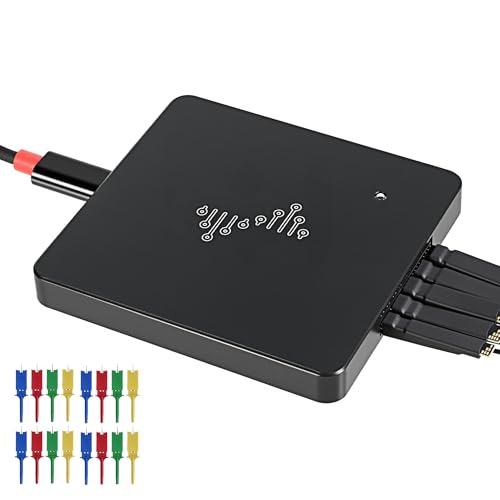
- Sixteen channels with up to 400 MHz sampling
- Stream and buffer modes for flexible capture
- 256 Mbits of memory and nearly 100 decoders
Best For: Fast digital analysis and long or deep captures
Open-Source Development Pick

- Combines logic analysis, debugging, and USB development
- Programmable with Python libraries
- Includes expansion and prototyping accessories
Best For: Custom hardware and USB development projects
Easy-Use Portable Pick

- Eight multi-use digital and analog inputs
- Decodes SPI, I2C, and 23+ other protocols
- Supports Logic 2 on Windows, Mac, and Linux
Best For: Accessible digital and analog signal analysis
High-Speed Multichannel Pick

- Offers 16 digital channels and up to 400 MHz sampling
- Supports streaming and onboard buffer capture modes
- Works with DSView and nearly 100 protocol decoders
Best For: High-speed, multichannel protocol analysis
Best with Extra Features
Comidox 8-Channel Logic Analyzer

- Eight channels and up to 24 MHz sampling
- Works with Saleae software and PulseView
- Decodes UART, SPI, and I2C
Best For: Affordable Arduino and embedded-protocol debugging
Best High-Speed Option
DSLogic U3Pro16 Logic Analyzer

- 16 channels with sampling up to 1 GHz
- Stream and buffer modes for flexible captures
- DSView supports Windows, macOS, and Linux
Best For: Advanced digital debugging and high-speed waveform capture
Best Complete Kit
LONELY BINARY 8-Channel Logic Analyzer

- Eight channels with up to 24 MHz sampling
- Breadboard adapter and breakout board included
- USB-A, USB-C, clips, wires, and case included
Best For: Ready-to-use Arduino, ESP32, and breadboard projects
Best Budget Pick – HiLetgo 8-Channel USB Logic Analyzer
The HiLetgo is a compact, budget-friendly choice for basic logic analyzers work, especially when you need to inspect common digital signals without a high-end sampling platform. It provides eight channels, adjustable sampling rates up to 24 MHz, and USB connectivity for computer-based analysis.
Best For: Hobbyists and embedded developers debugging moderate-speed UART, IIC, SPI, and other digital signals.
Pros:
- Eight channels with sampling rates up to 24 MHz.
- Supports adjustable rates from 25 kHz through 24 MHz.
- Input range of -0.5 V to 5.25 V suits many low-voltage digital circuits.
- Compact USB design with an included ferrite-ring cable.
Cons:
- Its 24 MHz maximum rate is below the faster analyzers in this roundup.
- Supplied notes do not specify included protocol-decoding software or operating-system support.
The HiLetgo offers a straightforward entry point for digital signal analysis and embedded debugging. Choose it when eight channels and moderate sampling speed meet your needs; demanding, high-speed captures call for a more capable model.
Best for Protocol Debugging – LA1010 16-Channel Logic Analyzer
The LA1010 is a practical step up for logic analyzers users who need more inputs and broader protocol coverage. Its 16 channels capture signals at up to 100 MHz per channel, while the included KingstVIS software displays waveforms and decodes more than 30 standard protocols.
Best For: Embedded-system developers working with UART, I2C, SPI, CAN, and other supported communication buses.
Pros:
- Sixteen input channels enable simultaneous digital-signal capture.
- Sampling rate reaches 100 MHz per channel.
- KingstVIS supports waveform visualization and 30+ protocol decoders.
- Compatible with Windows, macOS, and Linux.
Cons:
- It requires a computer and USB connection rather than operating as a standalone instrument.
- The supplied specifications include several inconsistent computer-related fields, so buyers should focus on the stated analyzer capabilities.
With twice the channel count of basic eight-channel tools and cross-platform software support, the LA1010 is well suited to everyday embedded debugging. It is a strong general-purpose option when protocol decoding matters more than standalone operation.
Best Premium Pick – Saleae Logic Pro 16
The Saleae Logic Pro 16 is a premium choice among logic analyzers for demanding capture and analysis work. Its 16 configurable inputs support both digital and analog signals, with digital sampling up to 500 MS/s, analog sampling up to 50 MS/s, and PC-backed capture capacity for long recordings.
Best For: Engineers handling precise timing measurements, reverse engineering, long-duration recordings, and mixed-signal debugging.
Pros:
- Provides 16 inputs that can be configured for digital or analog analysis.
- Digital sampling reaches 500 MS/s, with analog sampling up to 50 MS/s.
- Captures more than 10 billion digital samples and 500 million analog samples using PC memory.
- Supports SPI, I2C, and 23+ additional protocol decoders.
Cons:
- Its premium capabilities may be more than needed for simple UART or low-speed troubleshooting.
- The supplied notes do not list the full set of supported operating-system versions.
The Logic Pro 16 stands out when channel flexibility, high-speed sampling, and deep captures are priorities. Its USB 3.0 connection and cross-platform support make it a versatile professional debugging tool.
Best for Deep Captures – DSLogic Plus 16-Channel Analyzer
The DSLogic Plus is designed for logic analyzers users who need high-speed sampling and substantial capture depth. It combines 16 channels, a 400 MHz sampling rate, 256 Mbits of onboard memory, and stream or buffer modes for balancing long recordings with fast acquisition.
Best For: Developers analyzing fast digital systems, extended signal activity, and captures that benefit from adjustable thresholds and deep memory.
Pros:
- Sixteen channels with sampling rates up to 400 MHz.
- Stream mode supports real-time transfer for long sample durations.
- Buffer mode uses onboard memory for high-speed captures, with up to 256 Mbits of SDRAM.
- Supports Windows, macOS, and Linux plus nearly 100 protocol decoders.
Cons:
- It uses a USB 2.0 Type-C interface rather than USB 3.0.
- The supplied notes do not identify the included analysis application by name.
The DSLogic Plus is a compelling middle ground for users who want faster sampling and deeper capture options than entry-level analyzers provide. Its dual-mode design is especially useful when switching between long-duration monitoring and high-rate buffered analysis.
Open-Source Development Pick – GreatFET One Bundle
For developers who want more than a dedicated measurement tool, the GreatFET One Bundle combines logic-analyzer capabilities with USB experimentation, debugging, and hardware development. Its Python support and expansion-board design make it a flexible option for custom projects.
Best For: Makers and developers building custom USB peripherals, experimenting with hardware, or using logic analyzers alongside debugging tools.
Pros:
- Supports logic analyzing, debugging, and electronic development
- Programmable through high- and low-level Python libraries
- Expandable with add-on “neighbor” boards
- Includes the GreatFET One, Wiggler, USB cable, and 120 prototyping wires
Cons:
- Its broader development focus may require more setup than a dedicated logic analyzer
- Not described with a specific channel count or sampling rate in the supplied specifications
The GreatFET One Bundle is best viewed as an adaptable development platform that includes logic-analyzer functionality, rather than as a conventional plug-and-measure analyzer.
Easy-Use Portable Pick – Saleae Logic 8
The Saleae Logic 8 is a practical choice for everyday logic analyzers when you want digital and analog inputs in a compact, cross-platform package. Its software supports common protocol decoding and runs on Windows, Mac, and Linux.
Best For: Engineers, technicians, and hobbyists who want an approachable analyzer for digital and analog signal work across multiple operating systems.
Pros:
- Provides eight multi-use digital/analog inputs
- Decodes SPI, I2C, and more than 23 additional protocols
- Offers digital sampling up to 100 MS/s and analog sampling up to 10 MS/s
- Works with Saleae Logic 2 software on Mac, Windows, and Linux
Cons:
- Uses a USB 2.0 connection and a computer for operation
- Its eight-input layout provides fewer channels than the 16-channel DSLogic Plus
Choose the Logic 8 when ease of use, portability, and broad software compatibility matter more than having the highest channel count.
High-Speed Multichannel Pick – DSLogic Plus
The DSLogic Plus is built for demanding capture work, pairing 16 digital channels with sampling rates up to 400 MHz in buffer mode. Its dual-mode design lets you prioritize high-speed captures or extended recording through real-time streaming to a computer.
Best For: Advanced users who need many channels, high-speed capture, long sample durations, or extensive protocol-decoding support.
Pros:
- Provides 16 digital channels and up to 400 MHz sampling in buffer mode
- Supports up to 16G sample depth in stream mode
- Includes 256Mbits of onboard SDRAM
- DSView works with Windows, macOS, and Linux and supports nearly 100 protocol decoders
Cons:
- High-speed buffer operation uses fewer channels, with 400 MHz supported on four channels
- Its advanced dual-mode feature set may be more than needed for simple captures
- The supplied details specify USB 2.0 rather than a faster USB interface
With adjustable thresholds, shielded fly wires, and an aluminum case, the DSLogic Plus is a strong fit for users who value capture flexibility and high channel capacity.
Best with Extra Features – Comidox 8-Channel Logic Analyzer
For affordable logic analyzers, the Comidox CP317 offers eight digital channels and sampling up to 24 MHz. It is designed to work with Saleae Logic Analyzer software and PulseView, making it a practical option for checking UART, SPI, I2C, and other digital communications in Arduino, ARM, FPGA, and robotics projects.
Best For: Hobbyists and makers who need a low-cost, portable analyzer for common microcontroller protocols.
Pros:
- Eight channels with sampling rates up to 24 MHz
- Supports Saleae-compatible software and PulseView
- Can automatically analyze UART, I2C, SPI, and other standard protocols
- Includes a USB cable and 10 Dupont wires
Cons:
- Uses a 1.5V logic threshold and supports a 0V to 5.5V voltage range
- USB connectivity may require a compatible host computer and software setup
The CP317 is a sensible entry-level choice when you want multiple channels and protocol decoding without stepping up to a higher-end instrument. Its 24 MHz ceiling is better suited to general-purpose digital debugging than especially fast signal work.
Best High-Speed Option – DSLogic U3Pro16 Logic Analyzer
The DSLogic U3Pro16 is a high-performance choice among logic analyzers, combining 16 channels with sampling rates up to 1 GHz. Its USB 3.0 interface, dual capture modes, onboard DDR3 memory, and DSView software make it suited to demanding digital troubleshooting and detailed waveform analysis.
Best For: Engineers and advanced developers who need high sampling rates, deep capture memory, and broad protocol-decoding support.
Pros:
- Provides 16 digital channels and sampling up to 1 GHz
- Offers stream mode for long captures and buffer mode for high-rate sampling
- Includes 2Gbits of onboard DDR3 memory and up to 16G sample depth in stream mode
- DSView works with Windows, macOS, and Linux and supports nearly 100 protocol decoders
Cons:
- Its advanced features may be more than casual hobby projects require
- Performance varies by channel count and selected capture mode
With flexible stream and buffer operation, the U3Pro16 can handle both extended monitoring and fast transient captures. It is the strongest fit here for users who need more channels and substantially greater speed than entry-level USB analyzers provide.
Best Complete Kit – LONELY BINARY 8-Channel Logic Analyzer
The LONELY BINARY kit packages an eight-channel, 24 MHz USB logic analyzer with breakout boards and connection accessories. For buyers comparing logic analyzers for breadboard work, the included adapters, test clips, jumper wires, and dual USB cables make it easy to connect with Arduino, ESP32, Raspberry Pi, and other prototypes.
Best For: Students, hobbyists, and embedded developers who want a ready-to-use kit for breadboard-based UART, SPI, and I2C debugging.
Pros:
- Eight-channel analysis with sampling up to 24 MHz
- Includes a breakout board and dedicated breadboard adapter
- Comes with USB-A and USB Type-C cables for flexible computer connectivity
- Includes 10 test clips, five alligator clips, jumper wires, and a storage case
Cons:
- Its 24 MHz sampling rate is aimed at general-purpose rather than high-speed analysis
- Requires compatible open-source software and a supported operating system
The main advantage of this model is convenience: the connection hardware is organized around breadboard prototyping instead of requiring separate accessory purchases. It is a practical starter package for analyzing microcontroller communications and experimenting with embedded protocols.
How We Picked These Logic Analyzers
We selected products across several use cases and budgets rather than focusing on one specification alone. The lineup includes compact USB analyzers for Arduino and hobby projects, versatile 16-channel models for embedded development, premium Saleae hardware with refined software, and advanced instruments designed for faster signals and longer captures.
Our comparison emphasizes channel count, maximum sampling rate, capture memory, supported operating systems, protocol-analysis capability, portability, and overall practicality. Software quality also matters: a high specification is less useful if setup, triggering, decoding, or waveform navigation is unnecessarily difficult.
Quick Comparison
| Best For | Typical Choice | What to Look For |
|---|---|---|
| Basic serial debugging | 8-channel, 24MHz USB analyzer | UART, I²C, SPI decoding and low cost |
| General embedded work | 16-channel, 100MHz analyzer | More inputs and better timing headroom |
| High-speed captures | 400MHz or 1GHz model | Fast sampling, deep memory, USB 3.0 |
| Ease of use | Saleae Logic 8 or Logic Pro 16 | Reliable software and broad platform support |
| Open hardware experimentation | GreatFET One bundle | Hackability, development features, and community support |
Key Buying Factors for Logic Analyzers
Channel Count
Eight channels are sufficient for many UART, I²C, and small SPI investigations. Choose 16 channels when you need to monitor several buses simultaneously, compare multiple signals, or capture a wider parallel interface.
Sampling Rate and Signal Speed
A logic analyzer should sample considerably faster than the signal being measured. For basic microcontroller buses, 24MHz may be adequate. Higher-speed interfaces and tight timing relationships benefit from 100MHz, 400MHz, or 1GHz sampling, provided the probes and software can use that performance effectively.
Memory and Capture Duration
Deeper memory lets you record longer events at higher sample rates. This is especially useful when a fault occurs sporadically or after a lengthy startup sequence. Check whether the advertised depth is onboard memory, streamed memory, or dependent on the computer connection.
Software and Protocol Decoding
Look for support for your operating system and the protocols you use. Clear waveform controls, reliable triggers, searchable captures, and built-in decoders can save more time than a headline sampling-rate number. Saleae models are particularly focused on an integrated software experience, while other devices may work with third-party applications.
Electrical Compatibility
Confirm the analyzer’s input-voltage range, ground arrangement, and protection limitations before connecting it to a target. Most USB analyzers are passive measurement tools, but they are not automatically compatible with every voltage level or electrically noisy environment.
Who Should Buy Which Logic Analyzers?
Choose an affordable 8-channel analyzer if you mainly debug Arduino boards, simple UART links, I²C sensors, or occasional SPI traffic. A 16-channel, 100MHz model is a stronger all-purpose choice for developers who need extra inputs without moving to premium pricing.
Buy a 400MHz or 1GHz analyzer when you work with faster digital signals, need long captures, or regularly investigate timing-sensitive failures. Choose a Saleae Logic 8 or Logic Pro 16 if dependable software, cross-platform support, and a polished workflow are more important than minimizing cost. The GreatFET One is the better fit for open-hardware enthusiasts who want a flexible development and debugging platform rather than a conventional analyzer alone.