The right component kit can turn a circuit idea into a working prototype faster, whether you are learning electronics, testing a sensor project, or building on a breadboard.
We compared 10 popular kits by component variety, included prototyping hardware, organization, and beginner-friendly value so you can choose a set that fits your workbench and skill level.
Best 10 Electronic Component Kits for Circuit Prototyping Picks for 2026
Most Comprehensive Assortment

- 2,200 total components
- Broad range of through-hole parts
- Includes PCBs and storage box
Best For: Large, varied prototyping projects
Best Breadboard Starter Set
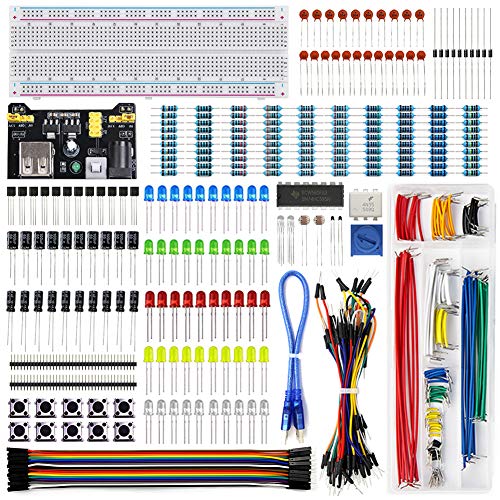
- More than 400 components
- Includes breadboard and power module
- Labeled storage and USB cable
Best For: Breadboard learning and Arduino-compatible projects
Best Value Basics
1390-Piece Electronic Component Kit

- 1,390 common components
- Includes six core part types
- Separate bags and marked resistors
Best For: Restocking essential through-hole parts
Best Compact Breadboard Kit
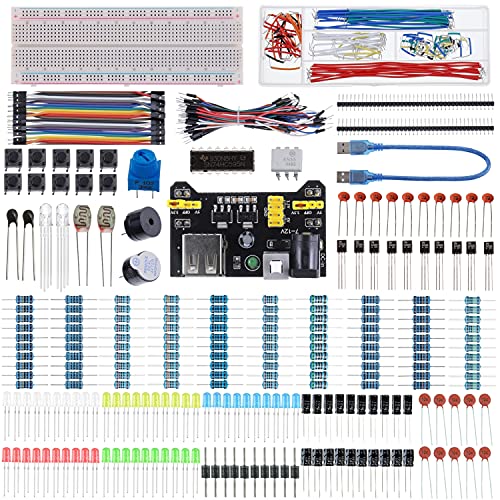
- More than 400 components
- Includes 830-point breadboard
- Power module and USB cable included
Best For: No-solder Arduino and Raspberry Pi experiments
Best High-Volume Assortment
1628-Piece Electronics Component Kit

- 1,628 pieces across resistors, capacitors, LEDs, diodes, and transistors
- Includes breadboards, PCB boards, and DuPont wires
- Labeled components support organized prototyping
Best For: High-volume circuit prototyping and electronics learning
Best Beginner-Friendly Kit
REXQualis 300+ Piece Electronics Kit

- More than 300 sensors and components
- Includes breadboard power supply and USB cable
- Labeled parts support simple Arduino or Raspberry Pi projects
Best For: Beginners working on simple controller-based projects
Best Organized Complete Set
2300-Piece DIY Electronics Assortment

- Wide mix includes ICs, PCBs, motors, speakers, and passive parts
- Compartmented transparent box helps organize components
- Includes 30X magnifying glass for inspecting part markings
Best For: Broad electronics learning, prototyping, and soldering practice
Versatile Power-and-Parts Kit
Raspberry Pi & STM32 Prototyping Set

- 326 listed items with common components and sensors
- 830-point breadboard plus jumper wires and power modules
- 3.3V/5V outputs with 9V adapter included
Best For: Raspberry Pi, STM32, and breadboard power experiments
High-Count Component Assortment
1780-Piece DIY Electronics Kit

- Large quantities of resistors, capacitors, LEDs, and transistors
- Two breadboards, four PCBs, and multiple wire types
- Includes motor, speakers, buzzers, ICs, and switches
Best For: High-volume learning, repairs, and varied DIY projects
Connected Learning Starter Kit
Arduino, Raspberry Pi & ESP Project Set
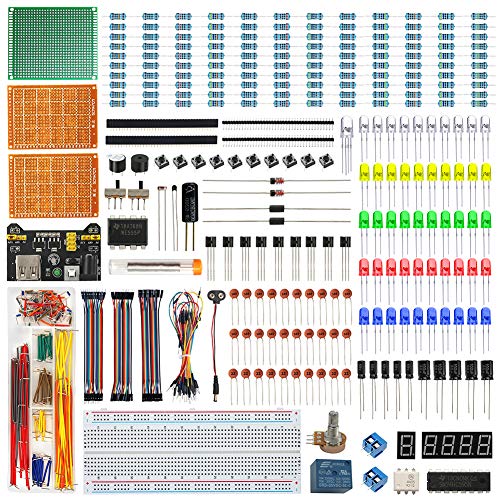
- Breadboard jumper wires plus a PCB soldering kit
- Includes LEDs, resistors, capacitors, diodes, and controls
- Designed for Arduino, Raspberry Pi, ESP32, and ESP8266
Best For: Board-based learning and soldering practice
Most Comprehensive Assortment – 2200-Piece Component Kit
For shoppers comparing electronic component kits for circuit prototyping, this assortment emphasizes quantity and breadth. It includes 2,200 through-hole components in a recyclable, organized box, covering common parts such as resistors, capacitors, transistors, diodes, LEDs, ICs, inductors, switches, potentiometers, and PCBs.
Best For: Builders who want a broad through-hole component supply for varied prototyping and electronics projects.
Pros:
- Large 2,200-piece assortment with many component categories.
- Includes useful extras such as PCBs, crystal oscillators, headers, terminals, switches, and trim pots.
- Comes in a recyclable 11 x 7 x 2.5-inch storage box.
Cons:
- The supplied notes do not specify the quantity breakdown for each component value.
- Its through-hole focus may be less suitable for primarily surface-mount work.
This is the quantity-focused choice in the group. It makes sense when variety matters more than having a breadboard, power module, or controller board included.
Best Breadboard Starter Set – REXQualis Component Fun Kit
This REXQualis set is one of the more hands-on electronic component kits for circuit prototyping because it combines more than 400 components with an 830 tie-point breadboard and power supply module. The labeled packaging, jumper wire, USB cable, and downloadable datasheet and tutorial support make it approachable for simple experiments with Arduino, Raspberry Pi, or STM32 projects.
Best For: Beginners and experimenters who need a breadboard-based starter kit with power accessories.
Pros:
- Includes an 830 tie-point breadboard, power supply module, jumper wire, and USB cable.
- Provides more than 400 sensors and components for simple electronic projects.
- Resistors, LEDs, transistors, and ICs are individually packaged and labeled.
Cons:
- The controller board is not included.
- The supplied notes do not provide a complete component-by-component inventory.
Unlike a component-only box, this kit is ready to support breadboard experiments once you add a compatible controller board. Its organization and included power hardware are useful for learning-focused prototyping.
Best Value Basics – 1390-Piece Electronic Component Kit
For straightforward electronic component kits for circuit prototyping, this 1,390-piece assortment concentrates on frequently used basics. The box includes metal film resistors, electrolytic and ceramic capacitors, common diodes, transistors, and LED diodes, with individual plastic bags and stamped resistor values for easier identification.
Best For: Hobbyists and professionals seeking a practical supply of common through-hole components.
Pros:
- Includes six core component categories and 1,390 pieces total.
- Resistor values are stamped, helping with identification.
- Different components are packaged separately in a storage box.
Cons:
- It does not include a breadboard, power module, jumper wires, or controller board.
- The assortment is narrower than the larger 2,200-piece kit.
This kit keeps the selection focused on foundational components rather than accessories. It is a sensible fit for restocking common parts when you already have your own prototyping hardware.
Best Compact Breadboard Kit – BOJACK 37-Value Fun Kit
The BOJACK kit pairs more than 400 components with the hardware needed to begin breadboard experiments. For electronic component kits for circuit prototyping, its practical combination of a precision potentiometer, jumper wire, power module, USB cable, and 830 tie-point breadboard makes setup more convenient without soldering.
Best For: Arduino, Raspberry Pi, and STM32 users who want a labeled breadboard kit with included power accessories.
Pros:
- Includes more than 400 components across 37 values.
- Provides an 830 tie-point breadboard, power module, USB cable, jumper wire, and precision potentiometer.
- Components are classified, labeled, and stored in a transparent box.
Cons:
- The supplied notes do not list the specific remaining component values.
- A compatible controller board is not listed as included.
Choose this set when convenience and breadboard compatibility are priorities. It offers a ready starting point for no-solder experiments, while the transparent labeled box helps reduce setup time.
Best High-Volume Assortment – 1628-Piece Electronics Component Kit
For shoppers comparing electronic component kits for circuit prototyping, this 1,628-piece assortment emphasizes quantity and variety. It includes LEDs, diodes, metal-film resistors, capacitors, transistors, DuPont wires, PCB boards, and breadboards for both solderless testing and more permanent builds.
Best For: Students, electronics enthusiasts, and experienced builders who want a broad through-hole and surface-mount component selection for learning and prototyping.
Pros:
- Large assortment with 600 metal-film resistors, 300 ceramic capacitors, 200 LEDs, and 180 transistors.
- Includes four breadboards, four PCB boards, and 120 DuPont wires for flexible circuit construction.
- Components are categorized and labeled for easier storage and retrieval.
Cons:
- The extensive assortment may be more than beginners need for simple projects.
- The supplied notes do not identify specific component values or provide a controller board.
This kit stands out when quantity matters. Its combination of breadboards for quick, solder-free experiments and PCB boards for compact builds makes it a versatile choice for a growing electronics workbench.
Best Beginner-Friendly Kit – REXQualis 300+ Piece Electronics Kit
This REXQualis set is a practical option among electronic component kits for circuit prototyping, especially for simple projects. It combines more than 300 sensors and components with a breadboard power supply, USB cable, jumper wires, LEDs, resistors, and other commonly used parts.
Best For: Beginners building fun, simple projects with Arduino or Raspberry Pi, provided they already have a compatible controller board.
Pros:
- Includes more than 300 sensors and electronic components for introductory experiments.
- Comes with a breadboard power supply and USB power cable.
- Resistors, LEDs, transistors, and integrated circuits are individually packaged and labeled.
- Compatible devices listed in the notes include Arduino and Raspberry Pi.
Cons:
- The controller board is not included.
- The kit is oriented toward simple projects rather than a very large component inventory.
Its labeled organization and included breadboard power module make this a straightforward starting point for hands-on learning. Account for the missing controller board when planning a complete project setup.
Best Organized Complete Set – 2300-Piece DIY Electronics Assortment
For buyers seeking electronic component kits for circuit prototyping with broad project coverage, this 2,300-piece set offers an unusually wide mix. The assortment includes capacitors, resistors, LEDs, diodes, transistors, ICs, potentiometers, speakers, motors, breadboards, PCBs, jumpers, and connection hardware.
Best For: Beginners, students, and DIY builders who want a large, organized assortment for circuit learning, breadboard work, soldering practice, and general electronics projects.
Pros:
- Broad selection includes ICs, motors, speakers, potentiometers, buzzers, switches, terminals, and prototype boards.
- Large transparent storage box uses multiple compartments to help sort and locate parts.
- Includes a 30X magnifying glass with jewelry attachments for inspecting component markings.
- Supports several use cases, including breadboard learning, PCB soldering, and DIY circuit production.
Cons:
- The large assortment may require substantial storage space; the package weighs 3.34 pounds.
- The supplied notes do not specify the quantities or values of each individual component type.
This is the most expansive option of the three for shoppers who value breadth and storage organization. Its extra hardware and magnifying glass add convenience, while the compartmented box makes a large assortment more manageable.
Versatile Power-and-Parts Kit – Raspberry Pi & STM32 Prototyping Set
This upgraded kit is a practical choice among electronic component kits for circuit prototyping when you want both basic parts and a breadboard power solution. It combines an 830-point breadboard, jumper wires, a 9V adapter, power modules, displays, sensors, and assorted semiconductors for hands-on projects.
Best For: Raspberry Pi, STM32, and general breadboard experiments requiring 3.3V or 5V power.
Pros:
- Includes a broad mix of resistors, capacitors, LEDs, diodes, transistors, ICs, buttons, and sensors.
- Includes an 830-point breadboard, DuPont wires, and power supply hardware.
- Offers both 3.3V and 5V power-module outputs.
Cons:
- The 9V battery is not included.
- LEDs require a series buck resistor to help avoid damage.
- The four-digit display uses common-anode wiring, which requires attention during setup.
With 326 listed items and compatibility noted for Raspberry Pi and STM32, this is a flexible starter set. Its integrated power options make it especially useful for learners who want to begin prototyping without assembling a separate power setup.
High-Count Component Assortment – 1780-Piece DIY Electronics Kit
For builders who want quantity and variety, this 1780-piece set is one of the more expansive electronic component kits for circuit prototyping. It includes large assortments of resistors, capacitors, LEDs, transistors, diodes, jumper wires, breadboards, PCB boards, and project-oriented parts.
Best For: Students, hobbyists, and experienced users building repeated or more complex through-hole and breadboard projects.
Pros:
- Provides substantial quantities, including 600 resistors, 300 ceramic capacitors, and 180 transistors.
- Includes two breadboards, four PCB boards, jumper wires, headers, and Dupont wires.
- Adds project parts such as motors, speakers, buzzers, switches, oscillators, ICs, and potentiometers.
Cons:
- The supplied notes do not identify a dedicated power supply or adapter.
- The extensive assortment may require more sorting before use despite categorized packaging.
This kit stands out when replenishment and component selection matter more than a narrowly curated beginner bundle. Its mix of breadboard and PCB options supports both quick testing and more permanent circuit builds.
Connected Learning Starter Kit – Arduino, Raspberry Pi & ESP Project Set
This starter bundle is a focused option among electronic component kits for circuit prototyping, pairing breadboard jumper wires with a PCB soldering kit and common discrete components. Its listed compatibility with Arduino, Raspberry Pi, ESP32, and ESP8266 makes it suited to learning and connected-device experiments.
Best For: Beginners and makers working with Arduino, Raspberry Pi, ESP32, or ESP8266 boards.
Pros:
- Combines a breadboard jumper-wire kit with a PCB soldering kit.
- Includes LEDs, resistors, capacitors, diodes, buttons, buzzers, and a potentiometer.
- Lists compatibility with Arduino, Raspberry Pi, ESP32, and ESP8266 projects.
Cons:
- The notes do not specify quantities for the individual components.
- The supplied details do not mention a dedicated AC adapter or battery.
Compared with larger bulk assortments, this kit emphasizes a practical collection for board-based experimentation and soldering practice. The included e-book and focused component selection can help new makers move from simple breadboard tests toward assembled circuits.
How We Picked the Best Electronic Component Kits for Circuit Prototyping
We focused on the features that matter when building and troubleshooting real circuits: useful component variety, practical quantities, breadboard compatibility, included jumper wires, power-supply access, and storage. Kits with resistors, capacitors, LEDs, diodes, transistors, potentiometers, and integrated circuits offer more room to experiment than narrow assortments.
We also considered whether each kit is suited to a beginner, classroom, hobby workbench, or more experienced maker. Large piece counts can be helpful, but only when the parts are organized clearly and the assortment includes components you are likely to use.
Quick Comparison
- Most complete assortments: Choose a high-count kit with ICs, a PCB, sensors, and a broad range of passive and active components.
- Best for breadboard projects: Look for an 830 tie-point breadboard, jumper wires, LEDs, resistors, and a plug-in power-supply module.
- Best for beginners: A kit with an e-book, labeled storage, basic components, and straightforward breadboard accessories reduces setup time.
- Best for expanding an existing bench: A focused resistor, capacitor, diode, or transistor assortment can fill gaps without duplicating tools you already own.
Key Buying Factors for Electronic Component Kits for Circuit Prototyping
Component Range and Values
Check the resistor values, capacitor types, LED colors, transistor varieties, diode selection, and potentiometer range. A high piece count is less important than having a balanced selection of commonly used values.
Prototyping Accessories
A solderless breadboard and jumper wires make rapid testing easier. A breadboard power module is especially useful, but confirm its input requirements and supported voltage outputs before connecting sensitive components.
Organization and Labeling
Clearly labeled compartments save time and reduce wiring mistakes. Storage boxes with separated values are preferable to loose bags, particularly for resistors and capacitors that look similar.
Learning Support and Limitations
An included guide or e-book can help new users get started, but verify whether projects provide circuit diagrams and component specifications. Remember that many kits do not include a multimeter, regulated bench supply, microcontroller, or specialized sensors unless explicitly listed.
Who Should Buy Which Electronic Component Kits for Circuit Prototyping?
Students and first-time makers should prioritize a breadboard-ready kit with jumper wires, a power module, labeled parts, and learning materials. Hobbyists building varied prototypes will benefit from larger assortments containing ICs, transistors, potentiometers, LEDs, diodes, and a PCB. Experienced electronics users should compare exact component values and quantities, choosing the kit that fills gaps in an existing inventory rather than simply selecting the largest box.
Before ordering, confirm the seller’s current parts list, quantity claims, voltage ratings, and included accessories. The best Electronic Component Kits for Circuit Prototyping are the ones that match your projects, keep parts easy to identify, and let you begin testing without buying a second set of basic essentials.