The right globe can turn geography lessons into a hands-on experience, helping students understand continents, oceans, borders, scale, and Earth’s shape more intuitively than a flat map alone.
These 10 options include classroom-ready raised-relief designs, illuminated constellation globes, writable surfaces, compact student models, and multipacks for group activities.
Best 10 Globes for Geography Lessons Picks for 2026
Classic Classroom Pick
Replogle Student 12-Inch Raised Relief Globe
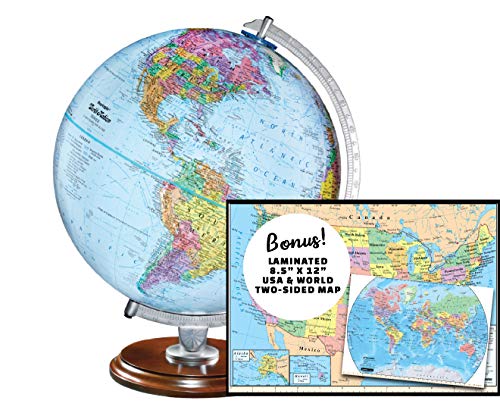
- 12-inch political globe with raised-relief mountains
- Includes time dial and population centers
- Color-coded U.S. states and wood base
Best For: Students and teachers wanting a tactile traditional globe
Writable Learning Tool
13-Inch Waterproof World Globe

- Wipe-clean surface for notes and travel routes
- Marks 200+ countries and regions
- Stable 360-degree rotating ABS stand
Best For: Interactive practice at home or in the classroom
Hands-On DIY Option

- Step-by-step self-assembly activity
- Shows boundaries, capitals, and major cities
- Rotating stand stands about 15.4 inches tall
Best For: Learners who enjoy building their own geography display
Group Learning Value

- Includes 12 rotating mini globes
- Compact 4.6-inch size for student desks
- Printed continents, countries, and oceans
Best For: Classrooms and groups needing one globe per learner or team
Detailed Classroom Reference

- 16-inch globe with up-to-date political cartography
- Over 4,000 place names and political boundaries
- Raised relief and full-rotation Gyro-Matic meridian
Best For: Detailed, hands-on geography lessons
Interactive Day-and-Night Learning
12-Inch Illuminated World Globe

- Day and night modes with political world map
- Rotating metal bracket and stable steel base
- Wipe-clean surface supports marker-based lessons
Best For: Interactive home or classroom geography learning
Compact Classroom Explorer

- Colorful political map with physical geography features
- Rotating design supports hands-on exploration
- Removable stand is convenient for demonstrations and storage
Best For: Compact classrooms and younger learners
Illuminated Explorer Globe
13-Inch Constellation World Globe

- Shows more than 190 countries, seas, and lakes
- Illuminates constellations with an LED
- Rotating globe with stainless steel stand and compass
Best For: Combined geography and constellation learning
Classroom Discovery Globe
8-Inch Educational World Map Globe
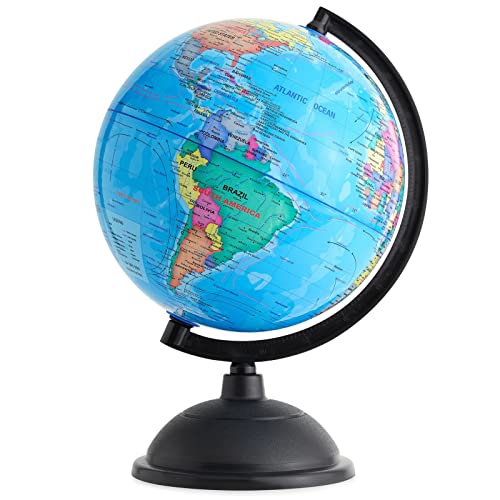
- Compact format for desks and classrooms
- Shows countries, continents, and oceans
- Rotating plastic globe built for hands-on use
Best For: Foundational geography lessons in small spaces
Compact Geography Globe
6-Inch Rotating Political World Globe

- Shows capitals, countries, water bodies, and borders
- 360-degree rotating plastic stand
- Compact option for desks, gifts, and classrooms
Best For: Small spaces and introductory geography practice
Classic Classroom Pick – Replogle Student 12-Inch Raised Relief Globe
For classrooms, study desks, and home learning spaces, this 12-inch Replogle globe is a traditional choice among globes for geography lessons. Its political map, raised-relief mountains, time dial, and color-coded U.S. states support hands-on exploration of physical and political geography.
Best For: Students and teachers who want a substantial desk or classroom globe with tactile terrain details.
Pros:
- Raised relief adds a 3D-like texture for identifying mountain areas.
- Includes a time dial, population centers, and differently colored U.S. states.
- Made in the USA with cartography following the manufacturer’s stated guidelines.
Cons:
- At 12 inches and about 4 pounds, it is less portable than miniature globes.
- The traditional map design includes visible trimming lines from the globe-making process.
Choose this model when physical feel, classroom presence, and traditional globe construction matter more than portability or interactive writing features.
Writable Learning Tool – 13-Inch Waterproof World Globe
This 13-inch globe stands out among globes for geography lessons because its coated surface can be marked with a marker and wiped clean. Students and teachers can practice capitals, trace travel routes, or add lesson highlights while using the rotating map for repeated study.
Best For: Interactive classroom practice, children’s geography activities, and adults who want to annotate a globe temporarily.
Pros:
- Waterproof writable surface supports repeat practice with wipe-clean markings.
- Shows boundaries for more than 200 countries and regions, along with islands and ocean currents.
- Stable ABS stand is designed for 360-degree rotation and frequent handling.
- High-quality printing is described as fade-proof and resistant to drops and scratches.
Cons:
- Marker compatibility and long-term surface performance are not specified.
- Its 13-inch size takes more desk space than compact classroom globes.
This is a practical pick when geography instruction benefits from writing, erasing, and revisiting map concepts rather than simply viewing a fixed display.
Hands-On DIY Option – EXERZ 12-Inch Political Globe
The EXERZ 12-inch globe adds an assembly activity to geography study, making it a hands-on option among globes for geography lessons. Once built, it displays countries, political boundaries, capitals, and major cities on a rotating stand.
Best For: Children over 8, with adult supervision, and geography enthusiasts who enjoy assembling educational displays.
Pros:
- Step-by-step assembly gives learners a practical introduction to the globe.
- English political map includes boundaries, capital cities, and major cities.
- Rotates on a sturdy stand and reaches about 15.4 inches in height with the stand.
- Can serve as both a learning tool and a home, office, or study decoration.
Cons:
- Assembly is required before use.
- Recommended for children over 8 with adult supervision.
Consider this model when the building process is part of the appeal. It offers a display-sized learning aid, though it is less suitable for buyers seeking an immediately ready-to-use globe.
Group Learning Value – Meooeck 12-Pack Mini Globes
For group instruction, this 12-pack offers a practical classroom alternative to buying one large globe. Each compact model rotates on its stand and provides a hands-on way for students to examine continents, countries, and oceans during globes for geography lessons.
Best For: Classrooms, homeschool groups, learning centers, study stations, and student rewards.
Pros:
- Twelve globes allow multiple students or teams to work at the same time.
- Compact 4.6-inch globes fit desks, tables, and learning stations.
- Printed countries, continents, and oceans support basic map-reading activities.
- 360-degree rotation and a stable base make viewing from different angles easy.
Cons:
- The smaller globe size provides less map detail than 12- or 13-inch models.
- Plastic construction is oriented toward basic classroom activities rather than a premium display.
This multipack is especially useful when participation matters more than maximum cartographic detail. It gives each learner or group a dedicated globe without taking much table space.
Detailed Classroom Reference – Replogle Eureka 16-Inch Globe
For geography lessons that benefit from a large, tactile reference, the Replogle Eureka offers a 16-inch political map with more than 4,000 place names and raised-relief mountain ranges. Its full-rotation Gyro-Matic meridian makes it practical for demonstrating locations, borders, and physical features.
Best For: Classrooms and older students who need a detailed, hands-on globe for geography lessons.
Pros:
- Large 16-inch diameter with detailed, up-to-date cartography
- Includes more than 4,000 place names and political boundaries
- Raised relief helps students visualize and feel mountain ranges
- Full rotation with a Gyro-Matic meridian
Cons:
- Its larger size may require more display and storage space
- Raised relief is not shown to real-world scale
- Traditional map trimming lines may be visible
This is the strongest choice when detail and physical interaction matter more than portability. The substantial 16-inch format provides a clear teaching surface for map-based exploration.
Interactive Day-and-Night Learning – 12-Inch Illuminated World Globe
This 12-inch illuminated globe combines a political world map with a night-light mode, giving geography lessons an interactive display option. Its stable metal base, 360-degree rotating bracket, and wipe-clean writing surface support repeated classroom or home use.
Best For: Children, families, and teachers seeking an interactive globe for geography lessons and after-dark display.
Pros:
- Day-and-night modes highlight countries, regions, islands, and ocean currents
- 360-degree double-bearing metal bracket supports frequent rotation
- Waterproof writing surface can be marked and wiped clean
- 12-inch size suits both children’s learning and adult teaching
Cons:
- More complex than a basic globe because it includes illumination controls
- The notes do not specify the number of place names or capitals shown
- At 12 inches, it displays less map area at once than a 16-inch globe
The writing surface and illumination make this a flexible teaching aid for demonstrations and review activities. It is especially appealing if the globe also needs to function as a decorative night lamp.
Compact Classroom Explorer – KISEER 8-Inch Rotating Globe
For classrooms that need an affordable, space-conscious option, the KISEER 8-inch globe presents countries, capitals, continents, political boundaries, oceans, islands, rivers, and deserts in a colorful rotating format. Its removable plastic base and frame make it suitable for demonstrations, storage, or display.
Best For: Younger students, compact classrooms, and geography lessons requiring a portable rotating globe.
Pros:
- Compact 8-inch size is easy to display, store, or transport
- Colorful map includes countries, capitals, continents, and physical features
- Rotating design encourages hands-on exploration
- Removable base and frame support classroom demonstrations
Cons:
- Smaller surface provides less room for map detail than larger globes
- Plastic construction may feel less substantial than metal-based alternatives
- The supplied notes do not mention illumination or raised relief
This globe is a practical pick when portability and storage matter. It covers core political and physical geography topics without taking up much classroom or desk space.
Illuminated Explorer Globe – 13-Inch Constellation World Globe
For shoppers comparing globes for geography lessons, this 13-inch model combines a detailed world map with an illuminated constellation display. It identifies more than 190 countries, seas, and lakes, while its rotating design supports hands-on exploration at home, in an office, or in a classroom.
Best For: Geography lessons that also introduce children and adults to constellations.
Pros:
- Large 13-inch globe with countries, continents, oceans, seas, lakes, and geographic color details.
- LED illumination highlights constellations at night.
- Rotating PVC globe with a heavy-duty stainless steel stand.
- Includes a compass for added navigation-related exploration.
Cons:
- The world map itself does not glow; only the constellations illuminate.
- Its 13-inch size and 5.1-pound weight require more desk space than compact globes.
This is the most feature-rich option in the group for buyers who want geography and astronomy in one display. Choose it when a larger classroom or study-area globe and nighttime constellation feature justify the added size.
Classroom Discovery Globe – 8-Inch Educational World Map Globe
This 8-inch Juvale globe is a practical choice for globes for geography lessons when desk space and easy handling matter. Its multicolor world map depicts countries, continents, and oceans, and the rotating design encourages children to explore locations hands-on.
Best For: Classrooms, children’s desks, and compact learning spaces.
Pros:
- Compact 8-inch size fits desks and smaller spaces.
- Displays countries, continents, and oceans for foundational geography learning.
- Rotates for interactive exploration and world-map activities.
- Plastic construction is designed for frequent handling and spinning.
Cons:
- Smaller than the 13-inch globe, so map details may be less prominent from a distance.
- Uses a plastic stand rather than the heavier stainless steel stand found on the larger model.
For basic geography instruction, this globe offers a straightforward balance of portability, durability, and visibility. It is especially suitable when several students need an approachable globe without taking up much table space.
Compact Geography Globe – 6-Inch Rotating Political World Globe
When space and budget are priorities, this 6-inch model is a compact option among globes for geography lessons. Its printed map includes countries, water bodies, capitals, continental borders, and regional borders, while the 360-degree rotation supports simple location games and classroom activities.
Best For: Students, small desks, and introductory geography teaching.
Pros:
- Compact 6-inch size is easy to place, store, and give as a practical educational gift.
- Includes countries, water bodies, capitals, continental borders, and regional borders.
- 360-degree rotating stand encourages interactive exploration.
- Clear printing and a stable plastic frame and base support desk use.
Cons:
- The 6-inch diameter provides less viewing area than larger classroom globes.
- Plastic construction may offer a less substantial feel than a globe with a metal base.
This is a sensible pick for quick reference, travel games, or a child’s study area. Its smaller map surface is a trade-off for easy placement and the inclusion of capitals and boundary information.
How We Picked the Best Globes for Geography Lessons
We focused on features that support real teaching and independent study: map readability, geographic detail, durability, rotation, size, stability, and age suitability. The selection spans 6- to 16-inch models, so teachers, parents, and homeschoolers can match the globe to available desk or classroom space.
We also considered practical extras, including raised terrain, illumination, writable finishes, constellation information, included maps, and multipack value. Political globes are especially useful for identifying countries and borders, while relief and illuminated models can make physical geography and Earth science easier to demonstrate.
Quick Comparison
| Best For | Look For | Recommended Type |
|---|---|---|
| Everyday classroom instruction | Clear labels, sturdy stand, smooth rotation | 12- to 16-inch desktop globe |
| Teaching landforms | Raised terrain and contrasting colors | Raised-relief globe |
| Nighttime or science lessons | Internal lighting and stable base | Illuminated globe |
| Group activities | Multiple matching units | Multipack of small globes |
| Limited desk space | Compact footprint and readable print | 6- to 8-inch globe |
Key Buying Factors for Globes for Geography Lessons
Size and Readability
Larger globes generally provide bigger labels and more visible borders, making them better for demonstrations or shared instruction. Smaller models work well for individual desks, activity stations, and decorative use, but their text may be harder to read.
Map Type and Geographic Detail
Choose a political map when the lesson centers on countries, capitals, and borders. A raised-relief globe adds tactile elevation for mountains and terrain. Check whether the map is current enough for your curriculum, particularly if students will study political boundaries.
Construction and Stability
A rotating globe is easier to use during lessons, but the stand should remain steady when students spin it. Look for a firm base, a durable meridian or frame, and a surface that can withstand regular handling. For younger children, avoid models with fragile parts or poorly secured bases.
Lighting and Extra Features
Illumination can reveal oceans, continents, or constellation information in a darker room, but it also introduces a cord, bulb, or electrical component. Writable surfaces are useful for temporary labeling and quizzes; confirm what markers are recommended and how easily they erase.
Who Should Buy Which Globes for Geography Lessons?
Teachers leading whole-class geography lessons should prioritize a 12- or 16-inch model with clear labeling, dependable rotation, and a stable stand. Raised-relief designs are a strong choice for lessons about mountains, elevation, and physical geography.
Parents and homeschoolers may prefer an illuminated or writable globe that supports several subjects and keeps lessons interactive. For younger learners, a colorful 6- to 8-inch globe can be approachable and easy to handle, while older students benefit from larger maps with more detailed political information.
For classrooms running centers or group projects, a multipack provides several matching globes without requiring students to share one display. Before buying, measure the intended surface, verify the globe’s map language, and decide whether durability, detail, or added teaching features matter most.