The best engineering building sets for elementary students turn STEM concepts into something children can build, test, revise, and explain. The options in this roundup range from guided bridge and structure challenges to flexible construction kits that encourage open-ended design.
We compared piece counts, recommended ages, challenge style, construction variety, and learning value to help families and educators choose a set that matches a child’s interests, classroom needs, and frustration tolerance.
Best 10 Engineering Building Sets for Elementary Students Picks for 2026
Best Starter City Builder
City Engineering & Design Building Set
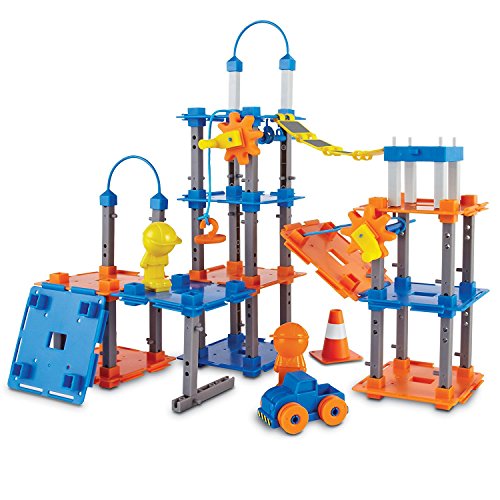
- 89-piece city-themed STEM building kit
- Activity cards guide the design process
- Recommended for ages 5–8
Best For: Young beginners exploring towers, bridges, and creative design
Best Classroom Bridge Set

- 207 pieces for hands-on construction
- Build 13 real-world bridge replicas
- Includes teacher guide and lesson resources
Best For: Grades 3–5 classrooms and collaborative bridge projects
Best Spatial-Reasoning Challenge

- 20 wooden planks and 30 puzzle cards
- Build 3D forms from 2D diagrams
- Recommended for ages 7 and up
Best For: Tabletop spatial reasoning and geometry practice
Best Structural Engineering Upgrade
Bridges & Skyscrapers Engineering Set

- Build 20 structural engineering models
- 287 pieces with interchangeable parts
- Explores force, load, compression, and tension
Best For: Intermediate builders ages 8–14 studying structural science
Best for Moving Models

- 480 rods and connectors
- Builds working vehicles and models
- Instructions for 35 creations
Best For: Elementary builders interested in moving constructions
Best for Early STEM Play
Rainbow ToyFrog Straw Constructor
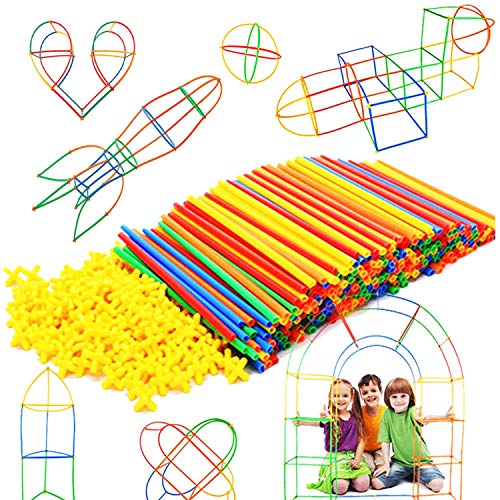
- 300 colorful straws and connectors
- Supports fine-motor development
- Portable reusable pouch
Best For: Younger builders and group classroom activities
Best Large Group Set
FUBAODA 600-Piece Building Blocks

- Includes 600 colorful blocks
- Supports 3D and spatial reasoning
- Works for one to four players
Best For: Solo, family, or classroom construction projects
Best Large Straw Set
600-Piece STEM Straw Constructor Kit

- 600 pieces for larger, varied creations
- Builds logic, spatial, and motor skills
- Works for solo or group STEM play
Best For: Open-ended STEM projects and group building
Best Model Variety
170-Piece Engineering Building Kit

- Builds 18-plus vehicle and character models
- Includes 20 removable wheels
- Storage box supports travel and cleanup
Best For: Guided construction play for ages 3 to 8
Best for Group Projects
1200-Piece Straw Constructor Set

- Enough pieces for three to five children
- Encourages teamwork and engineering skills
- Includes storage and supports indoor or outdoor play
Best For: Classroom STEM activities and cooperative building
Best Starter City Builder – City Engineering & Design Building Set
For families seeking engineering building sets for elementary students, this 89-piece city-themed kit offers an approachable introduction to design and problem solving. Children ages 5–8 can build towers, bridges, and other city structures with guided activity cards or open-ended materials.
Best For: Preschool and early elementary learners who are beginning to explore engineering concepts through hands-on building.
Pros:
- Activity cards introduce the design process: ask, imagine, plan, create, and improve.
- Supports creative building with towers, bridges, and city structures.
- Requires no batteries and works well at home, in classrooms, or homeschool spaces.
Cons:
- Its recommended age range of 5–8 may limit long-term use for older elementary students.
- Offers a smaller piece count than the more advanced construction sets in this roundup.
This is a practical first engineering set for younger children because it balances structure and freedom. The city theme and guided challenges can make core design ideas easier to approach.
Best Classroom Bridge Set – Intro to Structures: Bridges
Among engineering building sets for elementary students, this K’NEX Education kit stands out for its focus on real-world bridge structures. Its 207 rods, stems, and connectors support 13 functioning bridge models and are designed for grades 3–5, with two or three children able to work together.
Best For: Elementary classrooms, small-group projects, and learners interested in how different bridge designs work.
Pros:
- Models truss, arch, cantilever, beam, suspension, movable, and cable-stayed bridges.
- Includes building instructions, a teacher’s guide, lesson plans, and experiments.
- Portable storage tray helps keep the 207 pieces organized.
- Can also be used to build buildings, houses, and towers.
Cons:
- The recommended target audience is older than the beginner city-building set.
- The educational materials may be more useful in guided group or classroom settings than for purely casual play.
This is the strongest choice for structured bridge exploration. The range of bridge types and standards-aligned educational support gives teachers a clear way to connect construction with engineering concepts.
Best Spatial-Reasoning Challenge – KEVA Brainbuilders
This KEVA set takes a different approach to engineering building sets for elementary students by asking children to turn two-dimensional diagrams into three-dimensional structures. With 20 wooden planks and 30 double-sided puzzle cards, it emphasizes spatial awareness, geometry, patience, and trial-and-error problem solving.
Best For: Children ages 7 and up who enjoy tabletop puzzles and want to strengthen visual-spatial reasoning.
Pros:
- Cards show front, side, and overhead views of each design.
- Puzzles progress from beginner to expert difficulty.
- Encourages practice with balance, proportion, composition, and geometry.
- Zippered carrying case supports storage and portability.
Cons:
- With 20 planks, the set is focused on challenge cards rather than large free-form constructions.
- Its puzzle-centered format may be less suitable for children seeking broad building projects.
KEVA Brainbuilders is a good complement to a traditional construction kit. It rewards careful observation and persistence, making it especially useful when spatial thinking is the main learning goal.
Best Structural Engineering Upgrade – Bridges & Skyscrapers Engineering Set
For older elementary students ready for more involved engineering building sets, this Thames & Kosmos kit explores bridges, skyscrapers, and mechanical physics. Its 287 plastic pieces and illustrated 36-page manual support 20 models while introducing force, load, compression, tension, and building materials.
Best For: Intermediate builders ages 8–14 who want guided structural models and a deeper science focus.
Pros:
- Builds 20 different structural models.
- Explores force, load, compression, and tension through construction.
- Includes more than 285 interchangeable building pieces.
- Illustrated experiment manual and assembly guide provide structured support.
Cons:
- Its intermediate skill level may be challenging for younger or first-time builders.
- The focus on structural engineering is narrower than a general-purpose building set.
This kit makes a strong step up from introductory construction toys. It is best suited to children who are ready to connect hands-on models with more specific principles of structural science.
Best for Moving Models – K'NEX Adventure Wheels
For engineering building sets for elementary students, the K’NEX Adventure Wheels set stands out with 480 rods and connectors that support hands-on construction and working models. Its snap-fit pieces can be reassembled, while the included instructions provide guided starting points.
Best For: Elementary-age builders who enjoy vehicles, moving parts, and open-ended construction.
Pros:
- Includes 480 classic rods and connectors.
- Supports models with moving wheels, rotors, wings, and tracks.
- Includes step-by-step instructions for 35 models.
- Comes with a storage chest for keeping pieces together.
Cons:
- Recommended for ages 7 and up, so it may be too advanced for preschoolers.
- Small interlocking pieces require organized storage.
Choose this set when mechanical movement is a priority. It offers both guided projects and room for children to design their own structures, including vehicles, bridges, and rides.
Best for Early STEM Play – Rainbow ToyFrog Straw Constructor
This straw-and-connector kit is a practical option for engineering building sets for elementary students who benefit from simple, open-ended construction. With nearly 300 flexible, colorful pieces, children can practice connecting, balancing, and creating structures individually or in groups.
Best For: Younger children, classrooms, and collaborative building activities focused on fine-motor and early engineering skills.
Pros:
- Includes 300 colorful straws and connectors.
- Flexible pieces support open-ended building and imaginative play.
- Designed to encourage hand-eye coordination, dexterity, and critical thinking.
- Includes a reusable pouch and uses BPA-free plastic.
Cons:
- The set is recommended for ages 3 and up and may be less challenging for older elementary students.
- Its straw-based design may be better suited to lightweight structures than complex models.
This is a strong starter set for practicing connections and basic construction concepts. Its portable pouch and flexible pieces also make it convenient for classroom, indoor, outdoor, or travel use.
Best Large Group Set – FUBAODA 600-Piece Building Blocks
Families and classrooms looking for engineering building sets for elementary students may appreciate this 600-piece construction kit. The colorful interlocking blocks are designed for easy handling and can be used to make 3D structures while practicing spatial reasoning, coordination, and problem-solving.
Best For: Children who want a large supply of blocks for solo play, sibling projects, or group building.
Pros:
- Provides 600 colorful interlocking pieces.
- Blocks attach with minimal pressure and lock firmly in place.
- Supports 3D imagination, spatial reasoning, creativity, and problem-solving.
- Suitable for one to four players and includes easy storage.
Cons:
- The small pieces may be less suitable for children under the recommended 36-month minimum.
- The set does not specify guided model instructions in the supplied details.
This set is a good fit when quantity and collaborative play matter most. Its broad age range and large piece count provide plenty of material for repeated free-build projects, though buyers seeking structured lessons may prefer a kit with detailed plans.
Best Large Straw Set – 600-Piece STEM Straw Constructor Kit
For families seeking engineering building sets for elementary students, this 600-piece straw constructor kit offers plenty of parts for larger, open-ended designs. Its mix of long straws, short straws, and connectors supports planning, building, and experimenting rather than limiting children to one finished model.
Best For: Individual or group STEM projects for children ages 3 to 12 who enjoy creating larger structures.
Pros:
- Includes 600 pieces for varied and larger creations.
- Encourages problem-solving, spatial reasoning, hand-eye coordination, and motor skills.
- Suitable for individual play or group activities.
- Notes indicate testing for CPSC regulations and applicable safety standards.
Cons:
- The open-ended format may require adult guidance for children who prefer step-by-step models.
- The set uses only straws and connectors, without wheels or specialized model parts.
This is a strong choice when quantity and creative freedom matter most. It fits classroom-style exploration or home building sessions, though children looking for vehicle-focused builds may prefer a kit with wheels.
Best Model Variety – 170-Piece Engineering Building Kit
This 170-piece kit is a practical option for engineering building sets for elementary students who enjoy constructing recognizable models. The colorful pieces and removable wheels can be used to create more than 18 suggested designs, including vehicles, dinosaurs, robots, and helicopters.
Best For: Children ages 3 to 8 who benefit from guided model ideas, colorful parts, and portable storage.
Pros:
- Includes six colors and 20 removable wheels.
- Offers 18-plus model possibilities, including cars, robots, and helicopters.
- Comes in a sturdy plastic storage box for travel and cleanup.
- Plastic parts are described as BPA-, lead-, cadmium-, and phthalate-free, with no sharp edges.
Cons:
- With 170 pieces, it provides less building volume than the larger straw sets.
- The product details list the number of pieces inconsistently, so buyers should confirm the package contents.
Its wheels and model suggestions make this a more structured introduction to construction play. The storage box is especially useful for classrooms, travel, or homes where keeping parts organized is important.
Best for Group Projects – 1200-Piece Straw Constructor Set
For classrooms or families comparing engineering building sets for elementary students, this 1,200-piece straw constructor set is designed for shared building. Its large supply of interlocking tubes and connectors supports multiplayer projects, imaginative structures, and cooperative problem-solving.
Best For: Classrooms, children’s centers, and groups of three to five children ages 3 to 8.
Pros:
- Provides 1,200 pieces for multiple children to use together.
- Supports teamwork, engineering skills, reasoning, math, and imagination.
- Can be used indoors or outdoors and includes a storage box.
- Notes cite CPSIA and ASTM certification and non-toxic materials.
Cons:
- The large number of small components may require careful sorting and supervision.
- It is primarily an open-ended straw-and-connector system, with no dedicated wheels or electronic elements.
This set stands out when collaboration and quantity are priorities. It is well suited to classroom STEM stations and cooperative play, while smaller households may find the 600-piece set easier to manage.
How We Picked These Engineering Building Sets for Elementary Students
We focused on kits that support genuine building and problem-solving rather than simple assembly. The selection includes structured engineering activities, spatial-thinking challenges, bridge and skyscraper projects, vehicle construction, and connector-based sets for freeform designs.
We also considered age guidance, piece count, material and connector design, the likelihood of repeat play, and whether a child can work independently or benefits from adult instruction. A larger kit is not automatically better; usable challenges and reliable connections matter more than the number printed on the box.
Quick Comparison
| Best For | Look For |
|---|---|
| Guided STEM learning | Challenge cards, project instructions, and clear age or grade ranges |
| Bridge and structure practice | Beams, connectors, load-testing activities, and construction concepts |
| Open-ended creativity | Many compatible pieces, flexible connectors, and multiple build possibilities |
| Independent play | Visual instructions, manageable projects, and pieces that connect easily |
| Classroom or group use | High piece counts, durable parts, and activities that support collaboration |
Key Buying Factors
Age, Grade, and Difficulty
Match the kit to the child’s actual building experience, not just the maximum advertised age. Younger elementary students often need larger parts, simpler connectors, and short projects. Older students may prefer structural constraints, multi-step challenges, and opportunities to test why a design succeeds or fails.
Guided Versus Open-Ended Building
Challenge-based sets are useful for lessons or children who enjoy a clear goal. Open-ended straw, block, and connector kits provide more freedom and may offer better long-term value, but they usually require children to invent their own projects or receive prompts from an adult.
Connection Quality and Stability
Parts should connect firmly without requiring excessive force. Check whether the finished structures stand securely and whether pieces are easy to separate for rebuilding. Flexible connectors can support creativity, while rigid parts are often better for repeatable engineering experiments.
Piece Count and Storage
More pieces allow larger builds and group projects, but they also increase sorting and cleanup. For home use, a moderate kit with a storage solution may be more practical than a very large set. Verify that replacement parts or organized storage are available when possible.
Learning and Play Value
Choose a set that encourages prediction, measurement, balance, symmetry, or redesign. The strongest kits make it easy to discuss engineering ideas while still feeling like play.
Who Should Buy Which Engineering Building Sets for Elementary Students?
Choose a guided structures or bridges set for a child who enjoys instructions, classroom projects, and measurable challenges. Pick a brain-building or image-recreation kit for children who like puzzles and spatial reasoning. Vehicle-focused construction works well for builders motivated by motion and imaginative play.
For siblings, clubs, and classrooms, high-piece-count connector or straw kits offer broad creative potential and collaborative building. For younger children, prioritize larger, easy-to-handle parts and simpler designs over sheer quantity. If you are unsure, select a versatile kit with both instructions and open-ended building opportunities so the child can begin with support and gradually design independently.