The best engineering building sets for classrooms turn abstract STEM concepts into hands-on challenges students can see, test, and improve. This roundup compares structural kits, bridge-building sets, gears, machines, motion systems, and open-ended construction materials for different ages and lesson goals.
We focused on classroom usefulness, project variety, construction quality, student engagement, and how easily each set can support collaborative learning. Use the guide below to match the right kit with your grade level, available space, and curriculum needs.
Best 10 Engineering Building Sets for Classrooms Picks for 2026
Best for Model Variety
Engino Structures, Buildings & Bridges
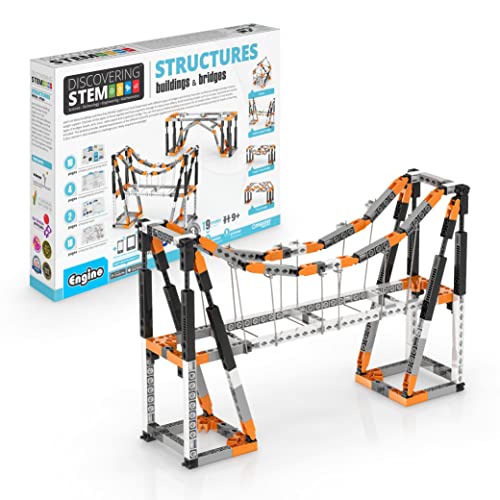
- Nine structural models, including five bridge types
- Theory, experiments, instructions, and quiz included
- Multi-directional pieces support 3D construction
Best For: Guided structural-engineering projects for ages 9+
Best Classroom Collaboration Set
STEM Explorers Bridge Builders

- 305 pieces for bridge and tower challenges
- Designed for small-group collaboration
- Supports up to 10 players
Best For: Team-based classroom engineering activities for ages 5+
Best for Structural Physics
Thames & Kosmos Bridges & Skyscrapers

- Builds 20 structural models
- Teaches compression, tension, force, and load
- Includes 285+ pieces and a 36-page manual
Best For: Intermediate structural-physics lessons for ages 8–14
Best for Early Mechanics
Learning Resources Gears Deluxe

- 100 pieces for building moving creations
- Introduces motion and cause and effect
- No batteries required; suitable for classroom centers
Best For: Beginner mechanics and fine-motor activities for ages 3–10
Real-World Bridge Building
Intro to Structures Bridges Set

- 207 rods, stems, and connectors
- Build 13 functioning bridge replicas
- Includes teacher guide and storage tray
Best For: Grades 3–5 small-group structural engineering lessons
Playground Design Lab
Playground Engineering & Design Set
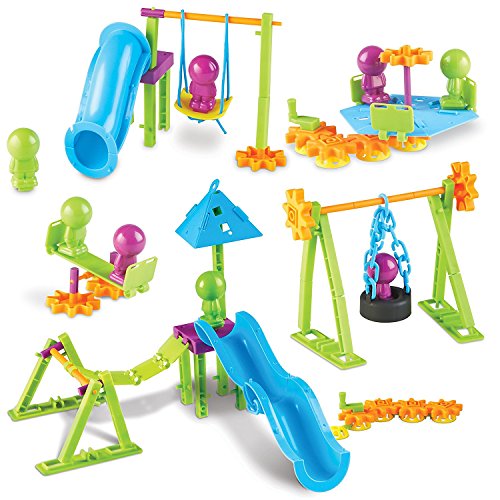
- 104-piece construction set for ages 5+
- Includes challenge cards and worksheets
- Supports guided or open-ended builds
Best For: Early elementary classroom STEM and design activities
Young Structural Engineers
STEM Explorers Bridge Builders

- Includes nine bridge and tower challenges
- Introduces real-world structural concepts
- Designed for early engineering skills
Best For: Ages 5–10 and introductory individual STEM challenges
Best Collaborative Straw Building Set

- 600 pieces for group construction
- Supports early engineering and creative thinking
- Includes wheels and storage box
Best For: Preschool and early-elementary collaborative building centers
Best Guided Machine-Building Set

- Includes 10 guided STEM challenges
- Builds machines with gears and pulleys
- Designed for ages 5–8
Best For: Structured early-elementary engineering lessons
Best Simple Machines Set

- Builds a catapult, trebuchet, and windmill
- Includes eight STEM challenges
- Explores force, motion, and testing
Best For: Kindergarten and early-elementary physics activities
Best for Model Variety – Engino Structures, Buildings & Bridges
For classrooms seeking engineering building sets for classrooms with strong structural focus, this Engino kit offers nine model options, including houses, pyramids, and several bridge designs. Its theory pages, experiments, quiz, and app support guided STEM activities beyond basic construction.
Best For: Students ages 9 and up exploring structural engineering through guided individual projects.
Pros:
- Builds nine real-world structures, including beam, arch, truss, cable-stayed, and suspension bridges.
- Includes theory, experiments, facts, instructions, and a quiz.
- Multi-directional snap-fit components support complex 3D models.
- Designed by an engineer and teacher, with a two-year limited warranty.
Cons:
- The recommended age range starts at 9, making it less suitable for younger classes.
- The set is designed primarily for one player at a time.
- AA batteries are listed as required.
This is a strong choice when a lesson needs both hands-on construction and explicit structural-engineering content. Its multiple bridge configurations can support comparisons of design principles, though teachers may need additional sets for larger group work.
Best Classroom Collaboration Set – STEM Explorers Bridge Builders
This expanded classroom set is purpose-built for engineering building sets for classrooms, with 305 pieces and challenges centered on designing, building, and testing bridges and towers. Its group-oriented format makes it especially practical for collaborative STEM stations.
Best For: Classroom teams ages 5 and up practicing bridge design, testing, problem-solving, and collaboration.
Pros:
- Students design, construct, and test bridges and towers.
- Introduces suspension bridges, beam bridges, and other structural concepts.
- Supports small-group collaboration and serves up to 10 players.
- Includes 305 interlocking plastic pieces.
Cons:
- The notes identify the audience broadly as children rather than providing a detailed upper age range.
- The set focuses on bridges and towers, so it offers less model variety than broader construction kits.
- Instructions or experiment materials beyond the listed classroom challenges are not specified.
For shared classroom use, this is the most directly aligned option in the group. Its emphasis on testing and teamwork suits engineering centers, although teachers may want to prepare their own recording sheets or assessment prompts.
Best for Structural Physics – Thames & Kosmos Bridges & Skyscrapers
Thames & Kosmos Structural Engineering is a focused option among engineering building sets for classrooms, combining 20 structural models with lessons on force, load, compression, and tension. The 36-page illustrated manual helps turn construction into an intermediate science activity.
Best For: Students ages 8 to 14 studying structural forces and mechanical physics through guided models.
Pros:
- Builds 20 different bridge and skyscraper models.
- Explores force, load, compression, tension, and building materials.
- Includes more than 285 interchangeable plastic building pieces.
- Provides a 36-page illustrated experiment and assembly manual.
Cons:
- The intermediate skill level may require teacher guidance for younger or inexperienced builders.
- The compact set is identified as small, which may limit simultaneous group construction.
- It is recommended for ages 8 to 14, so it is not aimed at early elementary learners.
This kit is well suited to lessons that connect physical models with vocabulary about structural forces. It offers substantial model variety and instructional support, but classrooms planning group projects may need multiple kits.
Best for Early Mechanics – Learning Resources Gears Deluxe
For younger learners, the Learning Resources Gears Deluxe set provides a hands-on introduction to motion, cause and effect, and simple mechanics. Its 100 colorful pieces make it a flexible choice among engineering building sets for classrooms, especially for STEM centers and open-ended exploration.
Best For: Early elementary learners ages 3 to 10 developing fine-motor, spatial-reasoning, and beginning engineering skills.
Pros:
- Includes 46 gears, 26 pillars, 21 axles, six bases, and a crank handle.
- Supports experiments with motion, cause and effect, and simple mechanics.
- Works for classroom centers, homeschool activities, and independent play.
- Requires no batteries and supports open-ended building.
Cons:
- It focuses on gears and moving mechanisms rather than structural engineering models.
- The set has no stated warranty.
- Its beginner level may not challenge older students seeking advanced engineering concepts.
This is a practical choice for introducing mechanical engineering concepts through short, repeatable activities. It is less appropriate for bridge or building-design units, but its accessible pieces and no-battery operation work well in rotating classroom stations.
Real-World Bridge Building – Intro to Structures Bridges Set
For classrooms seeking engineering building sets for classrooms, the K’NEX Education Intro to Structures Bridges Set offers a focused way to explore bridge design. Its 207 rods, stems, and connectors support 13 functioning bridge replicas, including truss, arch, suspension, and cable-stayed designs.
Best For: Grades 3–5 classrooms where two to three students can collaborate on hands-on structural engineering activities.
Pros:
- Builds 13 real-world bridge types with reusable snap-fit pieces.
- Includes a teacher’s guide, building instructions, lesson plans, and experiments.
- Portable storage tray with snap-on lid supports classroom cleanup.
- Can also be used to create buildings, houses, and towers.
Cons:
- The set is primarily focused on bridge and structure modeling.
- Its recommended classroom use is aimed at grades 3–5 rather than early learners.
This is a strong choice when your lessons need real-world examples and standards-aligned STEM activities. The collaborative format and teacher resources make it especially practical for small-group instruction.
Playground Design Lab – Playground Engineering & Design Set
Among engineering building sets for classrooms, the Learning Resources Playground Engineering & Design Building Set is a flexible option for younger students. Children connect 104 pieces to follow blueprints or invent playground-style structures, then take them apart and rebuild them.
Best For: Ages 5–12 in classrooms, homeschool settings, or independent and group STEM activities.
Pros:
- Supports open-ended construction and repeatable screen-free play.
- Includes challenge cards, an activity guide, and reproducible worksheets.
- Encourages problem-solving, coordination, logic, and fine motor development.
- Works for group or independent building without batteries.
Cons:
- The playground theme may be less suitable for lessons focused on bridges or larger structures.
- The set includes one 104-piece pack, which may require sharing in larger groups.
This set fits classrooms that want an accessible introduction to engineering through familiar playground designs. Its combination of guided challenges and open-ended building gives teachers room to adapt activities to different skill levels.
Young Structural Engineers – STEM Explorers Bridge Builders
The Learning Resources STEM Explorers Bridge Builders is a compact choice for engineering building sets for classrooms introducing structural concepts to young learners. Students design, construct, and test bridges and towers while working through nine STEM challenges based on real-world bridge types.
Best For: Ages 5–10, especially introductory bridge-building lessons and individual STEM challenge work.
Pros:
- Provides nine challenges involving bridge and tower construction.
- Introduces suspension, beam, and other structural engineering concepts.
- Encourages testing, redesign, critical thinking, and problem solving.
- Designed to help children as young as five develop early engineering skills.
Cons:
- It is designed for one player, so group use may require turn-taking or multiple sets.
- The activities are geared toward younger learners and may be less advanced for older students.
Choose this set when you want a clearly structured introduction to bridge engineering. The nine challenges give young students a manageable test-and-improve process without requiring batteries or screens.
Best Collaborative Straw Building Set – 600-Piece Straw Constructor
For classrooms seeking engineering building sets for classrooms that support open-ended construction, this 600-piece straw set gives children ages 3 and up plenty of connectors and tubes for group projects. The included wheels and multidirectional connectors expand the range of possible builds, while the storage box helps keep the large collection organized.
Best For: Preschool and early-elementary classrooms focused on collaborative, imaginative building.
Pros:
- 600 pieces support multiple children playing and building together.
- Encourages engineering skills, reasoning, construction, imagination, and hand-eye coordination.
- Includes wheels, multidirectional connectors, and a storage box.
- Listed as CPSIA- and ASTM-certified, with no batteries required.
Cons:
- Open-ended pieces may require teacher-provided challenges or ideas.
- The set is recommended for ages 3 and up, so it may be less suitable for older students seeking advanced mechanisms.
This is a practical choice when classroom value means quantity, cooperation, and creative construction. It is less structured than challenge-based kits, but its generous piece count makes it useful for free-build centers and shared projects.
Best Guided Machine-Building Set – STEM Explorers Machine Makers
Among engineering building sets for classrooms, Learning Resources STEM Explorers Machine Makers stands out for its guided format. Designed for ages 5–8, the 50-piece kit includes gears, pulleys, belt drives, connectors, and 10 activity cards to help children build and investigate machines such as a satellite dish, crane, and space rover.
Best For: Early-elementary classrooms that want structured engineering challenges with real-world machine themes.
Pros:
- Includes 10 STEM challenges and activity cards for guided instruction.
- Introduces gears, pulleys, belt drives, and connectors through hands-on builds.
- Encourages testing, tweaking, critical thinking, and problem solving.
- Compatible with other Gears! Gears! Gears! sets.
Cons:
- With 50 pieces, it may be better suited to individual or small-group work than a large class.
- The recommended age range of 5–8 may limit use with older students.
This kit is a strong fit for teachers who prefer ready-made activities over completely open-ended construction. Its machine-focused components give young learners a clear path into basic engineering and physics concepts while leaving room to refine designs.
Best Simple Machines Set – STEM Explorers Motioneering
For teachers comparing engineering building sets for classrooms, STEM Explorers Motioneering provides a focused introduction to force, motion, and simple machines. The 56-piece set and activity guide let children ages 5–10 build a catapult, trebuchet, and windmill, then test and adjust their designs.
Best For: Kindergarten and early-elementary lessons on physics, motion, and iterative design.
Pros:
- Supports three machine designs: a catapult, trebuchet, and windmill.
- Includes eight STEM challenges plus an activity guide.
- Encourages children to build, test, and tweak their designs.
- Targets critical thinking, engineering, force, and motion concepts.
Cons:
- The focused theme may offer less variety than a general-purpose construction set.
- Its 56 pieces may be most practical for individual learners or small groups.
Motioneering is a useful classroom option when the lesson objective centers on movement and physics rather than free-form building. The included challenges provide structure, while the test-and-tweak approach gives students a direct way to explore how design changes affect motion.
How We Picked the Best Engineering Building Sets for Classrooms
We evaluated these 10 sets by looking at the type of engineering concepts they introduce, the age or grade range they support, and how well they translate into practical classroom activities. Structural kits were considered for lessons on load, stability, bridges, and skyscrapers, while gears, machines, and motion-focused sets were judged for mechanical reasoning and cause-and-effect learning.
We also considered piece counts, project flexibility, opportunities for teamwork, guided-versus-open-ended play, and whether teachers can connect activities to common STEM and design-thinking objectives. A strong classroom set should offer more than one completed model; it should encourage students to predict, build, test, revise, and explain their results.
Quick Comparison
| Best For | Recommended Set Types | What Students Practice |
|---|---|---|
| Structures and civil engineering | Bridge and skyscraper kits | Stability, load distribution, balance, and structural design |
| Mechanical systems | Gears, machines, and motion sets | Force, movement, mechanical advantage, and sequencing |
| Creative construction | Open-ended building systems | Planning, prototyping, collaboration, and problem-solving |
| Early elementary STEM | Simple interlocking or playground-themed kits | Following designs, spatial reasoning, and basic engineering cycles |
Key Buying Factors for Engineering Building Sets for Classrooms
Age and Learning Objectives
Check the recommended age or grade range before buying. Younger students often benefit from larger, simpler components and guided challenges, while older learners may be ready for structural constraints, detailed mechanisms, and independent design work.
Project Variety and Flexibility
Prioritize sets that support multiple builds or challenge formats. A kit with reusable parts can serve several units, from bridge testing and tower construction to machine design and motion experiments.
Class Size and Piece Management
Consider whether one set is intended for an individual, a small group, or a full class. For group work, count the usable components and plan storage with labeled bins or project trays. Extra pieces can reduce downtime when several students build simultaneously.
Durability and Classroom Practicality
Parts should withstand repeated assembly and disassembly, especially in active elementary classrooms. Sets with straightforward connections, sturdy components, and clear instructions are easier to share, reset, and maintain.
Assessment and Extension Potential
The most useful engineering kits create opportunities to measure performance. Look for activities involving weight capacity, height, speed, distance, stability, or redesign so students can document evidence and explain why a solution worked.
Who Should Buy Which Engineering Building Sets for Classrooms?
Choose a bridge or structures set for lessons centered on civil engineering, forces, and load testing. These are particularly useful for grades 3–5 and for teachers who want clear, curriculum-friendly design challenges.
Choose a gears, machines, or motion kit when the goal is to explore mechanisms, movement, and mechanical systems. These options work well for stations, demonstrations, and collaborative investigations.
Choose an open-ended construction kit when you want students to design original solutions rather than follow a single model. For younger learners, select a set with accessible connectors and highly visual instructions. For mixed-age classrooms or STEM clubs, combine guided structural projects with free-build challenges to support different skill levels.