Hands-on demonstrations can make abstract physics concepts easier to see, measure, and discuss. The best classroom kits give students practical ways to explore forces, motion, circuits, magnetism, light, and simple machines.
This roundup compares 10 physics experiment sets for classrooms across different ages, lesson types, and budgets, helping teachers choose equipment that fits their curriculum and available lab time.
Best 10 Physics Experiment Sets for Classrooms Picks for 2026
Best Complete Electricity & Magnetism Kit
EUDAX Electricity and Magnetism Labs
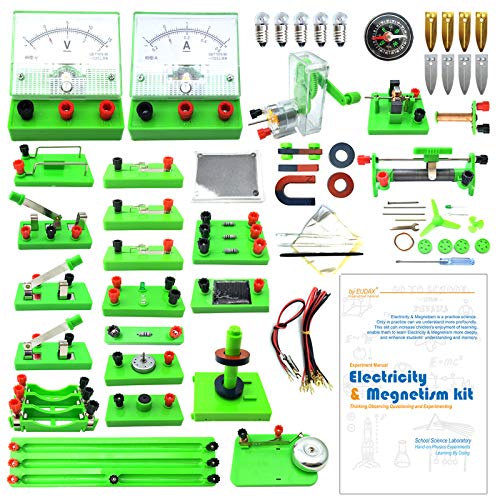
- Combines electricity and magnetism activities
- Includes 79 pieces and a color manual
- Requires three AA batteries, not included
Best For: High school introductory electromagnetism lessons
Best for Simple Machines
T&K Simple Machines Physics Set

- Includes 26 model-building exercises
- Covers all six classic simple machines
- Comes with a spring scale and 32-page manual
Best For: Hands-on lessons about force and mechanical advantage
Best Budget Magnetism Starter

- Includes 14 magnets and experiment accessories
- Features a compass and iron filings box
- Designed for ages 8 and up
Best For: Beginner magnetism stations and discovery activities
Best for Newton’s Laws
United Scientific Dynamics Carts

- Teaches velocity, acceleration, and momentum
- Includes two carts and four bumpers
- Supports varied collision experiments
Best For: Hands-on Newtonian mechanics and motion labs
Best Optics Demonstration Set

- Covers reflection and refraction demonstrations
- Includes lenses, prism, reflector, and light source
- Compact kit for learners aged 14 and up
Best For: Introductory classroom optics lessons
Best Comprehensive Mechanics Kit
26-Experiment Physics Mechanics Lab Set

- Supports 26 classical mechanics experiments
- Includes pulleys, balance, trolley, ramp, and gauges
- Designed for middle- and high-school lab work
Best For: Broad classroom mechanics instruction
Best Laser Optics Kit
Prisms and Triple-Light Refraction Set

- Demonstrates reflection and refraction with visible beams
- Includes lenses, prism, glass block, and reflector
- Comes with a 360-degree angle diagram
Best For: Visual physical-optics demonstrations
Hands-On Mechanics Pick

- Includes fixed and movable pulleys with ropes and hooks
- Supports single- and double-pulley classroom setups
- Iron components suit repeated middle school demonstrations
Best For: Middle school lessons on pulley systems and basic mechanics
Complete Electricity Bundle
Electricity and Magnetism STEM Kit

- Provides 55 items for more than 50 suggested experiments
- Includes circuit, LED, magnetic-switch, and electromagnet activities
- Comes with an illustrated manual and organized storage case
Best For: Teen students learning introductory electricity and magnetism
Magnetism Investigation Set
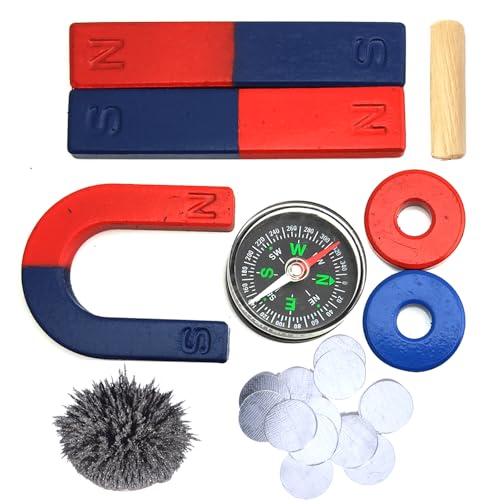
- Includes horseshoe, bar, and ring magnets plus a compass
- Supports attraction, repulsion, and magnetic-field activities
- Provides iron pieces, iron powder, and bilingual manuals
Best For: High school investigations of magnetic interactions and fields
Best Complete Electricity & Magnetism Kit – EUDAX Electricity and Magnetism Labs
For classrooms seeking physics experiment sets for classrooms that cover more than one topic, this EUDAX kit combines introductory electricity and magnetism activities. Its 79 pieces, color manual, and project ideas support hands-on work for students in grades 9–11, although three AA batteries are required and not included.
Best For: High school introductory lessons on circuits, electromagnetism, and basic electronics.
Pros:
- Covers both electricity and magnetism in one kit.
- Includes components for series and parallel circuits, fruit batteries, electromagnets, electric bells, and more.
- Includes a color-page manual, storage bag, and repair tools.
Cons:
- Requires three AA batteries, which are not included.
- The broad selection may require teacher planning and setup.
This is a versatile choice when a classroom wants one set for several introductory electromagnetism investigations. It offers strong activity variety, provided the teacher supplies batteries and organizes the components.
Best for Simple Machines – T&K Simple Machines Physics Set
This T&K set is a practical option among physics experiment sets for classrooms, using model building to introduce the six classic simple machines. Students complete 26 exercises and use the included spring scale to examine how machines affect the direction and magnitude of forces.
Best For: Elementary and middle school lessons on levers, pulleys, gears, and mechanical advantage.
Pros:
- Explores wheels and axles, levers, pulleys, inclined planes, screws, and wedges.
- Includes a force-measuring spring scale for quantitative activities.
- Provides a 32-page, full-color manual with step-by-step instructions.
Cons:
- Focuses on simple machines rather than a broad range of physics topics.
- Model-building activities may require classroom time for assembly.
With its structured exercises and measurement component, this kit fits classrooms that want students to build, test, and connect machines to familiar real-world examples. Its modular pieces may also work with compatible Thames & Kosmos construction systems.
Best Budget Magnetism Starter – Sntieecr Junior Magnetism Set
For teachers looking for compact physics experiment sets for classrooms, this Sntieecr magnetism set provides a focused collection of magnets and accessories. Students can investigate attraction, magnetic fields, compasses, and related observations using the included pieces plus common items such as paper, rulers, or pens.
Best For: Beginner magnetism demonstrations and open-ended STEM activities for students ages 8 and up.
Pros:
- Includes bar, U-shaped, ring, and magnetic car pieces.
- Provides a compass and iron filings box for visual exploration.
- Compact set supports classroom or home learning.
Cons:
- Focused on magnetism rather than electricity or broader physics topics.
- Some activities require additional everyday tools.
This is a straightforward starter set for introducing magnetic forces and encouraging student questions. It is best suited to short investigations, learning stations, or guided discovery rather than a complete physics curriculum.
Best for Newton’s Laws – United Scientific Dynamics Carts
These dynamics carts are a focused choice among physics experiment sets for classrooms, giving students a way to investigate motion through direct collision experiments. The pair supports lessons on velocity, acceleration, Newton’s laws, friction, and conservation of momentum.
Best For: Classroom motion labs involving collisions, momentum, and Newtonian mechanics.
Pros:
- Includes two 6-inch carts with low-friction snap-in wheels.
- Spring steel and rubber bumpers allow varied collision setups.
- Deep weight wells support experiments involving changing mass.
Cons:
- Provides carts and bumpers rather than a full measurement system.
- The set is specialized for dynamics and does not cover other physics units.
This set is a useful building block for structured motion demonstrations and lab activities. Teachers may need to pair it with measuring tools or additional classroom materials for more detailed data collection.
Best Optics Demonstration Set – Optical Experiment Set
For classrooms looking for physics experiment sets for classrooms focused on light, this compact optics kit provides lenses, a prism, mirrors, and an adjustable three-way light source. It supports demonstrations of reflection and refraction without requiring a large laboratory footprint.
Best For: Teachers and students aged 14 and up studying introductory physical optics and light behavior.
Pros:
- Supports multiple reflection and refraction demonstrations, including convex and concave lens activities.
- Includes three biconvex lenses, concave and convex lenses, a triangular prism, acrylic tile, reflector, and light source.
- Compact, lightweight design with an English color-page manual.
Cons:
- Requires two AAA batteries, which are not included.
- The components are primarily acrylic, metal, and plastic rather than full-size laboratory equipment.
This is a practical choice when a classroom needs a focused, portable optics demonstration kit. The adjustable light source and variety of lenses make it especially useful for visual explanations of core concepts.
Best Comprehensive Mechanics Kit – 26-Experiment Physics Mechanics Lab Set
Among physics experiment sets for classrooms, this mechanics lab set stands out for its broad coverage of classical physics. Its balance, pulleys, force gauge, trolley, ramp, pressure gauge, and other tools support hands-on investigation rather than demonstration alone.
Best For: Middle- and high-school classrooms, independent study, and lab activities covering mechanics, forces, pressure, buoyancy, and simple machines.
Pros:
- Designed for 26 experiments involving Newton’s Laws, kinematics, gravity, friction, pressure, and buoyancy.
- Includes varied equipment such as a tray balance, pulleys, lever ruler, spring dynamometer, trolley, ramp, and U-tube pressure gauge.
- Comes with a professional manual and organized storage box.
- Metal and plastic construction is intended for repeated classroom use.
Cons:
- Recommended for ages 14 and up, so it may be too advanced for younger students.
- Its larger range of components may require more setup and storage space than a single-topic kit.
This is the strongest all-around option of the three for a classroom building a broader mechanics program. It offers enough equipment to connect textbook principles with measurable, hands-on activities.
Best Laser Optics Kit – Prisms and Triple-Light Refraction Set
This optics-focused choice among physics experiment sets for classrooms combines a three-way laser light source with lenses, a prism, an acrylic glass block, and a multifunctional reflector. The visible beams are intended to make reflection, refraction, and changes in light direction easier to demonstrate.
Best For: Students aged 15 and up learning physical optics through visible laser-light demonstrations.
Pros:
- Covers plane, diffuse, convex-mirror, and concave-mirror reflection along with several refraction activities.
- Three-way light source produces bright, clear beams with adjustable direction.
- Includes an acrylic glass block, multiple lenses, triangular prism, reflector, and 360-degree angle diagram.
Cons:
- Batteries are not included and must be supplied separately.
- The manufacturer recommends it for ages 15 and up.
- It is specialized for optics rather than general physics topics.
The clear, adjustable beams make this a useful visual teaching aid when students need to see how light changes direction between media. Choose it over the other optics set if the included angle diagram and laser-style light source fit your lesson plans.
Hands-On Mechanics Pick – Pulley Lab Set
For classrooms looking for physics experiment sets for classrooms focused on basic mechanics, this pulley kit provides the core components for demonstrating force direction, load handling, and pulley arrangements. Its fixed and movable pulleys support practical assembly and observation during middle school lessons.
Best For: Middle school mechanics demonstrations involving fixed, movable, single, and double pulley systems.
Pros:
- Includes 4 fixed pulleys, 4 movable pulleys, 4 ropes, and 8 hooks.
- Supports both single- and double-pulley setups.
- Iron construction is suited to repeated classroom handling.
- Helps students connect rope movement with lifting tasks and force direction.
Cons:
- Focused on pulley mechanics rather than a broad range of physics topics.
- Teachers must assemble the experimental arrangements.
This is a practical choice when a lesson needs multiple pulley stations or flexible demonstrations. It is most useful for teachers who already have weights and other measurement materials available.
Complete Electricity Bundle – Electricity and Magnetism STEM Kit
For teachers seeking physics experiment sets for classrooms that cover electricity and magnetism, this 55-piece kit offers a broad, hands-on starting point. It includes circuit-oriented modules and a manual designed to guide students through more than 50 experiments and exploratory activities.
Best For: Students ages 13–18 exploring circuits, electromagnets, magnetic switches, LEDs, and introductory STEM concepts.
Pros:
- Includes 55 items and a manual with more than 50 suggested experiments.
- Covers topics such as light-controlled LEDs, magnetic switches, and Joule’s first law.
- Manual explains both what to do and why the experiments work.
- Solid storage case keeps components organized for classroom or group use.
Cons:
- The kit is centered on electricity and magnetism, not general physics.
- Its plastic, metal, and silicon components may require careful organization after activities.
Among these options, this is the broadest choice for introductory electrical and magnetic investigations. The guided manual and storage case make it particularly convenient for structured student projects and rotating classroom groups.
Magnetism Investigation Set – Classroom Magnets Kit
For physics experiment sets for classrooms centered on magnetism, this kit supplies several magnet shapes plus observation materials for interactive investigations. Students can explore attraction, repulsion, magnetic fields, and compass behavior through guided activities.
Best For: High school physics lessons on magnetic interaction, field observation, and introductory STEM investigations.
Pros:
- Includes horseshoe, bar, and ring magnets, along with a compass.
- Iron pieces and iron powder support magnetic-field and attraction activities.
- Suggested investigations include attraction versus repulsion and interactive forces.
- Provides both Chinese and English manuals.
Cons:
- Ferrite magnets are hard and brittle, so they should not be dropped.
- The 13-piece set is specialized for magnetism rather than a complete physics curriculum.
- Butterfly pieces are supplied randomly.
This compact set is a focused supplement for demonstrations where students need to see magnetic effects directly. Its assortment of shapes and field-viewing materials gives teachers more variety than a basic pair of bar magnets.
How We Picked These Physics Experiment Sets for Classrooms
We focused on kits that support repeatable, curriculum-linked activities rather than one-off demonstrations. The selection covers core classroom topics including electricity, magnetism, Newton’s laws, mechanics, pulleys, optics, refraction, reflection, and simple machines.
We also considered the usefulness of included components, the likelihood that students can work in pairs or small groups, the clarity of the intended experiments, and whether a set is better suited to elementary, middle school, or high school instruction. Because kit contents and packaging can vary, teachers should verify the current component list before ordering.
Quick Comparison
| Lesson Focus | Best Kit Type | Typical Classroom Use |
|---|---|---|
| Electricity and circuits | Basic electricity discovery kit | Series and parallel circuits, conductivity, and electromagnetism |
| Magnetism | Magnet set or junior magnetism kit | Magnetic fields, attraction, repulsion, and compass activities |
| Forces and motion | Dynamics carts or mechanics kit | Newton’s laws, acceleration, force, and momentum demonstrations |
| Simple machines | Engineering or pulley set | Mechanical advantage, work, balance, and lifting-force experiments |
| Optics | Light, lens, prism, and mirror set | Reflection, refraction, focal length, and color or beam-path studies |
Key Buying Factors for Physics Experiment Sets for Classrooms
Match the Kit to Your Curriculum
Choose equipment that directly supports upcoming lessons. A circuits kit is more useful for an electricity unit, while carts and force gauges are better for motion and Newton’s laws. Optics sets should include the specific lenses, mirrors, prisms, or light sources required for your activities.
Check Age Level and Supervision Needs
Look for simple, robust components for younger students and more adjustable equipment for advanced classes. Small magnets, sharp-edged parts, batteries, lasers, and glass or optical components may require close supervision and clear safety procedures.
Consider Group Size and Durability
One kit may serve a demonstration, a pair, or a full lab group. For active classrooms, prioritize sturdy carts, frames, connectors, and measuring tools. If several groups will work simultaneously, buying multiple identical kits usually makes lesson planning easier.
Assess Storage and Replacement Needs
Organized cases or labeled compartments can reduce setup time. Before purchase, confirm whether consumables, batteries, ropes, connectors, or replacement parts are included or readily available.
Who Should Buy Which Physics Experiment Sets for Classrooms?
Teachers introducing basic STEM concepts may prefer junior magnetism, electricity, or simple-machine sets with accessible experiments. Middle school classrooms can benefit from pulley, mechanics, dynamics-cart, and combined physics kits that support measurement and guided investigation. High school instructors should look for more versatile electricity, optics, and force equipment that allows students to vary conditions, record data, and analyze results.
For a broad program, combine kits rather than expecting one set to cover every physics unit. A circuits or magnetism kit pairs well with a mechanics set, while an optics kit adds a distinct area of study. If budget is limited, start with the topic most frequently taught and expand with specialized equipment as classroom demand grows.