The best weather stations for classrooms turn abstract weather concepts into observations students can see, record, and discuss. The options in this roundup range from tactile teaching aids and experiment sets to wireless displays that monitor indoor and outdoor conditions.
Use this guide to match your grade level, lesson goals, available space, and budget with a classroom-friendly station that supports repeatable measurements and engaging science activities.
Best 10 Weather Stations for Classrooms Picks for 2026
Hands-On Pick

- Five tools for wind, rain, temperature, and direction
- Includes a 32-page experiment manual
- Designed for ages 6–12 and outdoor measurements
Best For: Elementary meteorology and STEM activities
Data Display Pick
La Crosse Wireless Forecast Station

- Wireless indoor and outdoor temperature and humidity
- Color forecast icons and pressure-trend predictions
- Includes alerts, records, and adjustable backlight
Best For: Ongoing digital classroom weather tracking
Morning Meeting Pick
Learning Resources Weather Tracker

- Visual chart for daily weather and calendar routines
- Supports seasons, temperature, and weather vocabulary
- Hangs on a wall, whiteboard, or learning station
Best For: Preschool and kindergarten weather discussions
Large-Display Pick
DreamSky Wireless Weather Station

- Large colorful display for temperature and forecast data
- Supports up to three outdoor sensors
- Includes alerts, records, adjustable brightness, and backup power
Best For: Visible classroom monitoring of indoor and outdoor conditions
Best Hands-On Weather Board
Wooden Weather Station Cognitive Board

- Interactive board covers weather, seasons, months, and wind
- Includes 24 illustrated cards for weather diary activities
- Wooden, screen-free design for ages 3 to 7
Best For: Preschool weather lessons and daily observation routines
Best Display-Based Station
Newentor Wireless Indoor Outdoor Thermometer

- Color LCD shows temperature, humidity, and weather details
- Wireless sensor monitors indoor and outdoor conditions
- Always-on wall-powered display supports classroom visibility
Best For: Digital weather displays and indoor/outdoor data comparisons
Best for STEM Experiments
Fafeicy DIY Weather Station Kit

- Includes wind vane, anemometer, thermometer, and rain gauge
- Supports outdoor observations and repeated experiments
- Designed for learners ages 7 to 14 in home or school settings
Best For: Hands-on STEM projects and outdoor weather data collection
Best Classroom Forecasting Display
AcuRite Vertical Weather Forecaster
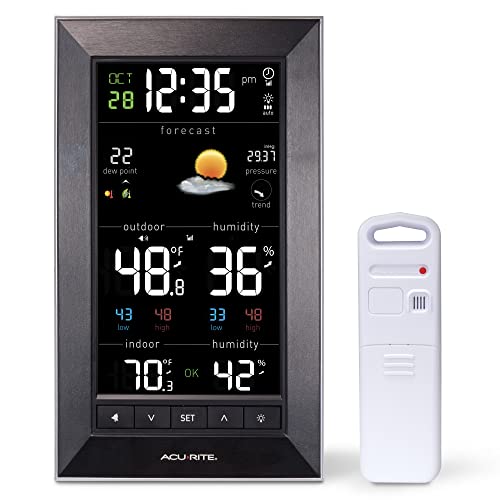
- Tracks indoor/outdoor temperature and humidity
- Adds 12-hour forecasts and barometric pressure
- Supports table or wall placement
Best For: Classroom weather tracking and time-based science lessons
Best Color Display for Group Viewing
AcuRite Wireless Color Weather Station
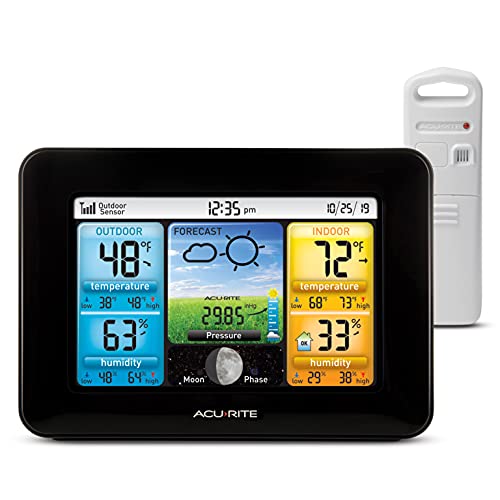
- Presents 15+ weather data points
- Uses forecast icons and trend arrows
- Includes adjustable display dimmer
Best For: Group demonstrations and weather-trend activities
Best for Humidity and Air-Quality Lessons
Wireless Thermometer Hygrometer Weather Station

- Measures temperature and humidity indoors and outdoors
- Adds heat index, dew point, and mold index
- Supports up to three wireless sensors
Best For: Humidity investigations and science lab comparisons
Hands-On Pick – T&K Weather & Climate Lab
For classrooms seeking weather stations for classrooms that support active investigation, the T&K Weather & Climate Lab combines five basic measuring tools with guided experiments. Students can take outdoor readings and connect them to lessons on weather, climate, and the water cycle.
Best For: Elementary students ages 6–12 learning meteorology through hands-on STEM activities.
Pros:
- Includes a wind vane, compass, rain gauge, anemometer, and thermometer.
- Durable stake supports outdoor placement in the ground or on a pole.
- 32-page, full-color manual provides experiment ideas and recording practice.
Cons:
- The plastic construction may be less suitable for rough, continuous outdoor use.
- Students must manually observe and record the measurements.
This is a strong choice when the goal is active observation rather than an always-on digital display. Its compact design and experiment guide make it especially useful for small-group science stations.
Data Display Pick – La Crosse Wireless Forecast Station
The La Crosse Technology 308-1415C suits classrooms wanting weather stations for classrooms with an easy-to-read digital reference point. Its wireless sensor reports indoor and outdoor temperature and humidity, while the display adds forecast icons, records, and alerts.
Best For: Classrooms that want ongoing digital weather readings for discussion, comparison, and data tracking.
Pros:
- Displays indoor and outdoor temperature and humidity readings.
- Color forecast icons use barometric pressure trends for localized predictions.
- Offers customizable high/low alerts, timestamped records, and adjustable backlight levels.
Cons:
- The main unit and wireless sensor require batteries, which are not included.
- It is powered primarily by a 5V adapter rather than being fully battery-operated.
Compared with a manual experiment kit, this station is better for maintaining a visible, ongoing class weather log. Teachers should plan for an outlet and the required AA batteries during setup.
Morning Meeting Pick – Learning Resources Weather Tracker
The Learning Resources Weather Tracker Pocket Chart is a simple visual option among weather stations for classrooms. Rather than measuring conditions electronically, it helps young learners organize daily weather, temperature, seasons, months, and calendar vocabulary.
Best For: Preschool, kindergarten, homeschool, daycare, and early-elementary morning routines.
Pros:
- Supports daily weather and calendar discussions with clear visual cues.
- Provides pockets for organizing cards and routine materials.
- Can hang on a wall, whiteboard, or classroom center station.
Cons:
- It does not provide actual temperature, humidity, wind, or rainfall measurements.
- The supplied notes do not indicate that cards or measuring instruments are included.
This pocket chart works best as a language and routine tool, not as a meteorological instrument. Pairing it with an outdoor thermometer or another measuring station can add real-world data to the daily discussion.
Large-Display Pick – DreamSky Wireless Weather Station
The DreamSky Weather Station offers a large, colorful display for classrooms that want weather stations for classrooms to remain visible from a distance. It shows indoor and outdoor temperature, humidity, forecast information, time, and date, with alerts and records for continued monitoring.
Best For: Classrooms needing a readable wall, desk, or demonstration display for indoor and outdoor conditions.
Pros:
- Large display shows indoor/outdoor temperature, forecast information, and humidity.
- Supports up to three outdoor sensors, with one sensor included.
- Provides high/low temperature alerts, records, adjustable brightness, and battery backup.
Cons:
- Only one outdoor sensor is included.
- Battery-only operation dims after about 10 seconds, so continuous visibility needs the adapter.
- Its forecast is calibrated over seven days and predicts the next 12–24 hours.
This model is useful when students need to read the display from across the room. Its clock and calendar features add everyday utility, while the wireless sensor supports comparisons between indoor and outdoor conditions.
Best Hands-On Weather Board – Wooden Weather Station Cognitive Board
For classrooms introducing weather stations for classrooms to preschool learners, this wooden board turns daily observation into a simple, interactive routine. Children can identify conditions, seasons, months, wind strength, temperature changes, and clothing choices using dials and 24 illustrated cards.
Best For: Preschool weather discussions, daily weather diaries, and early learning centers for children ages 3 to 7.
Pros:
- Combines weather, seasons, months, wind, and day-and-night concepts in one board.
- Includes 24 weather, activity, and clothing cards for guided lessons.
- DIY card backs support drawing, photos, and personalized weather diaries.
- Wood construction with smooth edges is designed for repeated exploration.
Cons:
- Designed for one child at a time, so group use may require teacher-led rotation.
- It focuses on visual and manual learning rather than live outdoor measurements.
This is a strong choice when the goal is foundational weather vocabulary and observation rather than instrument-based data collection. Its durable, screen-free format fits preschool and early elementary classroom routines.
Best Display-Based Station – Newentor Wireless Indoor Outdoor Thermometer
This Newentor station suits classrooms that want a continuously visible source of indoor and outdoor readings. Its color LCD displays temperature, humidity, high and low records, time, date, barometric pressure, moon phase, and a calculated 12-to-24-hour forecast.
Best For: Teacher-led weather displays, classroom comparisons of indoor and outdoor conditions, and older students learning to read digital data.
Pros:
- Large color display presents temperature and humidity information at a glance.
- Wireless sensor supports indoor/outdoor monitoring and can expand to three channels.
- Provides daily high/low records, customizable alerts, barometric pressure, and forecast information.
- Wall power enables an always-on display, while battery mode offers quick-glance operation.
Cons:
- Only one remote sensor is included.
- Batteries are not included, and battery-only use dims after a 15-second display period.
- Forecast accuracy depends on the station’s stated 7-to-10-day calibration period.
Unlike a toy-style weather board, this model offers real-time classroom reference data and a broad set of clock and weather functions. It is most useful where students can regularly read, record, and compare measurements.
Best for STEM Experiments – Fafeicy DIY Weather Station Kit
For hands-on weather stations for classrooms, the Fafeicy kit gives learners practical instruments to assemble and use. The set includes a wind vane, anemometer, thermometer, and rain gauge, allowing students to observe wind direction, wind movement, rainfall, and temperature.
Best For: STEM activities, outdoor observation, and science projects for children ages 7 to 14.
Pros:
- Combines four core observation tools in one lightweight plastic kit.
- Encourages repeated measurements of wind, rain, and temperature.
- Supports additional bottle greenhouse-effect testing and a feeding-box project.
- Portable design can move between classroom tables and outdoor activities.
Cons:
- Assembly is part of the activity, so younger students may need adult guidance.
- The supplied details do not list included components beyond the kit itself.
- It is intended for observation and learning rather than professional-grade measurement.
This kit is a better fit than a display-only station for classrooms emphasizing experimentation and student participation. Its multiple sensors create opportunities for observation logs, comparisons, and follow-up STEM discussions.
Best Classroom Forecasting Display – AcuRite Vertical Weather Forecaster
For classrooms seeking weather stations for classrooms that combine daily observations with timekeeping, this AcuRite model offers indoor and outdoor temperature, humidity, barometric pressure, and forecast information in one vertical display. Its large LCD, wireless sensor, and automatic clock make it practical for a science wall or demonstration table.
Best For: Classroom weather tracking, calendar and time lessons, and students comparing indoor and outdoor conditions.
Pros:
- Displays indoor/outdoor temperature and humidity with daily highs and lows.
- Provides a personalized 12-hour forecast based on current conditions.
- Includes automatic time and daylight-saving updates.
- Offers table or wall placement, with wireless sensor transmission up to 330 feet.
Cons:
- Requires three AAA batteries.
- The display is corded electric, so placement near an outlet may be necessary.
- Its home-oriented design may provide more features than needed for a simple thermometer lesson.
With more than 20 data points, programmable alarms, and a clear vertical layout, this is a strong choice when the classroom needs a dedicated, always-visible weather center rather than a basic temperature monitor.
Best Color Display for Group Viewing – AcuRite Wireless Color Weather Station
This AcuRite model is a useful option for classrooms comparing multiple weather variables at a glance. Its illuminated color LCD presents temperature, humidity, pressure trends, forecast icons, moon phase, and records in a format that can be placed on a desk, shelf, or wall.
Best For: Group demonstrations, weather journals, and classrooms where color-coded information can help students interpret trends.
Pros:
- Shows more than 15 data points, including indoor/outdoor temperature and humidity.
- Color display includes forecast icons, trend arrows, and moon phase information.
- Adjustable dimmer helps tailor screen brightness for classroom use.
- Wireless outdoor sensor is designed for simple setup and placement.
Cons:
- Outdoor sensor requires two AA batteries, which are not included.
- The display is smaller than some dedicated wall-sized classroom displays.
- Its forecast and moon-phase features may be unnecessary for basic measurement activities.
The readable color screen makes this a particularly engaging pick for shared viewing. Choose it when visual presentation and a broad set of weather indicators matter as much as taking temperature readings.
Best for Humidity and Air-Quality Lessons – Wireless Thermometer Hygrometer Weather Station
For weather stations for classrooms that emphasize humidity and microclimate concepts, this wireless thermometer and hygrometer provides detailed readings in a compact display. It measures indoor and outdoor temperature and humidity while also showing heat index, dew point, and mold index information.
Best For: Science labs, humidity investigations, greenhouse or garden observations, and lessons involving dew point or heat index.
Pros:
- Uses a high-precision Sensirion sensor with stated temperature and humidity accuracy.
- Displays heat index, dew point, and mold index for supported locations.
- Wireless sensor transmits updates within a range of up to 330 feet.
- Supports up to three sensors on separate channels.
Cons:
- Backlight illuminates for only 10 seconds when activated.
- Three AAA batteries are required and excluded.
- The compact screen may show less information at once than a larger classroom display.
This model stands out for lessons that go beyond temperature. Its extra humidity-related indexes and multi-sensor support make it flexible for comparing rooms, outdoor areas, or laboratory locations.
How We Picked the Best Weather Stations for Classrooms
We focused on how well each option supports classroom learning, not just how many readings it displays. Our selection includes hands-on kits for introducing weather instruments, visual tools for younger students, and electronic stations that make ongoing temperature, humidity, time, and forecast observations easy to track.
We also considered setup, readability, sensor range, durability, battery dependence, and whether a product encourages students to collect and interpret data. Because classroom needs vary widely, this list includes both simple teaching tools and more capable home-style weather monitors that can serve as a classroom data source.
Quick Comparison
| Best For | Recommended Type | What to Prioritize |
|---|---|---|
| Early elementary learners | Weather board or pocket chart | Large visuals, simple symbols, and daily participation |
| Hands-on science activities | Experiment or DIY station | Working instruments and guided observation |
| Daily data collection | Wireless digital station | Readable display, reliable sensor, and memory or trend data |
| Small classrooms | Compact monitor | Simple placement and low maintenance |
Key Buying Factors for Weather Stations for Classrooms
Learning Objective
Choose a teaching board or pocket chart when the goal is vocabulary, sequencing, and daily weather discussion. For measurement lessons, select a kit with instruments such as a thermometer, rain gauge, wind vane, or anemometer. Digital stations are better suited to comparing indoor and outdoor readings over time.
Readability and Display Design
Students should be able to read the main information from their seats. Large digits, high contrast, color coding, and uncluttered layouts matter more than a long list of advanced features. A station with too many small indicators may be difficult for younger learners.
Sensor Placement and Reliability
Wireless models require thoughtful placement. Check the stated transmission range, keep the outdoor sensor protected from direct weather exposure where appropriate, and install it where students can observe conditions safely. A consistent measurement routine is more valuable than occasional readings from a poorly positioned sensor.
Power, Maintenance, and Durability
Battery-powered products are convenient but need a replacement plan. Look for sturdy construction, accessible controls, and components that can withstand frequent handling. For experiment kits, confirm whether accessories or consumable materials are included.
Who Should Buy Which Weather Stations for Classrooms?
Buy a visual weather board or pocket chart if you teach younger children and want a quick daily activity involving symbols, vocabulary, and classroom discussion.
Choose a DIY or experiment station for elementary science units that emphasize building, observing, recording, and explaining how weather instruments work.
Choose a wireless digital station when students need real temperature and humidity readings for charts, math exercises, comparisons, or longer-term projects.
Choose a compact indoor/outdoor monitor when space and budget are limited but you still want students to compare classroom conditions with the outdoors. Before ordering, verify display size, sensor requirements, measurement units, and whether the included setup matches your lesson plan.