Finding the best 3D scanner for small objects means balancing fine detail, reliable tracking, scanning speed, and software that can produce usable models. The right choice depends on whether you are digitizing miniatures, mechanical parts, collectibles, or objects for 3D printing.
This roundup compares 10 handheld and portable scanners across different accuracy levels, scanning technologies, workflows, and budgets so you can choose with greater confidence.
Best 10 3d Scanner for Small Objects Picks for 2026
Best All-Around Pick

- 0.05mm accuracy with up to 30fps scanning
- Scans dark and metallic surfaces without spray
- 24-bit color and broad object-size range
Best For: Makers who want versatile small- and large-object scanning
Best for Detail and Speed

- 0.03mm precision for small parts and figurines
- Up to 110fps through USB 3.0
- Built-in touchscreen with dual-light scanning
Best For: Detail-focused creators and portable scanning workflows
Best Beginner-Friendly Option
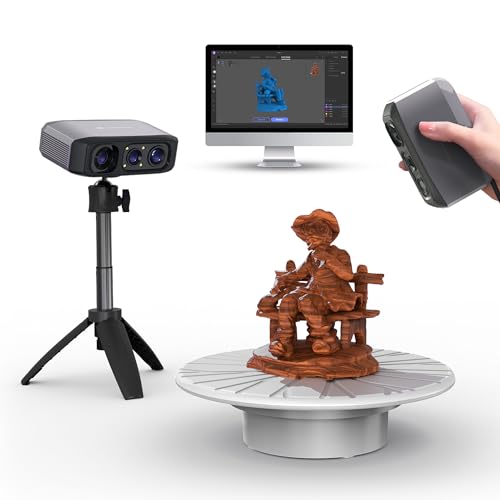
- 0.05mm precision with 10fps scanning
- AI tracking and automated model repair
- Marker-free scanning with anti-shake support
Best For: Beginners who want a simpler handheld workflow
Best Portable Performance

- 0.03mm accuracy with blue-laser scanning
- Up to 110fps and marker-free PC scanning
- Wireless, touchscreen-equipped, and battery-powered
Best For: Mobile makers scanning detailed parts and larger subjects
Best Precision Pick
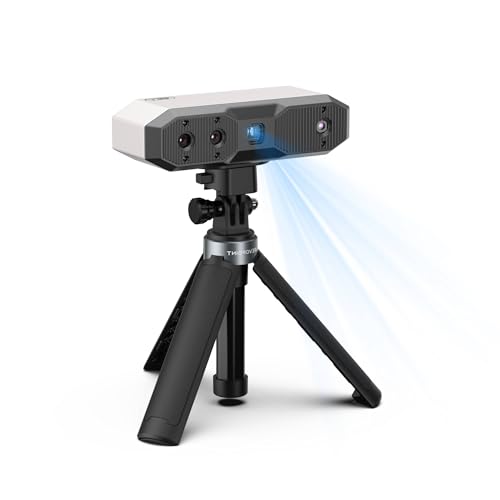
- Up to 0.02 mm single-frame precision
- 175 g portable design with USB-C and Wi-Fi 6
- Supports detailed color scans and 3D-printing formats
Best For: Detailed small parts, miniatures, and portable 3D-printing workflows
Best Versatility Pick

- 17-line blue laser scans small objects up to 90 fps
- Infrared mode handles larger, black, and outdoor subjects
- Wireless battery supports up to 3 hours of scanning
Best For: Mixed-size projects and challenging black or reflective materials
Best All-in-One Upgrade

- Near mode captures tiny details; Far mode handles large surfaces
- Integrated processing, display, and 256GB storage
- Optional photogrammetric kit supports detailed measurement workflows
Best For: Advanced users scanning tiny parts, large objects, and measured assemblies
Most Versatile

- 0.03mm blue-laser accuracy mode
- Scans 5mm to 2000mm objects
- Wireless, portable, AI-assisted workflow
Best For: Small precision parts and mixed-size scanning
Easiest Desktop Pick

- 0.1mm precision with anti-shake capture
- One-click operation for beginners
- 24-bit color and dark-object scanning
Best For: Computer-based beginner scanning
Best Mobile Workflow

- 0.1mm high-accuracy scanning mode
- Android-compatible mobile scanning
- Full color with up to 30 FPS point capture
Best For: Portable Android-based scanning
Best All-Around Pick – Creality Otter Lite Basic
The Creality Otter Lite Basic is a versatile 3d scanner for small objects, especially when you want detailed color scans without coating dark or metallic surfaces. Its 0.05mm accuracy, quad-camera design, and broad scanning range also make it suitable for larger projects.
Best For: Makers, reverse engineering, 3D printing, prototyping, and full-color scans of objects ranging from coins to larger parts.
Pros:
- 0.05mm accuracy and scanning speeds up to 30fps.
- Can scan dark and metallic objects without spray.
- Captures 24-bit color and supports marker, geometry, and texture alignment.
- Works with Windows, macOS, iOS, and Android.
Cons:
- Optional Scan Bridge handle is sold separately.
- Its maximum speed is lower than the Pika models listed here.
Choose the Otter Lite Basic if flexibility matters more than peak speed. It combines small-object detail, large-object coverage, and color capture in a single handheld scanner.
Best for Detail and Speed – Creality Pika Portable
The Creality Pika Portable is a high-speed 3d scanner for small objects such as models, figurines, coins, and precision parts. Its blue-laser mode is designed for fine contours, while NIR structured light adds flexibility for body scanning and other larger subjects.
Best For: Detail-focused creators, product designers, 3D printing enthusiasts, and users who want portable scanning with a built-in display.
Pros:
- 0.03mm precision for capturing small details.
- Blue-laser scanning reaches up to 110fps with a USB 3.0 computer.
- Built-in 3-inch touchscreen and Wi-Fi 6 support on the go.
- Includes AI retexturing, hole filling, and body-completion features.
Cons:
- Maximum 110fps speed requires USB 3.0 computer connection.
- Mobile scanning speeds are lower than the computer-connected laser speed.
The Pika is a strong choice when fine detail and scanning efficiency are priorities. Its dual-light system and portable controls make it more adaptable than a scanner focused only on small parts.
Best Beginner-Friendly Option – 3DMakerpro Moose Lite Premium
The 3DMakerpro Moose Lite Premium is a practical 3d scanner for small objects when ease of use is a priority. AI visual tracking, optical anti-shake hardware, and marker-free scanning are intended to simplify the process for beginners and reduce interruptions.
Best For: New users, hobbyists, and 3D-printing projects that benefit from automated tracking and model-repair tools.
Pros:
- 0.05mm precision for detailed captures.
- AI visual tracking can help detect gaps and automate model repair.
- Optical anti-shake design supports steadier handheld scanning.
- Marker-free scanning and lifetime OTA software updates.
Cons:
- Scanning speed is listed at 10fps.
- The supplied notes do not specify supported export formats or color-capture features.
- At 3.65 pounds, it is heavier than the listed Pika scanners.
Moose Lite Premium emphasizes a forgiving workflow rather than maximum speed. It is worth considering if automated assistance and steadier scanning are more important than portability.
Best Portable Performance – Creality Pika Dual-Mode
The Creality Pika Dual-Mode is a compact 3d scanner for small objects that combines seven-line blue laser scanning with NIR structured light. It offers 0.03mm accuracy for intricate parts, up to 110fps performance, and wireless operation for flexible indoor or outdoor use.
Best For: Portable 3D-printing, reverse engineering, collectibles, mechanical parts, and users who also want body-scanning capability.
Pros:
- 0.03mm accuracy and 0.1mm 3D resolution for detailed parts.
- Up to 110fps with marker-free scanning in wired PC mode.
- Pocket-sized design with Wi-Fi 6, touchscreen, and dual swappable batteries.
- Includes AI hole filling, retexturing, and body completion.
Cons:
- Some maximum performance figures depend on wired PC operation.
- Its advanced feature set may be more than needed for basic scanning.
This Pika version is the strongest fit for users who value mobility and speed together. The included tripod, turntable, calibration board, and accessories also make it a more complete setup for varied scanning tasks.
Best Precision Pick – Revopoint MINI 2
If you need a 3d scanner for small objects, the Revopoint MINI 2 emphasizes fine detail, portability, and straightforward scanning. Its blue-light system offers single-frame precision up to 0.02 mm, while the included software supports common 3D-printing and modeling formats.
Best For: Small, detailed parts, miniatures, and 3D-printing projects where precision and portability matter.
Pros:
- Up to 0.02 mm single-frame precision and capture speeds up to 16 fps.
- RGB camera, flash LEDs, and improved marker recognition help capture color and texture details.
- Lightweight 175 g design with USB-C and Wi-Fi 6 connectivity.
- Exports to PLY, OBJ, STL, 3MF, GLTF, FBX, and ASC formats.
Cons:
- Results can vary with object material and color; scanning spray may improve results.
- Scanning is limited to objects from 10 × 10 × 10 mm up to 0.5 × 0.5 × 0.5 m.
- Revo Design scan-to-CAD software is sold separately and supports Windows only.
The MINI 2 is a focused choice for detailed small-object work, especially when a compact scanner and high nominal precision are more important than scanning very large items.
Best Versatility Pick – EINSTAR 2 Wireless 3D Scanner
The EINSTAR 2 is a flexible 3d scanner for small objects that can also handle medium and large subjects. It combines a 17-line blue-laser mode for detailed work with VCSEL infrared scanning, wireless operation, and support for challenging black or reflective surfaces without spray.
Best For: Users who want one scanner for small parts, larger objects, varied materials, and mobile scanning.
Pros:
- 17 parallel blue-laser lines support detailed small-object scanning at speeds up to 90 fps.
- VCSEL infrared mode supports larger objects, black surfaces, and outdoor scanning.
- Can scan black or reflective objects directly without scanning spray.
- Swappable built-in battery provides up to 3 hours of wireless scanning.
Cons:
- At 5.72 pounds, it is substantially less portable than compact small-object scanners.
- Wireless scanning may be affected by Wi-Fi interference; a cable connection may be needed.
- The supplied notes do not specify a precision figure for small-object capture.
Choose the EINSTAR 2 when versatility and material adaptability are priorities. Its broader scanning range makes it a practical option for buyers who may outgrow a dedicated small-object scanner.
Best All-in-One Upgrade – Revopoint MIRACO Plus
The Revopoint MIRACO Plus is an all-in-one 3d scanner for small objects that also scales to large machinery and measurement projects. Its Near mode is designed for fine details such as tiny screws, while built-in processing, photogrammetric tools, and a high-resolution color camera support more advanced workflows.
Best For: Professionals and serious hobbyists scanning both tiny components and large objects with integrated processing and measurement features.
Pros:
- Near mode captures fine details on tiny objects, while Far mode handles large surfaces.
- Photogrammetric kit supports high-detail capture on large objects and length accuracy of 0.02 mm + 0.05 mm × L(m).
- Integrated 8-core processor, 32GB RAM, 256GB storage, and 6-inch flip display reduce reliance on a computer during scanning.
- Exports to PLY, OBJ, STL, ASC, 3MF, GLTF, and FBX formats.
Cons:
- At 750 g, it is heavier than the MINI 2 for handheld small-object scanning.
- Battery life is up to 2 hours of continuous scanning.
- Revo Design scan-to-CAD software is sold separately.
The MIRACO Plus is the most capable choice here for mixed-scale scanning and portable, self-contained workflows. It makes the most sense when photogrammetry, measurement, and large-object capability justify its added size and cost.
Most Versatile – Creality Pika 3D Scanner
For shoppers seeking a 3d scanner for small objects, the Creality Pika stands out with a stated 0.03mm accuracy mode, blue-laser detail capture, and a scan range covering objects from 5mm to 2000mm. Its wireless, lightweight design also makes it practical for scanning away from a desk.
Best For: Small precision parts, mixed-size projects, and users who want wireless scanning with scan-to-print exports.
Pros:
- 7-parallel blue laser source is specified for 0.03mm accuracy and fine details.
- Scans objects from 5mm to 2000mm, covering tiny components through larger items.
- Wireless Wi-Fi 6 connectivity, 260g weight, and hot-swappable batteries support portable use.
- AI hole-filling, body completion, and exports to STL, OBJ, PLY, and ASC streamline workflows.
Cons:
- The extensive feature set may be more than casual users need.
- Battery operation requires keeping the included lithium-ion battery setup charged.
The Pika is the strongest fit here for buyers who want one compact scanner to handle both very small objects and larger subjects. Its laser mode targets detail, while the infrared mode and AI tools emphasize speed and easier model cleanup.
Easiest Desktop Pick – Creality CR-Ferret SE
The Creality CR-Ferret SE is a straightforward option for a 3d scanner for small objects, combining stated 0.1mm precision with one-click operation and anti-shake technology. It is designed for computer-connected use on Mac or Windows and captures full-color models.
Best For: Beginners, desktop users, and makers who want simple scanning of dark, metallic, or small-to-medium objects.
Pros:
- Anti-shake technology helps reduce hand-tremor interference during capture.
- Claims support for black, dark, and metallic objects without spray or markers.
- 24-bit full-color scanning uses a built-in 2MP color camera.
- One-click scanning and a 105g portable design make it approachable and easy to carry.
Cons:
- Requires a Mac or Windows computer; the supplied notes state that Ferret SE does not support mobile-phone scanning.
- Its stated 0.1mm precision is lower than the Pika’s listed 0.03mm accuracy.
Choose the CR-Ferret SE when ease of use matters more than maximum specification. Its anti-shake design and no-spray support for difficult surfaces make it a sensible desktop tool for beginners and general modeling projects.
Best Mobile Workflow – Creality CR-Scan Ferret
For a mobile-friendly 3d scanner for small objects, the Creality CR-Scan Ferret combines a high-accuracy mode rated at 0.1mm with full-color capture and Android support. Its updated firmware is also described as improving tracking and performance when capturing smaller objects.
Best For: Android users, portable scanning, and makers who need full-color models with both fine-detail and wider-range modes.
Pros:
- High-accuracy mode reaches 0.1mm precision with 0.16mm resolution.
- Firmware improvements target smoother tracking and better small-object capture.
- Up to 30 FPS point-cloud capture and an ASIC processing chip support smoother scanning.
- Supports Android mobile scanning and can be powered through a 5V power bank or compatible Android device.
Cons:
- Mobile scanning is limited to Android devices in the supplied compatibility notes; iOS support is not indicated for this model.
- Computer use requires specified hardware, operating-system, RAM, and software versions.
- Its listed 0.1mm accuracy is less precise on paper than the Pika’s 0.03mm specification.
The Ferret is a practical choice if portability and Android scanning are priorities. It offers a useful balance of small-object detail, wider coverage, processing speed, and realistic color, provided your device meets the stated requirements.
How We Picked the Best 3d Scanner for Small Objects
We compared the listed scanners by their stated accuracy, scanning technology, capture speed, supported object sizes, color capability, connectivity, and intended workflow. We also considered practical features such as wireless operation, anti-shake assistance, AI-based completion, compatibility with phones and computers, and whether a scanner is suited to detailed parts or broader objects.
Specification claims are most useful as a starting point rather than a guarantee. Real-world results also depend on surface finish, lighting, object geometry, operator movement, and post-processing software.
Quick Comparison
| Priority | Look for | Best suited to |
|---|---|---|
| Fine geometric detail | Approximately 0.03mm to 0.05mm stated accuracy | Small parts, models, miniatures, and reverse engineering |
| Fast capture | High frame rate and stable tracking | Repeated scans and larger or more complex subjects |
| Color reproduction | Full-color scanning and suitable lighting | Art, collectibles, visual archives, and textured models |
| Portable work | Wireless operation, mobile support, or an all-in-one design | Field work, workshops, and scanning away from a desk |
Key Buying Factors for a 3d Scanner for Small Objects
Accuracy and Resolution
Accuracy describes how closely captured measurements match the original object, while resolution affects how finely surface features are recorded. For small mechanical parts or detailed models, prioritize a scanner with a strong stated accuracy and a mode designed for small objects. Do not assume the smallest advertised figure applies in every scanning mode.
Tracking and Scan Technology
Blue laser, structured light, infrared, and hybrid systems each have different strengths. Laser modes can be useful for precise edges and geometry, while infrared or structured-light modes may offer easier tracking and faster coverage. Multi-mode scanners provide more flexibility, especially when one object contains both detailed and featureless areas.
Surface, Lighting, and Color
Dark, glossy, transparent, or highly reflective surfaces can be difficult for many scanners. Full-color capture is valuable when appearance matters, but it does not automatically improve geometric accuracy. Matte spray, controlled lighting, markers, or turntables may still be needed for dependable results.
Software and Workflow
Check supported operating systems, export formats, mobile compatibility, alignment tools, mesh repair, and texture handling. A highly precise scanner can be frustrating if its software is difficult to use or cannot export files cleanly to your CAD, modeling, or slicing program.
Who Should Buy Which 3d Scanner for Small Objects?
Choose a high-accuracy blue-laser or hybrid model if you primarily scan small parts, miniatures, or objects where dimensional detail matters. A compact structured-light scanner is a sensible choice for hobbyists who want a balance of detail, ease of use, and 3D-printing compatibility.
Buy a faster, broader-range scanner if you expect to move from small objects to furniture, equipment, vehicles, or people. Select a full-color model when visual texture and appearance are as important as shape. For mobile or field use, prioritize wireless connectivity, phone support, or an all-in-one scanner with processing built in.
Before buying, confirm the scanner’s minimum object size, required computer or phone specifications, included accessories, and current software support. Those details often matter more to your workflow than a headline accuracy figure alone.