The best handheld 3D scanners make it easier to capture physical objects for 3D printing, reverse engineering, design, and digital archiving. The right choice depends on accuracy, scanning speed, portability, tracking, and how much post-processing you are willing to do.
We’ve gathered 10 notable models across entry-level, wireless, full-color, laser, and structured-light categories so you can match scanner capabilities to your projects and budget.
Best 10 Handheld 3d Scanners Picks for 2026
Best Precision Pick
Creality Pika Portable 3D Scanner

- 0.03mm stated accuracy and 0.1mm resolution
- Blue-laser and NIR modes for varied scan sizes
- Wireless, AI-assisted, and marker-free workflows
Best For: Detailed 3D printing, reverse engineering, and versatile portable scanning
Best Beginner-Friendly Option
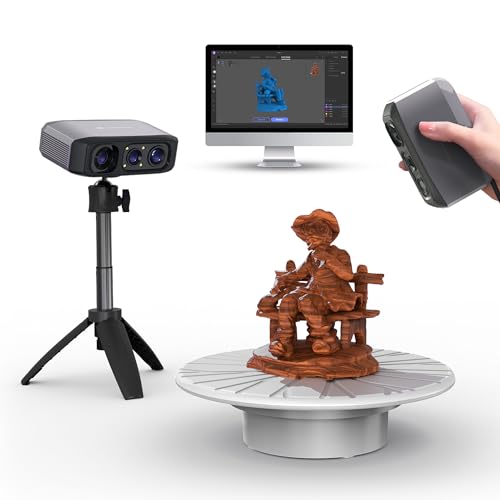
- AI visual tracking and optical anti-shake support
- Marker-free scanning with interruption recovery
- Lifetime OTA software upgrades
Best For: New users seeking a more forgiving scanning workflow
Best Standalone Professional Workflow
Revopoint MIRACO Plus 3D Scanner

- Onboard processing, storage, and 6-inch flip display
- Near and Far modes for small and large objects
- Photogrammetric kit supports precision measurement
Best For: Technical scanning, reverse engineering, and large-object measurement
Best Wireless Large-Object Scanner
Creality Otter Lite Wireless 3D Scanner

- 330g wireless design with up to 3 hours of scanning
- 30FPS capture with anti-shake and backtracking
- Quad-lens coverage for small and large objects
Best For: Mobile, cable-free scanning of varied object sizes
Best Portable Outdoor Scanner

- Dual scanning modes for varied surfaces
- 190 g design with Wi-Fi 6 connectivity
- Up to 0.05 mm accuracy and color capture
Best For: Portable outdoor scanning, 3D printing, and digital archiving
Best Large-Object Value

- Scans objects from 0.8 to 78 inches
- 30fps capture with 0.05 mm accuracy
- Handles dark and metallic surfaces without spray
Best For: Large-object scanning, inspection, and full-color models
Best High-Precision Scanner

- Up to 0.02 mm accuracy and 60fps scanning
- Blue laser and NIR modes cover varied object sizes
- Anti-shake tracking and 24-bit color capture
Best For: Reverse engineering, miniatures, automotive parts, and industrial components
Best Budget Pick

- Up to 0.1 mm accuracy
- Dual scanning modes
- Full-color texture capture
Best For: Beginners and makers seeking portable 3D scanning
Best for Professional Precision

- Up to 0.02 mm accuracy
- Scans 5 mm to 4 m objects
- Blue laser and NIR modes
Best For: Professional reverse engineering and industrial scanning
Best Wireless Option

- Wi-Fi 6 wireless scanning
- Up to 0.1 mm accuracy
- iOS, Android, and PC support
Best For: Mobile users wanting flexible wireless scanning
Best Precision Pick – Creality Pika Portable 3D Scanner
The Creality Pika is one of the most versatile handheld 3d scanners for users who need detailed captures in a compact, wireless design. Its blue-laser and NIR modes cover small parts through full-body scans, while AI tools help complete, repair, and retexture models.
Best For: Reverse engineering, 3D printing, collectibles, mechanical parts, and users who want portable scanning with high stated accuracy.
Pros:
- Up to 0.03mm scanning accuracy with 0.1mm 3D resolution.
- Dual blue-laser and NIR structured-light modes support objects from tiny parts to life-size scans.
- Wireless Wi-Fi 6 operation, a touchscreen, swappable batteries, and support for outdoor scanning.
- AI body completion, retexturing, and hole filling can streamline model preparation.
Cons:
- The broad feature set may require time to learn.
- Its smallest dimensions and highest accuracy claims may depend on the selected scanning mode and workflow.
The Pika stands out when accuracy, portability, and flexible scanning modes matter more than keeping the setup simple. It is a strong all-around option for makers and professionals working across varied object sizes.
Best Beginner-Friendly Option – 3DMakerpro Moose Lite Premium
The 3DMakerpro Moose Lite Premium is a practical choice among handheld 3d scanners for users who value assisted tracking and a simpler scanning process. AI visual tracking, optical anti-shake hardware, and marker-free operation are designed to reduce common beginner hurdles.
Best For: Beginners and hobbyists who want marker-free scanning, interruption recovery, and software updates across Windows, MacOS, Android, and iOS.
Pros:
- AI visual tracking can help detect vulnerabilities and support automated model repair.
- Optical anti-shake modules make handheld scanning more forgiving.
- Marker-free technology avoids the need to place reference markers.
- JMStudio software includes lifetime free OTA upgrades and a re-scanning function.
Cons:
- The supplied specifications list 0.05mm precision and 10FPS scanning, which may be less suitable for fast-moving workflows.
- At 3.65 pounds, it is heavier than several compact portable scanners.
Moose Lite Premium focuses on ease of use rather than a long list of advanced capture modes. Its tracking aids and recovery features make it worth considering when a more approachable scanning workflow is the priority.
Best Standalone Professional Workflow – Revopoint MIRACO Plus 3D Scanner
The Revopoint MIRACO Plus is a self-contained option among handheld 3d scanners, combining onboard processing, storage, scanning, and editing features. Its near and far modes, photogrammetric kit, and integrated display make it suited to measurement-heavy work across small and large objects.
Best For: Reverse engineering, product design, large-object measurement, and users who want an all-in-one scanner with photogrammetric capabilities.
Pros:
- Photogrammetric metrology kit supports large-object measurement and small-detail capture.
- Near and Far scanning modes cover tiny parts through large machinery.
- Integrated 8-core processor, 32GB RAM, 256GB storage, and a 6-inch 2K AMOLED flip screen reduce reliance on a computer during capture.
- Supports up to 20FPS continuous scanning and exports to formats including PLY, OBJ, STL, 3MF, GLTF, and FBX.
Cons:
- The Revo Design scan-to-CAD software is sold separately.
- At 750g, it is heavier than the most compact handheld models.
- The photogrammetric workflow uses targets and scale bars, adding setup steps.
MIRACO Plus is a strong fit for users who want substantial capability without carrying a separate computer for every scan. Its measurement kit and onboard hardware are especially compelling for technical and professional workflows.
Best Wireless Large-Object Scanner – Creality Otter Lite Wireless 3D Scanner
The Creality Otter Lite is a portable choice among handheld 3d scanners for users who want cable-free scanning and stable tracking. Its quad-lens system handles both small details and larger surfaces, while anti-shake tracking and backtracking help maintain continuity during freehand scans.
Best For: Wireless scanning of furniture, sculptures, car tires, figurines, jewelry, and other small-to-large objects.
Pros:
- Wi-Fi 6 wireless transmission provides a cable-free workflow with stated latency under 10ms.
- 330g body, 3-hour battery life, and 40W HyperCharge support mobile scanning.
- 30FPS capture, anti-shake tracking, and intelligent backtracking help with larger or interrupted scans.
- Quad-lens design supports both fine details and large objects, with full-color scanning and dedicated face and body modes.
Cons:
- The supplied notes do not specify a scanning accuracy or 3D resolution figure.
- Wireless operation depends on the included Wi-Fi and Pogo Pin workflow rather than a traditional USB connection.
Otter Lite prioritizes mobility and smooth tracking over a published high-accuracy specification. It is a sensible choice for users who frequently move around larger subjects or need a lightweight scanner for varied everyday projects.
Best Portable Outdoor Scanner – Revopoint INSPIRE 2
The Revopoint INSPIRE 2 is a lightweight option for shoppers comparing handheld 3D scanners for mobile work, outdoor projects, 3D printing, and detailed modeling. Its dual scanning modes, wireless connectivity, color capture, and support for reflective or dark surfaces make it adaptable across a range of tasks.
Best For: Portable outdoor scanning, 3D printing, reverse engineering, and full-color digital archiving.
Pros:
- Dual infrared structured-light and multi-line laser scanning modes handle varied materials and object sizes.
- 11 infrared laser lines can capture reflective or dark surfaces without scanning spray.
- Lightweight 190 g design with Wi-Fi 6 connectivity supports mobile scanning and remote streaming.
- Up to 0.05 mm accuracy, full-color texture capture, and optical zoom support detailed models.
Cons:
- Revo Design scan-to-CAD software is sold separately and supports Windows only.
- Recommended computer specifications are relatively demanding, including 16 GB RAM and an RTX 3060-class GPU for Windows.
INSPIRE 2 stands out when portability and outdoor flexibility matter. It is a strong fit for users who want a versatile scanner-to-CAD workflow, provided their computer or mobile device meets the listed requirements.
Best Large-Object Value – Creality Otter Lite Basic
The Creality Otter Lite Basic is a practical choice among handheld 3D scanners for users who need to move from small objects to automotive-sized projects. Its quad-camera design, 30fps scanning, and direct capture of dark or metallic surfaces give it broad coverage for design, inspection, and creative work.
Best For: Scanning objects from coins to cars, full-color models, reverse engineering, and quality inspection.
Pros:
- 0.05 mm accuracy and scanning speeds up to 30fps support detailed, efficient capture.
- Quad-camera setup covers objects from 0.8 to 78 inches, with a large single-frame capture area.
- DOE structured light can scan dark, shiny, and metallic surfaces without spray.
- 24-bit color capture, multiple alignment modes, and broad export format support add workflow flexibility.
Cons:
- The optional Scan Bridge handle is sold separately for added stability during extended sessions.
- Warranty coverage is listed as one year.
Otter Lite Basic is compelling for buyers who want one handheld scanner to cover both small and large subjects. Its broad size range and no-spray surface handling are especially useful for mixed-object workflows and outdoor industrial applications.
Best High-Precision Scanner – Creality CR-Scan Raptor
The Creality CR-Scan Raptor targets shoppers seeking handheld 3D scanners with high precision and fast capture. Its blue laser and NIR modes cover subjects from tiny parts to large components, while anti-shake tracking, autofocus, and marker-free scanning can simplify demanding handheld workflows.
Best For: High-precision reverse engineering, miniatures, automotive parts, faces, and large industrial components.
Pros:
- Blue laser scanning reaches up to 0.02 mm accuracy and up to 60fps.
- Dual blue-light and NIR technologies support objects from 5 mm to 2,000 mm.
- Anti-shake tracking and autofocus help reduce tracking loss and defocus during movement.
- 24-bit color capture with 12 circular LED texture lights supports detailed models in low light.
Cons:
- Compatibility is listed for Windows and macOS, with demanding recommended hardware requirements.
- Android use requires Android 10 or newer, a Snapdragon 888 or better, 8 GB RAM, and Wi-Fi 6.
- Warranty coverage is listed as one year.
Raptor is the strongest precision-focused option in this group, particularly for users scanning small mechanical details or larger industrial objects. Its performance depends on meeting the recommended computer or Android specifications, so check system compatibility before buying.
Best Budget Pick – Creality CR-Scan Ferret
The Creality CR-Scan Ferret is a practical entry point for shoppers comparing handheld 3d scanners for 3D printing, detailed object capture, and portable use. Its dual scanning modes balance broad coverage with up to 0.1 mm accuracy, while the built-in RGB camera adds full-color texture capture.
Best For: Beginners, makers, and 3D-printing users who want a lightweight scanner with color capture and flexible Android or computer connectivity.
Pros:
- High-accuracy mode reaches up to 0.1 mm precision with 0.16 mm resolution.
- Dual-mode scanning supports both larger objects and fine details.
- Built-in RGB camera captures realistic, full-color textures.
- Can be powered through a 5V power bank for portable scanning.
Cons:
- Mobile scanning is limited to compatible Android devices; iOS support is listed for the Ferret Pro.
- Requires relatively modern hardware, including at least 8GB of RAM for listed computer and Android setups.
The Ferret stands out as a compact, versatile option for everyday scanning and 3D-printing workflows. Its requirements and Android-focused mobile support are worth checking before purchase.
Best for Professional Precision – Creality CR-Scan Raptor Pro
The Creality CR-Scan Raptor Pro is aimed at demanding users evaluating handheld 3d scanners for reverse engineering, industrial design, automotive work, and other precision-focused applications. Its blue-laser and NIR modes support objects from 5 mm to 4 m, with accuracy reaching 0.02 mm.
Best For: Professional users who need high precision, broad size compatibility, fast capture, and integration with established 3D design software.
Pros:
- Offers up to 0.02 mm measurement accuracy.
- Handles black, metallic, and some transparent glass surfaces without scanning powder.
- Supports objects ranging from 5 mm to 4,000 mm.
- Includes 24-bit color capture and compatibility with software such as Geomagic, Rhino, ZBrush, Maya, and SolidWorks.
Cons:
- Recommended computer specifications are demanding, including 32GB RAM and an 8GB VRAM GPU for Windows.
- At 9.06 pounds, the package is substantially heavier than the other scanners in this roundup.
The Raptor Pro is the strongest fit when precision and material versatility matter more than simplicity or portability. Its professional capabilities come with higher hardware requirements and a heavier overall package.
Best Wireless Option – Creality CR-Scan Ferret Pro
The Creality CR-Scan Ferret Pro is a strong choice among handheld 3d scanners for users who want wireless convenience without giving up detailed, full-color scans. It combines up to 0.1 mm accuracy, 30 FPS scanning, Wi-Fi 6 transmission, and anti-shake tracking for smoother handheld operation.
Best For: iPhone, Android, and PC users who prioritize mobile scanning, wireless workflow flexibility, and easy export for 3D printing or design.
Pros:
- Supports wireless scanning on compatible Android devices and iPhone 11 or newer models with the dedicated bridge.
- Delivers up to 0.1 mm accuracy, 0.16 mm resolution, and 30 FPS scanning.
- Anti-shake tracking helps maintain smoother scans during hand movement.
- Exports OBJ, STL, and PLY files for printing, design, and reverse-engineering workflows.
Cons:
- Best results require avoiding highly reflective, transparent, or extremely dark surfaces.
- Wireless mobile scanning requires compatible devices and the dedicated bridge.
The Ferret Pro is the most flexible pick here for users who want to scan away from a desk. Its iOS support and Wi-Fi 6 workflow make it more mobile-friendly than the standard Ferret, while surface limitations remain part of the scanning process.
How We Picked These Handheld 3d Scanners
We focused on scanners with clearly stated performance specifications, practical handheld designs, and broad compatibility with common computers or mobile devices. The selection includes models for beginners, makers, 3D-printing workflows, automotive and industrial parts, large objects, and color capture.
We compared advertised accuracy, scan speed, scanning technology, tracking features, connection options, supported object sizes, and software compatibility. Because real-world results depend on lighting, surface finish, operator technique, and software settings, published specifications should be treated as useful benchmarks rather than guaranteed results in every situation.
Quick Comparison
Entry-level models such as the Creality Ferret series and 3DMakerpro Moose Lite can suit hobbyists who want an accessible route into object scanning. Wireless models, including the Otter Lite and Ferret Pro, are more convenient when working away from a desk. The Revopoint MIRACO Plus is designed as a more self-contained solution, while the CR-Scan Raptor and Raptor Pro emphasize higher speed and fine detail through blue-laser and NIR scanning.
For full-color work, check whether the scanner and its software support color capture in the mode you plan to use. For precise mechanical parts, prioritize accuracy, tracking stability, and reliable alignment over color features.
Key Buying Factors for Handheld 3d Scanners
Accuracy and Detail
Accuracy matters most for reverse engineering, replacement parts, inspection, and tightly fitted 3D-printed components. A lower-accuracy scanner may still be suitable for cosplay, figures, visual effects, or basic reference models.
Scanning Technology and Surface Handling
Blue laser systems can capture fine details and edges, while structured light is often versatile for general-purpose scanning. Dark, reflective, transparent, or textureless surfaces may require spray, markers, stronger lighting control, or additional preparation.
Speed, Tracking, and Object Size
Higher frame rates can make scanning smoother, but tracking quality is equally important. Look for anti-shake features, multiple tracking modes, and a stated object-size range that matches your projects. Small parts, human bodies, vehicles, and furniture each place different demands on the scanner.
Connectivity, Software, and Portability
USB, Wi-Fi, and mobile compatibility affect where you can work. Confirm operating-system support, file formats, export options, and whether the scanner requires a powerful computer. Wireless and all-in-one designs improve mobility but may involve battery limits or additional software considerations.
Who Should Buy Which Handheld 3d Scanners?
Beginners and hobbyists: Choose an affordable Ferret model or Moose Lite for learning, basic 3D printing, and occasional scanning.
Mobile makers: Consider a wireless Otter Lite or Ferret Pro if you value cable-free setup and flexible working locations.
Detail-focused users: The CR-Scan Raptor or Raptor Pro is better suited to users who need higher precision, faster capture, and more demanding part work.
Color and general-purpose users: Select a model with full-color capture and versatile tracking if you scan people, products, artwork, or textured objects.
Professional and production workflows: Prioritize the scanner with the strongest combination of accuracy, repeatability, software support, and object-size coverage—not simply the highest advertised resolution.